.

Dedicated to the military history and civilization of the Eastern Roman Empire (330 to 1453)


"Time in its irresistible and ceaseless flow carries along on its flood all created things and drowns them in the depths of obscurity."

- - - - Princess Anna Comnena (1083–1153) - Byzantine historian

Saturday, September 1, 2018

Battle of Tryavna Pass (1190 AD)


Eastern Roman Varangian Guard
A Hungarian reenactor's armor and comments
.
"The kit is mainly based on the Alexiad, most notably on the comments of Anna Komnena about the Varangian Guard. This character is of Scandinavian origin, in service of the Byzantine army, rather than the eastern rus contingent of 6000 warriors who formed the core of the Guard later in 988, if I recall correctly. Therefore I based most of the armour and clothing on the Gjermundbu, Birka and Valsgärde finds, with exception of the leather vest. It has a debated origin that byzantine troops used this type of vests along scale and lamellar armour. I refrained to acquire a lamellar armor as the Wisby find turned out to be a "hoax", well not a hoax, only it was originated centuries later. I also looked up on a large number of byzantine manuscripts about guardsmen, but they weren't really helpful aside from the clothing.
.
The kit is still incomplete, as I still miss a shield, a proper shoes (will be also based on Birka) and an authentic belt, but I'll have them as well soon enough..
A limb guards were based on the first misinterpreted Valsgärde find, it's not a complicated design, as you can see..
The gloves, well, those are of course a hoax as we don't have a find or manuscritp up to date about protective gloves from this era. But I'm not too keen to lose a finger or two, or my hand entirely, so I gotta wear something. Yeah, I too think the pale leather stands out, and I'm about to dye it darker if I'll have the time and proper materials for it.
(deviantart)

Bulgaria vs Constantinople


Origins of the War

Since 680 AD the Eastern Roman Empire had faced and endless wave of invasions by Bulgarian tribes. At his point that make 510 years of wars, sieges, invasions, counter invasions and slaughter.

In 1190, on paper at least, the Eastern Empire "ruled" from the Danube down to Greece. But huge areas had been re-populated with less than loyal barbarian tribes and had been burned over producing modest to little tax income for Constantinople.

In 1185 we saw the Uprising of Asen and Peter the theme of Paristrion.  

Eastern Roman Emperor Isaac II Angelus, in order to raise money for his wedding with the daughter of King Béla III of Hungary, levied a new tax which fell heavily on the population of the Haemus Mountains. They sent two leaders (Peter and Asen) to negotiate with the emperor. They asked to be added to the roll of the Byzantine army and to be granted land near Haemus to provide the monetary income needed to pay the tax. This was refused, and Peter and Asen were treated roughly. Their response was to threaten revolt.

In the spring of 1187, Isaac attacked the fortress of Lovech, but failed to capture it after a three-month siege. The lands between the Haemus and the Danube were now lost for the Byzantine Empire, leading to the signing of a truce, thus de facto recognising the rule of the Asen and Peter over the territory, leading to the creation of the Second Bulgarian Empire.

The Tarnovo Campaign
 The Bulgarian Army is in red and Byzantines in blue.
.
The Emperor marched the Roman Army north along the coast while the Roman fleet held his right flank just off the coast.
.
 The Byzantines made a bluff indicating that they would pass near the sea by Pomorie, but instead headed west and passed through the Rishki Pass to Preslav. The Byzantine army next marched westwards to besiege the capital at Tarnovo. At the same time, the Byzantine fleet reached the Danube in order to bar the way of Cuman auxiliaries from the northern Bulgarian territories.

Medieval Tarnovo
On high ground and surrounded by the Yantra River the Bulgarian capital of Tarnovo was an almost impossible military objective for the Byzantines.

The Tarnovo Fortress
Who thought this was a good idea?
hhh
The Roman Emperor Isaac II Angelos marches deep into enemy territory to attack the Bulgarian capital that is surrounded by the Yantra River.  To capture the city Roman troops would have to cross the river and attack up hill to reach the Bulgarian fortifications.

The newly restored Trapesitsa Fortress in Bulgaria's Veliko Tarnovo is now open for tourists.

Forces Involved

Because of the lack of property histories once again we have next to zero real knowledge of the forces involved in this battle and the massive amount of details about the combat that took place.

Bulgarian Army

The core of the Bulgarian army was the heavy cavalry, which consisted of 12,000–30,000 heavily armed riders. At its height in the 9th and 10th centuries, it was one of the most formidable military forces in Europe and was feared by its enemies. There are several documented cases of Byzantine commanders abandoning an invasion because of a reluctance to confront the Bulgarian army on its home territory.

Bulgarian army used large numbers of Cuman cavalry which numbered between 10,000 and 30,000 riders, depending on the campaign. These were drawn from among the Cumans who inhabited Wallachia and Moldavia.

In the battle of Kleidion the Bulgarian army numbered around 20,000 soldiers. According some estimates the total number of the army including the squads of local militia reached a maximum level of 45,000.

To put it mildly, any Roman Emperor who invaded Bulgaria did so at his own risk. The Bulgarians would have the advantage of defending their own lands and fortified cities while their armies would be easily supported by local militias or allied forces from across the Danube.

I would make an educated guess the number of 30,000 Bulgarian soldiers (perhaps more) defending their country in this campaign. Add to that number thousands of allied Cuman cavalry attacking the Byzantines in the rear.

Eastern Roman Army Strength

The Roman Army

We have a little better idea of the size of the Eastern Roman Army.  In this period it is was roughly 50,000 men under arms.

These professional Tagmata troops would have been divided into assorted units. 

For example, the most famous of all tagmatic units, the 6,000-strong mercenary Varangian Guard, was established ca. 988 by Emperor Basil II (r. 976–1025).  There was the heavy cataphract corps called the Athanatoi (Ἀθάνατοι, the "Immortals") after the old Persian unit, which were revived in the late 11th century by Michael VII Doukas (r. 1071–1078). There were the Megathymoi of the 1040s or the Archontopoulai and Vestiaritai (Imperial Guard) of Alexios I.

The Emperor had these professional units to all upon for an invasion of Bulgaria. What units he selected or the total strength of the army we have no idea.

Using a 50,000 man army as a base number we need to subtract from there. Thousands of troops would have been needed to face the Muslim Turks in Asia Minor. Fortresses would need to be manned and standing mobile forces would be needed to defend the frontier.

Even more troops would be needed to protect Constantinople, the Greek islands, Greece itself and other Western Balkan outposts against Bulgarian invasion.

That 50,000 man army starts shrinking fast.

What we do have is the Emperor himself invading deep into Bulgaria. That means all available troops would be gathered under his command to protect the head of state. We can assume this was an all out campaign by the Byzantine State to crush the revived Bulgarian Empire.

If 30,000 troops are held in place to defend different frontiers that might give the Emperor a force of 20,000 men to invade Bulgaria.  Might give him . . . this is just an educated guess. His army could have been smaller.

The Bulgarians may have had an army of 30,000 waiting for the Emperor and another 10,000 or more Cuman allied cavalry.  That makes a 20,000 man invading Byzantine army look like fresh meat for a Bulgarian grinder.

Late medieval Bulgarian soldier
(pinterest)

Invasion and Siege

In the late autumn of 1186, the Byzantine army marched northwards through Sredets (Sofia). The campaign was planned to surprise the Bulgarians. However, the harsh weather conditions and the early winter postponed the Byzantines and their army had to stay in Sredets during the whole winter.
In the spring on the following year, the campaign was resumed but the element of surprise was gone and the Bulgarians had taken measures to bar the way to their capital Tarnovo. Instead the Byzantines besieged the strong fortress of Lovech. The siege lasted for three month and was a complete failure.
Then the Byzantines dodged a bullet.  The soldiers of the Third Crusade with an army of 12,000–15,000 men, including 4,000 knights reached the Bulgarian lands. Asen and Peter offered to help the Emperor of the Holy Roman Empire, Frederick I Barbarosa, with a force of 40,000 against the Byzantines. But the Byzantines and Crusaders worked out their differences avoiding a major problem.

Emperor Isaac II wanted to end this Bulgarian threat once and for all and planned out a fairly good campaign using both the army and the navy. The problem was he lacked enough troops to pull it off.

The Byzantines marched north from Constantinople and made a bluff indicating that they would pass near the coastal city of Pomorie, but instead they headed west and passed through the Rishki Pass to Preslav.

As the Byzantine army moved inland to the west the Byzantine fleet sailed on to the Danube in order to bar the way of Cuman auxiliaries from the northern Bulgarian territories.  The fleet alone might not have been enough to stop the Cuman cavalry. We can speculate the navy might have had a certain amount of infantry or cavalry with them to secure crossing points on the Danube.

The Byzantines managed to overcome the passes of the Balkan mountains and march on to the Bulgarian capital of Tarnovo.

The Byzantine siege of Tarnovo was unsuccessful. The city was well situated on higher ground and protected by the Yantra River (see photo above). The defense of the city was led by Asen himself and the morale of his troops was very high. They were behind solid walls and defending their nation and people.

The Byzantine morale, on the other hand, was quite low for several reasons: the lack of any military success, heavy casualties and particularly the fact that the soldiers' pay was in arrears.

Asen sent an agent in the guise of a deserter to the Byzantine camp. The man told Isaac II that, despite the efforts of the Byzantine navy, an enormous Cuman army had passed the river Danube and was heading towards Tarnovo to relive the siege. 

Rather than verify the Cuman movements with scouts and his his navy the Byzantine Emperor panicked and immediately called for a retreat through the nearest pass.


Battle of Tryavna Pass

From the frying pan into the fire.

The Byzantine Emperor's plan was bold. Have the navy on the Danube hold enemy reinforcements at bay while the army marched deep into central Bulgaria to capture their capital.  But bold as that plan was the idea of marching a smaller Byzantine army into Bulgaria to attack a powerful fortification while being surrounded by enemy forces was rather stupid and reckless.

Now add into the mix the panic of the Emperor when he was told by one planted soldier that the Cuman cavalry had crossed the Danube. Isaac II did not bother to confirm this single report. He simply decided to turn tale and run for home.

The Bulgarian Emperor deduced that his opponent would go through the Tryavna Pass in his attempt to get to Byzantine territory.

The Byzantine army slowly marched southwards, their troops and baggage train stretching for kilometers. The Bulgarians reached the pass before them and staged an ambush from the heights of a narrow gorge.

The Byzantine vanguard concentrated their attack on the center where the Bulgarian leaders were positioned, but once the two main forces met and hand-to-hand combat ensued, the Bulgarians stationed on the heights showered the Byzantine force below with rocks and arrows.

In panic, the Byzantines broke up and began a disorganized retreat, prompting a Bulgarian charge, which slaughtered everyone on their way.

Isaac II barely escaped; his guards had to cut a path through their own soldiers, enabling their commander's flight from the rout. The Byzantine historian Niketas Choniates wrote that only Isaac Angelos escaped and most of the others perished.

The battle was a major catastrophe for the Byzantines.

The Bulgarians captured the imperial treasure including the golden helmet of the Byzantine Emperors, the crown and the Imperial Cross which was considered the most valuable possession of the Byzantine rulers - a solid gold reliquary containing a piece of the Holy Cross. It was thrown in the river by a Byzantine cleric but was recovered by the Bulgarians. These trophies later became the pride of the Bulgarian Treasure and were carried around the capital, Tarnovo, during official occasions.

11th Century Eastern Roman military formation
(kismeta.com)

Aftermath

Bulgaria was permanently lost to the Eastern Empire.  Tryavna Pass was but one of an endless stream of Bulgarian victories.

Up to that moment, the official Emperor was Peter IV, but, after the major successes of his younger brother, he was proclaimed Emperor later that year. Officially, Peter preserved his title and ruled from Preslav, but the state now governed by Ivan Asen I. In the next two years, he liberated many lands to the west and south-west including Sofia and Niš.

His troops looted Thrace and the Byzantines were powerless to resist the Bulgarian attacks.


 Eastern Roman infantry known as scutatii (Meaning ″shield men″) or skutatoi (on right).

The Empire before Bulgaria broke away.


(Medieval Bulgarian army)      (Second Bulgarian Empire)      (Tagmata)

(Third Crusade)      (Asen and Peter)      (Tryavna)       (pinterest)

(pinterest)      (Byzantine army)

Wednesday, August 1, 2018

Army - Unjust Treatment of the Soldiers


Roman heavy infantry
(Pinterest)

Corruptus in Extremis


The great weakness in the Empire was the decline of the different Roman assemblies so the people had no way of peacefully changing their government. 

By the time of Justinian the eastern Senate had become a rubber stamp institution with little power. The Emperor of the moment could trample on the rights of the people at will.

In this chapter below from Procopius' Secret History we get yet another example of Imperial corruption right at the top in the Royal Palace.

Short of a military coup there was nothing anyone in the Empire could do.


By Procopius of Caesarea
500 - 554 AD
The Secret History


UNJUST TREATMENT OF THE SOLDIERS


I must not pass over his treatment of the soldiers, over whom he appointed paymasters with instructions to hold out as much of their money as they found possible, on the understanding that one twelfth of what they thus collected was theirs. 

Their method each year was as follows. It was the regulation that different ranks in the army receive different pay: the young and newly enlisted received less, those who had seen hard service and had advanced half way up the list received more, and the veterans who should soon retire from service had a still higher rating, so that they could live on their savings as private citizens, and when their span of life was complete, might be able to leave some consolation to their families. In this way, the soldiers step by step arose in rank as their older comrades died or retired, and each man's pay fitted his degree of seniority.
But the paymasters forbade the erasing from the lists of the names of soldiers who died, even when many perished together, as frequently happened in the constant wars. Nor did they fill the vacancies in the lists, even after considerable time.
The result of this was that the number of soldiers grew continually less, and those who survived their dead comrades were deprived of their proper advancement in rank and pay; while the paymasters handed over to Justinian the money that should have gone to these soldiers all this time.
Furthermore, they fined the soldiers for other personal and unjust reasons, as a reward for the perils they underwent in the battlefield: on the charge that they were Greeks, as if none of that nation could be brave; or that they were not commissioned by the Emperor to serve, even when they showed his signature to that effect, which the paymasters did not hesitate to question; or that they had been absent from duty for a few days.


Eastern Roman Guard
Troops were expected to put their lives on the line while the Emperor cheated them of their pay.

(Pinterest)

Later, some of the palace guards were sent throughout the whole Roman Empire to investigate how many on the military lists were unfit for service; and some were relieved of their uniform for being old and use less, so that for the rest of their lives they had to beg their meals of the charitable in the public Forum, exhibiting their tears and lamentations to passersby; and the rest, lest they might suffer a similar fate, handed over their savings as a bribe, with the result that all the soldiers lost heart for their profession, were reduced to poverty, and had no further enthusiasm for campaigning.
This was ruinous to the Romans and their authority in Italy; and the paymaster Alexander, sent thither, had the audacity to reproach the soldiers for their poor morale; while he exacted further money from the Italians, on the pretext of punishing them for their negotiations with Theodoric and the Goths. The common soldiers, indeed, were not the only ones to be reduced to poverty and helplessness by these commissioners; for all the staff officers, under the generals, who had formerly been in high esteem, were utterly impoverished and in danger of famine, as they had no money left with which to buy their customary provisions.
Speaking of the soldiers reminds me to add further details. The Roman emperors hitherto had stationed large armies on all frontiers of the State to protect its boundaries; and particularly in the East, to repel incursions of the Persians and Saracens. These border troops Justinian used so ill and meanly from the start that their pay became four or five years overdue; and when peace was declared between the Romans and Persians, these poor men, instead of sharing in the fruits of peace, were forced to contribute to the public treasury whatever was owed them; after which they were summarily discharged from the army. Thereafter the boundaries of the Roman Empire were unguarded, and the soldiers were left suddenly on the hands of charity.
Another corps of not less than three thousand, five hundred other soldiers, originally mustered for the palace guard, and called the Scholars, had always received higher pay from the public treasury than the rest of the army. Originally they were chosen to this preferred company by special merit, from the Armenians; but from the time when Zeno became Emperor, it was possible for anyone, no matter how poor or cowardly a soldier, to wear this uniform. 

Now when Justin came to the throne, this Justinian distributed the honor among a large number upon their paying him a considerable price for it. And when he saw there was no further possible vacancy, he enrolled two thousand more, whom he called Supernumeraries. When he himself took over the throne, he immediately disbanded the Supernumeraries, without giving them back any of the money they had paid him.
This, however, is what he schemed with reference to the Student Corps. Whenever an army was about to be sent against Libya, Italy, or the Persians, he ordered them to pack for service with the regulars, though he knew well they were utterly unfit for the campaign. And they, trembling at the possibility of active service, surrendered their pay for the period of the war. The Students had this unpleasant experience more than once. Also Peter, during all the time he was Master of Offices, worried them daily with unheard-of thefts.
For he was a gentle seeming and unassuming man, but the biggest thief alive, and simply bursting with sordid meanness. It was this Peter whom I mentioned before as responsible for the murder of Amasalontha, Theodoric's daughter.
There were also others in the palace guard of much higher rank; and the more they paid into the treasury for their commissions, the higher was their military rating. These were called Domestics and Protectors, and had always been exempt from active service. Only as a matter of form they were listed in the palace guard. Some of them were regularly stationed in Constantinople, others had always been assigned to Galatia or other provinces. Justinian scared these, too, in the same way, into forfeiting their pay to him.
Finally, it was the law that every five years the Emperor should give each soldier a bonus of a fixed sum in gold. And every five years commissioners had been sent over all the Roman Empire to give each soldier five gold staters. Not to comply with this custom was simply unthinkable. Yet from the time that this man managed the State, he never once did this, nor had any idea of doing it, though he reigned for thirty-two years: so that the very custom was finally forgotten by everyone.


Empress Theodora 
by Jean-Joseph Benjamin-Constant (1887)
kk

"Now when the Emperor and Theodora dismissed John of Cappadocia, they wished to appoint a successor to his office, and agreed to choose a still baser rogue; so they looked everywhere for such an instrument of tyranny, examining all manner of men that they might be able to ruin their subjects the faster. 

For the time being, they appointed Theodotus to the office: a man who was by no means good, but still not bad enough to satisfy them; and meanwhile they continued their general search till finally, almost to their surprise, they discovered a banker named Peter, a Syrian by birth, surnamed Barsyames; who, after years of sitting at the copper money-changer's table had made himself rich by thievish malpractices, being gifted at stealing obols, which he could filch under the eyes of customers by the quickness of his fingers. He was not only smart at this sleight-of-hand thievery, but if he were ever detected, would swear it was a mistake, covering up the sins of his hands with the impudence of his tongue.

Enlisting in the Pretorian guard, he behaved so outrageously that Theodora was delighted with him, and decided he could most easily serve her in the worst of her nefarious schemes. So Theodotus, who had succeeded the Cappadocian, was straightway removed from office and Peter appointed in his place; and he did everything to their taste. Cheating all the soldiers of -their due pay, without the slightest shame or fear, he also offered offices for sale to a greater extent than ever to those who did not hesitate to engage in this impious traffic for dishonored positions; and he openly licensed those who bought these offices to use as they wished the lives and substance of their subjects. For he claimed himself, and granted to whoever paid the price of a province, the right to destroy and ravage without restriction."
Procopius

Eastern Roman Soldier


(sourcebooks.fordham)

Monday, July 9, 2018

Military and Government Couriers in the Roman Empire


Roman wagon that could have been part of the
state-run courier and transportation service.

The Cursus Publicus
The challenge of sending and receiving
information in the Roman Empire


The cursus publicus (Latin: "the public way") was the state-run courier and transportation service of the Roman Empire, later inherited by the Byzantine Empire. 

For an Empire that spread over Africa, the Middle East and Europe it was vital for both Rome and Constantinople to get news of enemy attacks as rapidly as possible so troops could respond.

The Emperor Augustus created it to transport messages, officials, and tax revenues between the provinces and Italy. The service was still fully functioning in the first half of the sixth century in the Byzantine Empire, when the historian Procopius accuses Emperor Justinian of dismantling most of its sections, except for the route leading to the Persian border. 

The extent of the cursus publicus is shown in the Tabula Peutingeriana, a map of the Roman road network dating from around AD 400.

A series of forts and stations was spread out along the major road systems connecting the regions of the Roman world. The relay points (stationes) provided horses to dispatch riders and (usually) soldiers as well as vehicles for magistrates or officers of the court. The vehicles were called clabulae, but little is known of them. 

Union Army Mail Wagon
No doubt the Roman system was not too different than those that came later.

Cursus Publicus
Rome used wagons as well as horsemen to deliver information and some packages to the Legions and local governments.


A diploma, or certificate, issued by the emperor himself was necessary to use the services supplied by the cursus publicus. Abuses of the system existed, for governors and minor appointees used the diplomata to give themselves and their families free transport. Forgeries and stolen diplomata were also used. Pliny the Elder and Trajan write about the necessity of those who wish to send things via the imperial post to keep up-to-date licences.

There is evidence that inspectors oversaw the functioning of the system in the provinces, and it may be conjectured that they reported to the 'Praefectus' in Rome. However, the office does not seem to have been considered a full-time position.

As Altay Coskun notes in a review of Anne Kolb's work done in German, the system "simply provided an infrastructure for magistrates and messengers who traveled through the empire. It consisted of thousands of stations placed along the main roads; these had to supply fresh horses, mules, donkeys, and oxen, as well as carts, food, fodder, and accommodation." 

Thus, there was no “department of postal service” with employees paid by the emperor. The one who was sending a missive would have to supply the courier, and the stations had to be supplied out of the resources of the local areas through which the roads passed.

Following the reforms of Diocletian and Constantine I, the service was divided in two sections: the fast and the regular. The fast section provided horses, divided into veredi ("saddle-horses") and parhippi ("pack-horses", and mules, and the slow section provided only oxen. The existence of the 'cursus clabularis' service shows that it was used to move heavy goods as well as to facilitate the travel of high officials and the carriage of government messages.


Speed of Delivery
How soon a letter got to its destination is something that varied widely for Roman Letter writers. On the reliable cursus publicus it is estimated that a courier could travel on average around fifty Roman miles a day, which was extremely fast for antiquity. But again, the cursus publicus was only open for the government.
For everyone else there was nowhere near that level of reliability. Over short distances messages moved rather quickly. It was common for a letter sent by a courier to get from Rome to Naples in five days. But, over long distances, especially when crossing water was involved, delivery times fluctuated wildly. 
Sometimes a letter to Athens would take only three weeks to reach Rome, while other times it could take as much as seventeen weeks to cover the same distance. There were many causes for delay, but one of the most common was simply that there were no ships heading to the letters destination. Couriers would sometimes wait weeks checking the harbors daily for the right ship.

Frank E. Webner, pony express rider, ca. 1861.  (Department of Commerce)

Persian Influence

The Romans adapted their state post from the ancient Persian network of the royal mounted couriers, the angarium. As Herodotus reports, the Persians had a remarkably efficient means of transmitting messages important to the functioning of the kingdom, called the Royal Road. 
The riders would be stationed at a day's ride along the road, and the letters would be handed from one courier to another as they made a journey of a day’s length, which allowed messages to travel fast. Augustus, at first, followed the Persian method of having mail handed from one courier to the next, but he soon switched to a system by which one man made the entire journey with the parcel. 
Although it is possible that a courier service existed for a time under the Roman Republic, the clearest reference by Suetonius suggests that Augustus created the system:

To enable what was going on in each of the provinces to be reported and known more speedily and promptly, he at first stationed young men at short intervals along the military roads, and afterwards post-chaises. The latter has seemed the more convenient arrangement, since the same men who bring the dispatches from any place can, if occasion demands, be questioned as well.

Tacitus says that couriers from Judea and Syria brought news to Vitellius that the legions of the East had sworn allegiance to him, and this also shows that the relay system was displaced by a system in which the original messenger made the entire journey. Augustus modified the Persian system, as Suetonius notes, because a courier who travels the whole distance could be interrogated by the emperor, upon arrival, to receive additional information orally.
The cursus operated in Italy and the more advanced provinces. There was only one in Egypt and one in Asia Minor, as Pliny's letters to Trajan attest. It was common for a village to exist every 12 miles (19 km) or so, and there a courier might rest at large, privately owned mansiones. 

Operated by a manceps, or a business man, the mansiones provided food and lodging, and care and a blacksmith for the horses. The cursus also used communities located along the imperial highways. These towns very often provided food and horses to messengers of the Legions, theoretically receiving reimbursement, and were responsible for the care of their section of the Roman roads.

Roman road of Tall Aqibrin in Syria

The Eastern Empire

The Imperial Post gave the legions the capacity to summon reinforcements and provide status reports before any situation deteriorated too badly. The average citizen sent letters and messages to friends across the sea with slaves and travelling associates. Most news reached its destination eventually.

The highest-ranking generals and frontier generals were issued passes, especially those at danger points like Mesopotamia.

Notwithstanding its enormous costs, in the Eastern Roman Empire the service was still fully functioning in the first half of the sixth century, when the historian Procopius charges Emperor Justinian with the dismantlement of most of its sections, with the exception of the route leading to the Persian border.
Procopius provides one of the few direct descriptions of the Roman post that allows an estimation the average rate of travel overland. In the 6th century, he described earlier times:
If the distance between stages was known, the distance five stages or eight stages and the average rate at which correspondence moved along the cursus publicus would both be known.
The dromos continued to exist throughout the Byzantine period, supervised for much of it by the logothetēs tou dromou, although this post is not attested before the mid-eighth century and a revival of the service may then have occurred after a substantial gap. It was by then a much reduced service.
Being able to pay for the system was the major problem.

The Eastern Empire was under endless military attack from just about every direction possible. Tax paying provinces were lost to enemies or were burned over by invading armies cutting tax income.

Supporting the troops on the front lines had first call on treasury funds. A standing courier service became more and more a luxury item.

So the cursus publicus faded as a full time organized unit within government. What took its place would have been ad hoc couriers chosen by Constantinople or local provincial governors to pass on military and administrative news.


The system of major and minor Roman Roads allowed both information and troops to move rapidly around the the Empire.

A portion of the well-preserved Roman Road that
leads, 31 mi., from Troas to Assos in Anatolia.


(www.scribd.com)      (Master of offices)      (Egypt in the Byzantine world)


(Cursus publicus)      (Roman Syria)      (Roman roads)      (Imperial Rome)

Friday, June 15, 2018

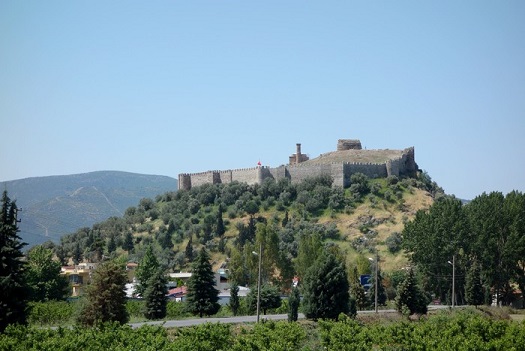
The Grand Byzantine Fortress of Selçuk (Ayasuluk)


Ayasuluk Castle, locally known as Ayasuluk Kalesi or Selçuk Kalesi, lies on a hill in the town of Selçuk, in the province of Izmir in Turkey. It is situated just a mile from the site of the ancient Greek city of Ephesus.
Ephesus was initially a harbour city but the continually silting up of its harbour eventually made it an inland site situated 5 km from the sea at present. At the beginning of the Byzantine era, Ephesus was still predominantly at its harbour location. During the 6th century the city declined and was split up. The old city at the harbour was enclosed by a defensive wall, making it considerably smaller and thus better to defend. The Ayasuluk hill had been part of the outskirts of the city and was now a mile outside the city. 
The Byzantines then built Ayasuluk Castle, using stones from disused Greek and Roman buildings, for its construction. On the slope of the hill they built the Basilica of St. John. Defensive walls coming down from the castle, encompassed the basilica. Effectively turning the site in a citadel with the castle as an upper castle and the area with the basilica as a lower castle.
The combination of the marble façades and the mortared rubble made the walls 4 meters thick. The citadel walls were 1.5 km around with 17 towers. Entry to the citadel from the south was through the Gate of Persecution, which first led into the Basilica. In the 8th century the square towers on either side of the gate were made pentagonal, aiding in their defensive capabilities.
Over the following centuries, however, people from the harbour site gradually migrated towards the citadel on the hill as the harbour continued to silt up and they battled malaria. By the end of the Byzantine period the harbour was abandoned, and Ephesus was centered around Ayasuluk Hill.
In 1090 Ephesus was conquered by Seljuk Turks under Tengribirmish, but by then it had declined to nothing more than a small village. In 1097 the Byzantines took back control and renamed the village Agios Theologus. They kept control until the early 14th century. Then it was finally taken by the Seljuks, who renamed the site Ayasuluk. They repaired the walls of the castle, dredged the harbour and put it to use again. This resulted in the town prospering again.
Around the beginning of the 15th century Ayasuluk came under Ottoman rule. By that time the harbour had silted up again and had become a swamp. The town declined again to a village. The Ottomans however did keep the castle garrisoned. In the mid-17th century it had a garrison of 40 soldiers. As the population kept declining, the castle was abandoned during the 18th century. In 1914 Ayasuluk was renamed Selçuk.
A nice castle. Inside there are a small ruined mosque, a part of a former church turned into a cistern, a couple of Ottoman cisterns and groundplans of a couple of houses. It can be visited as a visitor of the site of the basilica. For that you have to pay a fee.


Eastern Roman Empire about 1025.
Selçuk Fortress is located one mile from the ancient
Greek city of Ephesus on the Aegean coast.

The castle was built during the time of the Byzantine Empire and later remodeled by the Turks.

The combination of the marble façades and the mortared rubble made the walls 4 meters thick. The citadel walls were 1.5 km around with 17 towers.


(journey)      (Ayasuluk)      (ayasuluk castle)