.

Dedicated to the military history and civilization of the Eastern Roman Empire (330 to 1453)


"Time in its irresistible and ceaseless flow carries along on its flood all created things and drowns them in the depths of obscurity."

- - - - Princess Anna Comnena (1083–1153) - Byzantine historian

Showing posts with label Caucasus. Show all posts

Thursday, October 17, 2013

The Byzantine Fortress of Archaeopolis (Nokalakevi) in Georgia


The Fortress of Archaeopolis
Roman strong point in the endless Persian Wars


The Eastern Roman fortress of Archaeopolis (Greek Αρχαιόπολις, literally meaning "ancient town") and Tsikhegoji ("Fortress of Kuji"), is a village and archaeological site in the Senaki municipality, Samegrelo-Zemo Svaneti region, Georgia.  It is also known as Nokalakevi in Georgian.

Its population, known as the Caucasian Iberians, formed the nucleus of the Georgian people (Kartvelians), and the state, together with Colchis to its west, would form the nucleus of the medieval Kingdom of Georgia.

The term Caucasian Iberia is used to distinguish it from the Iberian Peninsula in Western Europe.

Roman Period

This close association with Armenia and Pontus brought upon the country an invasion (65 BC) by the Roman general Pompey, who was then at war with Mithradates VI of Pontus, and Armenia; but Rome did not establish her power permanently over Iberia. Nineteen years later, the Romans again marched (36 BC) on Iberia forcing King Pharnavaz II to join their campaign against Albania.

While another Georgian kingdom of Colchis was administered as a Roman province, Iberia freely accepted the Roman Imperial protection. A stone inscription discovered at Mtskheta speaks of the 1st-century ruler Mihdrat I (AD 58-106) as "the friend of the Caesars" and the king "of the Roman-loving Iberians." Emperor Vespasian fortified the ancient Mtskheta site of Arzami for the Iberian kings in 75 AD.

The next two centuries saw a continuation of Roman influence over the area, but by the reign of King Pharsman II (116 – 132) Iberia had regained some of its former power. Relations between the Roman Emperor Hadrian and Pharsman II were strained, though Hadrian is said to have sought to appease Pharsman. However, it was only under Hadrian's successor Antoninus Pius that relations improved to the extent that Pharsman is said to have even visited Rome, where Dio Cassius reports that a statue was erected in his honor and that rights to sacrifice were given.

The period brought a major change to the political status of Iberia with Rome recognizing them as an ally, rather than their former status as a subject state, a political situation which remained the same, even during the Empire's hostilities with the Parthians.

In 65BC an invasion by General Pompey first extended the influence
of the Roman Republic into the Caucasus Mountains.

Between Rome-Byzantium and Persia

Decisive for the future history of Iberia was the foundation of the Sasanian (or Sassanid) Empire in 224. By replacing the weak Parthian realm with a strong, centralized state, it changed the political orientation of Iberia away from Rome. Iberia became a tributary of the Sasanian state during the reign of Shapur I (241-272).

Relations between the two countries seem to have been friendly at first, as Iberia cooperated in Persian campaigns against Rome, and the Iberian king Amazasp III (260-265) was listed as a high dignitary of the Sasanian realm, not a vassal who had been subdued by force of arms. But the aggressive tendencies of the Sasanians were evident in their propagation of Zoroastrianism, which was probably established in Iberia between the 260s and 290s.

However, in the Peace of Nisibis (298) while the Roman empire obtained control of Caucasian Iberia again as a vassal state and acknowledged the reign over all the Caucasian area, it recognized Mirian III, the first of the Chosroid dynasty, as king of Iberia.

Roman predominance proved crucial in religious matters, since King Mirian III and leading nobles converted to Christianity around 317 and declared Christianity as state religion. The event is related with the mission of a Cappadocian woman, Saint Nino, who since 303 had preached Christianity in the Georgian kingdom of Iberia (Eastern Georgia).

The religion would become a strong tie between Georgia and Rome (later Byzantium) and have a large scale impact on the state's culture and society.

However, after the Emperor Julian was slain during his failed campaign in Persia in 363, Rome ceded control of Iberia to Persia.

The rivalry continued for centuries between both Rome and Byzantium against Sasanian Persia for supremacy in the Caucasus.

The Eastern Roman Empire extended into the Caucasus Mountains.


The Nokalakevi-Archaeopolis Fortress played a pivotal part in the major wars fought between the Byzantines and Sasanians in the South Caucasus during the sixth century AD. It was one of the key fortresses guarding Lazika from Sasanian, Persian and Iberian attack.

The Persian Sassanids recognized Lazica (Egrisi) as part of the Byzantine sphere of influence by the "Eternal Peace" Treaty of 532.

During the Byzantine–Sasanian Lazic War of 540 - 562 AD, the Persians' failure to take the Nokalakevi-Archaeopolis Fortress from the Byzantines and the Laz eventually cost them control of Lazika.
Sasanian Empire Cavalry
For over 700 years Rome faced
endless wars with Persia.

The early Byzantine defensive fortifications of Nokalakevi-Archaeopolis take advantage of the site's position within a loop of the river Tekhuri, which has carved a gorge through the local limestone to the west of the fortress. Furthermore, the steep and rugged terrain to the north of the site made the citadel established there almost unassailable.

A wall connected this 'upper town' to the 'lower town' below, where excavations have revealed substantial stone buildings of the fourth to sixth century AD. Beneath these late Roman period layers there is evidence of several earlier phases of occupation and abandonment, from the eighth to second centuries BC.

Archaeological work at the site

Modern study of the site began in the decades before the formal Russian annexation of Samegrelo, with a visit by the Swiss philologist Frédéric Dubois de Montpéreux in 1833-4. He identified the ruins as the Archaeopolis of Byzantine historians and argued that the site was Aia, the ancient Colchian capital of the Greek Argonaut myth.

This, unsurprisingly, stimulated much scholarly interest, which culminated in the 1920s with proposals for an archaeological excavation. In the winter of 1930-31, a joint German-Georgian team, led by Dr Alfonse-Maria Schneider of Freiburg University, traced the line of the walls and excavated about 40 survey trenches and one of the towers, as well as what they erroneously believed to be the agora in the 'lower' town.

Their findings — including an impressive hoard of gold solidi of the Emperor Maurice (AD 584-602) — confirmed Dubois de Montpéreux's identification of the site with Archaeopolis, without settling the question of Aia.

Fortress of Archaeopolis


Aerial View of Archaeopolis. Photo by travelgeorgia.ru via Wikimedia

The Forty Martyrs Church


The early Byzantine defensive fortifications of Archaeopolis take advantage of the site's position within a loop of the river Tekhuri, which has carved a gorge through the local limestone to the west of the fortress. Furthermore, the steep and rugged terrain to the north of the site made the citadel almost unassailable.

The Byzantine Fortress of Archaeopolis in the center of Lazica.


(Lazic War)        (Caucasian Iberia)        (georgiaabout.com - Nokalakevi-fortress)

(antiquity.ac.uk/projgall/everill)        (en - Nokalakevi)


Thursday, April 4, 2013

Siege of Phasis - Rome vs Persia


Sassanid Persian Cavalry Reinactment

Siege of Phasis  -  Rome vs Persia


The Siege of Phasis took place in 555–556 during the Lazic War between the Eastern Roman Empire and Sassanid Persia. The Persians besieged the town of Phasis in Lazica, held by the Byzantines, but failed to take it. The main source for the siege is the 6th-century historian Agathias.

Background

The Lazic War had started in 541 with the defection of the Lazi under their king Gubazes II from Rome to Persia. The Persians quickly overran the country, but after Gubazes learned that the Persians planned to kill him, deport his people and bring in Persian colonists, he asked the Byzantines for help.

In 554, the Persians won a major victory against the Laz-Byzantine forces at Telephis, forcing the latter to withdraw to the western parts of the country, and in the next year they were able to thwart a Byzantine attack on the fortress of Onoguris. In the spring of 556, the Persian general Nachoragan took the initiative in besieging their major stronghold, the town of Phasis, which lay at the mouth of the namesake river.


Byzantine Warrior

The exact site of Phasis has never been found.
The town's location was between the Black Sea and the River Phasis secured it from the east, north and west. At its south side, a moat was its first line of defense.  The Persians expected an easy victory as the town and its fortifications were built of wood and were vulnerable to fire.  The wooden fortifications above could have been something like what the Persians faced at Phasis.
A bridge of boats.
The city of Phasis was proteced by the river of the same name.  The Persians overcame that advantage by building a bridge of boats over the river and brought their infantry up to the walls.


Opposing forces and preparations for the siege

Nachoragan led an army of ca. 60,000 men. The Byzantine forces of the area were led by the magister militum per Armeniam Martin and his second-in-command Justin, son of Germanus. Their combined forces were less than 20,000 men. Nachoragan could expect an easy victory as the town and its fortifications were built of wood and were vulnerable to fire.

The Phasis River helped secure the city.

The town's location between the Black Sea and the River Phasis secured it from the east, north and west. At its south side, a moat was its first line of defense.

Nachoragan's forces however emptied the moat after days of hard work, and managed to surround the town from its river side too by building a bridge of boats across the Phasis.

Meanwhile, the Byzantines had organized the defense of the city, with their forces taking their places at the various sides of the fortifications.

The extreme western side, the one closest to the river, was guarded by Justin, while Martin positioned himself in the south-western side.

The south side was defended by Angilas, Theodore and Philomathius. Angilas is recorded leading a regiment of Moorish peltasts and spearmen, probably meaning they were only armed with shield and lances.

Theodore led heavy infantry consisting of Tzani, a recently Christianized tribe living in the mountains above Trapezus, while Philomathius led Isaurian slingers and dart-throwers.

The south-eastern side was guarded by Gibrus, who led a combined force of Heruli and Lombards. The extreme eastern side was guarded by Valerian, leading forces from the praetorian prefecture of the East. Their composition is not recorded. Finally, the Byzantine ships were placed under the protection of Dabragezas the Wend and Elmingir (Elminegeir) the Hun.

Eastern Roman infantry reenactors
The composition of the Roman Army at Phasis reflected the international nature and wide reach of the Empire.  Roman units came from as far away as Morocco.  Other ethnic groups represented were Huns, Isaurians, Heruli, Lombards and Wends (Western Slavs from Northern Europe).

Sassanid Cataphract


Events of the siege

Operations started with a volley of arrows from the Persians. Martin, the overall commander of the Byzantine troops, had given instructions to the whole army to stay at their respective posts. They were to disregard attempts by the Persians to induce them to sally forth from the fortifications and fight in the open. However, Angilas and Philomathius with about two hundred of their men opened a town gate, exited the town and attacked the nearest force of Sassanids whose archers were harassing the defenders.

Theodore at first attempted to restrain them, but then bowed down to "majority opinion" and followed them in attacking. He was reportedly reluctant to violate orders, but unwilling to be branded a coward by the soldiers.

The Byzantine force was heavily outnumbered, and Agathias reports that they "would almost certainly have been annihilated", but they were saved by an error of the Dailamites. The Dailamites were a force of auxiliaries, originating in the mountains of Persia. "They fought on foot, armed each with a sword, a shield, and three javelins".

Persian Dailamite infantry


They decided against attacking the Byzantines from a distance, and instead they "calmly awaited their approach" and then easily performed an encirclement. The encircled Byzantines however began a desperate attack on the enemies positioned closer to the town walls, and the Dailamites "opened up their ranks and made way from them" instead of standing their ground. Thus Angilas and the others escaped back to the safety of the city.

Martin eventually conceived a ruse of war, which would both raise the morale of his soldiers and spread fear in enemy units. He called the army in an assembly, supposedly to discuss further measures of defense. The assembly was interrupted by an unknown person, posing as a messenger from Constantinople.

Martin reported the contents of the "imperial message" to all those assembled. The fabricated message congratulated the defenders for their valour and informed them that reinforcements were approaching, and the "messenger" claimed that they were camped near the river Neocnus, at a short distance from the town itself. Martin then feigned indignation that newcomers would share the glory and spoil "with those who had borne the burden and the heat", to which his troops shouted their approval, being motivated to action.

The Byzantine reinforcements did not in fact exist, but news of their approach reached Nachoragan, who reacted in two ways. He first assigned a large reconnaissance force, sending them out to locate and observe the Byzantine reinforcements, and then launched the rest of his forces in a general attack on the walls, hoping to capture the city before the reinforcements arrived.

He boasted that he would burn the city and its inhabitants down, and sent his camp servants to the nearby woods and instructed them to gather timber to burn down the city. He also instructed them to watch for great smoke rising to the heavens, for it would mean that the city had fallen and that they should immediately return to help.

The Romans employed
Isaurian slingers and dart-throwers.


While Nachoragan was forming his plan, Justin decided to take advantage of the calm before the storm: he exited the city, leading a force of 5,000 men, cavalrymen and an infantry brigade to "a church of great sanctity in the vicinity".

We need to stop right here and question this part of the original account by the historian Agathias. 

Justin did not take 5,000 troops on some casual stroll or religious "pilgramage" to a local church.  With this seriously large force, there is no doubt that Justin was looking to meet the Persians and perhaps take out some smaller units that might have become separated from the main army.

Agathias says the Persians somehow failed to notice the departure of Justin's force, and began their great attack that same morning.  Did the Romans leave under cover of darkness to avoid detechtion?  We do not know, but it is a logical assumption.

A large Roman force walking out of the city implies that the Persians were not there in great enough numbers to completely cut off the city.

In the attack arrows and darts filled the air, while Sassanid siege weapons were attempting to destroy the wooden walls. The defenders answered by throwing "huge blocks of stone" at the weapons and smaller stones at the enemy soldiers.

The initial stages of the fight lasted long enough for Justin to return from his pilgrimage. He could not return to the city, but was able to organize his own forces and attack the rear of the enemy force. 

Attacking the rear of the Persians may, or may not, have been in the original Roman plan.  But a good general knows to take advantage of an opportunity.

The sudden attack of the Romans spread havoc, breaking through enemy lines. At least some of the Sassanid forces believed that Justin's men were the rumoured Byzantine reinforcements.

Panicked Sassanid troops started to retreat, and most of the Dailamites left their positions to "relieve those who were being hard pressed". Angilas and Theodore noticed that there were few troops left besieging their section of the fortifications and led a sortie against the besiegers.

The few Dailamites left behind were either slain or forced to flee, "pressed in relentless pursuit" by the Byzantine force. The other Dailamites noted that their kinsmen were in peril and abandoned their current positions in an attempt to face Angilas and Theodore, but their counterattack was disorganized and ineffective.

Sassanian Persian War Elephant Unit battle formation.
War Elephant Unit: Rider armed with spear and Persian 
Sword rides in front and archers armed with spears
and supplied with bow and arrows ride in the cabin.


The nearby Persian forces in turn thought that the Dailamites were retreating in haste, panicked and started fleeing "ignominiously in all directions". The Dailamites were left unsupported and "rushed to join them in flight".

Agathias regards them as the cause and victims of a "double misunderstanding". Angilas and Theodore thus succeeded in causing a general flight of the Sassanid forces. The rest of the Byzantine troops sallied forth from behind the walls and started pursuing the fleeing enemies. The entire left wing of the Sassanid army fell apart, although the right wing remained unbroken and continued to fight.

The right wing included the war elephants of the Sassanid force. They might have stopped the Byzantine advance, but one of the elephants panicked and turned against the Persian ranks. The horses of the Sassanid cavalry were terrified of the attacking elephant, panicked in turn and bolted. In the confusion, the Sassanid forces scattered.

Nachoragan gave the command to retreat, but by that time most of his forces had either already fled the battlefield or were in the process of doing so.

By the time night fell, the Persians had reportedly lost at least ten thousand fighting men and most of their siege equipment.

The Byzantine casualties "did not number more than two hundred". The Byzantines set the siege equipment on fire. The servants and porters of the Sassanid army reportedly mistook the smoke for a sign that the city had fallen, and started rushing towards the Byzantine lines. Nearly two thousand of them were killed that night, others captured.


Islamic Mughal Empire:  War Elephants
The Mughal Empire used war elephants in a sophisticated and pioneering manner, this part looks at the armour and tusks of the elephants.

The elephant war "tank" was used in wars for centuries in wars Africa, the Middle East and in Habbibal's famous invasion of Italy.


Aftermath  -  Flayed Alive

Nachoragan was already running out of supplies and winter was approaching. He broke off the siege and retreated the following day. His troops headed towards Kotais and Mochereisis. Sassanid reinforcements arrived too late to make a difference and also retreated. The Byzantine forces were left in undisputed control of the western districts of Lazica. Nachoragan eventually crossed into Caucasian Iberia to winter.

News of the disaster however reached the Persian shah, Khosrau I (r. 531–579), who was enraged with his general. Agathias reports that Nachoragan was flayed alive by orders of Khosrau. "His skin, torn off in one piece from head to foot, so as to retain the shape of the body, was sewn up and inflated like a bladder". Khosrau reportedly kept it on display as a warning against "anyone who fled before the enemies" of the King of Kings.

The Lazic War had started in 541 with the defection of the Lazi under their king Gubazes II from Rome to Persia. The Persians quickly overran the country, but after Gubazes learned that the Persians planned to kill him, deport his people and bring in Persian colonists, he asked the Byzantines for help.

The Roman - Persian Wars.
For centuries both empires had fought a series of nearly meaningless border wars with each other over the control of assorted smaller client states and selected fortresses.  For the most part, the Roman-Persian border hardly moved. 

Sassanid Persian Empire


Persian soldier at the walls of Ctesiphon, Persia.

(Lazic War)          (iranpoliticsclub.net - Sassanian)

(books.google - Siega of Phasis)         (Siege of Phasis)

Tuesday, July 19, 2011

The Roman - Persian War


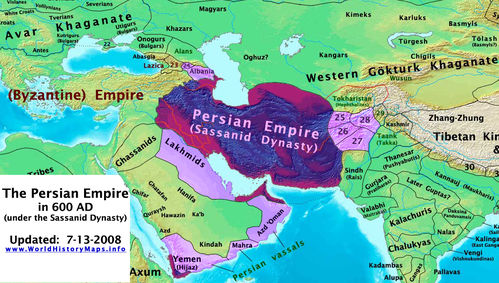
The Roman - Persian frontier.

Roman – Persian War of 572–591


The wars between the Roman Empire and Sassanid Persia had gone on and on for centuries.  Each side looking to gain territory or military advantage over the other.  The latest war was triggered by pro-Roman revolts in areas of the Caucasus under Persian hegemony, although other events contributed to its outbreak.

The politics and brushfire mini-wars of the period can easily make you dizzy.  The connections and interconnections and political-military layers are no different than the world today.

You had the Eastern Roman Empire attempting, and failing, to make a military alliance with Turkish tribes in Central Asia against Persia.  The Roman Empire and the Persian kingdom were in very similar circumstances. The Romans were placed between the Avars in the West and the Persians, just as the Persians were placed between the Turks (on the north) and the Romans.
Historical re-enactment of a Sassanid-era
Persian Cataphract.  Light to heavy armored cavalry
were used by the Persians.

The Romans also backed a pro-Roman faction in a takeover of Yemen.  The Persians in turn backed their allies in restoring a Persian client state in Yemen.  Both sides had their client Arab tribes battle each other on the frontier.

The Christians in Anatolia and the Caucasus region were in a constant state of actual or intermittent rebellion.  As the Christian population could not remain happy under Persian domination, they appealed to the Emperor of the Romans in the name of their common religion.  In 570 the Romans made a secret agreement to support an Armenian rebellion against the Sassanids, which began in 571, accompanied by another revolt in Iberia.

Any one of the causes mentioned might have been insufficient to produce a rupture, but all together were irresistible, and accordingly, when the time came for paying the stipulated peace treaty annuity, Emperor Justin II refused (572). The war which ensued lasted for twenty years; and its conclusion was due to the outbreak of a civil war in Persia.

The War Begins

Early in 572 the Armenians under Vardan Mamikonian defeated the Persian governor of Armenia and captured his headquarters at Dvin; the Persians soon retook the city but shortly afterwards it was captured again by combined Armenian and Roman forces and direct hostilities between Romans and Persians began.

By joining the Iberians, Lazi and Romans in a coalition of the region's Christian peoples, the Armenians dramatically shifted the balance of power in the Caucasus, helping Roman forces to carry the war deeper into Persian territory than had previously been possible on this front.

The Fall of Dara

In Roman Mesopotamia the war began disastrously.  After a victory at Sargathon in 573 they laid siege to the fortress of Nisibis and were apparently on the point of capturing this, the chief bulwark of the Persian frontier defenses, when the abrupt dismissal of their general Marcianus led to a disorderly retreat.

Persian forces under Shah Khosrau I (531-579) swiftly counter-attacked and encircled Dara.  Khosrau besieged it, using against its walls the engines which the Romans had left behind them at Nisibis. But it was not easily taken, and the Persians almost despaired. Finally, over-confidence produced remissness in the garrison, and after a siege of six months the city passed into the hands of the Persians.  Khosrau now held the two great fortresses of eastern Mesopotamia, Nisibis and Dara.
Minted Coin of Persian Shah Khosrau I.

At this juncture the Persians and their Arab allies invaded Syria and laid it waste as far as Antioch.

The invasion of Syria took place under the leadership of Adarmahan, and the country, as has been said, was devastated up to the walls of Antioch. The city of Apamea was committed to the flames. Syria seems to have been entirely undefended; for thirty years the inhabitants had been exempt from hostile attacks, and had consequently become so unaccustomed to the sights of war that they were unable to take measures for their own defense. The captives who were led away to Persia are said to have numbered in the tens of thousands.

To make matters worse, in 572 the Emperor Justin II (565–578) had ordered the assassination of his Arab ally the Ghassanid king al-Mundhir III.  Needless to say, the formerly pro-Roman tribe did nothing to help the Empire during this phase of the Persian invasion.

The Empire needed to buy time to regroup.  In 574 the Romans agreed to pay 45,000 nomismata for a one-year truce, and later in the year extended this to five years, secured by an annual payment of 30,000 nomismata.  These truces applied only to the Mesopotamian front and elsewhere the war went on.

Eastern Roman Empire infantry.
Shah Khosrau's Campaign

In 575 the Romans managed to settle their differences with the Ghassanids; this renewal of their alliance at once bore dramatic fruit as the Ghassanids sacked the Lakhmid capital at Hira. In the same year Roman forces took advantage of the favorable situation in the Caucasus to campaign in Caucasian Albania.

In 576 Khosrau set out on what was to be his last campaign and one of his most ambitious, staging a long-range strike through the Caucasus into Anatolia, where Persian armies had not been since the time of Shapur I (241-272). His attempts to attack Theodosiopolis and Caesarea were thwarted, but he managed to sack and burn Sebasteia before withdrawing.

Justinian, the son of Germanus, was appointed Magister militum (Latin for "Master of the Soldiers") and marched his troops to Armenia (576) to meet the Shah in battle. 

The Shah found himself in serious difficulties in a hostile and mountainous country, and apparently not supported in the rear.  Khosrau began to retreat. But he was not allowed by Justinian to depart with impunity; the Romans pressed on, and the Persians were forced to fight against their will.

The battle was fought somewhere between Sebaste and Melitene, probably in the valley of the river Melas, land its details are described or invented by a rhetorical historian. It resulted in a complete victory for Justinian.  Khosrau was forced to flee from his camp to the mountains, and leave his tent furniture, with all the gold, the silver, and the pearls which an oriental monarch required even in his campaigns. The booty, it is said, was immense.

The routed Persians grumbled at their lord for conducting them into this hole in the mountains, and Khosrau with difficulty mollified their indignation by an appeal to his gray hairs. Then the Sassanid descended into the plain of Melitene and burned that city, which had no means of resisting his attack. In the meantime, it may be asked, how was the Roman army occupied? It would seem that there was nothing to prevent the Romans from following the defeated and demoralized Persians, and at least hindering the destruction of Melitene, if they did not annihilate the host. This loss of opportunity is ascribed by a contemporary to the envy and divisions that prevailed among the Roman officers.

After the conflagration of Melitene, Khosrau retired towards the Euphrates, but he received a letter from the Roman general, reproaching him for being guilty of an unkingly act in robbing and then running away like a thief. The great king consented to accept offer of battle, and awaited the arrival of the Romans. The adversaries faced one another until the hour of noon; then three Romans rode forth, three times successively, close to the Persian ranks, but no Persian moved to answer the challenge. At length Khosrau sent a message to the Roman generals that there could be "no battle today," and took advantage of the fall of night to flee to the river. The Romans pursued and drove the fugitives into the waters of the Euphrates. More than half of the Persian army was drowned; the rest escaped to the mountains. It is said by Roman historians that Khosrau  signalized these reverses by passing a law that no Persian king should ever go forth to battle in person.

Sassanian Persian fortress in Derbent, Russia
The twenty-meter-high walls with thirty north-looking towers are believed to belong to the time of  Khosrau I of Persia. The chronicler Movses Kagankatvatsi wrote about "the wondrous walls, for whose construction the Persian kings exhausted our country, recruiting architects and collecting building materials with a view of constructing a great edifice stretching between the Caucasus Mountains and the Great Eastern Sea."   This Persian fortress is a good example of walled cities that both Roman and Persian armies would face in their endless border wars, sieges and invasions.


Thus the campaign of 576 was attended with good fortune for the Romans, notwithstanding the destruction of Sebaste and Melitene. Nor were the events to the west of the Euphrates the only successes. Roman troops  penetrated into Babylonia, and came within a hundred miles of the royal capital; the 24 war elephants which they carried off were sent to Constantinople.

The Romans exploited Persian disarray by raiding deep into Albania and Azerbaijan, launching raids across the Caspian Sea against northern Iran, wintering in Persian territory and continuing their attacks into the summer of 577. Khosrau now sued for peace, but a victory in Armenia by his general Tamkhosrau over his recent nemesis Justinian stiffened his resolve and the war continued.

In 576 - 577, the Persian general Tamkhusro invaded Armenia, where he defeated the Byzantines under Justinian. Later, Tamkhusro and Adarmahan launched a major raid into the Byzantine province of Osroene. They threatened the town of Constantina, but withdrew when they received word of the approach of the Byzantine army under Justinian. Following these reversals, later in the same year, the Byzantine regent, Caesar Tiberius, appointed Maurice as Justinian's successor.

Mesopotamia and Stalemate


A coin with Maurice in consular uniform.  Maurice
served as the Roman commander on the Persian front
and went on to become Emperor.
In 578 the truce in Mesopotamia came to an end and the main focus of the war shifted to that front. After Persian raids in Mesopotamia, the new magister militum of the East Maurice mounted raids on both sides of the Tigris, captured Aphumon and sacked the town of Singara. Khosrau again sought peace in 579, but died before an agreement could be reached and his successor Hormizd IV (579-590) broke off the negotiations.

In 580 the pro-Roman Ghassanid Arabs scored yet another victory over the pro-Persian Lakhmids, while Roman raids again penetrated east of the Tigris. However, around this time the future Khosrau II was put in charge of the situation in Armenia, where he succeeded in convincing most of the rebel leaders to return to the Sassanid allegiance, although Iberia remained loyal to the Romans.

The following year, an ambitious campaign along the Euphrates by Roman forces under Maurice and Ghassanids under al-Mundhir III failed to make progress, while the Persians under Adarmahan mounted a devastating campaign in Mesopotamia.

To concentrate on the Persian front, the Emperor Tiberias purchased peace with the Balkan Avars for 80,000 aurei.  Maurice became Emperor in 582 and continued the war as well as reforms in the Roman army.  For example, Maurice re-introduced the Roman custom of entrenching the army camps.

During the mid-580s the war continued inconclusively through raids and counter-raids, punctuated by abortive peace talks; the one significant clash was a Roman victory at the Battle of Solachon in 586.

In 588 there was a mutiny by unpaid Roman troops who also had their rations reduced by 25%.  Their new commander, Priscus, was wounded and fled.  This seemed to offer the Sassanids a chance for a breakthrough, but the mutineers themselves repulsed the ensuing Persian offensive; after a subsequent defeat at Tsalkajur, the Romans won another victory at Martyropolis. During this year, a group of prisoners taken at the fall of Dara 15 years earlier reportedly escaped from their prison in Khuzestan and fought their way back to Roman territory.

A Civil War in Persia

In 589 the war was raging on all fronts in Central Asia, the Caucasus, the the Arabian desert frontiers. 


In Central Asia the Persians were led by General Bahram Chobin who was chosen to lead an army against the Turkish tribes of the region.  Bahram's 42,000 man army included 12,000 hand picked Savaran, Persia's elite soldiers.  He successfully defeated a large Turkish army.  Reportedly, the Turkish forces outnumbered his troops five to one. Relying on the discipline and superior training of his Persian Cataphract cavalry.

His army defeated the Turks and Hephthalites in April 588 and again in 589, capturing Balkh and Herat respectively. He then proceeded to cross the Oxus river and managed to repulse the Turkish invasion.

In the Caucasus, Roman and Iberian offensives were repulsed by the Persian general Bahram Chobin, who had recently been transferred from the Central Asian front.  After suffering a minor defeat in battle on the river Araxes in Azerbaijan against the Romans, Shah Hormizd IV humiliated him, sending him women's clothing to wear.

Enraged at this humiliation,  Bahram raised a revolt which soon gained the support of much of the Sassanid army.  Alarmed by his advance, in 590 members of the Persian court overthrew and killed Hormizd, raising his son to the throne as Khosrau II (590–628).  Bahram pressed on with his revolt regardless and the defeated Khosrau was soon forced to flee for safety to Roman territory, while Bahram took the throne as Bahram VI.

With support from the Emperor Maurice, Khosrau set out to regain the throne, winning the support of the main Persian army at Nisibis and returning Martyropolis to his Roman allies. Early in 591 an army sent by Bahram was defeated by Khosrau's supporters near Nisibis, and Ctesiphon was subsequently taken for Khosrau by Mahbodh.


Having restored Dara to Roman control, Khosrau and the magister militum of the East Narses led a combined army of Roman and Persian troops from Mesopotamia into Azerbaijan to confront Bahram, while a second Roman army under the magister militum of Armenia John Mystacon staged a pincer movement from the north. At the Battle of Blarathon near Ganzak, a combined allied army of Romans and Persians decisively defeated Bahram, restoring Khosrau II to power and bringing the war to an end.

Bahram fled to the Turks in Central Asia and settled in Ferghana.  After some time he was murdered by the hired assassin sent by Khusrau II.

The Romans were left in a dominant position in their relations with Persia.  The Persians handed over many Roman cities.  The extent of effective Roman control in the Caucasus reached its zenith historically. Also, unlike previous truces and peace treaties, which had usually involved the Romans making monetary payments either for peace, for the return of occupied territories or as a contribution towards the defense of the Caucasus passes, no such payments were included on this occasion, marking a major shift in the balance of power. The Emperor Maurice was even in a position to overcome his predecessor's omissions in the Balkans by extensive campaigns.


 A HISTORY OF THE LATER ROMAN EMPIRE, by J.B. Bury