The centuries of Roman rule in Egypt began in 30 BC.
But that Roman rule was shaken to the core by the a 26 year long knock down war to the death of Rome vs. the Persian Empire from 602 to 628AD.
The Persian Sasanian conquest of Egypt started in 618 when the Persian army defeated the Roman forces in Egypt and occupied the province. The fall of Alexandria, the capital of Roman Egypt, marked the first and most important stage in the Sasanian campaign to conquer this rich province.
The Persian shah, Khosrow II, had taken advantage of the internal turmoil of the Roman Empire after the overthrow of Emperor Maurice by Phocas to attack the Roman provinces in the East. By 615, the Persians had driven the Romans out of northern Mesopotamia, Syria, and Palestine.
Determined to eradicate Roman rule in Asia, Khosrow turned his sights on Egypt, the Eastern Roman Empire's granary.
In 617 or 618 the Persian army headed for Alexandria, where Nicetas, Emperor Heraclius' cousin and local governor, was unable to offer effective resistance.
After the fall of Alexandria, the Persians gradually extended their rule southwards along the Nile.
The Persians did not try to force the population of Egypt to renounce their religion and practice Zoroastrianism. They did, however, persecute the Byzantine Church whilst supporting the Monophysite Church. The Egyptian Copts took advantage of the circumstances and obtained control over many of the Orthodox churches.
There were numerous Persian stations in the country, which included Elephantine, Herakleia, Oxyrhynchus, Kynon, Theodosiopolis, Hermopolis, Antinopolis, Kosson, Lykos, Diospolis, and Maximianopolis. The assignment of those stations was to collect taxes and get supplies for the military.
Several papyrus papers mention the collection of taxes by the Sasanians, which shows that they used the same method of the Byzantines for collecting taxes. Another papyrus mentions an Iranian and his sister, which indicates that some Persian families had settled in Egypt along with the soldiers.
Egypt and parts of Libya would remain in Persian hands for 10 years, run by general Shahrbaraz from Alexandria. As the Roman Emperor, Heraclius, reversed the tide and defeated Khosrow, Shahrbaraz was ordered to evacuate the province, but refused. In the end, Heraclius, trying both to recover Egypt and to sow disunion amongst the Persians, offered to help Shahrbaraz seize the Persian throne for himself.
An agreement was reached, and in the summer of 629, the Persian troops began leaving Egypt and a fleet from Constantinople arrived at Alexandria to garrison the country with Roman troops.
Egypt Was Conquered by Persia
Centuries of Roman rule in Egypt, Palestine and Syria came to a violent end with Persian armies invading and the lands being absorbed into the Persian Empire. For over 10 years the locals looked to Persia for their economy, laws, religious freedom and security. Constantinople and ties to Rome faded in the minds of an entire generation.
Click to enlarge
.
The Diocese of Egypt
Egypt was a province of the later Roman Empire from 381AD. It incorporated the provinces of Egypt and Cyrenaica. Its capital was at Alexandria, and its governor had the unique title of praefectus augustalis ("Augustal Prefect", of the rank vir spectabilis; previously the governor of the imperial 'crown domain' province Egypt)
The Muslim Invasion
Roman authority in Egypt had been undermined by the 10 year rule of Persia and the religious freedom that came with it.
The Emperor Heraclius appointed the Orthodox Bishop Cyrus from the Caucasus Mountain region to be both Patriarch of Alexandria and Governor of Egypt.
Cyrus began an active persecution of Monophysite "heretics". Menas, the brother of the Coptic Patriarch, was seized. His body was burned with torches and his teeth were pulled out. He was placed in a sack weighed with sand and rowed out to sea. Menas was offered his life if he accepted the Orthodox version of worship. When he refused he was thrown into the ocean.
Imperial soldiers were sent to Monophysite monasteries to torture or imprison the abbots who would not obey. Many Copts pretended to submit or fled the cities. It is likely that these events severed the last shreds of loyalty to Constantinople.
When the Muslims crossed into Egypt the local Coptic population was not very interested in defending an Empire that was crushing their freedom.
Click to enlarge
Map from The Great Arab Conquests (1964)
by Lieutenant-General Sir John Bagot Glubb, KCB, CMG, DSO, OBE, MC
Roman Egypt was a direct threat to the Muslim conquests in Syria and Palestine. The Roman Amphibious Attack to recapture Antioch in 638 had been executed by naval and ground forces based out of Egypt. Caesarea, the last remaining Roman city in Palestine, was being reinforced and supplied by the navy out of Alexandria, Egypt.
So in December 639, 'Amr ibn al-'As left for Egypt with a force of 4,000 troops. Taking the same ancient caravan road used by the Persian Army only a few years earlier, the Muslim forces reached the fortified town of Pelusium. The Persians has captured the town without much trouble. But the Muslims lacked heavy siege weapons and were unable to take it.
The Muslims blockaded the town for a month. Then one day there was an unsuccessful sally by the garrison and the Arabs were able to enter one of the gates with the retreating soldiers. Shipping in the port was burned, the churches pulled down and the fortifications dismantled. Amr destroyed much of the town because he did not have enough men to garrison the fortress, and he did not want the Romans to land troops from the sea and reoccupy the fortress which would be in his rear on his supply lines.
After the fall of Pelusium, the Muslims marched to Belbeis, some 40 miles from Memphis via desert roads. The Arabs had reached Nile Delta.
The famous Roman General Aretion came out of the city to negotiate with Amr. Aretion had been the Governor of Jerusalem and had fled to Egypt when the city fell to the Muslims. Amr gave them three options: convert to Islam, pay the jizya, or fight. They requested three days to reflect and then requested two extra days.
At the end of the five days the general decided to reject Islam and the jizya and fight the Muslims. The battle resulted in a Muslim victory during which Aretion was killed. Amr subsequently attempted to convince the native Egyptians to aid the Arabs and surrender the city, based on the kinship between Egyptians and Arabs. When the Egyptians refused, the siege resumed until the city fell around the end of March 640.
The siege of Belbeis had delayed the Muslims another month.
Meanwhile Cyrus, the Governor of Egypt, and Theodore, commander-in-chief of the Roman Army in Egypt, established themselves in the Fortress of Babylon.
General layout of the fortress of Babylon, Egypt
in the first century AD. (Sheehan, 2015)
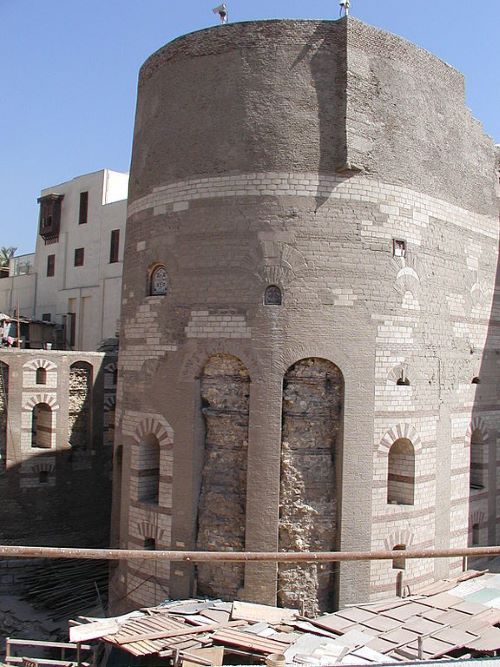
Remains of the Babylon Fortress
It is believed that the original Babylon Fortress was built during the 6th century BC by the Persians. It was located on the cliffs near to the Nile River, next to the Pharaonic Canal which effectively connected the Nile River to the Red Sea.
Boats and other river craft making their way up and down the Nile would have paid tolls at the fortress, and when the Romans seized control of the area, they continued to use the original Babylon Fortress, but only for a relatively short period of time.
While the Romans appreciated the strategic importance of the fort due to its original location, efficient water distribution was difficult, and the Roman emperor Trajan gave the orders to move Babylon Fortress closer to the river in order to make water distribution within the fortress grounds easier and more efficient. At the time when Babylon Fortress was moved to its new location, it was right next to the Nile River.
The Siege of Babylon (September 640 to April 641)
Babylon was a fortified city, and the Romans had indeed prepared it for a siege. Outside the city, a ditch had been dug, and a large force was positioned in the area between the ditch and the city walls. The fort was a massive structure 59 ft high with walls more than 6.6 feet thick and studded with numerous towers and bastions and manned by a force of some 4,000 Roman soldiers.
For the timeline of these events I am using those of General Sir John Bagot Glubb and his book The Great Arab Conquests.
Amr may have arrived in the Babylon area in the Spring of 640, but he was in a tough situation. His troops were basically lightly armed tribal desert raiders. They had no heavy siege equipment to take on Babylon. With no easy targets at hand or reinforcements coming from Medina, the morale of Amr's men would go down. He needed action and a victory of some type.
Amr skirmished for some weeks in the neighborhood with no results. Finally he captured a small outpost north of Babylon with a harbor and boats. Using the boats he ferried himself and his troops over the Nile to the West bank and marched about 50 miles south to the fertile district of Fayoum.
This was a risky move. Amr was on the West bank of the Nile. Any reinforcements from Arabia would be on the East bank of the Nile. The Roman garrison in Babylon would be between them. If Theodore, the commander of Babylon, took action he might be able to defeat the two separated Muslim armies in detail.
So around May, 640 Amr marched south to Fayoum. The Romans had anticipated this and had therefore strongly guarded the roads leading to the city. They had also fortified their garrison in the nearby town of Lahun. When the Muslim Arabs realized that Fayoum was too strong for them to invade, they headed towards the Western Desert, where they looted all the cattle and animals they could. A smaller town in the province was attacked and all of the men, women and children were massacred.
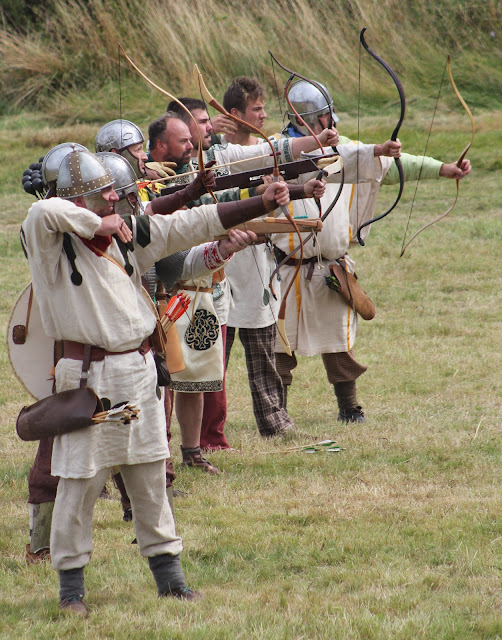
A 19th century Bedouin warrior The Arab forces facing the Romans would look much like this soldier.
John, the Roman commander of the Fayoum district, set out with 50 men to make a personal reconnaissance of the area. Amr received a report of his presence. He immediately sent a force, surrounded John and killed the entire patrol. Then receiving word that the reinforcements he asked for were arriving, Amr's army returned to Lower Egypt down the River Nile.
The Caliph had dispatched 4,000 men to reinforce Amr in Egypt. These were mostly veterans of the Syrian campaigns. Even with the reinforcements, Amr was unsuccessful and so, by August, 'Umar had assembled another 4,000-strong force, consisting of four columns, each of 1,000 elite men. The reinforcements arrived at Babylon sometime in September 640, bringing the total strength of the Muslim force to 12,000 up to perhaps 15,000 men, still quite modest.
The Muslim reinforcements of 10,000+ troops underZubair ibn al-Awam gathered to the north of Babylon.
The Roman commander Theodore had gathered a "large force" around Babylon. . . . . whatever that might mean. We have no numbers. It might have been equal to or greater than the Muslims. Theodore had a chance to attack Zubair to the north before Amr and his troops could return from Fayoum, but Theodore remained inactive. Meanwhile in July Amr re-crossed the Nile with his army and joined Zubair 10 miles north of Babylon near the city ofHeliopolis.
Faced with a united and larger Muslim army Theodore somehow felt now was a good time to march out of Babylon and take on the Arabs. So in July 640 he marched north out of the fortress and out on to the plain to attack at Heliopolis.
I will deal with the battle atHeliopolis in a future article. Suffice it to say, the Romans were ambushed and fled back to the safety of Babylon and closed the gates.
With no Roman army in the field the Muslims scoured the countryside for supplies and plunder. The Roman forces who had successfully defended Fayoum abandoned the province. They took to ships and sailed down the Nile going past Babylon (offering no help) and sailed 45 miles north to the town of Nikiou.
Amr immediately dispatched a force which took Fayoum by assault and massacred the inhabitants. The whole province then surrendered without resistance.
The Arabs occupied towns up to 35 miles north of Babylon. Amr continued to act towards the Egyptians with considerable ruthlessness, either because he had a cruel nature or because he made terrorism into policy to discourage resistance.
Having subdued the provinces of Misr and Fayoum the Muslims were in a good position to gather supplies for their army.
Meanwhile August had come and the Nile was rising soon to flood a great part of the Delta rendering further operations difficult. Amr decided to reduce Babylon before proceeding further.
Remains of Babylon Fortress
The fortress was surrounded in flood season with a moat made up of the Nile River.
The Siege of Babylon Begins
The great fortress consisted of an irregular quadrilateral of walls upwards of 6.5 to 8 feet thick and upwards of 60 feet high, built in alternate layers of brick and stone. Two towers rose considerably higher. In plan it was about 1,000 feet long by 500 feet wide at one end, tapering to 300 feet wide at the other end.
The River Nile washed one of the long sides. A small harbor for river boats lay at the foot of the wall by the south gate. The whole of the fortress was surrounded by a moat filled with water from the Nile.
Opposite the main fortress was the island of Raudha which lay in mid-stream. It also was fortified and garrisoned. The two fortresses were able to maintain communications by boat. To capture such a fortress presented a formidable task to Muslims who had found it difficult to even seize a town like Pelusium.
The Patriarch Cyrus, the Governor of Egypt, was himself besieged inside Babylon. The Roman garrison may have consisted of 5,000 to 6,000 men. They were well supplied with food and warlike stores.
The siege probably began in earnest in September 640.
The strong fortress of Babylon would have no trouble resisting the Muslims for months. But Cyrus must have been aware of the hatred felt for his regime in the country. He would also know that because the Empire had its hands full trying to keep the Arabs out of Anatolia, he could expect little to no help from Constantinople.
An interesting observation. Where was Roman Carthage during the invasion of Egypt?
In 608, Heraclius the Elder in Carthage renounced his loyalty to the Emperor Phocas, who had overthrown Maurice six years earlier. The rebels issued coins showing both Heraclii dressed as consuls, though neither of them explicitly claimed the imperial title at this time. Heraclius's younger cousin Nicetas launched an overland invasion of Egypt; by 609, he had defeated Phocas's general Bonosus and secured the province. Meanwhile, the younger Heraclius gathered a fleet and sailed eastward to Constantinople via Sicily and Cyprus finally being crowned Emperor in 610.
Troops in Carthage were available to invade Egypt in 609. So why were there no reinforcements from Carthage going to bolster Roman forces in Egypt? History is silent on the subject.
The Siege of Babylon
There were more Roman troops than would fit inside the fortress. So the extra troops entrenched themselves outside the walls behind a ditch they dug which was flooded by the waters of the Nile. But in General Glubb's book he says the moat surrounded the fortress. No doubt the troops continued the trench around the fortress and let the Nile fill it to the top.
With apparently no help coming from Constantinople or Carthage, in October 640 Cyrus was ferried over to the island of Raudha. From there a mission was sent to Amr to negotiate. Negotiations were conducted from the island so as not to depress the morale of the garrison inside Babylon.
The emissaries from Amr were told they could not resist Roman power over the long run, and they were offered a cash payment to leave Egypt. The Muslim reply was the standard one: submit to Islam, pay tribute and be 2nd class citizens under Muslim rule or fight.
Cyrus appeared to be inclined to accept payment of tribute, but a number of officers strongly protested. Perhaps these officers were residents of Egypt, whereas Cyrus was an outsider who had been sent to Egypt from the Caucasus Mountains region.
Amr offered Cyrus three days to consider his offer. When the three days ended the Romans lowered on of the drawbridges and sallied forth to attack the Arabs. After heavy fighting the Romans were repulsed and driven back inside the fortress. This reverse depressed those who had advocated resistance and strengthen the hand of Cyrus who wanted submission.
Negotiations were reopened. A treaty was drawn up in the usual form of tribute and submission. Christians were to be granted freedom of religion under the "protection" of the Muslims. A clause was added that the treaty was subject to approval of the Emperor. Pending agreement the military situation would remain unchanged.
Cyrus immediately sailed down the Nile to Alexandria. Once there is wrote a dispatch to Heraclius explaining why he had been compelled to submit and begging the Emperor to ratify the treaty. Heraclius was now an old and sick man, but he could not stomach the defeatism of Cyrus. He ordered Cyrus to report at once to Constantinople.
The Emperor received his Governor of Egypt with angry and bitter reproaches which were not unjustified. For Cyrus had alienated the loyalty of the great majority of Egyptians. He was accused of betraying the Empire to an enemy, was dismissed from his post and sent into exile.
When the Emperor's refusal to ratify the treaty became known hostilities reopened. At this point, certain Egyptians (Copts perhaps) began to assist the Muslims. However the garrison continued to carry out sallies and inflict casualties on the besiegers.
Gradually the winter dragged on. As the Nile flood subsided the protective moat almost dried up. The Muslims had not been able to make any impression on the walls of the fortress. The best they could do was blindly shoot arrows over the walls and hope they might land on someone.
In late winter Amr receiver news that a Roman force was gathering in the Delta. Leaving a small detachment at Babylon he set out to attack the Romans. The Muslims became entangled in the canals and irrigation ditches of the Delta and were roughly handled by Roman attacks forcing them to withdraw back to Baylon.
Then in March 641 news reached Babylon of the death of Emperor Heraclius. The garrison was depressed and the Arabs shouted for joy.
Encouraged by the news the Muslims prepared for an assault. In some places they had almost succeeded in filling in the moat. Scaling ladders were prepared and Zubair headed up the assaulting column. Under the cover of darkness Zubair and a handful of followers made it to the top of the wall.
There was still time for a determined counter attack to cut them down and throw them into the moat. But after a seven month siege from September 640 to April 641 the garrison had had enough.
As dawn broke the garrison commander offered to parley. Amr immediately accepted and a form of capitulation was drafted. After three days the garrison was to retire, embark in ships on the Nile and leave the fortress intact with all its stores.
On April 9, 641 the garrison withdrew and the great fortress of Babylon was occupied by the victorious Muslims.
Roman Emperor Heraclius Crowned Caesar Flavius Heraclius Augustus in 610. Latin was still the official language of the military and government. The Emperor faced invasions by Persians, Avars, Spanish Visigoths and Muslim Arabs. The Emperor personally commanded Roman troops in an invasion into the heart of Persia. He crushed their Empire and forced Persian troops to evacuate the conquered Roman provinces of Egypt, Palestine, Syria and Mesopotamia.
Aftermath
In Syria and Palestine, many of the local Christian Arab tribes had fought at the side of the Romans to the very end. That was not the case in Egypt.
Cyrus was largely responsible for the weakness of Egypt in the face of Arab invasion. The Copts were the large majority in Egypt and had experienced religious freedom under Persian rule. Then they saw ruthless religious persecution when the Romans returned. When the crisis came the only truly loyal groups supporting the Empire would have been the Greek speaking Orthodox people and a smaller number of Egyptians who adhered to the Orthodox Church.
The Copts might not have welcomed the Muslims, but they knew that in Syria the Muslims gave religious freedom to the local Christians as long as the tribute was paid. Their choice was to be slaves of the Romans or slaves of the Muslims. So why fight?
Babylon was a huge loss to the Empire. Rome had now lost control of central and upper Egypt. The Muslims were free to gather supplies and concentrate their forces on Alexandria.
For more go to Part X of my series on the titanic Battle for the Middle East.
Where Eastern Roman military history is addressed at all there are casual references to a single Battle of Yarmouk in 636 AD. "Historians" effectively say the Arabs just magically showed up one day at Yarmouk and defeated a weak Roman Empire.
Nothing could be further from the truth. My series details a Roman-Muslim slug fest taking place over many years and many battles over a huge geographical area.
EDITOR - While this is not exactly a "military" topic, money does make the world go around and certainly funds the armed forces. In this case the coins came from the Eastern Empire.
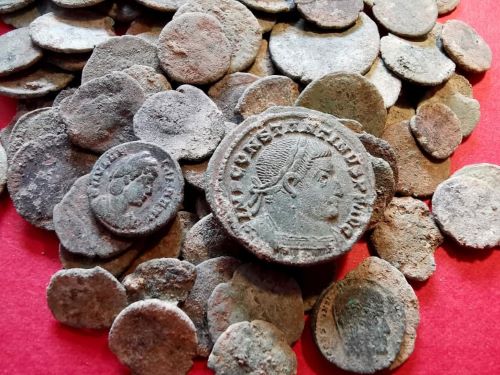
A treasure trove of some 200 Roman-era coins, dating from between the third and fifth century AD, was discovered in northwestern Spain thanks to the apparent efforts of a hungry badger hunting for food, archaeologists have said.
Described as "an exceptional find", the coins were discovered in April 2021 in La Cuesta cave in Bercio in the Asturias region, with details outlined in the Journal of Prehistory and Archaeology published last month by Madrid's Autonomous University.
The coins were likely dug up by a badger searching for food during the rare snowstorm which paralyzed Spain in January 2021 — a blizzard officials called "the most intense storm in the last 50 years."
The coins were probably hidden by people fleeing barbarians, archaeologists say.Credit: Alfonso Fanjul Peraza
Most of these late Roman era coins "originate from the north and eastern Mediterranean" from Antioch, Constantinople, Thessaloniki which later passed through Rome and Arles and Lyon in southern France, although at least one coin came from London, they wrote.
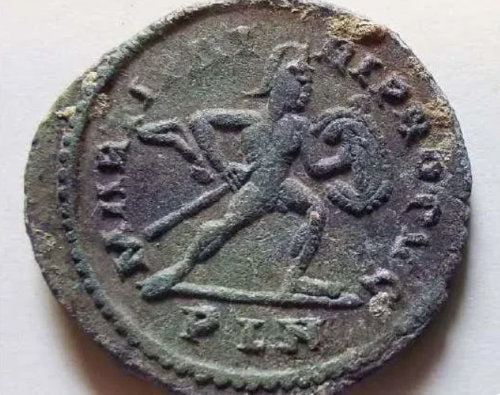
The researchers told El Pais the one minted in London was one of the most well preserved coins and is "bronze, weighing between eight and 10 grams, with an approximate 4% silver."
Reverse of the coin minted in London.
/ Credit: Journal of Prehistory and Archaeology
The researchers said the coins had likely been moved there in the "context of political instability" linked in particular to the invasion of the Suebians, a Germanic people, who pushed into the northwestern part of the Iberian peninsula in the 5th century.
Most of the coins are made of copper and bronze and the largest, weighing more than eight grams.
The Romans conquered the Iberian peninsula in 218BC, ruling until they were ousted by the Visigoths in the early fifth century. Researchers have speculated that the latest trove of coins were likely part of a larger haul that was hastily hidden in hopes of keeping them safe amid political and social instability.
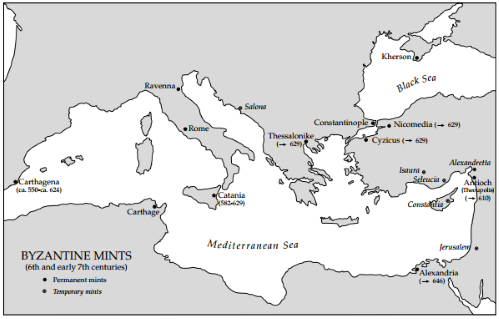
In the late Roman period, coins were minted in a number of cities, mainly because of the danger and cost of moving large quantities of precious metal from place to place. This system was inherited by Byzantium, and in the 6th century there were six mints in the Eastern Empire (Constantinople, Nicomedia, Cyzicus, Antioch [Theoupolis], Alexandria and Thessalonica) and three in the Western provinces that Justinian had reconquered from the Vandals and the Ostrogoths (Carthage, Rome and Ravenna).
Gold coins were minted mainly in the capital and consequently have the mint mark CON (for Constantinople), with OB added on the solidi to show that they were minted of pure gold.
To a large degree military historians live in a fantasy world of "Great Men and Great Armies" doing battle and do books and movies accordingly.
What is often forgotten or ignored is the boring matter of logistics . . . of how those troops were able to get there, of how they were fed and supplied. The fact of the matter is without a strong logistical support system any army would soon be boiling their leather shoes or killing dogs for food.
Strategy and tactics are easy to understand. But the science of equipping and feeding armed forces on campaign is extremely technical, its mysteries understood by only a few initiates. Still more than anything else logistical constraints limit the activities of any army during a war.
For example, in the 19th century the British military had a Land Transportation Corp that at one point had 14,000 men and 28,000 beasts.
The maintenance of Eastern Roman armies and the recruitment and equipping of its military expeditions constituted one of the heaviest burdens on the finances of the Empire. From the 7th to the 12th centuries there is virtually no contemporary evidence of how armies were raised and supplied even though there were numerous campaigns into the Balkans or against the caliphate on the Eastern Front.
The Empire's system of building an extensive and well-maintained road network, as well as its absolute command of the Mediterranean for much of its history allowed the navy to supply troops in widely scattered parts areas and then move men and supplies overland. Forces were routinely supplied via fixed supply chains, and although Roman armies in enemy territory would often supplement or replace this by foraging for food or purchasing food locally.
One historian estimated that a single legion would have required 13.5 tonnes of food per month, and that it would have proved impossible to source this locally.
The methods adopted for equipping and supplying armies crucially affect their fighting ability and potential, as well as the planning and execution of campaign strategy.
By the ninth century, it is clear that the system of recruiting and maintaining soldiers in what had been the field armies of the late Roman state had undergone a radical transformation, producing the pattern of provincially-based and recruited forces referred to as themata.
Themata, is a term for military forces based in the provinces.
At the height of the process of provincialized recruitment and maintenance of troops during the eighth and first half of the ninth centuries, there is plenty of evidence to show that voluntary recruitment to both elite and provincial forces, compulsory levies in the provinces, and the attraction of non-Byzantine mercenaries co-existed, and were invoked according to the requirements of the moment.
According to the treatise on military expeditions compiled by the magistros Leo Katakylas, and referring almost certainly to the campaign practice of the emperor Basil I, it is noted that the prôtonotarios of each thema through which the imperial force passes must provide certain supplies in kind.
If this is not sufficient, then the prôtonotarios should obtain the necessary produce from the eidikon - - - which fulfilled the dual function of imperial treasury and storehouse. As a treasury, it stored various precious materials such as silk or gold, and was responsible for the payment of the annual salaries (rogai) of officials of senatorial rank. As a storehouse, the eidikon controlled the state factories producing military equipment (the late Roman fabricae) and was responsible for supplying the necessary matériel for expeditions, ranging from weapons to "sails, ropes, hides, axes, wax, tin, lead, casks" for the fleet or even Arab clothing for the imperial spies.
According to these sixth-century regulations, the provincial officials are to be given advance notice of the army’s requirements in foodstuffs and other goods, which are to be deposited at named sites along the route of march.
The materials, food supplies and other requirements demanded by the provincial authorities on behalf of the central government were referred to as embolê, and meant simply that part of the regular tax assessment owed by each tax-payer (whether an estate, an individual peasant freeholder, or whatever) not paid in coin.
Exact records of the produce supplied by the tax-payers as embolê, were to be kept and reckoned up against the annual tax owed in this form; if more supplies were provided than were due in tax, then the extra was to be supplied by the tax-payers, but this was then to be paid for, at a fixed rate established by the appropriate state officials, out of the cash revenues already collected in the regular yearly assessment of that particular province.
If the provincial treasuries in question had insufficient local cash revenues left over to pay for these extra supplies, then they were to be paid for instead either from the general bank of the praetorian prefecture, in other words, the coemptio was still applied; or they were to be collected anyway and then their value (at the prices fixed by the state) deducted from the following year’s assessment in kind.
An example of the Roman Navy bringing in troops
and setting up a supply chain to support inland operations.
In the ninth and tenth centuries, is similar: the thematic prôtonotarios is to be informed in advance as to the army’s requirements, which are to be provided from the land-tax in kind and the cash revenues of the thema and stored at appropriate points along the route of march. An exact account of the supplies is to be kept, so that (where the thematic tax-payers provided more than their yearly assessment demands) the amount can be deducted (from the assessment for the following year).
It is clear from these texts that the basic fiscal mechanisms in the sixth and the ninth centuries were almost identical: the terminology had changed, and the administrative relationships between the different departments responsible for the procedure was slightly different, but in essentials the later system was very obviously derived from the earlier. The process by which the evolution of the later process out of the earlier occurred nicely illustrates the degree of systemic continuity between late Roman and middle Byzantine practices.
Armies were usually accompanied by a supply-train; the late tenth-century treatise on campaign organization stipulates a basic supply of 24 days’ rations of barley for the horses, which according to other sources was similarly to be put aside by the thematic prôtonotarios for collection by the army en route; and historians’ accounts of campaigns frequently mention the baggage-train or the supplies and fodder it carried.
Smaller units clearly foraged for their own fodder and supplies, whether in enemy territory or on Roman soil, which must have caused some hardship to the communities affected; while once on hostile terrain the commander must either have arranged to keep his supply-lines open by detaching small units to hold key passes and roads, or let the army forage for all its requirements once the supplies had run out.
Leo VI advised generals to carry sufficient supplies with the army and to forage on enemy territory rather than prey upon the citizens of the Empire; the need to avoid harming the provincials by permitting the army to forage and extract supplies without proper administrative controls is often repeated.
The average length of a day’s march for infantry or combined forces was probably rarely more than twelve – fourteen miles. The distances at which supply dumps could be established or stops made to feed and water men and animals was also directly related to the distance covered in a day’s march.
American Civil War. A military supply wagon train entering Petersburg VA. Getting food and supplies to the front-line troops was just as important as leadership.
In the fifth century, it was recommended that soldiers be trained to carry a load of up to sixty Roman pounds (about 42.3 lbs./19.6 kilos). In the late sixth century Stratêgikon, which also recommends that cavalry soldiers carry three to four days’ supply with them in their saddle bags.
Rations were consumed on a three-day rotation in the late Roman period: bucellatum (hard tack) for 2 days in 3, bread for 1 day in 3, salt pork for 1 day in 3, mutton for 2 days in 3, wine and sour wine on alternate days; as well as a number of additional substances such as fish, cheese and oil, depending on context and availability. The amount (weight) of such rations varied, but the figure of 1 lb. (11.28 oz/327 g) of meat and/or 2 – 3 lbs (1.41 lbs/654 g – 2.1 lbs/981 g) of bread per diem per man given in one document for stationary troops seems to have been standard into the seventh century in Egypt
This campaign ration would give the maximum sixty-(Roman) pound load per man for about twenty days; although under normal marching conditions much of the individuals’ supplies would be transported by pack-animal or wagon, as noted above.
A fifteen-thousand man army would thus require a minimum of some 900,000 (Roman) lbs. (i.e. 634,500 lbs or 288,400 kilos) of provisions, excluding drinking water/wine and necessary ‘extras’, such as lard and/or oil, cheese or fish, and so on, and not including fodder for the horses and the pack-animals, for a period of between two and, in exceptional cases, three weeks.
Assuming an average rate of march for infantry and cavalry together of between twelve and fourteen miles per day in good conditions (an optimistically high figure compared with the majority of known military marches from pre-industrial contexts), such a force could thus travel some 240-280 miles in a three-week march, which provides a very crude guide to the distances at which supply dumps would have had to be established in advance.
This figure is confirmed by the tenth-century treatise on campaign organization, which notes that ‘it is not feasible, in turn, for an army to transport more than a twenty-four days’ supply of barley from its own country for its horses’, which suggests the recognized maximum period for a cavalry force
We may conclude that major supply dumps were needed at stages of approximately 200 – 250 miles, although under very good conditions and with smaller numbers imperial forces may have moved more rapidly than this and needed re-supplying less frequently; fast-moving cavalry forces will have been even less demanding, although ample fodder and water will have been essential.
The Roman Navy was of major importance in the endless campaigns against the Arab Muslims, the Normans and Slavs. Roman troops and supplies often needed to be moved over huge distances to Africa, the Balkans or Italy.
Travelling across Anatolia presented a number of difficulties, even before entering hostile territory. From Constantinople as far as Dorylaion, which at 792 m above sea-level is situated near the northern limit of the Anatolian plateau, fodder will have been relatively easily obtained. Thereafter, as Crusader accounts make clear, armies will have had to carry much of their provisions and fodder with them until they reached the more fertile region around Ikonion.
Horses and mules were raised from a variety of different sources. If the imperial household was involved, then all the main state departments, the leading civil and military officers, the metropolitanates and the monastic houses of the empire had to provide a certain number of mules or other pack-animals to transport the household and its requirements. For regular non-imperial campaigns the main sources for the army were imperial stud-farms in Asia Minor requisitions from the estates of the Church, requisitions from secular landholders; and the soldiers themselves, who either brought their own animals or were required to purchase their requirements on the market using their salaries and campaign payments.
There is no evidence to suggest that the pattern of administration of expeditionary forces changed very markedly between the later tenth and later eleventh centuries. We can assume that preparations were made as before, informing thematic officials of the necessary requirements, which had to be prepared in advance ready for the army to collect, and that supplies provided were set against the annual tax demand for the region in question.
The imposition required by local districts of billeting and feeding soldiers and officers, grinding corn and baking bread, and providing extra supplies for units passing through or based in a district, providing craftsmen and artisans for public and military works, burning charcoal, providing labor for the maintenance or construction of roads and bridges, had existed from Roman times and are still found, sometimes under slightly different names, in the eleventh century. But in addition, from the middle of the seventh century and certainly by the tenth and eleventh centuries a group of new impositions had evolved, including the provision or fabrication of weapons and items of military equipment.
The fiscalised strateia was still collected by state officials as a further source of revenue for the maintenance of the armies; so that it is not correct to suggest that the registers of thematic stratiôtai were entirely neglected – it was from these that the regular tagmata of the themes were recruited, and upon the basis of which the fiscalised strateia was also extracted. By the time of the Mantzikert campaign, however, and as a result of imperial neglect and reductions in military salaries, the regular or Roman tagmatic forces recruited from each thema were reduced in number and poorly equipped: emperors had not taken to the field themselves for many years, and the revenues from the strateiai had been employed for other than military expenditures.
The basic requirements for the organisation of military expeditions and campaigns in the eleventh century remained the same as in the preceding centuries. What changed were the conditions under which those requirements had to be met.
A World War I soldier drives an escort wagon through water logged fields and roads. Note the spare wheel carried behind the driver; attrition of vehicles was high.
In the campaign against the Turks conducted by Romanos IV after his accession, the regular entrenched camps, the accompanying supply-train and the supplies carried with the army are all referred to. Such supplies were raised by the various fiscal and military officials mentioned in the exemptions granted to monastic landlords. In Byzantine territory, and presumably when the army arrived in a district which was not warned in advance, troops were sent out to purchase corn and other requirements from the local populations.
For the Mantzikert campaign, Romanos could raise as many as some 60,000 men in all, according to a recent estimate. He seems also to have been able to rely on the traditional means of raising and distributing supplies for his troops while they were en route to confront the Seljuk forces, although the arrangements did not always work especially well: Attaleiates notes that the troops, and the foreign mercenary forces in particular, caused considerable damage to the region around Krya Pêgê.
His supply train was considerable, as the presence of a large number of wagons with siege equipment appears to testify, suggesting that the central armories, the local provincial officials and the commanders of the army were able effectively to co-operate on the traditional pattern for the provisioning and equipping of the imperial troops. Once in territory which had been in hostile hands, however, he was forced to forage for provisions: the Franks under Roussel de Bailleul based near Chliat were ordered to seize the harvested crops; the troops from Theodosioupolis were ordered to provide two months’ supplies for themselves; and Matthew of Edessa notes that some 12,000 troops were sent towards Abkhazia to find supplies.
The military treatises of the tenth century and the historians’ accounts of many of the campaigns of this period show that foraging for supplies was one of the most risk-laden activities which the commander had to organize – failure to guard against surprise attack, on the one hand, and the failure of the foragers to locate and secure adequate provisions could prove disastrous.
The later tenth- and eleventh-century sources the documents suggest that a wide range of state impositions on the rural population was maintained to ensure the adequate arming, equipping and provisioning of troops.
The synônarioi,strateutai, chartoularioi of the themata, and many others such as epoptai, are referred to, officials responsible for raising the supplies needed for the army, for registering or raising the soldiers in each province, and related issues. Their existence illustrates the continued effectiveness of the central authorities in extracting resources for its troops. Some of the letters of Theophylact of Ochrid, referred to already, mention these officials and their exactions.
It was these officials who will have been responsible for the arrangements made by Alexios in the 1090s for the passage and provisioning of the Crusader forces, arrangements whose success demonstrates the continued efficiency of the imperial military and provincial administration in catering for its armies at this time.
There were enormous demands made upon the ordinary population of the empire when a military expedition was undertaken. This required an administrative structure which could deal with all facets of the armies’ needs, whether in terms of raising and equipping new recruits or in respect of supplying the vast number of men, horses, mules and other animals which an army on the march needed.
What is evident, and important to recognize, is that the basic structures which had evolved by the late Roman period retained their relevance in the early and middle Byzantine period; but it is also apparent that those structures continued to evolve and to develop in response to the changed context.