|
| Umayyad Arab infantry early 8th century. |
Fanatical Muslim Armies Thrust Deep into the Empire
The Siege of Nicaea of 727 was an unsuccessful attempt by the Umayyad Caliphate to capture the Roman city of Nicaea, the capital of the Opsician Theme. Ever since its failure to capture the Roman capital in 717–718, the Caliphate had launched a series of raids into Byzantine Asia Minor. In 727, the Arab army, led by one of the Caliph's sons, penetrated deep into Asia Minor, sacked two Roman fortresses and in late July arrived before Nicaea.
Despite constant attacks for 40 days, the city held firm and the Arabs withdrew and returned to the Caliphate. The successful repulsion of the attack was a major boost for Roman Emperor Leo III the Isaurian's recently initiated campaign to abolish the veneration of icons in the Empire. Leo claimed it as evidence of divine favor for his policy.
The siege of Nicaea marks also the high point of the Umayyad raids, as new threats and defeats on their far-flung frontiers diverted Umayyad strength elsewhere, while Roman power gradually recovered.
 |
| A section of the 5 miles of Roman walls still surrounding Nicaea. |
 |
| The Arab Invasions of the Roman Empire The Romans faced an endless series of Arab invasions into Asia Minor for decades on end. The Romans fought wars with the Arabs over three continents: Asia, Africa and Europe. The invasions were horribly disruptive to the Empire's economy and its ability to collect taxes to support the state and military. The Romans were virtually on a permanent war footing with the Arabs for centuries. . Ultimately the Arab invasions of Anatolia failed. The Romans held on to Constantinople and all the important cities. The Arabs were always forced to withdraw back into Syria. |
Background
Following the failure of the year-long assault by the Umayyad armies on the Roman capital of Constantinople in 717–718, a short period of peace followed as the Umayyads licked their wounds, suppressed the rebellion of Yazid ibn al-Muhallab and re-assessed their priorities. When warfare on the Arab–Roman frontier recommenced in 720, the strategic focus of the Caliphate had shifted away from outright conquest.
The Muslim raids across the Taurus Mountains into Byzantine Asia Minor still occurred regularly every spring and summer, sometimes accompanied by naval raids and followed by a winter expedition; they devastated large tracts of Asia Minor, and destroyed several fortresses.
But the Arabs could not hold on to lands on the west side of the Taurus Mountains. The Romans continued to hold fortified points throughout Asia Minor in the rear of the Arab armies. With Roman troops at their rear they had to retreat back into Syria after each attack.
The Roman Army - At the time of the siege the Eastern Roman Army would have numbered roughly from 90,000 to 100,000 plus men. As strong as that sounds on paper, that force could not be gathered in one place to combat invaders. (see chart below)
Roman units would have been thinly spread to defend a geographically huge Empire from Italy to Armenia to the Crimea to the Balkans.
Information on the structure of the army is guess work. In past years the armored cavalry (cataphract) was the mailed fist of the Roman commanders. But for 100 years the Romans had faced, and been defeated by, the fast and nimble light Arab cavalry.
For the most part, the Romans had little interest in meeting the Arabs out in the open sword to sword. We can assume that the bulk of military spending was directed into defensive fortifications and the infantry units needed to man the walls. Light and heavy cavalry would have given a secondary role and used for scouting, smaller combats and frontier raids.
Roman reaction to the Arab invasions during these years was necessarily passive. The Empire needed to nurse its strength against the vastly superior resources of the Caliphate while simultaneously defend many other parts of the nation from invasion.
The Romans did not obstruct or confront the raiding Arab armies, but rather retreated to well-fortified positions scattered throughout Asia Minor.
But the Arabs could not hold on to lands on the west side of the Taurus Mountains. The Romans continued to hold fortified points throughout Asia Minor in the rear of the Arab armies. With Roman troops at their rear they had to retreat back into Syria after each attack.
 |
| Emperor Leo III the Isauian faced wars in Asia Minor, the Balkans and Italy. |
The Roman Army - At the time of the siege the Eastern Roman Army would have numbered roughly from 90,000 to 100,000 plus men. As strong as that sounds on paper, that force could not be gathered in one place to combat invaders. (see chart below)
Roman units would have been thinly spread to defend a geographically huge Empire from Italy to Armenia to the Crimea to the Balkans.
Information on the structure of the army is guess work. In past years the armored cavalry (cataphract) was the mailed fist of the Roman commanders. But for 100 years the Romans had faced, and been defeated by, the fast and nimble light Arab cavalry.
For the most part, the Romans had little interest in meeting the Arabs out in the open sword to sword. We can assume that the bulk of military spending was directed into defensive fortifications and the infantry units needed to man the walls. Light and heavy cavalry would have given a secondary role and used for scouting, smaller combats and frontier raids.
Roman reaction to the Arab invasions during these years was necessarily passive. The Empire needed to nurse its strength against the vastly superior resources of the Caliphate while simultaneously defend many other parts of the nation from invasion.
The Romans did not obstruct or confront the raiding Arab armies, but rather retreated to well-fortified positions scattered throughout Asia Minor.
After the accession of Caliph Hisham (r. 723–743), the scale and ambition of the Muslim raids grew. One of the most prominent Umayyad leaders in these campaigns was Hisham's son Mu'awiyah, who led expeditions in 725 and 726, the first of which went as far west as Dorylaion.
 |
| A large Arab army from Syria thrust deep into the Roman Empire and conducted a 40 day siege against Nicaea. |
 |
| The Walls of Nicaea Southern gate; triumphal arches were incorporated when the walls were built. |
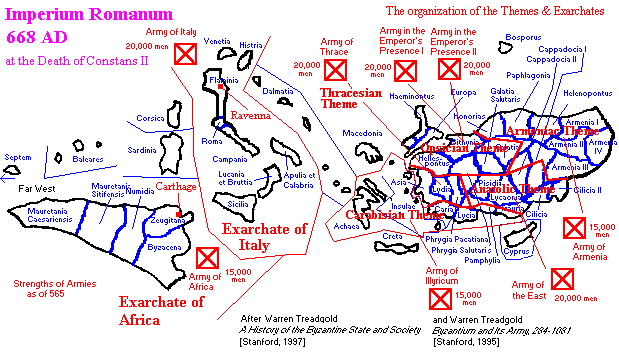
Roman troop deployments a few years before the Nicaea campaign. By 727 the Exarchate of Africa had been captured by Muslim forces.
Invasion of 727 and the siege of Nicaea
In summer 727, another large-scale invasion was led by Mu'awiyah, with Abdallah al-Battal heading the vanguard of the army.
The Byzantine chronicler Theophanes the Confessor claims that the vanguard alone numbered 15,000 men and the entire invasion force 100,000, clearly a grossly inflated number.
What is clear is this was a major invasion directed against The Opsician Theme, one of the most powerful themes in the Empire and located right next to Constantinople itself. In the chart above the Roman troops near Constantinople could have been in the 40,000 man range. Those Roman forces would have been divided among many cities to fend off Arab attacks.
The Arabs came prepared for battle with siege engines to knock down the walls of cities that opposed them. It is fair to assume if the Arabs came to take cities then they would have brought enough troops to outnumber the Romans. You do not lay siege to cities if the defenders outnumber you. Call the size of the Arab army at no less than 40,000 men.
The Arab army moved west into northwestern Asia Minor, and the vanguard under al-Battal attacked and sacked the town of Gangra in Paphlagonia and a place called in Arab sources Tabya (possibly the fort of Ateous in Phrygia).
Gangra was razed to the ground, but during the attack on Tabya the Arabs, especially the Antiochene contingent, are said to have suffered heavy losses.
The Byzantine chronicler Theophanes the Confessor claims that the vanguard alone numbered 15,000 men and the entire invasion force 100,000, clearly a grossly inflated number.
What is clear is this was a major invasion directed against The Opsician Theme, one of the most powerful themes in the Empire and located right next to Constantinople itself. In the chart above the Roman troops near Constantinople could have been in the 40,000 man range. Those Roman forces would have been divided among many cities to fend off Arab attacks.
The Arabs came prepared for battle with siege engines to knock down the walls of cities that opposed them. It is fair to assume if the Arabs came to take cities then they would have brought enough troops to outnumber the Romans. You do not lay siege to cities if the defenders outnumber you. Call the size of the Arab army at no less than 40,000 men.
The Arab army moved west into northwestern Asia Minor, and the vanguard under al-Battal attacked and sacked the town of Gangra in Paphlagonia and a place called in Arab sources Tabya (possibly the fort of Ateous in Phrygia).
Gangra was razed to the ground, but during the attack on Tabya the Arabs, especially the Antiochene contingent, are said to have suffered heavy losses.
 |
| Arab Cavalry |
 |
| Arab Mailed Archer |
From there, the Arabs turned west towards Nicaea, the chief city of Bithynia and capital of the powerful Opsician Theme.
The Arabs arrived before the city in late July, with al-Battal's vanguard preceding the main army. The Byzantines, probably under the command of the Count of the Opsicians, Artabasdos, did not meet them in the field, but instead retreated behind the city's walls.
The Arabs assaulted the city for forty days, employing siege engines which destroyed a part of the walls, but eventually failed to take it. This one sentence summary is maddening, but historical records are few. A 40 day siege was a major attack by any standards. Also with part of the walls destroyed you know there was considerable hand-to-hand combat to keep the Arab infantry out of the city. But again, we have no details, only our imagination.
In late August, they raised the siege and departed, taking along many captives and much booty. The 12th-century chronicle of Michael the Syrian claims that the city's inhabitants abandoned it and fled by ship through Lake Ascanius, whereupon the Arabs destroyed Nicaea, but this is clearly an error.
The Arabs arrived before the city in late July, with al-Battal's vanguard preceding the main army. The Byzantines, probably under the command of the Count of the Opsicians, Artabasdos, did not meet them in the field, but instead retreated behind the city's walls.
The Arabs assaulted the city for forty days, employing siege engines which destroyed a part of the walls, but eventually failed to take it. This one sentence summary is maddening, but historical records are few. A 40 day siege was a major attack by any standards. Also with part of the walls destroyed you know there was considerable hand-to-hand combat to keep the Arab infantry out of the city. But again, we have no details, only our imagination.
In late August, they raised the siege and departed, taking along many captives and much booty. The 12th-century chronicle of Michael the Syrian claims that the city's inhabitants abandoned it and fled by ship through Lake Ascanius, whereupon the Arabs destroyed Nicaea, but this is clearly an error.
Aftermath
The repulsion of the Arab assault on Nicaea was an important success for the Byzantines. Emperor Leo III the Isaurian (r. 717–741) regarded the city's survival as a sign of divine favor towards his newly instituted iconoclastic policies, and was encouraged to drive them further.
This is probably related to an incident mentioned in the account of Theophanes, where a certain Constantine, who served as a groom (strator) to Artabasdos, threw a stone on an icon of the Virgin Mary and then trampled on it. The soldier was killed the next day by a catapult, a fact which Theophanes reports as evidence of divine vengeance. However, this passage shows strong signs of tampering by the fervently anti-iconoclast Theophanes, from what was probably originally a pro-iconoclast story.
This is probably related to an incident mentioned in the account of Theophanes, where a certain Constantine, who served as a groom (strator) to Artabasdos, threw a stone on an icon of the Virgin Mary and then trampled on it. The soldier was killed the next day by a catapult, a fact which Theophanes reports as evidence of divine vengeance. However, this passage shows strong signs of tampering by the fervently anti-iconoclast Theophanes, from what was probably originally a pro-iconoclast story.
Militarily, the siege of Nicaea was the high-water-mark of the post-718 Umayyad raids. Never again would Umayyad armies penetrate as deeply into Asia Minor.
Increasingly thereafter the Syro-Jaziran army, that provided the manpower for the raids against Byzantium, was diverted in the hard and fruitless wars against the Khazars in the Caucasus: the Khazars inflicted a heavy defeat on the Muslims in 730.
A Byzantine–Khazar alliance was sealed by the marriage of Leo III's son and heir Constantine V (r. 741–775) with the Khazar princess Irene shortly after.
Roman strength also revived as the Muslim military situation on all fronts of the over-extended Caliphate deteriorated. Consequently, in the 730s, Arab raids were mostly limited to the immediate frontier regions and their successes became fewer, until in 740 the Byzantines inflicted a heavy defeat against the largest invasion force assembled after 718 at the Battle of Akroinon.
Increasingly thereafter the Syro-Jaziran army, that provided the manpower for the raids against Byzantium, was diverted in the hard and fruitless wars against the Khazars in the Caucasus: the Khazars inflicted a heavy defeat on the Muslims in 730.
A Byzantine–Khazar alliance was sealed by the marriage of Leo III's son and heir Constantine V (r. 741–775) with the Khazar princess Irene shortly after.
Roman strength also revived as the Muslim military situation on all fronts of the over-extended Caliphate deteriorated. Consequently, in the 730s, Arab raids were mostly limited to the immediate frontier regions and their successes became fewer, until in 740 the Byzantines inflicted a heavy defeat against the largest invasion force assembled after 718 at the Battle of Akroinon.
 |
| Byzantine troops in the 7th Century. 1. Armored infantryman: The 7th century was another period from which few illustrations survive. The best-equipped infantry appear to have had short-sleeved mail hauberks and remarkably large shields, plus spears and swords. This man's helmet is based upon one found in Central Europe which may be of Byzantine form. The addition of the mail aventail is hypothetical, reflecting a high degree of Turkish and specifically Avar influence. His sword is based upon an unusual Scandinavian form which is itself likely to reflect Byzantine origins. 2. Armored cavalryman: This trooper has been given a plumed cap over his helmet, as worn by warriors from Iran and the Caucasus. This could be the explanation for the otherwise extraordinary outlines of many helmets seen in 7th-9th century Byzantine art. Turkish and Avar influences can be seen on the belt, sword and bowcase, as shown by surviving fragments and pictorial sources. 3. Noble commander, late 7th century: One remarkable and recently discovered fragment of wall painting sheds light on the costume of the 7th century Byzantine elite though not, unfortunately, on their military equipment. A long tunic with richly embroided claves and three-quarter sleeves was worn over a long-sleeved shirt, either with soft riding boots or, as here, with highly decorated shoes indicating high status. The practice of impaling the head and hands of a defeated rebel, presumably as a warning to others, seems to have been common in Byzantium at this time. |
 |
| 8th to 9th Centuries The first defensive campaigns fought against the first Islamic armies took a certain form, with the imperial forces struggling to match the mobility and speed of the Arab raiders, who were able to deprave the Roman commanders of the initiative not simply by virtue of their fast-moving, hard-hitting tactics, but also because the type of warfare they practised made any notion of a regular front untenable. The Arab Islamic conquests radically altered the strategic and political geography of the whole east Mediterranean region. The complete failure of attempts to meet and drive back the invaders in open battle induced a major shift in strategy whereby open confrontation with the Muslim armies were avoided. The comitatenses field armies were first withdrawn to north Syria and Mesopotamia, shortly thereafter back to the line of the Taurus and Anti-Taurus ranges. By the mid-640s the armies which had operated in Syria, Mesopotamia and Palestine had been withdrawn into Anatolia. The regions across which they were based were determined by the ability of these districts to provide for the soldiers in terms of supplies and other requirements. The field forces thus came to be quartered across Asia Minor and Thrace, where they were referred to by the Greek term for these districts, themata or themes. The themes were at first merely groupings of provinces across which different armies were based. By the latter 8th century some elements of fiscal as well as military administration were set up on a thematic basis, although the late Roman provinces continued to subsist. |
 |
| City wall around Nicaea |
 |
| Nicaea Northern city gate, 3 of the 4 gates survive, restricted to pedestrians. |


 |
| Roman aqueducts used until the 1970s, this one is outside the eastern gate. |
 |
| Ruins of the ancient Hagia Sophia, where the First Ecumenical Council met in Nicaea. |
 |
| The Nicaea theater was supported by arches as the land was flat; note entrance for beasts. |
Nicaea
One of Alexander the Great's generals founded the city in 316 BC, naming it Antigonela for himself. When taken by another general, it was named Nicaea for his wife. Nicaea became an important religious center following Constantine's edit of tolerance for Christianity in AD 313. The city has been important in the Roman, Byzantine, Seljuk, and Ottoman empires.
Located on the eastern shore of Lake Iznik, the city has long been a stopping place on the route between Constantinople and Anatolia. The area surrounding Nicaea is fertile with rich agriculture.
.
When controversy arose about the nature of Jesus Christ, Constantine called the first Ecumenical Council to Nicaea in AD 325 to settle the issue. All the bishops came, meeting for two months in the Senatus Palace, now submerged in Lake Iznik. The council affirmed Christ's divinity and established what is now known as the Nicene Creed. Nicaea hosted another Ecumenical Council in 787, that rejected iconoclasm, thus permitting the use of icons in worship. This second Nicaean council met in Hagia Sophia.
When controversy arose about the nature of Jesus Christ, Constantine called the first Ecumenical Council to Nicaea in AD 325 to settle the issue. All the bishops came, meeting for two months in the Senatus Palace, now submerged in Lake Iznik. The council affirmed Christ's divinity and established what is now known as the Nicene Creed. Nicaea hosted another Ecumenical Council in 787, that rejected iconoclasm, thus permitting the use of icons in worship. This second Nicaean council met in Hagia Sophia.
In 1075 the Seljuk commander Süleyman Sah I changed Nicaea's name to Iznik and made it his capital. Through the years, particularly in the 16th and 17th centuries, Iznik has been renown for tiles and ceramics that have greatly influenced decoration in mosques and palaces throughout Turkey. Described as the third 'holy city' after Jerusalem and the Vatican, the Second Vatican Council in 1962, declared Iznik a 'holy city' for Christians.
Siege of Nicaea (727) Opsician Theme Umayyad Caliphate