Cabras, the church of San Giovanni di Sinis Early Christian church (6th century AD) of San Giovanni The building is the result of the transformation longitudinal trinavata of a Byzantine church with cross plan inscribed, dated to the sixth-seventh century, of which only the body and domed wishbones, with mullioned windows open in early Romanesque
Imperial Roman Sardinia
For over 1,000 years the island of Sardinia was an imperial province of both the Western and Eastern Roman Empires.
Circa 1000 BC the Phoenicians began visiting Sardinia with increasing frequency, presumably initially needing safe over-night and/or all-weather anchorages along their trade routes from the coast of modern-day Lebanon as far afield as the African and European Atlantic coasts and beyond. The most common ports of call were Caralis, Nora, Bithia, Sulcis, Tharros, Bosa and Olbia. .
While the Phoenicians stuck to the coastline, their relationship with the Sardinians was peaceful. However, after a few hundred years of habitation, they began expanding inward. They took over valuable natural resources such as silver and lead mines, and established a military presence in the form of a fortress on Monte Sira in 650 BC.
The Sardinians resented these intrusions, and in 509 BC they mounted a series of attacks against Phoenician settlements. The Phoenician settlers called upon Carthage for help, and when it arrived they successfully took control of part of the southern part of the island.
Conquest by the Roman Republic
In 238 BC the Carthaginians, as a result of their defeat by the Romans in the First Punic War, surrendered Corsica and Sardinia to Rome, and together they became a Roman province.
The existing coastal cities were enlarged and embellished, while Coloniae such as Turris Lybissonis and Feronia were founded. These were populated by Roman immigrants.
The Roman military occupation brought the Nuragic civilization to an end. Roman domination of Sardinia lasted 694 years, during which it was an important source of grain for the capital.
Latin came to be the dominant spoken language of Sardinia during this period, though Roman culture was slower to take hold, and Roman rule was often contested by the inhabitants of Sardinia's mountainous central regions.
A variety of revolts and uprisings occurred: however, since the interior areas were densely forested, the Romans avoided them and set them aside as the “land of the barbarians”.
Overall, Corsica and Sardinia became trivial gains compared to the Roman Empire’s Eastern gains. From Corsica, the Romans did not receive much spoil nor were the prisoners willing to bow to foreign rule, and to learn anything Roman. It was said that “whoever has bought one [Corsican] regrets the waste of his money”. The Romans regarded the islands and their people as backward and unhealthy. ,.
Even though the Romans considered them trivial, Corsica and Sardinia ended up playing an important role in the happenings of the Empire. Sardinia provided much of the grain supply during the time of the Roman Republic. Corsica provided wax to the empire, as that was all that could be found on the island.
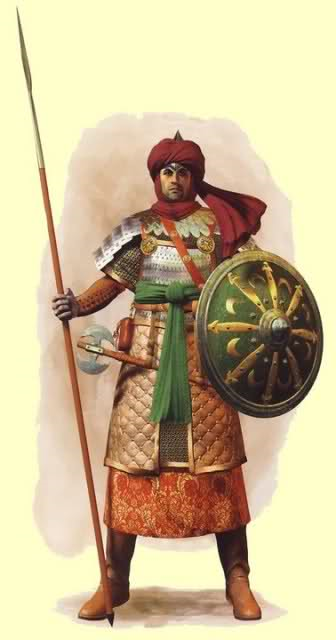
Vandal Warrior
The islands also indirectly contributed to the demise of the Roman Republic. Gaius Marius and Lucius Cornelius Sulla Felix settled their veterans on Corsica and used the islands' grain supply to support their war efforts.
Julius Caesar had Sardinia occupied by his delegates and gained control of the grain supply. This supply of grain fed his army and ensured their victory in the civil war of 49 BC. Within the second triumvirate, Octavian received the islands as part of his share and used its grain supply to feed his armies against Brutus and Cassius.
Corsica and Sardinia also came to be recognized as a place of exile. C. Cassius Longinus, the lawyer accused of conspiracy by Nero was sent to the province as was Anicentus, murderer of the first Agrippina. Many Jews and Christians were also sent to the islands under Tiberius.
Vandal Conquest
The east Germanic tribe of the Vandals conquered Sardinia in 456. Their rule lasted for 78 years up to 534, when eastern Roman troops under Cyrillus retook the island. It is known that the Vandal government continued the forms of the existing Roman Imperial structure.
The governor of Sardinia continued to be called the praeses and apparently continued to manage military, judicial, and civil governmental functions via imperial procedures. (This continuity was not novel to Sardinia; like the Visigoths, the Vandals generally maintained the pretense of the empire, nominally acknowledging Constantinople and declaring themselves its deputies.)
The only Vandal governor of Sardinia about whom there is substantial record is the last, Godas, a Visigoth noble. In AD 530 a coup d'état in Carthage removed King Hilderic, a convert to Nicene Christianity, in favor of his cousin Gelimer, an Arian Christian like most of his kingdom. Godas was sent to take charge and ensure the loyalty of Sardinia. He did the exact opposite, declaring the island's independence from Carthage and opening negotiations with Emperor Justinian I, who had declared war on Hilderic's behalf.
In AD 533 Gelimer sent the bulk of his army to Sardinia to subdue Godas, with the catastrophic result that the Vandal Kingdom was overwhelmed when Justinian's own army under Belisarius arrived in their absence. The Vandal Kingdom ended and Sardinia was returned to Byzantine rule.
Church of Santa Sabina, Silanus, Sardinia The church of Santa Sabina located in the plane of Silanus. The church has circular plan, with room central apse flanked by two cells. The church was built between X and XI century, in Byzantine period. (Silanus, Sardinia)
The Byzantine Re-Conquest
In AD 533 Sardinia returned under the rule of the Eastern Roman Empire when the Vandals were defeated by the armies of Justinian I under the General Belisarius in the Battle of Tricamarum, in their African kingdom; Belisarius sent his general Cyrillus to Sardinia to retake the island.
Sardinia remained in Byzantine hands for the next 300 years, aside from a short period in which it was invaded by the Ostrogoths in 551.
Under Byzantine rule, the island was divided into districts called merèie, which were governed by a judge residing in Caralis (Cagliari) and garrisoned by an army stationed in Forum Traiani (today Fordongianus) under the command of a dux.
The praeses stood at the head of the civil bureaucracy and the judicial system as a supreme judge, the iudex provinciae, and was seated at Cagliari. The dux was the supreme commander of the military and was responsible for the defense of the island. His base was at Forum Traianus (Fordongianus). As the jurisdiction and mandate of both functions overlapped in many areas the function of praeses soon disappeared and both civil and military power concentrated in the hands of the dux which subsequently moved to Cagliari. The dux was at that time also referred to as ipatos and in letters of the pope as iudex (judge).
Walls of the Byzantine castrum at Tharros
The Byzantine Castra
Under Byzantine rule the towns changed as Christianity played a more central role in town life and in town planning. Because of continuous military threats there was a need to build new fortifications, the Byzantine castra (sing. castrum), to defend the troops stationed on the island.
The Byzantine castra can be found near the old towns on the coast and in strategical locations inland to protect urban centres and the fertile lowlands. The reason the dux was initially stationed at Forum Traianus would have been to contain the barbaric tribes of the interior. This may have concerned a tribe of Maurs, deported by the Vandals from north-Africa to Sardinia.
A Byzantine castrum has been found near the Roman bridge that connected Sant'Antioco to the mainland and the fortifications on the hill of the tower of San Giovanni at Tharros are ascribed to a Byzantine castrum where older, punic, sandstone blocks have been reused. It is known that at Santa Vittoria di Serri soldiers of the exercitus Sardiniae were stationed there, and in other places like the Castello di Medusa near Samugheo, the Castello di Barumele near Ales and the castrum at Oschiri, all sites where the military presence has been found as a result of archaeological excavations.
During this time, Christianity took deeper root on the island, supplanting the Paganism which had survived into the early Medieval era in the culturally conservative hinterlands. Along with lay Christianity, the followers of monastic figures such as St. Basil became established in Sardinia. While Christianity penetrated the majority of the population, the inland region of Barbagia remained largely pagan.
Arab Warrior The Arab conquest of Sicily cut Sardinia off from Byzantium.
In Barbagia towards the end of the 6th century, a short-lived independent principality established itself, returning to the local traditional religions. One of its princes, Ospitone, conducted raids upon the neighbouring Christian communities controlled by the Byzantine dux Zabarda. He was later reprimanded by Pope Gregory I within a letter for "Living, all like irrational animals, ignorant of the true God and worshiping wood and stone" In 594.
Ospitone was then convinced by Gregory the Great, to convert to Christianity after receiving the papal letter. His followers, however, were not immediately convinced and ostracised their prince for a short time before they themselves converted.
The dates and circumstances of the end of Byzantine rule in Sardinia are not known. Direct central control was maintained at least through c. 650, after which local legates were empowered in the face of the rebellion of Gregory the Patrician, Exarch of Africa and the first invasion of the Umayyads in North Africa.
The Incursions of the Arabs
There is some evidence that senior Byzantine administration in the Exarchate of Africa retreated to Cagliari following the final fall of Carthage to the Arabs in 697.
The loss of imperial control in Africa led to escalating Muslim Moorish and Berber raids on the island, the first of which is document in 705, forcing increased military self-reliance in the province.
Raiding on Sardinia, Sicily and Southern Italy continued in the eighth century and increased in intensity in the ninth century. The incursions lead to devastation in coastal towns like Sant'Antioco, Nora and Tharros and many Sards would have been enslaved or killed. But apart from some short periods in time and on small parts of Sardinia there has never been an Arab domination of the island in this whole period of time.
Communication with the central government became daunting if not impossible during and after the Muslim conquest of Sicily between 827 and 902.
The Sardinians had to ask often for help from outside. There was even a Sardinian delegation at the court of the Frankish king Louis the Pious asking for his support against the Arabs. Eventually in the tenth century when the Arabs conquered Sicily and cut off the Byzantine empire from its possessions in the west Sardinia became really isolated.
At the beginning of the eleventh century the island turned to the upcoming naval powers Genua and Pisa for support and protection at sea. In Arab and Pisan chronicles an Arab prince is mentioned, called Mugiahid (Museto), who attacked the island in 1015 and managed to conquer parts of the south of Sardinia. The next year he could be defeated with the help of Genua and Pisa ending this brief experience of occupation. It marked one of the ugliest moments for Sardinia in this period.
Ending Byzantine Rule
A letter by Pope Nicholas I as early as 864 mentions the "Sardinian judges", without reference to the empire and a letter by Pope John VIII (reigned 872-882) refers to them as principes ("princes").
By the time of De Administrando Imperio, completed in 952, the Byzantine authorities no longer listed Sardinia as an imperial province, suggesting they considered it lost.
The final transformation from imperial province to independent sovereign resulted from imperial abandonment or local assertion, by the 10th century, the giudici had emerged as the autonomous rulers of Sardinia.
The Giudicati of Sardinia. The Giudicati (Sardinian: Judicados, literally: judgeships or judicatures) were the indigenous kingdoms of Sardinia from about 900 until 1420, when the last was sold to the Crown of Aragon. The rulers of the Giudicati were the giudici. . The title of iudex was that of a Byzantine governor (praeses or judex provinciae) dating from the creation of the Exarchate of Africa in 582. The Byzantines were totally cut off from the Tyrrhenian Sea by the Muslim conquest of Sicily in 827. A letter of Pope Nicholas I in 864 mentions for the first time the "Sardinian judges," and their autonomy was clear in a later letter of Pope John VIII in which he referred to them as principes ("princes"). The local authority was exercised initially by curatores - who each ruled over a curatoria - who were subject to the judges, whose responsibilities included the administration of justice and command of the army. . Originally the giudicati' were Byzantine districts that became independent due to the Arab expansion in the Mediterranean, that obstructed connections between Sardinia and Byzantium.
The Eastern Roman Empire The Empire at the accession of Leo III, c. 717. Striped area indicates land raided by the Arabs. The imperial islands of Sicily, Sardinia and Corsica were subjected to endless raids and invasion by armies of Jihadi Arabs bent on conquest.
Flag of Sardinia The flag shows the heads of Muslim Moors from North Africa blindfolded and facing to the left. The Moors represent the era of the Muslim invasions of Italy starting about 827 AD. . Before the Kingdom of Sardinia was founded, the rulers of the island were known as archons (ἄρχοντες in Greek) or judges (iudices in Latin and Sardinian, giudici in Italian). The island was organized into one "judicatus" from the 9th century on. After the Muslim conquest of Sicily, in the 9th century, the Byzantines, who ruled Sardinia before, couldn't manage to defend their far west province. . Probably, a local noble family acceded to the power, still identifying themselves as vassal of the Byzantines, but independent "de facto" as communications with Constantinople were very difficult. This family adopted as its own coat of arms, the Byzantine one, that can be seen in several Sardinian sculpture of the period. It was a silver cross patonce on a blue field similar to the contemporaneous flag of the Duchy of Amalfi. . At the beginnings of the 11th century an attempt to conquer the island was made by Spanish Muslims. We have very little information on that war, but the Christians won and retained control of the island.
The Roman Re-Conquest of North Africa (533 - 534 AD)
The Germanic tribe called the Vandals had conquered Roman North Africa in 439 AD. They also controlled the islands of Corsica, Sardinia and the Balearics. . The Vandals were fearsome warriors having spread terror wherever they went. In 455 they sacked Rome itself sending shock waves through the ancient world. . In 468 AD the Eastern Roman Empire tried to take back Africa in the Battle of Carthage only to fail. . The Romans called them barbarians even though they had become somewhat Romanized. They had adopted Arian Christianity. Very little is known about the Vandalic language itself, which was of the East Germaniclinguistic branch. The Goths have left behind the only text corpus of the East Germanic language type: a 4th-century translation of the Gospels. All Vandals that modern historians know about language is they were able to speak Latin, which also remained the official language of the Vandal administration. . But Romanized or not, the Emperor Justinian wanted their lands for himself.
Roman Carthage in Tunisia.
Background to Invasion: The Emperor Justinian was determined to drive out the barbarian invaders holding the western provinces of the Roman Empire. The obstacles were enormous and after the disastrous fiasco of 468, and he needed someone to successfully lead the army in this new invasion. A young general from Thrace named Belisarius had just made a name for himself on the Eastern Front by defeating a Persian army nearly twice his size. Justinian felt he had found his man.
Finding a general was only the fist step. Justinian was responsible for defending an incredibly long border against many enemies. The main enemy at the moment was the Persian Empire. For the first five years of his reign Justinian reluctantly waged a costly and unprofitable war against the Persians. The victory by Belisarius at Dara (and a truck load of gold) helped in negotiating (or at least buying) the "Endless Peace" with the Persians. Now eastern regiments were freed up for the invasion of Africa.
Video: Roman - Byzantine North Africa
The Roman provinces of North Africa were very important to the Empire. Africa provided tax revenue, trade and food exports to support the rest of the Empire. Re-capturing these provinces was a high priority for Emperor Justinian.
The Emperor Justinian and his court.
Justinian's advisors were solid in their opposition to the campaign. From a military point of view they felt it was folly to send an invasion fleet of heavy transport ships over 1,000 miles from its' home base into enemy controlled waters, and then to land an outnumbered army (with no reinforcements available) to attack entrenched land forces. In addition the fleet could only sail in the summer calm of May to November. The autumn and winter storms would leave the army cut totally cut off. The finance ministers warned of the huge drain on the treasury and pointed out how the failed attack in 468 nearly bankrupted the nation.
John of Cappadocia warned the Emperor that their land forces were already spread very thin: "Have you dragon's teeth to sow? Well, then, summon up twenty thousand swordsmen . . . Can they win their way past the Vandalic battle fleets? Let a miracle destroy the Vandals! What follows? Caesar, can your army master and hold a continent? . . . You undertake to besiege Carthage: by land, the distance is not less than one hundred and forty days journey; on the sea, a whole year must elapse before you can receive any intelligence from your fleet. If Africa should be reduced, it cannot be preserved without the additional conquest of Sicily and Italy. Success will impose the obligations of new labors; a single misfortune will attract the Barbarians into the heart of your exhausted empire." Justinian's answer was that God was on their side. The Gathering of the Fleet: The Roman Empire was still the only world power. No other nation had the resources to assemble such a strike force. The logistics alone must have been a nightmare: 36,000 soldiers and sailors, some 6,000 horses, arms, engines, military stores, water and provisions to last for a three month voyage of over 1,000 miles.
A wider view of the political divisions in Europe and Africa at the time of Justinian.
Procopius said of the invasion fleet: "And for the whole force five hundred ships were required, no one of which was able to carry more than fifty thousand medimni, nor any one less than three thousand. And in all the vessels together there were thirty thousand sailors, Egyptians and Ionians for the most part, and Cilicians, and one commander was appointed over all the ships, Calonymus of Alexandria. And they had also ships of war prepared as for sea-fighting, to the number of ninety-two, and they were single-banked ships covered by decks, in order that the men rowing them might if possible not be exposed to the bolts of the enemy. Such boats are called "dromones" by those of the present time; for they are able to attain a great speed. In these sailed two thousand men of Byzantium, who were all rowers as well as fighting men; for there was not a single superfluous man among them."
At the harbor of Constantinople the navy brought together from Egypt, Cilicia and Ionia some 20,000 sailors and 500 transports ranging from 30 up to 500 tons. The proud galleys of old that had made the Mediterranean a Roman lake were long gone. Protecting the fleet were only 92 light brigantines.
Army regiments were withdrawn from the Eastern Front courtesy of the "Endless Peace" with Persia. About 10,000 infantry from Thrace and Isauria marched to Constantinople. Another 5,000 excellent cavalry were assigned. There were two additional bodies of Allied Troops: 600 Huns and 400 Heruls, all mounted horse archers.
A Byzantine dromone.
The strike force of the Eastern Romans was the cavalry. They had adopted the metal stirrups invented by the Huns. This made the cavalry an effective shock force that could charge pell-mell with no fear of falling off. They also adopted from the Persians the "Cataphract." This was a horse and rider in armor. The cataphracts were skilled archers. They made initial assaults from a distance with their armor making them almost invulnerable to enemy fire. When the enemy fell into disorder the horsemen could close in for the kill. The Vandals and Goths did not copy this method of warfare. The cataphract was much more than just a horse, a bow and some armor. It took long years of training for a man to be able to control his horse with his knees while aiming his bow in any direction at full gallop.
In supreme command of both the navy and the army was Belisarius. Justinian granted Belisarius the title of Autocrator with almost boundless power to act as if the Emperor himself were present. In June 533 the fleet was ready. The Emperor and the Patriarch went in procession down to the docks. Icons waved behind them while marching choirs sang "Rex gloriae, Domine virtutum . . . King of Glory, Lord of armed hosts . . . " The Patriarch offered prayers for the success of the expedition. Most of those who witnessed the sailing felt that they would never return.
Small as the forces looked on paper this was a major effort by the Empire. Failure could do serious damage to the defense of the nation. At the very best the Eastern Roman's army and navy numbered no more than 150,000. The hard core professional battlefield regiments was a much smaller number. The force of 36,000 committed to the invasion amounted to 24% of their armed strength. No more troops could be committed without leaving their huge borders defenseless.
Smoothing the Way: Facing the Romans would be a Vandal land force of perhaps 30,000 plus a large fleet. The Emperor recognized that diplomacy was a vital ingredient to a successful invasion. Perhaps a revolution or two would draw Vandal attention and troops from the main attack. He encourage a rising of Pro-Roman factions in Tripolitana with a small military force and successfully drove out the Vandals.
Roman Amphitheatre of El Jem, Tunisia
The 3rd biggest amphitheater known to man, so impressive that they
filmed Russel Crowe’s Gladiator here. It could hold up to 35,000 people. Built in
300AD.
Justinian urged the Vandal governor of Sardinia to rebel, which he did. There was also a dynastic quarrel among Vandals. Gelimer had deposed Hilderic as king three years before and was keeping him and a few supporters as prisoners. Justinian also used a dispute between the Goths of Italy and the Vandals to his advantage. The Goths granted the Romans permission to dock their invasion fleet in Sicily on the way to Africa.
Vandal King Gelimer reacted to the revolutions just as Justinian had hoped. The King dispatched his brother Zano with 5,000 soldiers and 120 galleys to re-capture Sardinia. Now there would be no Vandal fleet nearby to attack the Roman troop transports when they were at their most vulnerable and a large part of the army would be wasted on a distant island. What's more, by making no attempt to recover Tripolitana, Gelimer ensured that if a Roman army made it to Africa they would be landing on a somewhat more friendly soil.
The Invasion: It was vital to keep the large fleet together. Procopius said, "The sails of the three ships in which he (Belisarius) and his following were carried he painted red from the upper corner for about one third of their length, and he erected upright poles on the prow of each, and hung lights from them, so that both by day and by night the general's ships might be distinguishable; then he commanded all the pilots to follow these ships. Thus with the three ships leading the whole fleet not a single ship was left behind."
Flavius Belisarius. Belisarius was granted a Roman triumph (the last ever given) when he returned to Constantinople. He was also made consul of the Roman Empire in 535, one of the last individuals ever to hold this office.
The fleet suffered thirst having been becalmed for 16 days. An additional 500 men died from disease. Finally after many weeks they were able to dock at Caucana on the southern shore of Sicily where Gothic officers had been ordered to help provision the Roman troops.
Belisarius was at a loss how to proceed. He had no idea where the Vandal navy and army was deployed. His own soldiers were openly afraid of the military legend of Vandal power. Procopius reports that men in the Roman navy talked of turning their ships fleeing if Vandal ships approached. While soldiers in the army said if they made it to dry land they would "try" to be brave against the enemy.
Belisarius sent Procopius, his adviser, to Syracuse to gather intelligence on the Vandal's movements. In entering Syracuse, Procopius ran into a fellow Roman and childhood friend who was engaged in the shipping business. He discovered that the Vandal King Gelimer had reacted to the two revolutions just as Justinian had hoped.
Tripolitana was too far away for the Vandals and the Romans in Egypt could easily support that revolt. So the King had just dispatched his brother Zano with 5,000 soldiers and 120 galleys to re-capture Sardinia. Now there would be no Vandal fleet nearby to attack the Roman troop transports when they were at their most vulnerable and a large part of the army would be wasted on a distant island.
Video: Carthage, North Africa
Today we see only the ruins of a great civilization. At the time of the invasion by Belisarius, these Roman cities and buildings would have been alive with merchants, farmers, teachers, soldiers, churches and more.
Gelimer had no idea there was a Roman invasion force at sea. After dispatching his brother the King was staying in Hermione, which is in Byzacium, four days' journey distant from the coast and Carthage.
Procopius rushed back to Belisarius with the news. The general urged everyone to speed the operation. The fleet set sail again, passed Malta, and finally dropped anchor 5 days south of Carthage.
Before landing Belisarius had a council or war with some of his generals. They urged that they sail straight for Carthage and surprise it. Belisarius overruled this view. No one knew the exact location of the Vandal fleet. With the disaster of 467 A.D. in mind he felt is was better to get on dry land without delay.
Making Camp in Africa: Some three months after their departure from Constantinople the army and its' supplies safely made it to shore. The fleet was formed into a semicircle with five bowmen stationed on each ship as a guard. The rest of the army built a camp on the sea shore "which they fortified, according to ancient discipline, with a ditch and rampart.," and a stockade was also completed and the pointed stakes were fixed in place all around.
Outline of a traditional Roman fort. Being deep inside enemy territory, Belisarius made sure his men and their supplies were protected by building the standard Roman fortifications while on the march to Carthage.
On the next morning Belisarius awoke to find neighboring gardens pillaged by his troops. He inflicted strong corporal punishment on the men involved and then sharply rebuked the offenders saying: "This using of violence and the eating of that which belongs to others seems at other times a wicked thing only on this account, the Libyans, being Romans from of old, are unfaithful and hostile to the Vandals, and for this reason I thought that no necessaries would fail us and, besides, that the enemy would not do us any injury by a sudden attack. But now this your lack of self-control has changed it all and made the opposite true. For you have doubtless reconciled the Libyans to the Vandals, bringing their hostility round upon your own selves."
Belisarius imposed s rigid discipline which soon resulted in the natives selling all supplies possible to the Romans.
The capture of Syllectus: Procopius said, "The city of Syllectus was distant one day's journey from the camp, lying close to the sea on the road leading to Carthage, and that the wall of this city had been torn down for a long time, but the inhabitants of the place had made a barrier on all sides by means of the walls of their houses, on account of the attacks of the Moors, and guarded a kind of fortified enclosure; he, accordingly, sent one of his spearmen, Boriades, together with some of the guards, commanding them to make an attempt oh the city, and, if they captured it, to do no harm in it, but to promise a thousand good things and to say that they had come for the sake of the people's freedom, that so the army might be able to enter into it. And they came near the city about dusk and passed the night hidden in a ravine."
"But at early dawn, meeting country folk going into the city with waggons, they entered quietly with them and with no trouble took possession of the city. And when day came, no one having begun any disturbance, they called together the priest and all the other notables and announced the commands of the general, and receiving the keys of the entrances from willing hands, they sent them to the general."
Roman Cavalry from the 6th Century.
The March to Carthage: Belisarius began the 10 to 12 day march to Carthage along a Roman road that followed the coast. He sent out 3 miles ahead of the main army 300 horse of his own guard under John the Armenian as advanced scouts. If John should see anything of the enemy he was to report it with all speed, so that the main force would be ready for battle.
The Allied contingent of 600 Huns were ordered to march the same distance to the left of the road to protect against a flank attack. The entire Roman fleet was instructed to sail within sight of the land forces to cover the right flank aganist the Vandal navy. The Roman infantry and remaining cavalry marched as a group shielded on three sides.
Belisarius had no worries about his rear. Tripolitana was controled by the Romans and the locals had been made friendly with kind treatment.
Procopius writes "when Belisarius reached Syllectus, the soldiers behaved with moderation, and they neither began any unjust brawls nor did anything out of the way, and he himself, by displaying great gentleness and kindness, won the Libyans to his side so completely that thereafter he made the journey as if in his own land; for neither did the inhabitants of the land withdraw nor did they wish to conceal anything, but they both furnished a market and served the soldiers in whatever else they wished. And accomplishing eighty stades each day, we completed the whole journey to Carthage, passing the night either in a city, should it so happen, or in a camp made as thoroughly secure as the circumstances permitted.
"Thus we passed through the city of Leptis and Hadrumetum and reached the place called Grasse, three hundred and fifty stades distant from Carthage. In that place was a palace of the ruler of the Vandals and a park the most beautiful of all we know. For it is excellently watered by springs and has a great wealth of woods. And all the trees are full of fruit; so that each one of the soldiers pitched his tent among fruit-trees, and though all of them ate their fill of the fruit, which was then ripe, there was practically no diminution to be seen in the fruit."
The Vandals React: News of the invasion reached King Gelimer and put the Vandals in a panic. A Roman army had suddenly appeared out of nowhere and was within a few miles of Carthage itself. It was the last thing he had expected. The King needed to prolong the war as long as possible until his brother could return from Sardinia with the army and fleet.
Gelimer sent word to kill the old king who was a prisoner and all the others connected with him either by birth or otherwise. The Vandals quickly mobilized what troops were at hand for battle.
The Ad Decimum battlefield area. General Belisarius marched up from the south along a coastal Roman road. In the march to Tunis he sent an advanced guard of hand picked cavalry several miles ahead to act as scouts. Some 6oo Hun warriors marched several miles to his left as a screen against a Vandal flank attack and the Roman fleet followed just off shore to his right in case the Vandal fleet appeared. . The Vandal battle plan was to cut off the Roman Army from their fleet when Belisarius moved away from the ocean on the march to Tunis. The Vandals would surround the Romans with three different Vandal forces and push them up against the Lake of Tunis.
The Battle of Ad Decimum (or Ten Mile Post)
Unfortunately the Vandals had destroyed, or allowed to decay, many of the old fortifications of the Romans leaving the King only two options: abandon Carthage or engage in battle on open ground.
King Gelimer chose to fight at the ten mile mark outside of the city called Decimum. At that point the coast road turns inland and the Romans would be separated from their fleet.
The Vandal Battle Plan: Even though seriously pressed for time, Gelimer came up with an excellent battle plan. The King knew that the Romans would have to leave their fleet behind them as Belisarius turned away from the coast at the Lake of Tunis.
So Gelimer divided his quickly thrown together army of perhaps 10,000 men into three forces. A smaller force under his brother Ammatas would march to the defile of Decimum some ten miles from Carthage just below Tunis. There they would try to hold the position against the Roman advanced guard. A second force under the King's nephew Gibamund with 2,000 men would march across a salt plain southwest of Tunis to strike the Roman left flank.
The main Vandal cavalry force under Gelimer with 7,000 men would make a wide sweep to the south around the entire Roman army and hit them in the rear. The Romans would be out of reach of their fleet and pinned with their backs against the Lake of Tunis by three Vandal armies.
It was a bold plan. But plans never survive first contact with the enemy.
First phase, the Roman advance parties defeat the Vandal flanking detachments.
Vandal and Alan warriors.
The Vandal Holding Force: When the Romans bivouacked in Grasse, scouts coming from both armies met each other, and after an exchange of blows they each retired to their own camp. Both sides were now aware the enemy was not far away. As the Romans marched from there it became impossible to discern their ships at sea.
The Vandal holding force under Ammatas never came together properly. Ammatas made a serious error by showing up at the Decimum defile hours ahead of time with only a few men. The rest of his troops were strung out in small groups of 20 to 30 men each on the road from Carthage. While surveying the ground Ammatas ran into John the Armenian's troop.
Ammatas was a brave warrior and killed by his own hand 12 of John's best men before he himself was slain. After Ammatas fell the Vandals, fleeing at top speed, swept back all those who were coming from Carthage to Decimum.
John's men gave chase right up to the city gates leaving a 10 mile trail of large numbers of dead Vandals.
March on the Roman Left Flank:Gelimer had commanded his nephew Gibamund to take 2,000 Vandals and march through a salt plain south of Tunis and attack the Roman left flank. . If Belisarius had not arranged his forces with John to take the lead, and the 600 Huns to march on the left of the army, the Romans would never have been able to escape the Vandals. . Gibamund and his two thousand Vandals came to Pedion Halon, which is forty stades distant from Decimum on the left as one goes to Carthage. It is destitute of human habitation or trees or anything else, since the salt in the water permits nothing except salt to be produced there. In that place they encountered the Huns and were all destroyed. . The Vandals had no experience of battle with the Hun, but heard that the nation was very warlike. They were terrified at the danger. Though outnumbered 3 to 1, when the Hun cavalry charged the Vandals could not withstand them. They broke ranks and ran and never thinking of resistance. The Vandals were all disgracefully destroyed and Gibamund killed.
Video: Byzantine Cavalry
Second phase, King Gelimer routs the Roman foederati.
King Gelimer's Attack from the South:Belisarius knew nothing at all of what had happened with John's advanced guard. But seeing a place well adapted for a camp some thirty-five stades distant from Decimum, he surrounded it with a stockade which was very well made, and placing all the infantry there. . Belisarius made a speech to his troops. He was fearful of going directly to the enemy stronghold of Carthage. But he pointed out the advantages the Romans had. The Romans had fought many wars with Persians and Scythians. . The general said, ". . . but the Vandals, since the time they conquered Libya, have seen not a single enemy except naked Moors. And who does not know that in every work practice leads to skill, while idleness leads to inefficiency? Now the stockade, from which we shall have to carry on the war, has been made by us in the best possible manner. And we are able to deposit here our weapons and everything else which we are not able to carry when we go forth; and when we return here again, no kind of provisions can fail us."
Belisarius did not want to risk the entire army at this point in the campaign. He left the infantry and supplies in the stockade and took the cavalry on the road.
Byzantine infantry
The Foederati cavalry reached Decimum, they saw the corpses of their fallen comrades from the forces of John and near them Ammatas and some of the Vandals. Hearing from the inhabitants of the place the whole story of the fight, they were at a loss as to where they ought to go. In climbing the hills to reconnoiter they saw a cloud of dust coming from the south and then a large force of Vandal cavalry. Gelimer's army was coming. An urgent message was sent to Belisarius for help.
Gelimer had followed Belisarius at a safe distance, but the hilly nature of the terrain did not allow him to see the movements of the Romans nor the disaster to the Vandals on his left.
There was a brief skirmish between the Roman Foederati and the vanguard of the Vandals. The Foederati fled for about a mile down the road where they met up with another 800 Romans. Seeing the Foederati galloping toward them in disorder they joined the panic and rode back to the main force.
Third phase, the final clash between Belisarius and Gelimer.
Victory was now within reach of Gelimer. The historian Procopius personally witnessed the terror of the fleeing Roman cavalry. "Had Gelimer pursued immediately," said Procopius, "I do not think that even Belisarius would have withstood him, but our cause would have been utterly ruined, so large appeared the multitude of the Vandals and so great the fear they inspired; or if he had made straight for Carthage he would have slain easily all the men with John, and would have preserved the city and its treasurers, and would have taken our ships which had approached near, and deprived us not only of victory but of the means of escape."
Instead Gelimer descended from the hill at a walk, and when he reached the level ground and saw the corpse of his brother. He became completely unmanned and expressed loud lamentations. Rather than pursue the fleeing Romans, he could only think of burying the corpse of his family member.
Meantime Belisarius, meeting the fugitives stopped their flight, and arrayed them all in order and rebuked them at length; then. After hearing of the death of Ammatas and the pursuit of John, and learning what he wished concerning the place and the enemy, he proceeded at full speed against Gelimer and the Vandals.
The Vandals believing the fighting was at an end had dismounted and were inspecting the battlefield while Gelmer arranged funeral rites. Belisarius charged the barbarians bringing with him a large cloud of drifting dust that gave the impression of a much larger Roman force. The Vandals could not withstand the onset of the Romans, but fled with all their might, losing many men. The battle only ended at nightfall. . Procopius reported, "Now the Vandals were in flight, not to Carthage nor to Byzacium, whence they had come, but to the plain of Boulla and the road leading into Numidia. So the men with John (the Armenian) and the Massagetae (Huns) returned to us about dusk, and after learning all that had happened and reporting what they had done, they passed the night with us in Decimum.
An older view of Carthage.
The Capture of Carthage: Procopius says, "But on the following day the infantry with the wife of Belisarius came up and we all proceeded together on the road toward Carthage, which we reached in the late evening; and we passed the night in the open, although no one hindered us from marching into the city at once. For the Carthaginians opened the gates and burned lights everywhere and the city was brilliant with the illumination that whole night, and those of the Vandals who had been left behind were sitting as suppliants in the sanctuaries." . "But Belisarius prevented the entrance in order to guard against any ambuscade being set for his men by the enemy, and also to prevent the soldiers from having freedom to turn to plundering, as they might under the concealment of night. On that day, since an east wind arose for them, the ships reached the headland, and the Carthaginians, for they already sighted them, removed the iron chains of the harbour which they call Mandracium, and made it possible for the fleet to enter. . . . . There they arrived about dusk and all anchored, except, indeed, that Calonymus with some of the sailors, disregarding the general and all the others, went off secretly to Mandracium, no one daring to hinder him, and plundered the property of the merchants dwelling on the sea, both foreigners and Carthaginians."
"On the following day Belisarius commanded those on the ships to disembark, and after marshalling the whole army and drawing it up in battle formation, he marched into Carthage; for he feared lest he should encounter some snare set by the enemy. There he reminded the soldiers at length of how much good fortune had come to them because they had displayed moderation toward the Libyans, and he exhorted them earnestly to preserve good order with the greatest care in Carthage. For all the Libyans had been Romans in earlier times and had come under the Vandals by no will of their own and had suffered many outrages at the hands of these barbarians."
Dougga / Thugga
This northern Tunisan town is known
as one of the best reserved
Roman towns in all of Africa.
"After such words of exhortation he entered Carthage, and, since no enemy was seen by them, he went up to the palace andseated himself on Gelimer's throne. There a crowd of merchants and other Carthaginians came before Belisarius with much shouting, persons whose homes were on the sea, and they made the charge that there had been a robbery of their property on the preceding night by the sailors. And Belisarius bound Calonymus by oaths to bring without fail all his thefts to the light. And Calonymus, taking the oath and disregarding what he had sworn, for the moment made the money his plunder, but not long afterwards he paid his just penalty in Byzantium. For being taken with the disease called apoplexy, he became insane and bit off his own tongue and then died. But this happened at a later time."
"But then, since the hour was appropriate, Belisarius commanded that lunch be prepared for them, in the very place where Gelimer was accustomed to entertain the leaders of the Vandals. This place the Romans call "Delphix," not in their own tongue, but using the Greek word according to the ancient custom. For in the palace at Rome, where the dining couches of the emperor were placed, a tripod had stood from olden times, on which the emperor's cupbearers used to place the cups."
"So Belisarius dined in the Delphix and with him all the notables of the army. And it happened that the lunch made for Gelimer on the preceding day was in readiness. And we feasted on that very food and the domestics of Gelimer served it and poured the wine and waited upon us in every way. And it was possible to see Fortune in her glory and making a display of the fact that all things are hers and that nothing is the private possession of any man. And it fell to the lot of Belisarius on that day to win such fame as no one of the men of his time ever won nor indeed any of the men of olden times."
" . . . . all the soldiers under the command of this general showed themselves so orderly that there was not a single act of insolence nor a threat, and indeed nothing happened to hinder the business of the city; but in a captured city, one which had changed its government and shifted its allegiance, it came about that no man's household was excluded from the privileges of the market-place; on the contrary, the clerks drew up their lists of the men and conducted the soldiers to their lodgings, just as usual, and the soldiers themselves, getting their lunch by purchase from the market, rested as each one wished."
The Vandal Zano with 5,000 soldiers and 120 galleys was sent to re-capture Sardinia.
"Afterwards Belisarius gave pledges to those Vandals who had fled into the sanctuaries, and began to take thought for the fortifications. For the circuit-wall of Carthage had been so neglected that in many places it had become accessible to anyone who wished and easy to attack. For no small part of it had fallen down, and it was for this reason, the Carthaginians said, that Gelimer had not made his stand in the city." To This Point: So far it had been a brilliant, almost textbook, military campaign. . The coast of Libya was in Roman hands. What is southern Tunisia up to and including the city of Carthage was now under Roman control. Belisarius had a solid base to work from, but the destruction of the Vandal Kingdom was far from over. . On the negative side, Belisarius was still very isolated from the Empire and any possible help. There were potential hostile Gothic kingdoms in Italy and Spain to consider. . The Vandals were damaged but undefeated. King Gelimer still had a large army under his command. The 5,000 Vandal troops in Sardinia had put down the pro-Roman revolt. Soon they would be joining Gelimer. With the two armies united and working on their home soil they could take on the victorious Roman army hold up inside Carthage. . But that is another story.




.jpg)


