.

Dedicated to the military history and civilization of the Eastern Roman Empire (330 to 1453)


"Time in its irresistible and ceaseless flow carries along on its flood all created things and drowns them in the depths of obscurity."

- - - - Princess Anna Comnena (1083–1153) - Byzantine historian

Tuesday, March 5, 2013

Column of Justinian


The Column of Justinian was a Roman triumphal column erected in Constantinople by the Byzantine Emperor Justinian I in honour of his victories in 543. It stood in the western side of the great square of the Augustaeum, between the Hagia Sophia and the Great Palace, and survived until the early 16th century, when it was demolished by the Ottomans.

The column of Justinian stood on the south-west of Hagia Sophia and was nearly as high as its dome. The column was built of brick and covered with a bronze sheating. On its top there was a statue of Emperor Justinian (527-565) on horseback, the left hand holding a globe, the right hand raised and pointing to the east.

The column was made of brick, and covered with brass plaques. The column stood on a marble pedestal of seven steps, and was topped by a colossal bronze equestrian statue of the emperor in triumphal attire (the "dress of Achilles" as Procopius calls it), wearing an antique-style muscle cuirass, a plumed helmet of peacock feathers (the toupha), holding a globus cruciger on his left hand and stretching his right hand to the East. There is some evidence from the inscriptions on the statue that it may actually have been a reused earlier statue of Theodosius I or Theodosius II.

Contemporary drawing of the equestrian
statue of Justinian (1430).

The column survived intact until late Byzantine times, when it was described by Nicephorus Gregoras, as well as by several Russian pilgrims to the city. The latter also mentioned the existence, before the column, of a group of three bronze statues of "pagan (or Saracen) emperors", placed on shorter columns or pedestals, who kneeled in submission before it. These apparently survived until the late 1420s, but were removed sometime before 1433.

The column itself is described as being of great height, 70 meters according to Cristoforo Buondelmonti. It was visible from the sea, and once, according to Gregoras, when the toupha fell off, its restoration required the services of an acrobat, who used a rope slung from the roof of the Hagia Sophia.

By the 15th century, the statue, by virtue of its prominent position, was actually believed to be that of the city's founder, Constantine the Great. Other associations were also current: the Italian antiquarian Cyriacus of Ancona was told that it represented Heraclius.

It was therefore widely held that the column, and in particular the large globus cruciger, or "apple", as it was popularly known, represented the city's genius loci. Consequently, its fall from the statue's hand, sometime between 1422 and 1427, was seen as a sign of the city's impending doom. Shortly after their conquest of the city in 1453, the Ottomans removed and dismantled the statue completely as a symbol of their dominion, while the column itself was destroyed around 1515. Pierre Gilles, a French scholar living in the city in the 1540s, gave an account of the statue's remaining fragments, which lay in the Topkapi Palace, before being melted to make cannons:

Among the fragments were the leg of Justinian, which exceeded my height, and his nose, which was over nine inches long. I dared not measure the horse's legs [...] but privately measured one of the hoofs and found it to be nine inches in height.

The appearance of the statue itself with its inscriptions is preserved, however, in a 1430s drawing (see left) made at the behest of Cyriacus of Ancona.

It was probably the only monumental statue of an emperor that survived until the late Byzantine times.


Computer recreation of the Column of Justinian
.
This image used under FAIR USE from Byzantium1200.
.
Review for comment, criticism and scholarship as allowed under FAIR USE section 107 of the US Copyright Law. In accordance with Title 17 U.S.C.
.
Those who have not done so should visit the article and images published by the website Byzantium 1200 and view their article on the Column of Justinian in Constantinople.  The artists have done an exceptional and stunningly beautiful job in recreating the column as this sample image can attest.
.
We have drawings and eyewitness accounts of the Column making it a lot easier for us to reconstruct this monument and put in its proper place in the city.  But even so Byzantium 1200 mess up by not showing the carvings on the Column as drawn by eyewitnesses. 
.
With this information Byzantium 1200 has beautifully incorporated images of the Column into several different articles on building in Constantinople.
(Column of Justinian)

Wednesday, February 20, 2013

Battle of Klokotnitsa - Bulgarians vs Greeks


Tsar Kaloyan of Bulgaria
In 1205 Tsar Kaloyan defeated the Latins at Serres and captured Philippopolis (Plovdiv), overrunning much of the territory of the Latin Empire in Thrace and Macedonia.  The fall of Constantinople in 1204 to the Fourth Crusade saw endless battles over territory in the Balkans.

Despotate of Epirus


The Despotate or Principality of Epirus was one of the Byzantine Greek successor states of the Byzantine Empire that emerged in the aftermath of the Fourth Crusade in 1204. It claimed to be the legitimate successor of the Byzantine Empire, along with the Empire of Nicaea, and the Empire of Trebizond. Conquered by the Serbian Kingdom in 1337, it was restored in 1356 and existed until the Ottoman conquest in 1479.

The Epirote state was founded in 1205 by Michael Komnenos Doukas, a cousin of the Byzantine Emperors Isaac II Angelos and Alexios III Angelos.

The Battle of Klokotnitsa occurred on 9 March 1230 near the village of Klokotnitsa in Haskovo Province, Bulgaria.

As a result, the Second Bulgarian Empire emerged once again as the most powerful state in Eastern Europe and the power of the Despotate of Epirus faded. The battle is often considered by historians to be the luckiest and most fruitful in Bulgarian military history.

Origins of the Conflict
Theodore Komnenos Doukas

Theodore Komnenos Doukas was ruler of Epirus from 1215 to 1230 and of Thessalonica from 1224 to 1230.

Initially in the service of the Nicaean Emperor Theodore I Laskaris, Theodore joined his half-brother Michael I in Epirus in c. 1210. When Michael was murdered in 1215, Theodore took his place and embarked on a policy of aggressive expansion after allying himself with Serbia and the Albanian clans.

Taking advantage of the temporary weakness of Bulgaria and the Kingdom of Thessalonica, Theodore seized most of Macedonia (with Ohrid) and Thessaly in c. 1216. In 1217, when the new Latin Emperor of Constantinople Peter II of Courtenay attempted to cross through Epirus to reach his lands, Theodore defeated and captured him. In 1220 he took Beroia, and in 1221 Serres and Drama, tightening the noose around Thessalonica.

Around 1221–1222 the Bulgarian Emperor Ivan Asen II made an alliance with Theodore Komnenos Doukas of Epirus. Secured by the treaty, Theodore managed to conquer Thessalonica from the Latin Empire, as well as Bulgarian lands in Macedonia including Ohrid.

Theodore's forces advanced through the Aegean coast of Thrace and in 1225 seized Adrianople and the surrounding portions of Thrace from the Nicaeans.   Elated by his success, Theodore arranged for his coronation as Byzantine Emperor in 1225 or 1227 by the autocephalous archbishop of Ohrid, Demetrios Chomatianos. 

After the death of the Latin Emperor Robert of Courtenay in 1228, Bulgaria's Ivan Asen II was considered the most probable choice for regent of Baldwin II.

Theodore was worried by the alliance of Ivan Asen II of Bulgaria with the Latin Empire of Constantinople.  Theodore thought that Bulgaria was the only obstacle left on his way to making him Emperor at Constantinople and restoring the Roman Empire.  In the beginning of March 1230 he invaded the country, breaking the peace treaty and without a declaration of war.

X to XII Century Bulgarian Light Cavalry
Cavalry - The heavy Bulgar cavalrymen usually wore a chain mail with either short or long sleeves, on top of which lamellar/scale armor. Another option was a hard leather breastplate with steel or iron plates tied in. By the XIIIth century Bulgarian cavalry armor could possibly have included elbow guards and knee-pads made from iron, bronze or steel.
.
Helmets were usually the traditional Bulgarian type of the conehelm which featured an aventail. Though not so common, versions resembling the sallet were used, as well as chain mail masks.
The shields used remained mostly of the large round. Bulgar shields were made from iron or steel, with hard leather underneath. Sometimes there was a spike on the shield, allowing it to be used as a weapon.

.
The horses of the heavy cavalry had a decorative plate protecting their head and their neck was protected by a “belt” of hard leather or mail. Sometimes the area around the saddle was protected by chain mail and/or leather veil. Still, protection for the horses was usually limited to the head and neck.
.
Weapons of the heavy cavalry included a sword, composite bow (with a quiver of arrows) and a long spear. The traditional flag- the horsetail on the spear- was almost entirely replaced by Christian flags. Another traditional weapon, the sabers, though not uncommon was largely replaced by the sword. The spears and arrows featured different types of points.

Battle of Klokotnitsa March 9, 1230 which saw Tsar Ivan Asen II defeat Theodore of Epirus, Bulgaria, 13th century / De Agostini Picture Library / A. de Gregorio / The Bridgeman Art Library

The Battle

Theodore Komnenos summoned an enormous army including western mercenaries. He was so confident for his victory that he took the whole royal court with himself including his wife and children.

His army moved slowly and plundered the villages on its way. When the Bulgarian tsar learned that the state was invaded, he gathered a small army of a few thousand men and quickly marched southwards. For four days the Bulgarians covered a distance three times longer than Theodore's army for a week.

On 9 March, the two armies met near the village of Klokotnitsa. It is believed that Ivan Asen II ordered the broken mutual protection treaty to be stuck on his spear and used as a flag. He was a good tactician and managed to surround the enemy who was surprised to meet the Bulgarians so soon. The battle continued until sunset.

The Epirotians were completely defeated, only a small force under the despot's brother Manuel managed to escape the battlefield. The rest were killed in the battle or captured, including the royal court of Epirus and Theodore himself.
Tsar Ivan Asen II of Bulgaria

Ivan Asen II's Tarnovo Inscription

In order to commemorate the battle, the Bulgarian emperor had an inscription carved in one of the marble columns of the church "Holy Forty Martyrs" in the capital of the Bulgarian empire Great Tarnovo. Among all existing documents the text of this inscription is the most accurate evidence of the outcome and the aftermath of the battle:

"In the year 6738 (1230), third indiction. John Asen in God Christ true Tsar and sovereign of the Bulgarians, son of the old Tsar Asen, raised from the foundations and decorated with art this holy church in the name of the Holy 40 Martyrs, with the help of whom in the twelfth year of my reign when this temple was being decorated. I made war in Byzantium and defeated the Greek army and captured their Tsar, Kyr Teodore Komnenos, together with all his bolyars. And I occupied all of his land from Odrin (Adrianople) to Drach (Dyrrhachium), Greek and also Albanian and Serbian; and the towns around Constantinople and this very town were ruled by the Frizes (Latins), but they also subjugated to my empire; because they had no other Tsar but me and thanks to me they spent their days, because God ordered this, because without Him neither a deed, nor a word is done. Glory to Him forever, amen."

Aftermath

Ivan Asen II immediately released the captured soldiers without any conditions and the nobles were taken to Tarnovo.  At some point during his captivity he became involved in a conspiracy and was blinded.

Theodore's lands were divided between Ivan Asen II (who took over Thrace, Macedonia, and Albania), Theodore's brothers Manuel (who took Thessalonica) and Constantine (who took Acarnania), and Theodore's nephew Michael II (who took Epirus).


Battle of Klokotnitsa


The Latin Empire, Empire of Nicaea, Empire of Trebizond
and the Despotate of Epirus about 1204.

The growth of the Despotate of Epirus.

(Battle of Klokotnitsa)        (Despotate of Epirus)        (Theodore Komnenos Doukas)

Monday, February 11, 2013

The Armeniac Military Theme and Amasya Castle


Amasya Castle
The principle fortification of the Roman Military Theme of Armeniac.


Theme of Armeniac


The themes or themata were the main administrative divisions of the middle Byzantine Empire. They were established in the mid-7th century in the aftermath of the Muslim conquests of Byzantine territory and replaced the earlier provincial system established by emperors Diocletian and Constantine the Great.

In their origin, the first themes were created from the areas of encampment of the field armies of the East Roman Army, and their names corresponded to the military units they had resulted from. The theme system reached its apogee in the 9th and 10th centuries, as older themes were split up and the conquest of territory resulted in the creation of new ones. The original theme system underwent significant changes in the 11th and 12th centuries, but the term remained in use as a provincial and financial circumscription, until the very end of the Empire.


__________________________________________________


The Armeniac Theme (Greek: Άρμενιακόν [θέμα], Armeniakon [thema]), more properly the Theme of the Armeniacs (Greek: θέμα Άρμενιάκων, thema Armeniakōn) was a Byzantine theme located in northeastern Asia Minor.


First themes: 7th–8th centuries  -  The massive Arab invasions forced major changes in the Eastern Roman military.  At some point in the mid-7th century, probably in the late 630s and 640s, the Empire's field armies were withdrawn to Anatolia, the last major contiguous territory remaining to the Empire. The armies were assigned to the districts that became known as the themes.

Territorially, each of the new themes encompassed several of the older provinces, and with a few exceptions, seems to have followed the old provincial boundaries. The first four themes were those of the Armeniacs, Anatolics and Thracesians, and the Opsician theme.
Gnaeus Pompeius Magnus
Pompey the Great helped bring
Amaseia into the Empire.

The Armeniac Theme was one of the four original themes, established sometime in the mid-7th century. Although the mention of a "George, tourmarchēs of the Armeniacs" in 629, during the Persian campaigns of Emperor Heraclius (r. 610–641), may suggest the existence of the theme at such an early date, the first unambiguous reference to it in literary sources occurs during the revolt of its general, Saborios, in 667/668.

It is next mentioned on a seal of 717/718. Together with the other themes, it was created from the remnants of one of the field armies of the old East Roman army following the disastrous defeats suffered during the first wave of the Muslim conquests, a process probably complete by the late 640s.

Thus, the army of the magister militum per Armeniae (the "Armeniacs") was withdrawn and settled in the areas of Pontus, Paphlagonia and Cappadocia, giving its name to the region.

The theme's capital was at Amaseia.

Historically Amaseia was capital of the kings of Pontus until about 183 BC.  Amaseia was captured by the Roman Lucullus in 70 BC from Armenia and was quickly made a free city and administrative center of his new province of Bithynia and Pontus by Pompey.

By this time Amaseia was a thriving city, the home of thinkers, writers and poets, and one of them, Strabo, left a full description of Amaseia as it was between 60 BC and 19 AD. Around 2 or 3 BC, it was incorporated into the Roman province of Galatia, in the district of Pontus Galaticus. Around the year 112, the emperor Trajan designated it a part of the province of Cappadocia.

Later in the 2nd century it gained the titles 'metropolis' and 'first city'. After the division of the Roman Empire by Emperor Diocletian the city became part of the East Roman Empire. At this time it had a predominantly Greek-speaking population.

The city's location in a steep valley makes the city a mountain stronghold, easy to defend, and thus Amasya has had a long and prominent history.

Eastern Roman Infantry Officer

The theme was governed by a stratēgos, who ranked, together with the stratēgoi of the Anatolic and Thracesian themes, in the first tier of stratēgoi, drawing an annual salary of 40 gold pounds.

In the 9th century, it fielded some 9,000 men and encompassed 17 fortresses. Its size and strategic importance on the Byzantine Empire's north-eastern frontier with the Muslims made its governor a powerful figure, and the theme's forces participated in several revolts in the 8th century.

Consequently, in the 9th century it was broken up: the smaller provinces of Charsianon and Cappadocia were formed, first as kleisourai and later as full themes, along the border in the south and east, while in circa 819, the coastal themes of Paphlagonia and Chaldia were split off, followed later by the area of Koloneia (first under a doux, by 863 under a full strategos), leaving a rump Armeniac theme encompassing the western Pontus.

The theme remained in Byzantine hands until the late 11th century. In 1073, however, following the disastrous Battle of Manzikert, Frankish mercenaries under Roussel de Bailleul seized control and governed the region for several months, until Byzantine authority was restored by general Alexios Komnenos.

Shortly after, the region was overrun by the Seljuk Turks, with only a few coastal forts holding out.   In 1075 following 700 years of Byzantine rule Amasya was conquered by the Turkmen Danishmend emirs. It became their capital until it was annexed by the Seljuk ruler Kiliç Arslan II.

The Komnenian emperors managed to recover the coastal regions for the Empire, but the Armeniac theme was not restored.

Amasya - View from the Castle


Armeniac Theme
Theme of the Eastern Roman Empire
640s/660s  –  ca. 1073
Capital  Amaseia
Fell in 1073 to Frankish mercenaries and then Seljuks


The Roman Empire in 650 under Constans II.  The Armeniac Theme
would have been created roughly about this time.  Arab forces had
captured Syria and Egypt.  The themes in Asia Minor were created
to organize defenses against the Arabs.


Modern Amaseia.
The city served as capital of the Roman theme of Armeniac. 


Amasya Castle
The castle is located at top of the Hersena Mountain which rises and surrounds the northern part of the city.  Some historians believe the castle was first built by Mithridates, King of Pontus.
.
The castle changed hands over the centuries - Pontus, Rome, Persia and Turk.  It has been destroyed and rebuilt several times.  The majority of the castle walls are still standing.  There are cisterns, water tanks, ruins of a bath from the Ottoman period and rock carved tombs of the Kings of Pontus.
.


(Byzantine Themes)     (Armeniac Theme)     (fazturkey.com)     (About Amasya)

Tuesday, February 5, 2013

The Byzantine Silk Industry


Detail of a Byzantine silk with a pattern of quadrigas (four-horse chariots) in roundels, from the tomb of Charlemagne, Aachen. Musée National du Moyen Age, Cluny, Paris


The Byzantine capital of Constantinople was the first significant silk-weaving center in Europe. Silk was one of the most important commodities in the Byzantine economy, used by the state both as a means of payment and of diplomacy.

Raw silk was bought from China and made up into fine fabrics that commanded high prices throughout the world. Later, silkworms were smuggled into the Empire and the overland silk trade gradually became less important. After the reign of Justinian I, the manufacture and sale of silk became an imperial monopoly, only processed in imperial factories, and sold to authorized buyers.

Byzantine silks are significant for their brilliant colours, use of gold thread, and intricate designs that approach the pictorial complexity of embroidery in loom-woven fabric. Byzantium dominated silk production in Europe throughout the Early Middle Ages, until the establishment of the Italian silk-weaving industry in the 12th century and the conquest and break-up of the Byzantine Empire in the Fourth Crusade (1204).


The Silk Industry

By J.B. Bury
History of the Later Roman Empire (1889 1st edition / and 1923)


The efforts of Justinian and his Abyssinian friends to break down the Persian monopoly of the silk trade had been frustrated by the superior organisation of Persian mercantile interests in the markets of Ceylon. There was one other route by which it might have been possible to import silk direct from China, namely overland through Central Asia and north of the Caspian Sea to Cherson. This possibility was no doubt considered. Justinian, however, does not seem to have made any attempt to realise it, but it was to be one of the political objects of his successor.


Emperor Justinian
After the outbreak of the war with Persia in A.D. 540, the private silk factories of Berytus and Tyre suffered severely. It must be explained that, in order to prevent the Persian traders from taking advantage of competition to raise the price of silk, all the raw material was purchased from them by the commerciarii of the fisc, who then sold to private enterprises all that was not required by the public factories (gynaecia) which ministered to the needs of the court.

 Justinian instructed the commerciarii not to pay more than 15 gold pieces (£9:7:6) for a pound of silk, but he could not force the Persians to sell at this price, and they preferred not to sell at all or at least not to sell enough to serve the private as well as the public factories. It is not clear whether hostilities entirely suspended the trade, but at best they seriously embarrassed it, and as the supplies dwindled the industrial houses of Tyre and Berytus raised the prices of their manufactures.

The Emperor intervened and fixed 8 gold pieces a pound as the maximum price of silk stuffs. The result was that many manufactures were ruined. Peter Barsymes, who was Count of the Sacred Largesses in A.D. 542, took advantage of the crisis to make the manufacture of silk a State monopoly, and some of the private industries which had failed were converted into government factories. This change created a new source of revenue for the treasury.

Chance came to the aid of Justinian ten years later and solved the problem more effectively than he could have hoped. Two monks, who had lived long in China or some adjacent country, visited Constantinople (A.D. 552) and explained to the Emperor the whole process of the cultivation of silkworms. Though the insect itself was too ephemeral to be carried a long distance, they suggested that it would be possible to transport eggs, and were convinced that they could be hatched in dung, and that the worms could thrive on mulberry leaves in Europe as successfully as in China.


The coronation mantle for the Holy Roman Emperor was made from Byzantine silk, embroidered, 3.4 meter wide, and weighed 11 kg.

Justinian offered them large rewards if they procured eggs and smuggled them to Constantinople. They willingly undertook the adventure, and returned a second time from the East with the precious eggs concealed in a hollow cane. The worms were developed under their instructions, Syria was covered with mulberry trees, and a new industry was introduced into Europe. Years indeed must elapse before the home-grown silk sufficed for the needs of the Empire, and in the meantime importation through Persia continued, and Justinian's successor attempted to open a new way of supply with the help of the Turks.

If we regard commerce as a whole, there is no doubt that it prospered in the sixth century. Significant is the universal credit and currency which the Imperial gold nomisma enjoyed. Cosmas Indicopleustes, arguing that the "Roman Empire participates in the dignity of Christ, transcending every other power, and will remain unconquered till the final consummation," mentions as a proof of its eminent position that all nations from one end of the earth to the other use the Imperial coinage in their mercantile transactions.

Illustrative anecdotes had been told of old by merchants who visited Ceylon. Pliny relates that a freedman who landed there exhibited Roman denarii to the king, who was deeply impressed by the fact that all were of equal weight though they bore the busts of different Emperors. Sopatros, a Roman merchant who went to Ceylon in an Ethiopian vessel in the reign of Zeno or Anastasius, told Cosmas that he had an audience of the king along with a Persian who had arrived at the same time. The king asked them, "Which of your monarchs is the greater?" The Persian promptly replied, "Ours, he is the king of kings."

Byzantine Silk

When Sopatros was silent, the king said, "And you, Roman, do you say nothing?" Sopatros replied, "If you would know the truth, both the kings are here." "What do you mean?" asked the king. "Here you have their coins," said Sopatros, "the nomisma of the one and the drachm of the other. Examine them." The Persian silver coin was good enough, but could not be compared to the bright and shapely gold piece. Though Sopatros was probably appropriating to himself an ancient traveller's tale, it illustrates the prestige of the Imperial mint.

The independent German kingdoms of the West still found it to their interest to preserve the images and superscriptions of the Emperors on their gold money. In the reign of Justinian the Gallic coins of the Merovingian Franks have the Emperor's bust and only the initials of the names of the kings. The Suevians in Spain continued to reproduce the monetary types of Honorius and Avitus. The last two Ostrogothic kings struck Imperial coinage, only showing their hostility to Justinian by substituting for his image and inscriptions those of Anastasius.


Byzantine Silk
Silk with "Samson" and the Lion (detail), late 6th–early 7th century. Made in Eastern Mediterranean. Weft-faced compound twill (samit) in polychrome silk. Byzantine Collection, Dumbarton Oaks, Washington, D.C


J.B. Bury - History of the Later Roman Empire           (Byzantine Silk)
 

Tuesday, January 22, 2013

The Arab Siege of Nicaea


Umayyad Arab infantry early 8th century.


Fanatical Muslim Armies Thrust Deep into the Empire


The Siege of Nicaea of 727 was an unsuccessful attempt by the Umayyad Caliphate to capture the Roman city of Nicaea, the capital of the Opsician Theme. Ever since its failure to capture the Roman  capital in 717–718, the Caliphate had launched a series of raids into Byzantine Asia Minor. In 727, the Arab army, led by one of the Caliph's sons, penetrated deep into Asia Minor, sacked two Roman fortresses and in late July arrived before Nicaea

Despite constant attacks for 40 days, the city held firm and the Arabs withdrew and returned to the Caliphate. The successful repulsion of the attack was a major boost for Roman Emperor Leo III the Isaurian's recently initiated campaign to abolish the veneration of icons in the Empire. Leo claimed it as evidence of divine favor for his policy. 

The siege of Nicaea marks also the high point of the Umayyad raids, as new threats and defeats on their far-flung frontiers diverted Umayyad strength elsewhere, while Roman power gradually recovered.

A section of the 5 miles of Roman walls still surrounding Nicaea.

The Arab Invasions of the Roman Empire
The Romans faced an endless series of Arab invasions into Asia Minor for decades on end.  The Romans fought wars with the Arabs over three continents:  Asia, Africa and Europe.  The invasions were horribly disruptive to the Empire's economy and its ability to collect taxes to support the state and military.  The Romans were virtually on a permanent war footing with the Arabs for centuries.
.
Ultimately the Arab invasions of Anatolia failed.  The Romans held on to Constantinople and all the important cities.  The Arabs were always forced to withdraw back into Syria.   

Background

Following the failure of the year-long assault by the Umayyad armies on the Roman capital of Constantinople in 717–718, a short period of peace followed as the Umayyads licked their wounds, suppressed the rebellion of Yazid ibn al-Muhallab and re-assessed their priorities. When warfare on the Arab–Roman frontier recommenced in 720, the strategic focus of the Caliphate had shifted away from outright conquest. 
The Muslim raids across the Taurus Mountains into Byzantine Asia Minor still occurred regularly every spring and summer, sometimes accompanied by naval raids and followed by a winter expedition; they devastated large tracts of Asia Minor, and destroyed several fortresses. 

But the Arabs could not hold on to lands on the west side of the Taurus Mountains.  The Romans continued to hold fortified points throughout Asia Minor in the rear of the Arab armies.  With Roman troops at their rear they had to retreat back into Syria after each attack.  
Emperor Leo III the Isauian
faced wars in Asia Minor, the
Balkans and Italy.

The Roman Army  -  At the time of the siege the Eastern Roman Army would have numbered roughly from 90,000 to 100,000 plus men.  As strong as that sounds on paper, that force could not be gathered in one place to combat invaders.  (see chart below)

Roman units would have been thinly spread to defend a geographically huge Empire from Italy to Armenia to the Crimea to the Balkans.

Information on the structure of the army is guess work.  In past years the armored cavalry (cataphract) was the mailed fist of the Roman commanders.  But for 100 years the Romans had faced, and been defeated by, the fast and nimble light Arab cavalry.  

For the most part, the Romans had little interest in meeting the Arabs out in the open sword to sword.  We can assume that the bulk of military spending was directed into defensive fortifications and the infantry units needed to man the walls.  Light and heavy cavalry would have given a secondary role and used for scouting, smaller combats and frontier raids. 

Roman reaction to the Arab invasions during these years was necessarily passive. The Empire needed to nurse its strength against the vastly superior resources of the Caliphate while simultaneously defend many other parts of the nation from invasion.

The Romans did not obstruct or confront the raiding Arab armies, but rather retreated to well-fortified positions scattered throughout Asia Minor.
After the accession of Caliph Hisham (r. 723–743), the scale and ambition of the Muslim raids grew. One of the most prominent Umayyad leaders in these campaigns was Hisham's son Mu'awiyah, who led expeditions in 725 and 726, the first of which went as far west as Dorylaion.

A large Arab army from Syria thrust deep into the Roman Empire
and conducted a 40 day siege against Nicaea.


The Walls of Nicaea
Southern gate; triumphal arches were incorporated when the walls were built.


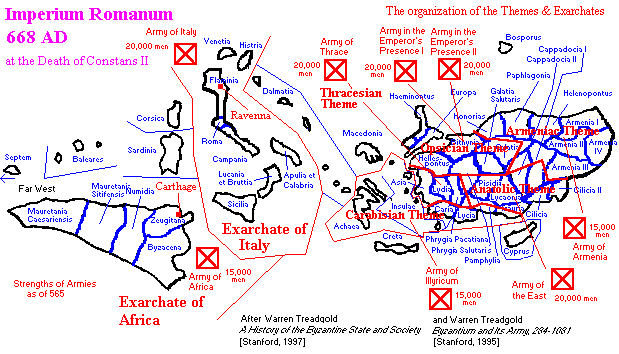
Roman troop deployments a few years before the Nicaea campaign.  By 727 the Exarchate of Africa had been captured by Muslim forces.


Invasion of 727 and the siege of Nicaea


In summer 727, another large-scale invasion was led by Mu'awiyah, with Abdallah al-Battal heading the vanguard of the army.  

The Byzantine chronicler Theophanes the Confessor claims that the vanguard alone numbered 15,000 men and the entire invasion force 100,000, clearly a grossly inflated number.

What is clear is this was a major invasion directed against The Opsician Theme, one of the most powerful themes in the Empire and located right next to Constantinople itself.  In the chart above the Roman troops near Constantinople could have been in the 40,000 man range.  Those Roman forces would have been divided among many cities to fend off Arab attacks.

The Arabs came prepared for battle with siege engines to knock down the walls of cities that opposed them.  It is fair to assume if the Arabs came to take cities then they would have brought enough troops to outnumber the Romans.  You do not lay siege to cities if the defenders outnumber you.  Call the size of the Arab army at no less than 40,000 men.   

The Arab army moved west into northwestern Asia Minor, and the vanguard under al-Battal attacked and sacked the town of Gangra in Paphlagonia and a place called in Arab sources Tabya (possibly the fort of Ateous in Phrygia). 

Gangra was razed to the ground, but during the attack on Tabya the Arabs, especially the Antiochene contingent, are said to have suffered heavy losses.


Arab Cavalry


Arab Mailed Archer

From there, the Arabs turned west towards Nicaea, the chief city of Bithynia and capital of the powerful Opsician Theme. 

The Arabs arrived before the city in late July, with al-Battal's vanguard preceding the main army. The Byzantines, probably under the command of the Count of the Opsicians, Artabasdos, did not meet them in the field, but instead retreated behind the city's walls.

The Arabs assaulted the city for forty days, employing siege engines which destroyed a part of the walls, but eventually failed to take it.  This one sentence summary is maddening, but historical records are few.  A 40 day siege was a major attack by any standards.  Also with part of the walls destroyed you know there was considerable hand-to-hand combat to keep the Arab infantry out of the city.  But again, we have no details, only our imagination.

In late August, they raised the siege and departed, taking along many captives and much booty. The 12th-century chronicle of Michael the Syrian claims that the city's inhabitants abandoned it and fled by ship through Lake Ascanius, whereupon the Arabs destroyed Nicaea, but this is clearly an error.

Aftermath

The repulsion of the Arab assault on Nicaea was an important success for the Byzantines. Emperor Leo III the Isaurian (r. 717–741) regarded the city's survival as a sign of divine favor towards his newly instituted iconoclastic policies, and was encouraged to drive them further. 

This is probably related to an incident mentioned in the account of Theophanes, where a certain Constantine, who served as a groom (strator) to Artabasdos, threw a stone on an icon of the Virgin Mary and then trampled on it. The soldier was killed the next day by a catapult, a fact which Theophanes reports as evidence of divine vengeance. However, this passage shows strong signs of tampering by the fervently anti-iconoclast Theophanes, from what was probably originally a pro-iconoclast story.
Militarily, the siege of Nicaea was the high-water-mark of the post-718 Umayyad raids. Never again would Umayyad armies penetrate as deeply into Asia Minor. 

Increasingly thereafter the Syro-Jaziran army, that provided the manpower for the raids against Byzantium, was diverted in the hard and fruitless wars against the Khazars in the Caucasus: the Khazars inflicted a heavy defeat on the Muslims in 730.  

A Byzantine–Khazar alliance was sealed by the marriage of Leo III's son and heir Constantine V (r. 741–775) with the Khazar princess Irene shortly after. 

Roman strength also revived as the Muslim military situation on all fronts of the over-extended Caliphate deteriorated. Consequently, in the 730s, Arab raids were mostly limited to the immediate frontier regions and their successes became fewer, until in 740 the Byzantines inflicted a heavy defeat against the largest invasion force assembled after 718 at the Battle of Akroinon.


Byzantine troops in the 7th Century.

1. Armored infantryman:


The 7th century was another period from which few illustrations survive. The best-equipped infantry appear to have had short-sleeved mail hauberks and remarkably large shields, plus spears and swords. This man's helmet is based upon one found in Central Europe which may be of Byzantine form. The addition of the mail aventail is hypothetical, reflecting a high degree of Turkish and specifically Avar influence. His sword is based upon an unusual Scandinavian form which is itself likely to reflect Byzantine origins. 

2. Armored cavalryman:

This trooper has been given a plumed cap over his helmet, as worn by warriors from Iran and the Caucasus. This could be the explanation for the otherwise extraordinary outlines of many helmets seen in 7th-9th century Byzantine art. Turkish and Avar influences can be seen on the belt, sword and bowcase, as shown by surviving fragments and pictorial sources.

3. Noble commander, late 7th century:

One remarkable and recently discovered fragment of wall painting sheds light on the costume of the 7th century Byzantine elite though not, unfortunately, on their military equipment. A long tunic with richly embroided claves and three-quarter sleeves was worn over a long-sleeved shirt, either with soft riding boots or, as here, with highly decorated shoes indicating high status. The practice of impaling the head and hands of a defeated rebel, presumably as a warning to others, seems to have been common in Byzantium at this time.


8th to 9th Centuries

The first defensive campaigns fought against the first Islamic armies took a certain form, with the imperial forces struggling to match the mobility and speed of the Arab raiders, who were able to deprave the Roman commanders of the initiative not simply by virtue of their fast-moving, hard-hitting tactics, but also because the type of warfare they practised made any notion of a regular front untenable.

The Arab Islamic conquests radically altered the strategic and political geography of the whole east Mediterranean region. The complete failure of attempts to meet and drive back the invaders in open battle induced a major shift in strategy whereby open confrontation with the Muslim armies were avoided. The comitatenses field armies were first withdrawn to north Syria and Mesopotamia, shortly thereafter back to the line of the Taurus and Anti-Taurus ranges.

By the mid-640s the armies which had operated in Syria, Mesopotamia and Palestine had been withdrawn into Anatolia. The regions across which they were based were determined by the ability of these districts to provide for the soldiers in terms of supplies and other requirements. The field forces thus came to be quartered across Asia Minor and Thrace, where they were referred to by the Greek term for these districts, themata or themes.

The themes were at first merely groupings of provinces across which different armies were based. By the latter 8th century some elements of fiscal as well as military administration were set up on a thematic basis, although the late Roman provinces continued to subsist.


City wall around Nicaea

Nicaea Northern city gate, 3 of the 4 gates survive, restricted to pedestrians.


Roman aqueducts used until the 1970s, this one is outside the eastern gate.


Ruins of the ancient Hagia Sophia, where the First Ecumenical Council met in Nicaea.


The Nicaea theater was supported by arches as the land was flat; note entrance for beasts.

Nicaea


One of Alexander the Great's generals founded the city in 316 BC, naming it Antigonela for himself. When taken by another general, it was named Nicaea for his wife. Nicaea became an important religious center following Constantine's edit of tolerance for Christianity in AD 313. The city has been important in the Roman, Byzantine, Seljuk, and Ottoman empires.

Located on the eastern shore of Lake Iznik, the city has long been a stopping place on the route between Constantinople and Anatolia. The area surrounding Nicaea is fertile with rich agriculture.
.
When controversy arose about the nature of Jesus Christ, Constantine called the first Ecumenical Council to Nicaea in AD 325 to settle the issue. All the bishops came, meeting for two months in the Senatus Palace, now submerged in Lake Iznik. The council affirmed Christ's divinity and established what is now known as the Nicene Creed. Nicaea hosted another Ecumenical Council in 787, that rejected iconoclasm, thus permitting the use of icons in worship. This second Nicaean council met in Hagia Sophia.

In 1075 the Seljuk commander Süleyman Sah I changed Nicaea's name to Iznik and made it his capital. Through the years, particularly in the 16th and 17th centuries, Iznik has been renown for tiles and ceramics that have greatly influenced decoration in mosques and palaces throughout Turkey. Described as the third 'holy city' after Jerusalem and the Vatican, the Second Vatican Council in 1962, declared Iznik a 'holy city' for Christians.


Siege of Nicaea (727)        Opsician Theme        Umayyad Caliphate