.

Dedicated to the military history and civilization of the Eastern Roman Empire (330 to 1453)


"Time in its irresistible and ceaseless flow carries along on its flood all created things and drowns them in the depths of obscurity."

- - - - Princess Anna Comnena (1083–1153) - Byzantine historian

Thursday, August 12, 2021

Battle of Myriokephalon - Seljuks vs Romans (1176AD)


Late Roman / Eastern Empire dart throwing infantry.
While uniforms and armor varied over the centuries the basics changed very little.


A Declining Roman Empire?

Maybe Not.


The Battle of Manzikert in 1071 has always been the point in time historians say marked the decline of the Eastern Roman Empire.

But is that true?

The Roman Republic and Empire had recovered again and again from military defeats. In this article we see over 100 years after Manzikert that the Roman Army was still able to mount major campaigns against the Turks in Anatolia, in the Balkans, in Italy and in Egypt. The Romans held their lands and even expanded.

In my view the "decline" of the Eastern Empire had a lot more to do with the treachery of the Crusaders in 1204 and their sack of Constantinople. The sack of the city happened only 28 years after this battle.

Background

Between 1158 and 1161 a series of Roman campaigns against the Seljuk Turks of the Sultanate of Rûm resulted in a treaty favorable to the Empire, with the Sultan recognizing a form of subordination to the Roman Emperor.

Immediately after peace was negotiated the Seljuk sultan Kilij Arslan II visited Constantinople where he was treated by Emperor Manuel I Komnenos as both an honored guest and an imperial vassal. Following the Sultan's visit there was no overt hostility between the two powers for many years.

BOTTOM LINE - The Turks badly wanted to expand over to the coast, but they took one look at the Roman Army and declined to take action.

The Romans took advantage of this peace to expand their power. 

Emperor Manuel I Komnenos pursued an energetic and ambitious foreign policy. In the process he made alliances with Pope Adrian IV and the resurgent West. He invaded the Norman Kingdom of Sicily, although unsuccessfully, He was the last Eastern Roman emperor to attempt reconquests in the western Mediterranean

In the East, the Emperor recovered Cilicia from local Armenian dynasts and managed to reduce the Crusader Principality of Antioch to vassal status.

The passage of the potentially dangerous Second Crusade through his empire was adroitly managed. Manuel established a Roman protectorate over the Crusader states. Facing Muslim advances in the Holy Land, he made common cause with the Kingdom of Jerusalem and participated in a combined invasion of Fatimid Egypt. Manuel reshaped the political maps of the Balkans and the eastern Mediterranean, placing the kingdoms of Hungary and Outremer under Roman hegemony.

While the Romans were rebuilding their power so were the Turks. 

Kilij Arslan used this peaceful period to destroy the Danishmend emirates of eastern Anatolia and also eject his brother Shahinshah from his lands near Ankara. Shahinshah, who was Manuel's vassal, and the Danishmend emirs fled to the protection of Rome. 

In 1175 the peace between the Empire and the Sultanate of Rûm fell apart when Kilij Arslan refused to hand over to the Romans, as he was obliged to do by treaty, a considerable proportion of the territory he had recently conquered from the Danishmends.

Both side moved to a new war.

Strengthening the Economy

Here is a good spot to review the growing power of the Romans.

Former money changer Michael IV the Paphlagonian (1034–41) assumed the throne in 1034 and began the slow process of debasing the gold coins

The debasement was gradual at first, but then accelerated rapidly. about 21 carats (87.5% pure) during the reign of Constantine IX (1042–1055), 18 carats (75%) under Constantine X (1059–1067), 16 carats (66.7%) under Romanus IV (1068–1071), 14 carats (58%) under Michael VII (1071–1078), 8 carats (33%) under Nicephorus III (1078–1081) and 0 to 8 carats during the first eleven years of the reign of Alexius I (1081–1118).

Under Alexius I Comnenus (1081–1118) the debased solidus (tetarteron and histamenon) was discontinued and new gold coinage of higher fineness (generally .900-.950) was established, commonly called the hyperpyron.

Income to the Roman Treasury is a vital measurement of the strength of the state.

The exact amount of annual income the Roman government received, is a matter of considerable debate, due to the scantiness and ambiguous nature of the primary sources. The following table contains approximate estimates.

YearAnnual Revenue
3059,400,000 solidi/42.3 tonnes of gold
4577,800,000 solidi
5188,500,000 solidi
5335,000,000 solidi
54011,300,000 solidi/50.85 tonnes of gold
5556,000,000 solidi
5658,500,000 solidi
6413,700,000 nomismata
6682,000,000 nomismata
7751,800,000 nomismata
7752,000,000 nomismata
8423,100,000 nomismata
8503,300,000 nomismata
9594,000,000 nomismata
10255,900,000 nomismata
11505,600,000 hyperpyra
13031,800,000 hyperpyra
13211,000,000 hyperpyra

Click to enlarge map
.
A map of the Roman Empire showing the location of Myriokephalon.


The Empire Was NOT in Decline

With 20-20 hindsight historians jump on the decline of the Empire side.

To me three factors show the Empire was not in decline: 

  1. The improved Roman political and military position in the Balkans and in the East; 
  2. The improved value of the nation's gold coins; 
  3. And the steady growth since 775 AD on (above chart) tax income to the treasury.

Yes there were problems, but when did problems not exist for any nation?

While not at a peak of power it is fair to say the Empire had recovered from Manzikert and was growing its power.


A Mamluk soldier by Carle Vernet, 1822.
Mamluk translated as "one who is owned", meaning "slave", is a term most commonly referring to non-Arab, ethnically diverse Muslim slave-soldiers and freed slaves to which were assigned military and administrative duties.


The Roman Army

All sources agree that the Emperor gathered an exceptionally large army to teach the Turks a lesson.

One historian puts Manuel's army at around 35,000 men. The number is derived from the fact that sources indicated a supply train of 3,000 wagons accompanied the army, which was enough to support 30,000–40,000 men.  

The army may have contained 25,000 Roman troops with the remainder composed of an allied contingent of Hungarians sent by Manuel's kinsman Béla III of Hungary and tributary forces supplied by the Principality of Antioch and Serbia.

The main division of the army consisted of the eastern and western Imperial Tagmata Regiments. The vanguard was mostly infantry with some cavalry units. The right wing was largely composed of Westerners led by Baldwin of Antioch (Manuel's brother-in-law). 

Then we have baggage and siege trains. The Roman left wing, led by Theodore Mavrozomes and John Kantakouzenos; then comes the Emperor and his picked troops; and finally the rear division under the experienced general Andronikos Kontostephanos.

The Seljuk Army

Modern historians have estimated that the various Seljuk successor states (such as the Sultanate of Rum) could field at most 10,000–15,000 Turks. 

This is likely a closer estimate for the possible Seljuk strength at Myriokephalon considering the much larger and united Seljuk Empire fielded around 20,000–30,000 men at the Battle of Manzikert in 1071. 

The Sultanate of Rum was much smaller territorially than the Seljuk Empire and probably had smaller armies, for example, its army at the Battle of Dorylaeum in 1097 has been estimated at between 6,000–8,000 men.

The Seljuk army consisted of two main sections: the askars of the sultan and of each of his emirs, and an irregular force of Turkoman tribesmen. The askari (Arabic for 'soldier') was a full-time soldier, often a mamluk, a type of slave-soldier though this form of nominal slavery was not servile. 

They were supported by payments in cash or though a semi-feudal system of grants, called iqta'. These troops formed the core of field armies and were medium to heavy cavalry; they were armored, and fought in coherent units with bow and lance. 

In contrast, the Turkoman tribesmen were semi-nomadic irregular horsemen, who served under their own chieftains. They lived off their herds and served the sultan on the promise of plunder, the ransom of prisoners, for one-off payments, or if their pasturelands were threatened. These tribesmen were unreliable as soldiers, but were numerous, and were effective as light mounted archers, adept at skirmish tactics.


The Battle - September 17, 1176

The Emperor assembled the full Imperial army and marched against the Seljuk capital of Iconium. Manuel's strategy was to prepare the advanced bases of Dorylaeum and Sublaeum, and then to use them to strike as quickly as possible at Iconium.

The battle took place near Lake Beyşehir.

Speed may have been the goal, but Manuel's army of 35,000 men was large and unwieldy. According to a letter that Manuel sent to King Henry II of England, the advancing column was ten miles long.

The Turks destroyed crops and poisoned water supplies to make Manuel's march more difficult. King Arslan harassed the Roman army in order to force it into the Meander valley, and specifically the mountain pass of Tzivritze near the fortress of Myriokephalon.

IMPORTANT - Just outside the entrance to the pass at Myriokephalon, Manuel was met by Turkish ambassadors, who offered peace on generous terms. The Sultan saw a Roman army perhaps three times the size of his own force and offered peace.

The mistake came from the Roman leadership. Most of Manuel's generals and experienced courtiers urged him to accept the offer. The younger and more aggressive members of the court urged Manuel to attack, however, and he took their advice and continued his advance into a narrow pass.

The lack of forage, and water for his troops, and the fact that dysentery had broken out in his army may have induced Manuel to decide to force the pass regardless of the danger of ambush.

Manuel made serious tactical errors, such as failing to properly scout out the route ahead. These failings caused him to lead his forces straight into a classic ambush.


Maria of Antioch with Emperor Manuel I Komnenos

In this matter the Emperor, at a minimum, acted foolishly to pass up a peace proposal and acted recklessly to march a 10 mile long army column into a narrow pass that was not properly scouted.

The Roman vanguard was the first to encounter King Arslan's troops. They went through the pass with few casualties, as did the main division. Possibly the Turks had not yet fully deployed in their positions.

The Roman divisions sent their infantry up onto the slopes to dislodge the Seljuk soldiers, who were forced to withdraw to higher ground. The following divisions did not take this precaution, also they were negligent in not maintaining a defensive formation of closed ranks and they did not deploy their archers effectively.

By the time the first two Roman divisions exited the far end of the pass, the rear was just about to enter; this allowed the Turks to close their trap on those divisions still within the pass.

The Turkish attack, descending from the heights, fell especially heavily on the Roman right wing. This division seems to have quickly lost cohesion and been broken, soldiers fleeing one ambush often running into another. Heavy casualties were sustained by the right-wing and its commander, Baldwin, was killed.

The Turks then concentrated their attacks on the baggage and siege trains, shooting down the draught animals and choking the roadway.

The left-wing division also suffered significant casualties and one of its leaders, John Kantakouzenos, was slain when fighting alone against a band of Seljuk soldiers.

The remaining Roman troops were panicked by the carnage in front of them and the realization that the Turks had also begun to attack their rear. The sudden descent of a blinding dust-storm did nothing to improve the morale or organization of the Roman forces, though it must have confused the Seljuk troops also.

At this point, Manuel seems to have suffered a crisis of confidence and reputedly sat down, passively awaiting his fate and that of his army.

The Emperor was eventually roused by his officers, re-established discipline and organized his forces into a defensive formation; when formed up, they pushed their way past the wreck of the baggage and out of the pass.

Debouching from the pass they rejoined the unscathed van and main divisions, commanded by John and Andronikos Angelos, Constantine Makrodoukas and Andronikos Lampardas. Whilst the rest of the army had been under attack in the pass the troops of the van and main divisions had constructed a fortified encampment. The rear division, under Andronikos Kontostephanos, arrived at the camp somewhat later than the emperor, having suffered few casualties.

The night was spent in successfully repulsing further attacks by Seljuk mounted archers. Niketas Choniates states that Manuel considered abandoning his troops but was shamed into staying by the scathing words of an anonymous soldier and the disapproval of a shocked Kontostephanos. However, this would appear to be hyperbole on the historian's part as Manuel would have placed himself in much greater danger by flight than if he remained in the midst of his army. 

The following day, the Turks circled the camp firing arrows; Manuel ordered two counterattacks, led by John Angelos and Constantine Makrodoukas respectively, but there was no renewal of a general action.


Eastern Empire reenactors. The headwear shows the 
influence of the Arabs they fought for centuries.

Outcome

The Roman siege equipment had been quickly destroyed, and Manuel was forced to withdraw – without siege engines, the conquest of Iconium was now impossible.

Both sides had suffered casualties, though their extent is difficult to quantify. Modern historians have postulated that about half of the Roman army was engaged and around half of those became casualties.

As the Roman army moved back through the pass after the battle it was seen that the dead had been scalped and their genitals mutilated, "It was said that the Turks took these measures so that the circumcised could not be distinguished from the uncircumcised and the victory therefore disputed and contested since many had fallen on both sides."

Also the Seljuk Sultan was keen for peace to be restored as soon as possible; he sent an envoy named Gabras, together with gifts of a Nisaean warhorse and a sword, to Manuel in order to negotiate a truce. As a result of these negotiations, the Roman army was to be allowed to retreat unmolested on condition that Manuel destroy his forts and evacuate the garrisons at Dorylaeum and Sublaeum in the Roman-Seljuk borderlands.

However, despite Kilij Arslan's protestations of good faith, the retreat of the Roman army was harassed by the attacks of Turkoman tribesmen. This, taken with an earlier failure by the sultan to keep his side of a treaty signed in 1162, gave Manuel an excuse to avoid observing the terms of this new arrangement in their entirety. He therefore demolished the fortifications of the less important fortress of Sublaeum but left Dorylaeum intact.

The defeat at Myriokephalon has often been depicted as a catastrophe in which the entire Roman army was destroyed. Manuel himself compared the defeat to Manzikert.

In reality, although a defeat, it was not too costly and did not significantly diminish the Roman army. Most of the casualties were borne by the right wing, largely composed of allied troops commanded by Baldwin of Antioch, and also by the baggage train, which was the main target of the Turkish ambush.

In a message to Constantinople the Emperor: "Then extolled the treaties made with the sultan, boasting that these had been concluded beneath his own banner which had waved in the wind in view of the enemy's front line so that trembling and fear fell upon them." 

It is notable that it was the sultan who initiated peace proposals by sending an envoy to Manuel and not the reverse. The conclusion that Kilij Arslan, though negotiating from a position of strength, did not consider that his forces were capable of destroying the Roman army is inescapable. A possible reason for Kilij Arslan's reluctance to renew the battle is that a large proportion of his irregular troops may have been far more interested in securing the plunder they had taken than in continuing the fight, thus leaving his army seriously weakened.

The limited losses inflicted on native Roman troops were quickly recovered, and in the following year Manuel's forces defeated a force of "picked Turks". John Komnenos Vatatzes, who was sent by the Emperor to repel the Turkish invasion, not only brought troops from the capital but also was able to gather an army along the way. Vatatzes caught the Turks in an ambush as they were crossing the Meander River; the subsequent Battle of Hyelion and Leimocheir effectively destroyed them as a fighting force. 

This is an indication that the Roman army remained strong and that the defensive program of western Asia Minor was still successful. After the victory on the Meander, Manuel himself advanced with a small army to drive the Turks from Panasium, south of Cotyaeum.

Manuel continued to meet the Seljuks in smaller battles with some success, and concluded a probably advantageous peace with Kilij Arslan in 1179. However, like Manzikert, Myriokephalon was a pivotal event and following it the balance between the two powers in Anatolia gradually began to shift, and subsequently, the Eastern Empire was unable to compete for dominance of the Anatolian interior.


This image by Gustave Doré shows the Turkish ambush at the pass of Myriokephalon. This ambush destroyed Manuel's hope of capturing Konya.


Click to enlarge map


(Manuel I Komnenos)    (Byzantine economy)    (Byzantine coinage)

(Myriokephalon)    (Mamluk)


Read More:
.


Monday, July 19, 2021

Gold Coin Hoard Pinpoints Persian Destruction of Jerusalem


Photo 3. One of the Heraclius gold solidi from the Givati parking lot. Photo by Clara Amit of the IAA.


"The use of coins welds together our whole life, and is the basis of all our transactions. Whenever anything is to be bought or sold, we do it all through coins."
John Chrysostom
Archbishop of Constantinople


(Coin Week)  If a hoard of 264 Byzantine gold solidi suddenly appeared and careful examination showed that every coin in the hoard was struck from the SAME dies–a die set never before identified–experts would be quick to suggest the possibility of forgery. (Photo 1)

Photo 1: The Givati parking lot gold hoard in situ. Photo Israel Antiquities Authority (IAA).

Real life, however, can be stranger than fiction.

One of the great numismatic stories of the last 50 years revolves around just such a hoard of coins that was excavated a dozen years ago at the Givati parking lot in Jerusalem. The lot is just outside of the Old City’s Dung Gate, on the north-western side of the City of David excavations. The latest report on this hoard was published in an article by my long-time friend Gabriella Bijovsky, a senior numismatist at the Israel Antiquity Authority. (IAA Reports 66, 2020, Chapter 5, “A Hoard of Solidi of Heraclius.”)

The coins were found in the remains of a large Byzantine building. Their location within the building suggested that they “were originally arranged in rows, and were most likely wrapped in a cloth or in a purse, which was not preserved. The excavators suggest that the coins were stored on a shelf…”

At the time these coins were discovered, they received quite a lot of publicity. But the story behind the story, which is quite remarkable, is summarized by Bijovsky, who was responsible for studying the coins.

There were 264 gold solidi with the portrait of Heraclius in the Givati hoard. Heraclius ruled the East Roman Empire from 610 to 641 CE. None of the coins are clipped, carry graffiti, or have any other significant signs of use. At first look, the coins all appear to be from the early Heraclius solidi series struck from 610 through 613. In fact, however, they are more likely part of an emergency issue struck at a Jerusalem mint, Bijovsky explains. (Photo 2)


Photo 2. The Givati hoard after cleaning at the laboratories of the Israel Antiquities Authority. Photo by Clara Amit of the IAA.

The Givati hoard coins are an unpublished variant of the 610-613 series. The obverse legend is dNAERACLI-ЧS. PP AVC• with an A instead of the usual h and a small dot after the “S” of Heraclius.

“The last letter C of the obverse legend is inclined and is followed by a small dot to its right. A short, curved stroke of dots is visible on the upper left side of the emperor’s crown. The reverse inscription ends with the letter Δ, unknown in the original series (Grierson 1959:145), and a tiny star is attached to the exergue inscription: CONOB*.” (Photo 3)

Bijovsky concludes that all of the coins were produced by the same pair of dies. The gold content of 41 of the solidi was studied using X-ray fluorescence (XRF) at the Weitzman Institute of Science. “The results showed a uniform composition deviation, clearly indicating that all the coins were produced from the same load of gold.” Hence, the minting process for this group was “a single event.”

On first glance, Bijovsky explains, “the mintmark, fabric, and style of these coins seem to suggest that this series was issued by the imperial mint of Constantinople. Indeed, the style of the bust die appears standard to this mint and is even better executed than many other official dies of the same general type.”

In the late Roman period, coins were minted in a number of cities, mainly because of the danger and cost of moving large quantities of precious metal from place to place. This system was inherited by Byzantium, and in the 6th century there were six mints in the Eastern Empire (Constantinople, Nicomedia, Cyzicus, Antioch [Theoupolis], Alexandria and Thessalonica) and three in the Western provinces that Justinian had reconquered from the Vandals and the Ostrogoths (Carthage, Rome and Ravenna).

Gold coins were minted mainly in the capital and consequently have the mint mark CON (for Constantinople), with OB added on the solidi to show that they were minted of pure gold.


“On the other hand, the obverse inscription of our solidi showing the name AERACLIVS seems to be a misspelling based on Latin phonetics. Is this an indication about the origin of the die engraver? Still, it seems very improbable that a state official in Constantinople would write incorrectly the name of the emperor on a gold coin,” Bijovsky says. Thus, these coins are more likely a ‘provincial’ issue.

Even though all of the Givati hoard solidi coins appear to be uncirculated, there is an unusual variance of the standard weight (4.55 g for the Byzantine solidus during this period) from as light as 3.97 g to 4.69 g.

“It is hard to believe that the official mint of Constantinople would have tolerated imperial solidi being officially struck without control of an accurate weight standard,” Bijovsky writes. She also asks, “Who would be interested in striking gold coins that contain more precious metal than required by the standard?”

Bijovsky further cites Michael Hendy, and points out that “hoards characterized by heavy concentrations of coins struck from the same pair, or from a limited number of dies, or that contain coins from a single officina, ‘probably tend to have derived at no great distance from bodies of coins dispatched from the mint in purses.’”

The Givati hoard is singularly homogeneous, and Bijovsky concludes that “during this time (608-615 CE), and especially after the capture of Antioch by the Persians in 611 and until 613, the presence of a Byzantine military garrison in Jerusalem could explain the operation of a temporary mint in order to pay the troops and emphasize Byzantine sovereignty over the city… Given the fact that all Antioch surrendered to the Persians in 610, Emesa and Apamea in 611, and Damascus in 613, Jerusalem remained the only major Byzantine stronghold in the region capable of coin production.”

Archaeological remains associated with the Persian conquest are quite sparse in Jerusalem. The archaeologists believe that the Givati hoard is correctly identified as an ‘emergency’ hoard that was “concealed during times of imminent danger, siege, or war. These hoards usually reflect the coinage in current circulation at the time of their deposition.”

This hoard is all the more remarkable because it “proves the need for an emergency coinage, a new series of Heraclian solidi which has been exceptionally struck in Jerusalem under hasty conditions… the combination of both numismatic features and historical circumstances provides solid evidence for the existence of a temporary mint in Jerusalem that functioned during the first years of the reign of Heraclius.”

The Givati parking lot excavations “have shed new light upon Jerusalem at the close of the Byzantine period. The Persian conquest of Palestine in 614 CE, one of the dramatic events that mark the ‘beginning of the end’ of the Byzantine domination in Palestine in the early seventh century seems to be well reflected in the archaeological record at this site,” Bijovsky explains.

Before the discovery of the Givati coin hoard, there were very few coin finds in Jerusalem from during the time of the Persian conquest. Seven mass burials have been discovered around Jerusalem and are generally believed to be from the Persian devastation of the city in 614. According to historic sources, the Persian conquest cost many lives and caused great damage. The conquest and the subsequent 14 Sassanid rulers left few other significant remains. It appears that the large Byzantine building in the Givati parking lot was deliberately destroyed during the Persian invasion of Jerusalem and, unlike the city’s other damaged but surviving buildings, including churches, it was never rebuilt or repaired.

Summing up, Bijovsky notes that “the Givati hoard presents several features that tell us quite explicitly the story of its concealment. The uniform date and the character of the hoard reveal that it was an ‘emergency hoard’ concealed at a time of imminent danger, siege, or war. Such hoards usually reflect the coinage in circulation at the time of their deposition.”

(Coinweek.com)

Gold solidus of Romanos I with his eldest son, Christopher Lekapenos.  Romanos I Lekapenoswas an Armenian who became a Roman naval commander and reigned as Emperor from 920 until his deposition on December 16, 944.
.
Read More:


Sunday, July 4, 2021

Column of Phocas


The Column of Phocas is a Roman monumental column in the Roman Forum of RomeItaly, built when Rome was part of the Eastern Roman Empire after reconquest from the Kingdom of the Ostrogoths

Erected in front of the Rostra and dedicated or rededicated in honour of the Eastern Roman Emperor Phocas on August 1, 608 AD, it was the last addition made to the Forum Romanum. The fluted Corinthian column stands 13.6 m (44 ft) tall on its cubical white marble socle. On stylistic grounds, the column seems to have been made in the 2nd century for an unknown structure, and then recycled for the present monument. Likewise, the socle was recycled from its original use supporting a statue dedicated to Diocletian; the former inscription was chiselled away to provide a space for the later text.

The base of the column was uncovered in 1813, and the inscription is in Latin. The English translation is as follows:

  • To the best, most clement and pious ruler, our lord Phocas the perpetual emperor, crowned by God, the forever august triumphator, did Smaragdus, former praepositus sacri palatii and patricius and Exarch of Italy, devoted to His Clemency for the innumerable benefactions of His Piousness and for the peace acquired for Italy and its freedom preserved, this statue of His Majesty, blinking from the splendor of gold here on this tallest column for his eternal glory erect and dedicate, on the first day of the month of August, in the eleventh indiction in the fifth year after the consulate of His Piousness.

The precise occasion for this signal honour is unknown, though Phocas had formally donated the Pantheon to Pope Boniface IV, who rededicated it to all the martyrs and Mary (Sancta Maria ad Martyres). 

Atop the column's capital was erected by Smaragdus, the Exarch of Ravenna, a "dazzling" gilded statue of Phocas (which probably only briefly stood there). 

Rather than a demonstration to mark papal gratitude as it is sometimes casually declared to be, the gilded statue on its column was more likely an emblem of the imperial sovereignty over Rome, which was rapidly fading under pressure from the Lombards, and a personal mark of gratitude from Smaragdus, who had been recalled by Phocas from a long exile and was indebted to the Emperor for retrieving his position of power at Ravenna.

In October 610, Phocas was overthrown and killed; his statues everywhere were overthrown.


Gold solidus of Heraclius and his father in consular robes, struck during their revolt against Phocas.


Revolt against Phocas and Accession

The Emperor Maurice was murdered by Phocas at the harbor of Eutropius on 27 November 602. The deposed emperor was forced to watch his five younger sons executed before he was beheaded himself. 

Empress Constantina and her three daughters were temporarily spared and sent to a monastery. The palace eunuch Scholasticus aided their escape to St. Sophia, but the church turned them over to Phocas, who sent them back to the monastery. A few years later, they were all executed at the harbor of Eutropius when Constantina was found guilty of a conspiracy against Phocas.

Phocas was widely regarded as an incompetent leader, by both much of the ruling class and army.

In 608, Heraclius the Elder renounced his loyalty to the Emperor Phocas, who had overthrown Maurice six years earlier. The rebels issued coins showing both Heraclii dressed as consuls, though neither of them explicitly claimed the imperial title at this time.

Heraclius the Elder, the Exarch of Carthage, began to prepare to invade, by cutting off the supply of grain to Constantinople and assembling a large army and navy.

Heraclius's younger cousin Nicetas launched an overland invasion from Carthage into Egypt; by 609, he had defeated Phocas's general Bonosus and secured the province. Meanwhile, the younger Heraclius sailed eastward with another force via Sicily and Cyprus.

As he approached Constantinople, he made contact with prominent leaders and planned an attack to overthrow aristocrats in the city, and soon arranged a ceremony where he was crowned and acclaimed as Emperor. 

When he reached the capital, the Excubitors, an elite Imperial Guard unit led by Phocas's son-in-law Priscus, deserted to Heraclius, and he entered the city without serious resistance. 

When Heraclius captured Phocas, he asked him "Is this how you have ruled, wretch?" Phocas's reply—"And will you rule better?"—so enraged Heraclius that he beheaded Phocas on the spot. 

He later had the genitalia removed from the body because Phocas had raped the wife of Photius, a powerful politician in the city.


Column of Phocas

Exarchate of Ravenna


Sunday, June 6, 2021

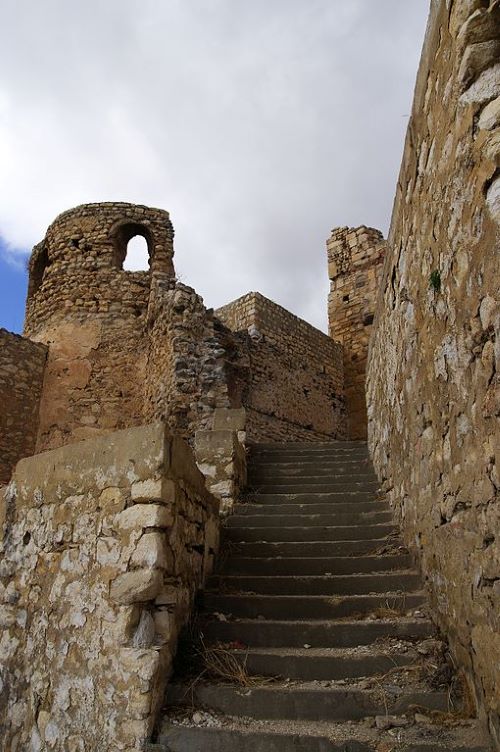
The African Roman Fortress of Vaga


Vaga
Defending Roman North Africa


VagaVecca or Theodorias is an ancient city in Tunisia built by the Berbers and ruled sequentially by the Carthaginians, the Numidians, the Romans, the Vandals and the Byzantines until it was captured by the Arabs who changed its name to the present day Béja. The town was the capital of the Numidian Kingdom during the rule of Jugurtha.

The Vaga fortress was built in the 2nd century BC and still exists till today which makes it one of oldest citadels in the region.

The fortress was built on the top of a hill of 305 meters, and this site was chosen so the castle can overlook the city and its surrounding plains and countryside.

Little is known about the date of the foundation of Vaga, but it's sure that it was before the foundation of Carthage.

In 14 BC, the Romans demolished the old Carthaginian citadel and built a new one on the ruins of the previous and built also fortifications with walls and 22 towers. 

The Romans erected many other monuments which some of them still exist today. And in 105 BC under the rule the Emperor Trajan, the Romans began the building of the bridge near Vaga, the constructions lasted nearly 25 years and event ended only under the reign of Emperor Hadrian and which become known as the Trajan bridge.

Vaga, still flourishing, was promoted by Emperor Septimius Severus to the rank of Roman colonia under the name of Colonia Septimia Vaga. The city continues its prosperity for nearly two centuries till the Vandal invasion of Africa.

The Vandals in 429 and under the leadership of Genseric stormed the Roman province of Africa and made it in 435 as their new kingdom, in their route they destroyed several cities, within them Vaga which was devastated. In 442, the Western Roman Emperor Valentinian III made peace with the Vandals giving them the land between the sea and the three cities of ThevesteSicca Veneria and Vaga. And in 448 Genseric destroyed the fortifications of the city and dismantled its castle.


The Roman Fortress of Vaga

Rule By The Eastern Roman Empire

In 533, has the Eastern Roman Emperor Justinian I restored Africa as a Roman province and put an end to the Vandalic rule, and with that Vaga became a flourishing town again, as the Emperor charged the Count Paulus to leads the works to restore the fortress of the city back. 

But the Emperor didn't only rebuilt the castle, but he also rebuilt the entire city which was ruined by the Vandal rule, and he enlarged, embellished and repopulate the city like it was before, and to be grateful for his actions, the townspeople had renamed their city after the Empress Theodora, Theodorias.

Because of the endless wars and incursions by the Moors Justinian ordered the building of a chain of forts along the frontier. 

Behind this first line was a second barrier of larger towns and stronger garrisons. Watchmen on the first line used signal fires to alert the larger towns of barbarian invasions for locals could seek refuge inside the walled cities.   Vaga was part of this system.

With the Muslim conquest of north Africa the new rulers of the country gave fortress the name "Kasbah" and made it the official center of their representatives of the northern-region.

The Ottomans too contributed to the expansion of the citadel by establishing a flanking tower that protected the southern parts of the Kasbah and Janissary garrison, and in 1677 the Tunisian monarch Ali I Bey supported the garrison by a battalion of 500 Spahis.

After the French occupation of Tunisia in 1881, the Kasbah become a Gendarmerie barracks from September 21, 1888 till the independence of the country in 1957.


Vaga was one of many North African fortifications that protected coastal Roman cities from desert raiders. A number of the forts were built by the Patrician Solomon.

Byzacena was a Late Roman province in the central part of Roman North Africa, which is now roughly Tunisia, split off from Africa Proconsularis. Vaga is located to the left of Carthage.


By Procopius    
The Buildings of Justinian
Written in the 550s AD


These things, then, were done by Justinian at modern Carthage. In the surrounding region, which is called Proconsularis, there was an unwalled city, Vaga by name, which could be captured not only by a planned attack of the barbarians, but even if they merely chanced to be passing that way.  This place the Emperor Justinian surrounded with very strong defenses and made it worthy to be called a city, and capable of affording safe protection to its inhabitants.  And they, having received this favour, now call the city Theodorias in honour of the Empress.  He also built in this district a fortress which they call Tucca. 

In Byzacium there is a city on the coast, Adramytus by name, which has been large and flourishing from ancient times, and for this reason it won the name and rank of metropolis of the region, since it chances to be first in point of size and, in general, of prosperity.

The Vandals had torn the circuit-wall of this city down to the ground, so that the Romans might not be able to use it against them. And it lay conveniently exposed to the Moors when they overran that region.  Nevertheless, the Libyans who lived there tried to make provision, so far as they could, for their own safety, and so they made a barricade out of the ruins of the walls and joined their houses together;  and from these they would fight against their assailants and try to defend themselves, though their hope was slight and their position precarious.  So their safety always hung by a hair and they were kept standing on one leg, being exposed to the attacks of the Moors and to the neglect of the Vandals.

However, when the Emperor Justinian became master of Libya by conquest, he put an exceedingly massive wall about the city and stationed there an adequate garrison of troops, thus giving the inhabitants assurance of safety and enabling them to disdain all enemies.  For this reason they now call the place Justinianê, thus repaying the Emperor for their deliverance and displaying their gratitude simply by the adoption of the name, since they had no other means by which they could requite the Emperor's beneficence, nor did he himself wish other requital. 

(Kasbah)     (Vaga)

Friday, May 7, 2021

Byzantine Land Mines


Now That is Going To Hurt


The "landmine" called a caltrop is an area denial weapon made up of two or more sharp nails or spines arranged in such a manner that one of them always points upward from a stable base. Historically, caltrops were part of defenses that served to slow the advance of troops, especially horseschariots, and war elephants and were particularly effective against the soft feet of camels.

In Roman Republic warfare the caltrop was being used against enemy war elephants as early as 279BC in the Battle of Asculum.

Archaeological excavations around Alesia show the use of caltrops by Caesar's legions. 

The late Roman writer Vegetius, referring in his work De re militari to scythed chariots, wrote:

The armed chariots used in war by Antiochus and Mithridates at first terrified the Romans, but they afterwards made a jest of them. As a chariot of this sort does not always meet with plain and level ground, the least obstruction stops it. And if one of the horses be either killed or wounded, it falls into the enemy's hands. The Roman soldiers rendered them useless chiefly by the following contrivance: at the instant the engagement began, they strewed the field of battle with caltrops, and the horses that drew the chariots, running full speed on them, were infallibly destroyed. A caltrop is a device composed of four spikes or points arranged so that in whatever manner it is thrown on the ground, it rests on three and presents the fourth upright.

A Roman historian mentions their use against Persian cavalry in the 5th century. 

In the 6th century the Roman historian Procopius tells how the general Belisarius used caltrops to defend open gates during the siege of Rome.

As cavalry rose in importance the use of caltrops gained in importance to hamper an enemy cavalry attack or to restrict movement.

In an anonymous 6th century Roman treatise caltrops are presented as a full-fledged war stratagem.

He said the caltrops should be used to protect the Roman fortified camp. The caltrops would be laid along the ditch some 12.5 meters in length. The commander of each unit would be responsible to gather them for their re-use and to prevent them from injuring their own troops when they leave camp.

Rear guard soldiers were told to have a supply of caltrops available to delay or wound any enemy in pursuit.


In the Emperor Maurice's war manual the Strategikon, the caltrop is also shown to protect the camp as well as for use on the battlefield. A light wagon was assigned to Roman units with "caltrops tied together with light cords attached to an iron peg so they can be easily collected." If attacked from the rear the caltrops can be thrown from the wagon into the path of an enemy.

When part of the army is forced to leave the main force they are told to bring caltrops along.

Maurice called for a "minefield of calthrops" on the battlefield. Unobserved by the enemy, Roman troops were to spread calthrops along the entire field of battle 100 feet deep. In four or five places there would be 300 foot wide gaps that would allow Roman troops to go and return unhurt. These passages would be market with tree branches or piles of stone. If an enemy was enticed into this minefield they would be confused and more easily destroyed.

The Taktika of Emperor Leo VI written in the 9th and 10th centuries reaffirms the use of calthrops. Almost word for word Leo repeats Maurice's writings on calthrop use in camps or the battlefield.

Leo is original in urging calthrops be thrown on to the decks of enemy ships to hamper the movement of the crews.

In the 10th century work by Heron of Byzantium he suggested wooden soled shoes to protect the infantry and farm rakes to clear a path of calthrops.

In 1082 Emperor Alexios Komnenos used fields of calthrops against Norman cavalry in the Balkans - - - - but the Normans avoided the calthrops by flanking the Roman line.

From the Alexiad: "There he [Alexios I Komnenos] assembled his regiments and mercenaries again and started on his march against Bohemund, with a new device in his head for overcoming the Franks. For he prepared iron caltrops, and on the eve of the day on which he expected a battle, he had them spread over the intermediate part of the plain, where he guessed the Frankish cavalry would make their fiercest onslaught, thus aiming to break the first irresistible attack of the Latins by piercing the feet of their horses." 

But nothing lasts forever.

At the end the Empire's population was exhausted, their wealth was spent, their economy was shattered and perhaps worst of all they were mostly alienated from Western Europe who had come to their aid in the previous centuries. 

A few competent rulers in a row would have helped them more than caltrops or maybe just a few competent diplomats.


(Caltrop)    (BYZANTINE LANDMINE)