 |
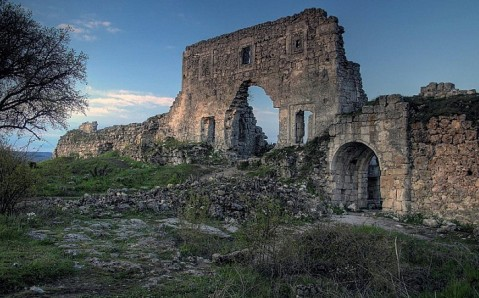
Mangup Kale - Byzantine Fortress in the Crimea and is
located on a plateau about 9 miles due east of Sevastopol (ancient Chersones).
|
The Roman Theme System
In Rome the province was the basic and largest territorial and administrative unit of the empire's territorial possessions outside of Italy. Provinces were generally governed by politicians of senatorial rank, usually former consuls or former praetors.
In the late empire the provinces were grouped originally into twelve dioceses, headed usually by a vicarius, who oversaw their affairs. Only the proconsuls and the urban prefect of Rome (and later Constantinople) were exempt from this, and were directly subordinated to the tetrarchs.

Justinian I made the next great changes in 534–536 by abolishing, in some provinces, the strict separation of civil and military authority that Diocletian had established. This process was continued on a larger scale with the creation of extraordinary Exarchates in the 580s.
In the late empire the provinces were grouped originally into twelve dioceses, headed usually by a vicarius, who oversaw their affairs. Only the proconsuls and the urban prefect of Rome (and later Constantinople) were exempt from this, and were directly subordinated to the tetrarchs.
Justinian I made the next great changes in 534–536 by abolishing, in some provinces, the strict separation of civil and military authority that Diocletian had established. This process was continued on a larger scale with the creation of extraordinary Exarchates in the 580s.
The themes or themata were the main administrative divisions of the middle Byzantine Empire. They were established in the mid-7th century in the aftermath of the Muslim conquests of parts of Byzantine territory.
In most of the Empire, the old system continued to function until the 640s, when the eastern part of the Empire collapsed under the onslaught of the Muslim Caliphate. The rapid Muslim conquest of Syria and Egypt and consequent Byzantine losses in manpower and territory meant that the Empire found itself struggling for survival.
In order to respond to this unprecedented crisis, the Empire was drastically reorganized. The remaining imperial territory in Asia Minor was divided into four large themes, and although some elements of the earlier civil administration survived, they were subordinated to the governing general or stratēgos.
The traditional view holds that the establishment of the themes meant the creation of a new type of army. Instead of the old force, heavily reliant on foreign mercenaries, the new Byzantine army was mostly based on native farmer-soldiers living on state-leased military estates.
A theme was an arrangement of plots of land given for farming to the soldiers. The soldiers were still technically a military unit, under the command of a strategos, and they did not own the land they worked as it was still controlled by the state. Therefore, for its use the soldiers' pay was reduced.
By accepting this proposition, the participants agreed that their descendants would also serve in the military and work in a theme, thus simultaneously reducing the need for unpopular conscription as well as cheaply maintaining the military. It also allowed for the settling of conquered lands, as there was always a substantial addition made to public lands during a conquest.
The Theme of Cherson
Formally called the Klimata, Cherson was a Byzantine theme (a military-civilian province) located in the southern Crimea, headquartered at Cherson.
Formally called the Klimata, Cherson was a Byzantine theme (a military-civilian province) located in the southern Crimea, headquartered at Cherson.
The theme was officially established in the early 830s and was an important centre of Black Sea commerce. Despite the destruction of the city of Cherson in the 980s, the theme recovered and prospered, enduring until it became a part of the Empire of Trebizond after the dissolution of the Byzantine Empire in 1204.
 |
| Crimea in the "Regnum Bosporanum" during Roman Emperor Trajan's conquests (98 to 117 AD). |
Greek and Roman Crimea
Greek city-states began establishing colonies along the Black Sea coast of Crimea in the 7th or 6th century BC. In the 5th century BC, Dorians from Heraclea Pontica founded the sea port of Chersonesos (in modern Sevastopol).
During the AD 1st, 2nd and 3rd centuries, Taurica was host to Roman legions and colonists in Charax, Crimea. The Charax colony was founded under Vespasian with the intention of protecting Chersonesos and other Bosporean trade emporiums from the Scythians.
The Roman colony was protected by a vexillatio of the Legio I Italica; it also hosted a detachment of the Legio XI Claudia at the end of the 2nd century. The camp was abandoned by the Romans in the mid-3rd century. This de facto province would have been controlled by the legatus of one of the Legions stationed in Charax.
 |
| Military Theme of Cherson in Crimea In order to implement its policy in the northern Black Sea, Byzantium relied on maintaining control over Cherson and other regions along the southeastern coast of the Crimea, from which it kept an eye on developments and moves by potential enemies in the steppe of south Russia. Therefore, the Crimea was the key in a Byzantine early-warning system on the empire’s northern frontier. |
Byzantine Crimea
In the 6th century the Eastern Roman Empire again took control of the region under Justinian I.
In the 6th century, probably at the end of the reign of Justinian I, the status of Roman Crimea changed. Taurica became the Province of Chersonesos, which also included Bosporos and the southern coast of Crimea.
This enlargement of Byzantine Taurica resulted in the elevation of the ranks of its governors. In the second half of the 6th century, the military and civil authorities in the region were entrusted to the military deputy, "doux Chersonos".
The city of Chersonnesos was used by the Romans as a place of banishment: St. Clement of Rome was exiled there and first preached to Gospel. Another exile was Justinian II, who is said to have destroyed the city in revenge.
Most of Roman Crimea fell under Khazar overlordship in the late 7th century.
 |
| Emperor Theophilus, in the Chronicle of John Skylitzes. Theophilus reestablished Roman rule in Crimea. |
Byzantine authority was re-established by Emperor Theophilos (r. 829–842), who displayed interest in the northern littoral of the Black Sea and especially his relations with the Khazars.
Petronas Kamateros is credited as the theme's first governor (strategos) in 840/1. The new province was at first called ta Klimata, "the regions/districts", but due to the prominence of the capital Cherson, by ca. 860 it was known even in official documents as the "Theme of Cherson".
The province played an important role in Byzantine relations with the Khazars and later, after the Khazar Khaganate's collapse, with the Pechenegs and the Rus'. It was a center for Byzantine diplomacy rather than military activity, since the military establishment in the theme seems to have been small and to have chiefly consisted of a locally-raised militia. Its weakness is underlined by the stipulation, in the Byzantine treaties with the Rus' of 945 and 971, of the latter's undertaking to defend it against the Volga Bulgars.
Cherson prospered greatly during the 9th–11th centuries as a centre of Black Sea commerce, despite the city's destruction by Vladimir of Kiev in 988/9. The city recovered quickly: the city's fortifications were restored and extended to the harbour in the early 11th century. At the same time, possibly after the defeat of Georgius Tzul in 1016, the theme was extended over the eastern Crimea as well, as evidenced by the styling of a certain Leo Aliates as "strategos of Cherson and Sougdaia" in 1059. The region however was lost again in the late 11th century to the Cumans. Almost nothing is known of Cherson in the 12th century, pointing to a rather tranquil period.
Cherson and its province remained under Byzantine control until the dissolution of the Empire by the Fourth Crusade in 1204, when they passed under the sovereignty of the breakaway Empire of Trebizond (see Perateia).
Later in 1204, Constantinople fell to the Fourth Crusade and Cherson passed to the Byzantine successor state of Trebizond. But Cherson was allowed to become more and more distant from Byzantium because of Turkish pirates and the long distance of the sea. The other threat to the rule of Byzantium in the Crimea was the Genoese who rapidly began to take over the Crimea for their own commercial interests.
By the middle of fourteenth century, almost all the peninsula was in Genoese hands. However Cherson's death blow didn't come from these traders, but from the barbarians the city had always fought against in the form of the armies of the Golden Horde who finally took the city in 1399 and completely destroyed it to the point that it was never again resettled. All that remains of this venerable city is a few ruins in the suburbs of the modern city of Sevastopol.
Theme Administration
The Theme of Cherson appears to have been organized in typical fashion, with the full array of thematic officials, of whom a tourmarches of Gothia is known at the turn of the 11th century, as well as the ubiquitous fiscal and customs officials known as kommerkiarioi.
The cities of the theme, however, appear to have retained considerable autonomy in their own government, as exemplified by Cherson itself, which was administered by the local magnates (archontes) under a proteuon ("the first").
Cherson also retained the right to issue its own coins, having resumed minting under Emperor Michael III (r. 842–867), and was for a long time the only provincial mint outside Constantinople. Its autonomy is also evidenced by the fact that the imperial government paid annual subsidies (pakta) to the city leaders in the fashion of allied rulers, and in the advice of Emperor Constantine Porphyrogennetos (r. 913–959) in his De Administrando Imperio to the local strategos concerning the possibility of a revolt in the city: he was to cease payment of the subsidies and relocate to some other city in the theme. In the late 11th century, the theme was governed by a katepano.
 |
| Cherson and its province remained under Byzantine control until the dissolution of the Empire by the Fourth Crusade in 1204, when they passed under the sovereignty of the breakaway Empire of Trebizond. |
.
(Themes) (Roman provinces) (History of Crimea)
(Roman Crimea) (Cherson) (blacksea.ehw.gr)
(Xenophon-mil.org) (Roman and Byzantine Crimea)
(Chersonesus)


