.

Dedicated to the military history and civilization of the Eastern Roman Empire (330 to 1453)


"Time in its irresistible and ceaseless flow carries along on its flood all created things and drowns them in the depths of obscurity."

- - - - Princess Anna Comnena (1083–1153) - Byzantine historian

Showing posts with label Europe. Show all posts

Monday, January 9, 2023

Defender Of A Byzantine Fort Was Decapitated By The Ottomans


(Forbes)  On the acropolis of ancient Abdera in western Thrace, within the fortress of Polystylon, archaeologists discovered a cemetery dating to the final throes of the battle between local Byzantine occupants and invading Ottoman Turks. A single decapitated skull found in the center of the burials may be evidence of the last human trophy head, removed from a defender of the fort.

In the early 1380s, residents of Polystylon made a stand against the Ottoman Turks encroaching upon their family land. It was the last Byzantine stronghold that the Ottomans vanquished along the shores of western Thrace, after all its neighbors fell to the Turks. 

During the final occupation of Polystylon, a large number of people perished and were buried inside the walls. About two-thirds were kids between the ages of 4 and 11, and almost all the rest were adult men. Although DNA work has not yet been completed, skeletal and dental variations on the bones show biological kinship. One sole female skeleton has been found in the Late Byzantine cemetery at Abdera, due either to the evacuation of women prior to the commencement of fighting or to their capture and removal during warfare.

The cemetery within the fortification walls of Polystylon was discovered in 1991 and contained at least 20 graves, all of which were studied by Anagnostis Agelarakis, a bioarchaeologist at Adelphi University. One particular grave, that of a young child, was found nearly dead center in the cemetery. Rows of nails were all that remained of a simple wooden coffin. The child wore bronze beads that likely formed a bracelet around the left wrist and had every indication of healthy teeth and a good quality diet. Also found next to the child was a single human head, that of a middle-aged adult male.


 PHOTO COURTESY A. AGELARAKIS / ADELPHI UNIVERSITY


"In my 30-plus years of working in bioarchaeology, it was the first time that I have uncovered such a find," Agelarakis tells me. "It's a truly spectacular time capsule of the Late Byzantine period safely preserved in the earth at Polystylon." In a recent report in the journal Byzantina Symmeikta, Agelarakis details the remains he studied and weaves a narrative of the fall of the fortress and decapitation of one of its last occupants.

Agelarakis's investigation of the adult skull revealed a traumatic injury to the front midline of the skull caused by a sharp blow from a heavy weapon that likely fatally penetrated the frontal lobe. The presence of three small neck vertebrae fragments and the jaw suggest that the head was still mostly fleshed at the time it was deposited near the child's grave, but no clear evidence of the location of the decapitation was found.

Because of this information, Agelarakis hypothesizes that the man may have been decapitated and his body unburied for a period of time. While the rest of the body has not been found, it is possible that someone pitied the man and clandestinely buried his head in the Late Byzantine cemetery. A large fragment of utilitarian pottery was found near the two bodies; it may have been used as a shovel, and then was left in the pit with the head after burial.

Beheadings are not commonly found on archaeological sites from this period, which means the timing of the injury and decapitation is particularly interesting. On the one hand, if beheading was the cause of the man's death, then the head trauma would have been the post-mortem mutilation. If the head wound preceded the beheading, though, then the decapitation would represent a post-mortem mutilation of the man's body.

"Historical records," Agelarakis writes, "provide ample narratives of both executions by impalement and beheading of combatants that had surrendered in battle against the Ottomans, and decapitations for the verification through trophy keeping of important individuals who had fallen while resisting Ottoman subjugation."


 A. AGELARAKIS / ADELPHI UNIVERSITY

The importance of the decapitated man may be seen in the trauma he suffered about a decade before his death. Agelarakis notes that he sustained a fracture of his lower jaw that healed, although not particularly well. While the exact mechanism of this injury is unknown, he may have broken his jaw falling from a horse, from being struck by a spear or dagger, or from being hit by a projectile.

To survive and thrive after such an injury suggests some amount of medical care was tendered to the man while he recuperated. It also may suggest that he was important to the people of Polystylon. Cutting off the man's head may therefore have been a "revengeful act of subjugation, a punishment toward worthy opponents, possibly aimed to belittle, dehumanize, and silence him forever," Agelarakis suggests.

Unusual cases of human skeletons are interesting to look at, but in the end, their importance rests with what new information they can provide about life in the past. As an example of healed trauma, the isolated head reveals evidence that practices detailed in the much earlier Hippocratic Corpus were followed, Agelarakis tells me. And as an example of decapitation, he says, "the warrior head adds valuable data to the historical record of the time period and the relative dating of the Polystylon fortress."

Forbes.com

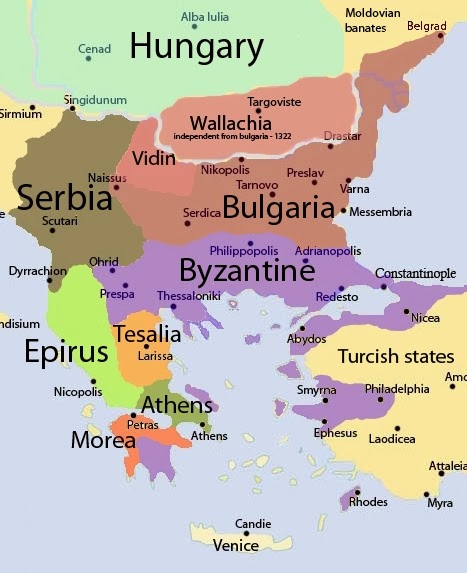
The Byzantine Empire in the early 1300s.


Wednesday, June 17, 2020

Battle For The Mediterranean - The Arab Conquest of Malta


North African Arab Warriors
(epicalm.com)

The Muslim Conquests

Starting in 639 AD the Muslims began their conquest of Roman North Africa by invading Egypt. After Egypt the Muslims moved across North Africa one by one taking the Roman provinces of Tripolitania and the lands controlled by the Exarchate of Africa.

In 708 AD the Roman fortress of Septem on the coast or Morocco and the surrounding territories were the last area of Roman Africa to be occupied by the Arabs.

With Africa under control the Muslims invaded Spain.

Then starting in the early-800s the semi-independent Emirs of Ifriqiya began a decades long battle for the control of Sicily and southern Italy.

These endless back and forth battles between the Muslims and Romans prove the historical nonsense of so-called "easy and rapid" Arab victories.

For over 200 years the Romans contested every inch of ground in Africa and Italy.  For example, after the fall of Carthage to the Muslims in 695 the Roman Navy in 697 staged an amphibious operation in North Africa, landed an army and re-captured Carthage.

And that brings us to Malta.

Battle For The Mediterranean
Malta was a key Roman Fortress
.
By holding Malta the Eastern Romans could threaten Muslims in both Africa and well as when they crossed the sea and attacked Sicily and Italy.
.
This map shows the dates of the endless battles between both sides. Muslim attacks and victories are in green and Roman attacks and victories are in red.


Muslims Target Malta

Sicily was first invaded by the Arab forces of Caliph Uthman in 652. The Arabs failed to make any permanent gains, and returned to Syria after gathering some booty.

By the end of the 7th century, with the Umayyad conquest of North Africa, they had captured the nearby port city of Carthage, allowing the Arabs to build shipyards and a permanent base from which to make more sustained attacks.

Around 700, the island of Pantelleria was captured by Arabs. Attacks from Muslim fleets repeated in 703, 728, 729, 730, 731, 733 and 734, the last two times meeting with a substantial Roman resistanceThe first true conquest expedition was launched in 740 and captured Syracuse but then returned to Africa.


The Muslim attacks and invasions went on and on into the 800s. 

It because obvious that Malta provided a naval base and staging area for the Romans to attack Muslim ships and soldiers making runs to Italy. That base had to be eliminated.

Roman Fortress of Melite
A possible reconstruction of the Roman walls of Melite (model by Richard Azzopardi and Stephen C. Spiteri, displayed at the Fortifications Interpretation Centre)


The 868 Siege of Malta

Dates are all over the place and sometimes when events happened is just a guess.

The reason behind the attack can be better explained if one bears in mind that Malta was considered a threat to North Africa's security. The Island, with its good natural harbors, served as an important base from where to wage war on Africa. It was a well-known fact that the Romans, who were a strong maritime power in the Mediterranean by far superior to the Arabs at the time, were making use of Malta's harbors to strike against Africa.

The Aghlabid dynasty in Africa attacked Malta at least twice. Khalaf, a freed slave, masterminded the first attack in 868. Khalaf was known for his construction of mosques, bridges and wells. he had great difficulties to succeed in the campaign and met his death in the Siege of Malta.

This first attack was a complete failure. The Arab army suffered a crushing defeat.  The island and, in particular, its capital city were well fortified by the Romans to the extent that they could offer resistance to any invading army.

The Conquest of Malta in 870

Conquering Malta meant removing an obstacle which stood in the way of the Arab conquest of Syracuse in Sicily. In fact, the fall of Syracuse came eight years after that of Malta. No doubt Roman Malta had a strong political, economic and religious relationship with this important Roman city and she was offering help, through her maritime networks, to resist the onslaught of Arab attacks.

Taking into consideration the geographical situation of the times, it was impossible to keep an army in Malta for an entire winter period. While Malta had good harbors for the fleet, such a large army needed resources. Again, this possibility went against the military strategy adopted by the Aghlabids at the time. It was not their custom to set out on a two-year continuous siege.

The attack in 870 is recorded in the Chronicle of Cambridge and by an anonymous Arab geographer. Muslims laid siege to the ancient Roman city-fortress of Melite.

The city withstood the siege for some weeks or months, but it ultimately fell to the invaders, and its inhabitants were massacred and the city was sacked the local cathedral's marble columns were sent to Africa and its fortifications razed.

The events of 868 can perhaps help us to explain why the Arabs moved with such ferocity against Malta in 870, destroying everything they came across, thus rendering the Island barren for a number of years. One cannot fail to consider that such ruthless destruction was in fact a form of punishment. First of all, the Arabs wanted to avenge the death of Khalaf.

Secondly, they wanted to ensure that the Island could not be used as a base for Roman incursions against Ifriqiyya. This explains why one author described Malta as being a wasteland for many years.

The fall of Malta ended over 300 years of Eastern Roman rule.

The fall of Malta had important ramifications for the defense of what remained of Roman Sicily: with Reggio Calabria and now Malta in their hands, the Muslims completed their encirclement of Sicily, and could easily interdict any aid sent from the east.

19th Century North African Arab Warriors
The Romans would have faced troops much like these soldiers.
(epicalm.com)

Modern Malta
 Malta fell to the Roman Republic in 218 BC, and it remained part of the Roman and later the Eastern Roman Empire until 870 AD, when it was captured and destroyed by the invading Aghlabids. Muslims.


(core.ac.uk)     (Melite)    (Malta)

Saturday, September 1, 2018

Battle of Tryavna Pass (1190 AD)


Eastern Roman Varangian Guard
A Hungarian reenactor's armor and comments
.
"The kit is mainly based on the Alexiad, most notably on the comments of Anna Komnena about the Varangian Guard. This character is of Scandinavian origin, in service of the Byzantine army, rather than the eastern rus contingent of 6000 warriors who formed the core of the Guard later in 988, if I recall correctly. Therefore I based most of the armour and clothing on the Gjermundbu, Birka and Valsgärde finds, with exception of the leather vest. It has a debated origin that byzantine troops used this type of vests along scale and lamellar armour. I refrained to acquire a lamellar armor as the Wisby find turned out to be a "hoax", well not a hoax, only it was originated centuries later. I also looked up on a large number of byzantine manuscripts about guardsmen, but they weren't really helpful aside from the clothing.
.
The kit is still incomplete, as I still miss a shield, a proper shoes (will be also based on Birka) and an authentic belt, but I'll have them as well soon enough..
A limb guards were based on the first misinterpreted Valsgärde find, it's not a complicated design, as you can see..
The gloves, well, those are of course a hoax as we don't have a find or manuscritp up to date about protective gloves from this era. But I'm not too keen to lose a finger or two, or my hand entirely, so I gotta wear something. Yeah, I too think the pale leather stands out, and I'm about to dye it darker if I'll have the time and proper materials for it.
(deviantart)

Bulgaria vs Constantinople


Origins of the War

Since 680 AD the Eastern Roman Empire had faced and endless wave of invasions by Bulgarian tribes. At his point that make 510 years of wars, sieges, invasions, counter invasions and slaughter.

In 1190, on paper at least, the Eastern Empire "ruled" from the Danube down to Greece. But huge areas had been re-populated with less than loyal barbarian tribes and had been burned over producing modest to little tax income for Constantinople.

In 1185 we saw the Uprising of Asen and Peter the theme of Paristrion.  

Eastern Roman Emperor Isaac II Angelus, in order to raise money for his wedding with the daughter of King Béla III of Hungary, levied a new tax which fell heavily on the population of the Haemus Mountains. They sent two leaders (Peter and Asen) to negotiate with the emperor. They asked to be added to the roll of the Byzantine army and to be granted land near Haemus to provide the monetary income needed to pay the tax. This was refused, and Peter and Asen were treated roughly. Their response was to threaten revolt.

In the spring of 1187, Isaac attacked the fortress of Lovech, but failed to capture it after a three-month siege. The lands between the Haemus and the Danube were now lost for the Byzantine Empire, leading to the signing of a truce, thus de facto recognising the rule of the Asen and Peter over the territory, leading to the creation of the Second Bulgarian Empire.

The Tarnovo Campaign
 The Bulgarian Army is in red and Byzantines in blue.
.
The Emperor marched the Roman Army north along the coast while the Roman fleet held his right flank just off the coast.
.
 The Byzantines made a bluff indicating that they would pass near the sea by Pomorie, but instead headed west and passed through the Rishki Pass to Preslav. The Byzantine army next marched westwards to besiege the capital at Tarnovo. At the same time, the Byzantine fleet reached the Danube in order to bar the way of Cuman auxiliaries from the northern Bulgarian territories.

Medieval Tarnovo
On high ground and surrounded by the Yantra River the Bulgarian capital of Tarnovo was an almost impossible military objective for the Byzantines.

The Tarnovo Fortress
Who thought this was a good idea?
hhh
The Roman Emperor Isaac II Angelos marches deep into enemy territory to attack the Bulgarian capital that is surrounded by the Yantra River.  To capture the city Roman troops would have to cross the river and attack up hill to reach the Bulgarian fortifications.

The newly restored Trapesitsa Fortress in Bulgaria's Veliko Tarnovo is now open for tourists.

Forces Involved

Because of the lack of property histories once again we have next to zero real knowledge of the forces involved in this battle and the massive amount of details about the combat that took place.

Bulgarian Army

The core of the Bulgarian army was the heavy cavalry, which consisted of 12,000–30,000 heavily armed riders. At its height in the 9th and 10th centuries, it was one of the most formidable military forces in Europe and was feared by its enemies. There are several documented cases of Byzantine commanders abandoning an invasion because of a reluctance to confront the Bulgarian army on its home territory.

Bulgarian army used large numbers of Cuman cavalry which numbered between 10,000 and 30,000 riders, depending on the campaign. These were drawn from among the Cumans who inhabited Wallachia and Moldavia.

In the battle of Kleidion the Bulgarian army numbered around 20,000 soldiers. According some estimates the total number of the army including the squads of local militia reached a maximum level of 45,000.

To put it mildly, any Roman Emperor who invaded Bulgaria did so at his own risk. The Bulgarians would have the advantage of defending their own lands and fortified cities while their armies would be easily supported by local militias or allied forces from across the Danube.

I would make an educated guess the number of 30,000 Bulgarian soldiers (perhaps more) defending their country in this campaign. Add to that number thousands of allied Cuman cavalry attacking the Byzantines in the rear.

Eastern Roman Army Strength

The Roman Army

We have a little better idea of the size of the Eastern Roman Army.  In this period it is was roughly 50,000 men under arms.

These professional Tagmata troops would have been divided into assorted units. 

For example, the most famous of all tagmatic units, the 6,000-strong mercenary Varangian Guard, was established ca. 988 by Emperor Basil II (r. 976–1025).  There was the heavy cataphract corps called the Athanatoi (Ἀθάνατοι, the "Immortals") after the old Persian unit, which were revived in the late 11th century by Michael VII Doukas (r. 1071–1078). There were the Megathymoi of the 1040s or the Archontopoulai and Vestiaritai (Imperial Guard) of Alexios I.

The Emperor had these professional units to all upon for an invasion of Bulgaria. What units he selected or the total strength of the army we have no idea.

Using a 50,000 man army as a base number we need to subtract from there. Thousands of troops would have been needed to face the Muslim Turks in Asia Minor. Fortresses would need to be manned and standing mobile forces would be needed to defend the frontier.

Even more troops would be needed to protect Constantinople, the Greek islands, Greece itself and other Western Balkan outposts against Bulgarian invasion.

That 50,000 man army starts shrinking fast.

What we do have is the Emperor himself invading deep into Bulgaria. That means all available troops would be gathered under his command to protect the head of state. We can assume this was an all out campaign by the Byzantine State to crush the revived Bulgarian Empire.

If 30,000 troops are held in place to defend different frontiers that might give the Emperor a force of 20,000 men to invade Bulgaria.  Might give him . . . this is just an educated guess. His army could have been smaller.

The Bulgarians may have had an army of 30,000 waiting for the Emperor and another 10,000 or more Cuman allied cavalry.  That makes a 20,000 man invading Byzantine army look like fresh meat for a Bulgarian grinder.

Late medieval Bulgarian soldier
(pinterest)

Invasion and Siege

In the late autumn of 1186, the Byzantine army marched northwards through Sredets (Sofia). The campaign was planned to surprise the Bulgarians. However, the harsh weather conditions and the early winter postponed the Byzantines and their army had to stay in Sredets during the whole winter.
In the spring on the following year, the campaign was resumed but the element of surprise was gone and the Bulgarians had taken measures to bar the way to their capital Tarnovo. Instead the Byzantines besieged the strong fortress of Lovech. The siege lasted for three month and was a complete failure.
Then the Byzantines dodged a bullet.  The soldiers of the Third Crusade with an army of 12,000–15,000 men, including 4,000 knights reached the Bulgarian lands. Asen and Peter offered to help the Emperor of the Holy Roman EmpireFrederick I Barbarosa, with a force of 40,000 against the Byzantines. But the Byzantines and Crusaders worked out their differences avoiding a major problem.

Emperor Isaac II wanted to end this Bulgarian threat once and for all and planned out a fairly good campaign using both the army and the navy. The problem was he lacked enough troops to pull it off.

The Byzantines marched north from Constantinople and made a bluff indicating that they would pass near the coastal city of Pomorie, but instead they headed west and passed through the Rishki Pass to Preslav.

As the Byzantine army moved inland to the west the Byzantine fleet sailed on to the Danube in order to bar the way of Cuman auxiliaries from the northern Bulgarian territories.  The fleet alone might not have been enough to stop the Cuman cavalry. We can speculate the navy might have had a certain amount of infantry or cavalry with them to secure crossing points on the Danube.

The Byzantines managed to overcome the passes of the Balkan mountains and march on to the Bulgarian capital of Tarnovo.

The Byzantine siege of Tarnovo was unsuccessful. The city was well situated on higher ground and protected by the Yantra River (see photo above). The defense of the city was led by Asen himself and the morale of his troops was very high. They were behind solid walls and defending their nation and people.

The Byzantine morale, on the other hand, was quite low for several reasons: the lack of any military success, heavy casualties and particularly the fact that the soldiers' pay was in arrears.

Asen sent an agent in the guise of a deserter to the Byzantine camp. The man told Isaac II that, despite the efforts of the Byzantine navy, an enormous Cuman army had passed the river Danube and was heading towards Tarnovo to relive the siege. 

Rather than verify the Cuman movements with scouts and his his navy the Byzantine Emperor panicked and immediately called for a retreat through the nearest pass.


Battle of Tryavna Pass

From the frying pan into the fire.

The Byzantine Emperor's plan was bold. Have the navy on the Danube hold enemy reinforcements at bay while the army marched deep into central Bulgaria to capture their capital.  But bold as that plan was the idea of marching a smaller Byzantine army into Bulgaria to attack a powerful fortification while being surrounded by enemy forces was rather stupid and reckless.

Now add into the mix the panic of the Emperor when he was told by one planted soldier that the Cuman cavalry had crossed the Danube. Isaac II did not bother to confirm this single report. He simply decided to turn tale and run for home.

The Bulgarian Emperor deduced that his opponent would go through the Tryavna Pass in his attempt to get to Byzantine territory.

The Byzantine army slowly marched southwards, their troops and baggage train stretching for kilometers. The Bulgarians reached the pass before them and staged an ambush from the heights of a narrow gorge.

The Byzantine vanguard concentrated their attack on the center where the Bulgarian leaders were positioned, but once the two main forces met and hand-to-hand combat ensued, the Bulgarians stationed on the heights showered the Byzantine force below with rocks and arrows.

In panic, the Byzantines broke up and began a disorganized retreat, prompting a Bulgarian charge, which slaughtered everyone on their way.

Isaac II barely escaped; his guards had to cut a path through their own soldiers, enabling their commander's flight from the rout. The Byzantine historian Niketas Choniates wrote that only Isaac Angelos escaped and most of the others perished.

The battle was a major catastrophe for the Byzantines.

The Bulgarians captured the imperial treasure including the golden helmet of the Byzantine Emperors, the crown and the Imperial Cross which was considered the most valuable possession of the Byzantine rulers - a solid gold reliquary containing a piece of the Holy Cross. It was thrown in the river by a Byzantine cleric but was recovered by the Bulgarians. These trophies later became the pride of the Bulgarian Treasure and were carried around the capital, Tarnovo, during official occasions.

11th Century Eastern Roman military formation
(kismeta.com)

Aftermath

Bulgaria was permanently lost to the Eastern Empire.  Tryavna Pass was but one of an endless stream of Bulgarian victories.

Up to that moment, the official Emperor was Peter IV, but, after the major successes of his younger brother, he was proclaimed Emperor later that year. Officially, Peter preserved his title and ruled from Preslav, but the state now governed by Ivan Asen I. In the next two years, he liberated many lands to the west and south-west including Sofia and Niš.

His troops looted Thrace and the Byzantines were powerless to resist the Bulgarian attacks.


 Eastern Roman infantry known as scutatii (Meaning ″shield men″) or skutatoi (on right).

The Empire before Bulgaria broke away.


(Medieval Bulgarian army)      (Second Bulgarian Empire)      (Tagmata)

(Third Crusade)      (Asen and Peter)      (Tryavna)       (pinterest)

(pinterest)      (Byzantine army)

Tuesday, April 10, 2018

Nicephorus Phocas and the Scythians


Scythian warrior on horseback.
(pinterest)


Here we go again. I was not even looking for an article on Eastern Roman Emperor Nicephorus Phocas let alone Scythian barbarian invaders. But Google giveth many strange links.

I cannot find much background for the author of the article below. He appears to be Hungarian with an interest in early Hungarian invading tribes and their link to Byzantium. Well that's good enough for me. His article helps shed some light on a part of Byzantine military history that no one has really covered.

A near total lack of data.  When dealing with subjects like Napoleon, the American Civil War or World War II these events took place over a few short years, but we have literally mountains and mountains of excruciatingly detailed information to shift through. But when it comes to Eastern Roman history a century of barbarian invasions might, if we are lucky, get a passing mention by what passed for "historians" at the time. Meaningful details? Not gonna happen.

So this article helps shed some light on nearly ignored segment of Byzantine military history.

"Scythian" Barbarians

The question basically is "What is a Scythian?"

The Byzantines had something of a "if you have seen one barbarian tribe you have seen them all" attitude. The Byzantines had no interest in the fine points of different barbarian cultures. After all these invading barbarian tribes were all trying to kill Romans and conquer the Empire so what difference did it make?

In general the often nomadic peoples of the regions of modern Russia, the Black Sea and the Caspian Sea were lumped together and called "Scythians" and in later times called "Turks".

These nomadic warlike peoples, were particularly known for their equestrian skills, and their early use of composite bows shot from horseback. With great mobility, the Scythians could absorb the attacks of more cumbersome foot soldiers and cavalry. Such tactics wore down their enemies, making them easier to defeat. The different Scythian tribes were notoriously aggressive warriors.

In the case of this article the Scythians were likely nomadic Magyar warrior clans invading from the from the region of Ural Mountains into Europe.

____________________________


Nicephorus Phocas and the Scythians


By LÁSZLÓ BALOGH 

Hungarians conquered the Carpathian Basin in the late ninth century. From there they conducted numerous campaigns to both the East and West in the course of the tenth century. However, while the western campaigns are well known in the Latin sources, the attacks against the Byzantine Empire, are mentioned in few sources. In the present paper, I would like to discuss a short source detail which have not yet been connected by historians to the Hungarians of the tenth century. 

Byzantine sources of the Hungarian history in the ninth-tenth centuries - thanks to the meticulous and all encompassing work of the renowned Hungarian Byzantinologist, Gyula Moravcsik - have hardly increased in number during the past decades. Recently, Ferenc Makk has collected the new sources concerning Hungarian history in the ninth-tenth centuries. He mentioned only one sentence in the work of Joannes Skylitzes that Moravcsik did not know of, which refers to tenth-century Hungarians. 

In 2009, István Baán drew the scholars' attention to a Byzantine diploma which mentioned the destruction of Hungarian troops in the Byzantine Empire during the tenth century. The number of new details is very limited. Thus any information - even if it is very brief - serves as a valuable addition to our knowledge of Hungarians in tenth-century history.

The Byzantine army of Asia Minor proclaimed Nicephorus Phocas as emperor in 963. He told them that they should expect a serious civil war. Previously they fought bravely against Cretans, Scythians and Arabs, but they now had to fight against their countrymen. The three examples of related events were certainly known to the soldiers.  


Emperor Nicephorus Phocas 
(from ‘Rulers of the Byzantine Empire’ published by KIBEA)
Emperor from 963 to 969. His brilliant military exploits resulted in the conquest of Cilicia and the re-conquest of the island of Cyprus from the Muslims. He conducted raids into Upper Mesopotamia and Syria. In the West he lost Sicily completely to the Muslims and faced Magyar raids deep into the Balkans.
(thehistoryofbyzantium.com)

Nicephorus Phocas' army invaded the island of Crete in the summer of 960. The besiegers conquered the capital city, Kandia, in 961. As a result of the victory, after one and a half centuries of Muslim rule, the island again fell under the control of the Byzantine Empire. 

Almost simultaneously, Nicephorus Phocas's brother, Leon Phocas took a part of the Byzantine troops from the Balkans to Asia Minor. Exploiting the fact that most of the Byzantine army was on the island of Crete, Sayf al-Dawla, the prince of Hamdanids carried out more attacks against the border of the Byzantine Empire in Asia Minor. 

When Emperor Romanus II found out about this, he sent Leon Phocas, who previously had successfully defended the Balkans' border of the Empire, to Asia Minor fighting against the Muslims. Leon Phocas's troops defeated Sayf al-Dawla's army when they returned home with booty and numerous Byzantine prisoners on 8 November 960. In the course of the attack the prince barely escaped due to his ingenuity. Subsequently Leon Phocas went to Constantinople, which held a triumph in his honor. 

Following the successful campaign against Crete, Nicephorus Phocas continued the war against the Hamdanids. As a result, the capital of Sayf al-Dawla, Aleppo fell into the hands of the Byzantines in 962 with the exception of its citadel. It appears that the fighting against Cretans and Arabs which is mentioned in Nicephorus Phocas' speech refers to these two victorious wars. It is obvious that Nicephorus Phocas (or Leon Diaconus, who attributes the speech to him) wanted to refer to well-known, recent events in the case of the war against the Scythians.

Leon Diaconus used the Scythian name to indicate a number of peoples who lived then or at once in Scythia, north of the Danube area and the Black Sea. It was him who called the Bulgarians, the Hungarians and the Russians, and in general the peoples living in Scythia (which in some cases perhaps also included the Pechenegs) all Scythians. The question is raised, however, which of these peoples were defeated by the Byzantine soldiers?


Scythian Warrior
(pinterest)

Bulgarians cannot be identified with these Scythians. There was peace between the Byzantine Empire and Bulgaria around this time, which only ended after the Nicephorus Phocas occupied the throne. Thus it is not surprising, that the collection containing the Byzantine sources of Bulgarian history does not mention the emperor's speech. Similarly, we know of no Russian or Pecheneg attacks in the 950s reaching the Byzantine Empire.  

Therefore it is most likely that by a struggle against the Scythians we are to understand Scythian invasion which was successfully beaten back by Nicephorus Phocas brother's Leon Phocas, according the Leon Diaconus' work. According the unanimous opinion of historians, the same event was reported in one part of the Vita Athanasii.w Leon Diaconus mentions that when a Scythian army crossed the Danube, Leon Phocas did not immediately enter into a battle with them because he had only a very small army, instead, he was waiting for the appropriate moment and he attacked the opposing camp at night. 

The Byzantine troops killed many of the Scythians, while many others were forced to flee. The Vita Athanasii mentions that Leon Phocas, who was the "commander of the West(ern affairs)" brought a serious defeat onto the Scythians. The identification of the enemy is very clear in this case. The Byzantine sources reported an ill-fated attack by a Hungarian army.  
  
This campaign could be identical with the Hungarian campaign which had reached the Byzantine Empire in 961. According to Theophanes Continuatus, Hungarian troops invaded the Byzantine Empire at the Easter of 961 (on 7 April, 961). Emperor Romanus II sent Marianos Argyros, who was the "commander of the West", to stop the attackers. The Byzantine general defeated the Hungarians, and forced them to return home.  

However, this view is hardly tenable. Scholars probably dated the Hungarian attack to be in the year 961 because this date was written on the margin of the text in the collection of sources. However, it is not the date of the fight against the Scythians: it only indicates that Leon Diaconus's second book discusses the events of 961. The Byzantine author only makes a brief mention of Leon Phocas's previous victory as the one that reveals his courage. However, Leon Phocas left the Balkans in 960. Romanus II sent Leon Phocas to Asia Minor, because the commander fought successfully against the Scythians. Thus, he could not be fighting the Scythians in 961 or later.


The Empire is Pressured on Three Fronts
Every morning the Emperor and his generals woke up in a nightmare. No matter where you looked there was always a new invasion or a military disaster and there were never enough troops to stabilize the borders or reconquer lost territory.
.
In the 9th and 10th centuries the Empire faced massive attacks on three fronts.  There were endless invasions by Muslims from Africa into Byzantine Italy where they conquered Corsica, Sardinia, Sicily and established themselves on the mainland. The Danube frontier had totally collapsed with invading Magyar and other barbarian tribes thrusting deep into the Balkans. Then there was the non-stop warfare with the Arabs on the eastern front in Anatolia.


The Vita Athanasii mentions that Leon Phocas visited Athanasios after having brought defeat onto the Scythians. The source explains that first Athanasios met Leon Phocas, then he was tempted by the Devil for one year, afterwards he visited Nicephorus Phocas in Crete in 961. This also suggests that the campaign against the Scythians took place in or before 960 but not in 961. According to the Vita Athanasii, Leon Phocas fought against the Scythians as commander of the West. But in 961 it was Marianos Argyros and not Leon Phocas who occupied this position. 

Thus, it is obvious that Leon Phocas cannot have been fighting against the Scythians in 961. When did, then, Leon Phocas fight against the Scythians? And who were these Scythians?

Two Byzantine authors, Theophanes Continuatus and Pseudo-Symeon mention that the Hungarians (Turks) attacked the Byzantine Empire in 959. The emperor, Constantinus Porphyrogenitus, sent Pothos Argyros, the commander of a guardian army with general of Bukellarioi, Opsikion and Thrakesion, against them. The Byzantine troops attacked the Hungarians in the night and defeated them - just like Leon Phocas's troops in the story by Leon Diaconus. The Hungarian army was forced to return home. The details of the campaign: a night attack, the year 959, the enemies (Turks, Scythians namely the Hungarians) it creates an impression that Leon Diaconus, Theophanes Continuatus and Pseudo-Symeon reported about the same war.  

Some problems, however, remain. Theophanes Continuatus only mentions Pothos Argyros but not Leon Phocas in relation with the war to the spring of 959. According to Vita Athanasii, Leon Phocas was the „commander of the West(ern affairs)", but he was appointed to this rank by Romanus II, at the end of 959. Assumptions are necessary to interpret of the sources. It is presumable that since Leon Phocas fought at the eastern and western borders of the Empire in 959-960, the Vita Athanasii did not exactly follow the rapid changes of his titles, sometimes identifying him as commander of the West already during the spring of 959. In such a mistake, a bibliography of a saint would not be unusual to some extent. 

It is also possible that the Byzantine chronicles only accidentally fail to mention Leon Phocas in relation with the fight of 959 (perhaps he would be the unnamed general of Bukellarioi, Opsikion and Thrakesion). The other possibility is that the sources do not speak of the same campaign. If we accept that Leon Phocas was the commander of the West when he fought against the Hungarians (his brother, Nicephorus Phocas was the general of Anatolia at this time), then a Hungarian army again attempted to attack the Byzantine Empire in the beginning/ early summer of 960. So Pothos Argyros and Leon Phocas defeated two different Hungarian armies using the same tactics on two occasions

After Leon Phocas gained victory over the Hungarian troops (959 or 960), Emperor Romanus II sent the successful general to the eastern border of the Empire. But the Hungarian attacks did not end. Again a Hungarian army invaded the Empire in 961. Although these raids were beaten back by the Byzantine army, but Byzantine soldiers were able to experience how dangerous their enemy was. In 963 Nicephorus Phocas mentions three dangerous enemies: the Arab warriors on the island of Crete, the army of Hamdanids in Asia Minor, and the Scythians, that is the Hungarians in the Balkans. 

He tells the truth; Hungarian troops regularly attacked the Byzantine Empire at this time. Thus the short datum in speech of Nicephorus Phocas provides a piece of the colorful mosaic of the tenth-century history of the Hungarians. 


The Magyars successfully conquered the Pannonian Basin (i.e. what is now Hungary) by the end of the 9th century, and launched a number of plundering raids both westward into what used to be the Frankish Empire and southward into the Byzantine Empire.
.
The westward raids were stopped only with the Magyar defeat of the 
Battle of Lechfeld of 955, which led to a new political order in Western Europe centered on the Holy Roman Empire. The raids in to Byzantine territories continued throughout the 10th century, until the eventual Christianisation of the Magyars and the establishment of the Christian Kingdom of Hungary in 1000 or 1001.  (More)

Magyar Warrior
(pinterest.com)


(Hungarian invasions)      (chronica)      (Scythians)

(Nikephoros II Phokas)      (Magyar tribes)

Monday, February 12, 2018

Roman Fortress of Viminacium in Serbia


Late Roman Infantry
(pinterest)


Viminacium, the capital of the Roman province of Moesia Superior, was one of the most important Roman cities and military camps in the period from 1st to 4th centuries. Its exceptional strategic importance was reflected both in the defense of the northern border of the Roman empire and in turn of communications and commercial transactions.

At its peak it is believed the city had 40,000 inhabitants, making it one of the biggest cities of that time. It lies on the Roman road Via Militaris.  The archaeological site occupies a total of 450 hectares (1,100 acres), and contains remains of temples, streets, squares, amphitheatres, palaces, hippodromes and Roman baths.


There was virtually no Roman emperor who did not pass through Viminacium or spend some time there. Among visits by Roman emperors, mention should certainly be made of Hadrian’s residency when hunts were organized for him at Viminacium on two occasions; the Emperor Septimus Severus visited twice; later on other emperors stayed there: Gordian III, Phillip the Arab, Trebonius Gallus, Hostilian, Diocletian, Constantine The Great, Constans I and Julian. Gratian was the last emperor known to have visited Viminacium.

Castrum

The Roman fort (castrum) at Viminacium was built in the first decades of the 1st century AD. The existence of an earthwork fortification, although not archaeologically confirmed, was very likely built as early as the beginning of that century.

The camp’s dimensions have been determined by geophysical methods and by analysis of digital soil sampling. They were 443 metres by 387 metres. These methods determined that the original camp was twice that size and that there is reason to believe that two legions were probably stationed there, most likely until Domitian’s edict of 86 AD. That year the order was issued that due to the threat posed to the Roman Empire, it was prohibited to station two legions at the same place. 

The remnants of the entrance gate with massive tiling, cesspool and lavishly decorated architectural elements point to the powerful defensive system for which the camp was built on the then northern frontier of the Empire. The unearthed store of bronze coins dating back to the beginning of the 4th until the middle of the 5th centuries AD indicates the time of the destruction of the camp which, after the Hun invasion in 441 AD was abandoned and had never since been restored to its former glory. 

Aerial pictures, as well as geo-radar and geomagnetic filming carried out on the site of the former castrum, provide a true picture of the camp with its ramparts, gates, turrets, the legion’s headquarters and barracks lying beneath the fertile cultivated fields.


Viminacium was the permanent base of the Seventh Legion Claudia.
(Pinterest)

The Romans became interested in the region during the Illyrian Wars. It has been argued that the Fourth Legion Scythica stayed in Viminacium (or the neighborhood) during the first half of the reign of the emperor Augustus

Another unit that may have stayed here for a short while, is the Fourth Legion Flavia Felix, which took part in Domitian's war against the Dacians after 86. However, it would soon find its permanent base in Singidunum (Belgrade), and Viminacium was to be the permanent base of the Seventh Legion Claudia.


In the legion camp, 6.000 soldiers were stationed, and 30-40.000 lived nearby. A cavalry unit was stationed here, and it appears that the city was the place where the prefect of the Danube Fleet had his office.

In the first half of then the 3rd century the city was in full development, as evidenced by the fact that at that time it acquired the status of a Roman colony, and the right to coin local money.


Byzantine Era  (395AD to 600?)

In 395 AD the Empire permanently split into east and west and Viminacium come under the rule of Constantinople. 

Then in 441 Viminacium was completely destroyed by the Attila the Hun.  Shortly after in 476 AD the Western Empire fell.  But destroyed or not the strategic importance of Viminacium was not lost to the Eastern Emperors.


In addition is reconquering Africa, Spain and Italy the Emperor Justinian (r527-565) began a major building project in the Balkans. Up and down the Roman frontier Justinian built and re-built fortifications.

Viminacium was re-built and fortifications strengthened. In 535 the city had a bishop and was raised to the rank of archdiocese. 

Some historical sources say the city was again destroyed by Avars during their invasion in 582.


I have my doubts that the city was destroyed. 

Records are nearly non-existent about the state of the city, but the actions of both the Avars and Romans suggest the city still stood.

In 599 the Romans sent an army to the city and set up camp. It was noted that the commanders spent time in the city. The Avars and Romans then fought a series of three battles around Viminacium resulting in a major Roman victory.

It is fair to say that the Emperor would not send an important general (Priscus) and an army to defend a pile of rubble. Nor would the Avars send a large army to attack Romans who were defending rubble. 

So the city was still active at some level. Since the battles resulted in Roman victories it is reasonable to say that Viminacium continued to exist to some degree into the 600s. 

The 600s continued to see endless barbarian invasions over the Danube. With the Roman-Persian War of 602–628 all military focus was directed to the east to defend Anatolia, Syria and Egypt. Protecting the Balkan cities far from Constantinople was about as low a military priority as you could have.

We can safely say that it was during this period that Viminacium finally fell never to be rebuilt again.


Click to enlarge
Viminacium map. Excavations of Mihailo Valtrovic in 1882


Viminacium was a Legion outpost and capital
of the Eastern Roman province of Moesia.
h

Think of the word "Porous"

The Danube Limes was not a solid wall defending the Empire's frontier.  Rather it a was a series of fortified cities, small forts and watchtowers.  The Danube River itself was the most dominant element of the frontier system, used as a demarcation line against the Barbarian world to the north and as a fortified transport corridor.

The Limes was porous with assorted invading Slavs, Huns or Avars pouring through on raids dedicated to looting or conquest.  In theory the Roman/Byzantine strongpoints would slow down invaders allowing for troops stationed close by to push the enemy back over the border.
 

Model of Viminacium

Roman Legion camp of Viminacium

Viminacium


Viminacium Roman Aqueduct

Re-Building The Danube Limes


By Procopius of Caesarea
500 - 554 AD
Procopius - Buildings

Thus did the Emperor Justinian fortify the whole interior of Illyricum. I shall also explain in what manner he fortified the bank of the Ister River, which they also call the Danube, by means of strongholds and garrisons of troops.  

The Roman Emperors of former times, by way of preventing the crossing of the Danube by the barbarians who live on the other side, occupied the entire bank of this river with strongholds, and not the right bank of the stream alone, for in some parts of it they built towns and fortresses on its other bank.  However, they did not so build these strongholds that they were impossible to attack, if anyone should come against them, but   they only provided that the bank of the river was not left destitute of men, since the barbarians there had no knowledge of storming walls.  In fact the majority of these strongholds consisted only of a single tower, and they were called appropriately "lone towers," and very few men were stationed in them.  

At that time this alone was quite sufficient to frighten off the barbarian clans, so that they would not undertake to attack the Romans.  But at a later time Attila invaded with a great army, and with no difficulty razed the fortresses; then, with no one standing against him, he plundered the greater part of the Roman Empire.  But the Emperor Justinian rebuilt the defences which had been torn down, not simply as they had been before, but so as to give the fortifications the greatest possible strength; and he added many more which he built himself.  In this way he completely restored the safety of the Roman Empire, which by then had been lost. And I shall explain how all this was accomplished.
Emperor Justinian

The River Ister flows down from the mountains in the country of the Celts, who are now called Gauls; and it passes through a great extent of country which for the most part is altogether barren, though in some places it is inhabited by barbarians who live a kind of brutish life and have no dealings with other men.  

When it gets close to Dacia, for the first time it clearly forms the boundary between the barbarians, who hold its left bank, and the territory of the Romans, which is on the right.  Consequently the Romans apply the term Ripesia to this part of   Dacia, for ripasignifies bank in the Latin tongue.  Accordingly they had made a beginning by building on the bank there in ancient times a city, by name Singidunum.  This the barbarians captured in time, and they immediately razed it, leaving the place quite destitute of inhabitants.  They did precisely the same thing to most of the other strongholds.  

But the Emperor Justinian restored the entire city and surrounded it with a very strong fortification, and thus made it once more a famous and important city.  And he set up another new fortress of exceptional strength about eight miles distant from Singidunum, which they call by the appropriate name of Octavus.  

Beyond it was the ancient city of Viminacium, which the Emperor rebuilt entire and made new, for it had long before been ruined down to its uttermost foundations.

As one goes on from Viminacium there chance to be three strongholds on the bank of the Ister, Pinci and Cupi and Novae.  These were formerly both single in construction and when named were single towers. But now the Emperor Justinian has greatly increased the number of the houses and enlarged the defences at these places, and thereby has properly given them the rank of cities.  

And opposite Novae in the mainland on the other side of the river, had stood from ancient times a neglected tower, by name Literata; the men of former times used to call this Lederata.    This the present Emperor transformed into a great fortress of exceptional strength.  After Novae are the forts of Cantabaza, Smornês, Campsês, Tanata, Zernês, and Ducepratum. And on the opposite side he built a number of other forts from their lowest foundations. 

Farther on is the so‑called Caput Bovis, the work of the Roman Emperor Trajan, and beyond this is an ancient town named Zanes.  And he placed very strong defences around all these and so made them impregnable bulwarks of the State.  And not far from this Zanes there is a fort, Pontes by name. The river throws out a sort of branch there, and after thus passing around a certain small portion of the bank, it turns again to its own stream and is reunited with itself.  It does this, not of its own accord, but compelled by human devices.  The reason why the place was called Pontes, and why they made this forced diversion of the Ister at this point, I shall now make clear.


(Procopius Buildings)      (Viminacium)      (Moesia)

(Viminacium)      (Viminacium)      (Viminacium)