.

Dedicated to the military history and civilization of the Eastern Roman Empire (330 to 1453)


"Time in its irresistible and ceaseless flow carries along on its flood all created things and drowns them in the depths of obscurity."

- - - - Princess Anna Comnena (1083–1153) - Byzantine historian

Showing posts with label Israel. Show all posts

Monday, July 19, 2021

Gold Coin Hoard Pinpoints Persian Destruction of Jerusalem


Photo 3. One of the Heraclius gold solidi from the Givati parking lot. Photo by Clara Amit of the IAA.


"The use of coins welds together our whole life, and is the basis of all our transactions. Whenever anything is to be bought or sold, we do it all through coins."
John Chrysostom
Archbishop of Constantinople


(Coin Week)  If a hoard of 264 Byzantine gold solidi suddenly appeared and careful examination showed that every coin in the hoard was struck from the SAME dies–a die set never before identified–experts would be quick to suggest the possibility of forgery. (Photo 1)

Photo 1: The Givati parking lot gold hoard in situ. Photo Israel Antiquities Authority (IAA).

Real life, however, can be stranger than fiction.

One of the great numismatic stories of the last 50 years revolves around just such a hoard of coins that was excavated a dozen years ago at the Givati parking lot in Jerusalem. The lot is just outside of the Old City’s Dung Gate, on the north-western side of the City of David excavations. The latest report on this hoard was published in an article by my long-time friend Gabriella Bijovsky, a senior numismatist at the Israel Antiquity Authority. (IAA Reports 66, 2020, Chapter 5, “A Hoard of Solidi of Heraclius.”)

The coins were found in the remains of a large Byzantine building. Their location within the building suggested that they “were originally arranged in rows, and were most likely wrapped in a cloth or in a purse, which was not preserved. The excavators suggest that the coins were stored on a shelf…”

At the time these coins were discovered, they received quite a lot of publicity. But the story behind the story, which is quite remarkable, is summarized by Bijovsky, who was responsible for studying the coins.

There were 264 gold solidi with the portrait of Heraclius in the Givati hoard. Heraclius ruled the East Roman Empire from 610 to 641 CE. None of the coins are clipped, carry graffiti, or have any other significant signs of use. At first look, the coins all appear to be from the early Heraclius solidi series struck from 610 through 613. In fact, however, they are more likely part of an emergency issue struck at a Jerusalem mint, Bijovsky explains. (Photo 2)


Photo 2. The Givati hoard after cleaning at the laboratories of the Israel Antiquities Authority. Photo by Clara Amit of the IAA.

The Givati hoard coins are an unpublished variant of the 610-613 series. The obverse legend is dNAERACLI-ЧS. PP AVC• with an A instead of the usual h and a small dot after the “S” of Heraclius.

“The last letter C of the obverse legend is inclined and is followed by a small dot to its right. A short, curved stroke of dots is visible on the upper left side of the emperor’s crown. The reverse inscription ends with the letter Δ, unknown in the original series (Grierson 1959:145), and a tiny star is attached to the exergue inscription: CONOB*.” (Photo 3)

Bijovsky concludes that all of the coins were produced by the same pair of dies. The gold content of 41 of the solidi was studied using X-ray fluorescence (XRF) at the Weitzman Institute of Science. “The results showed a uniform composition deviation, clearly indicating that all the coins were produced from the same load of gold.” Hence, the minting process for this group was “a single event.”

On first glance, Bijovsky explains, “the mintmark, fabric, and style of these coins seem to suggest that this series was issued by the imperial mint of Constantinople. Indeed, the style of the bust die appears standard to this mint and is even better executed than many other official dies of the same general type.”

In the late Roman period, coins were minted in a number of cities, mainly because of the danger and cost of moving large quantities of precious metal from place to place. This system was inherited by Byzantium, and in the 6th century there were six mints in the Eastern Empire (Constantinople, Nicomedia, Cyzicus, Antioch [Theoupolis], Alexandria and Thessalonica) and three in the Western provinces that Justinian had reconquered from the Vandals and the Ostrogoths (Carthage, Rome and Ravenna).

Gold coins were minted mainly in the capital and consequently have the mint mark CON (for Constantinople), with OB added on the solidi to show that they were minted of pure gold.


“On the other hand, the obverse inscription of our solidi showing the name AERACLIVS seems to be a misspelling based on Latin phonetics. Is this an indication about the origin of the die engraver? Still, it seems very improbable that a state official in Constantinople would write incorrectly the name of the emperor on a gold coin,” Bijovsky says. Thus, these coins are more likely a ‘provincial’ issue.

Even though all of the Givati hoard solidi coins appear to be uncirculated, there is an unusual variance of the standard weight (4.55 g for the Byzantine solidus during this period) from as light as 3.97 g to 4.69 g.

“It is hard to believe that the official mint of Constantinople would have tolerated imperial solidi being officially struck without control of an accurate weight standard,” Bijovsky writes. She also asks, “Who would be interested in striking gold coins that contain more precious metal than required by the standard?”

Bijovsky further cites Michael Hendy, and points out that “hoards characterized by heavy concentrations of coins struck from the same pair, or from a limited number of dies, or that contain coins from a single officina, ‘probably tend to have derived at no great distance from bodies of coins dispatched from the mint in purses.’”

The Givati hoard is singularly homogeneous, and Bijovsky concludes that “during this time (608-615 CE), and especially after the capture of Antioch by the Persians in 611 and until 613, the presence of a Byzantine military garrison in Jerusalem could explain the operation of a temporary mint in order to pay the troops and emphasize Byzantine sovereignty over the city… Given the fact that all Antioch surrendered to the Persians in 610, Emesa and Apamea in 611, and Damascus in 613, Jerusalem remained the only major Byzantine stronghold in the region capable of coin production.”

Archaeological remains associated with the Persian conquest are quite sparse in Jerusalem. The archaeologists believe that the Givati hoard is correctly identified as an ‘emergency’ hoard that was “concealed during times of imminent danger, siege, or war. These hoards usually reflect the coinage in current circulation at the time of their deposition.”

This hoard is all the more remarkable because it “proves the need for an emergency coinage, a new series of Heraclian solidi which has been exceptionally struck in Jerusalem under hasty conditions… the combination of both numismatic features and historical circumstances provides solid evidence for the existence of a temporary mint in Jerusalem that functioned during the first years of the reign of Heraclius.”

The Givati parking lot excavations “have shed new light upon Jerusalem at the close of the Byzantine period. The Persian conquest of Palestine in 614 CE, one of the dramatic events that mark the ‘beginning of the end’ of the Byzantine domination in Palestine in the early seventh century seems to be well reflected in the archaeological record at this site,” Bijovsky explains.

Before the discovery of the Givati coin hoard, there were very few coin finds in Jerusalem from during the time of the Persian conquest. Seven mass burials have been discovered around Jerusalem and are generally believed to be from the Persian devastation of the city in 614. According to historic sources, the Persian conquest cost many lives and caused great damage. The conquest and the subsequent 14 Sassanid rulers left few other significant remains. It appears that the large Byzantine building in the Givati parking lot was deliberately destroyed during the Persian invasion of Jerusalem and, unlike the city’s other damaged but surviving buildings, including churches, it was never rebuilt or repaired.

Summing up, Bijovsky notes that “the Givati hoard presents several features that tell us quite explicitly the story of its concealment. The uniform date and the character of the hoard reveal that it was an ‘emergency hoard’ concealed at a time of imminent danger, siege, or war. Such hoards usually reflect the coinage in circulation at the time of their deposition.”

(Coinweek.com)

Gold solidus of Romanos I with his eldest son, Christopher Lekapenos.  Romanos I Lekapenoswas an Armenian who became a Roman naval commander and reigned as Emperor from 920 until his deposition on December 16, 944.
.
Read More:


Tuesday, May 15, 2018

Battle of Ajnadayn - Islam vs Christianity


Three Arab warriors with rifles standing and sitting in the desert during the Arab Revolt 1916-1918. The invading Arabs the Romans faced might have looked much like these soldiers.

Islam on the March
Battle for the Middle East Part IV


Here we are in Part IV of the titanic Battle for the Middle East.

In 629 AD the Roman Empire was enjoying a much deserved period of peace after a brutal 26 year long war of all wars with the Persian Empire.  Finally there was peace.  No one in Constantinople had any idea that a fresh invasion from the southern deserts would happen in a matter of months.

Part I  -  In Part I of this series we saw the first military contact between Romans and Muslim Arabs at the Battle of Mota (Mu'tah) in the Roman province of Palaestina Salutaris.  A force of Romans and their Christian Arab allies mauled the invading Muslim army forcing them to return to Medina.

Part II  -  In Part II we saw the Muslims turn their attention to a weakened Persian Empire. Muslims defeated the Persians in a series of battles. The Muslims marched up the Euphrates River through Persian Mesopotamia finally coming within 100 miles of the Roman frontier at Firaz. Firaz was at the outermost edge of the Persian Empire but it still contained an undefeated Persian garrison. There the Persians joined forces with the local Roman garrison and with Christian Arabs to take on the invaders. They were soundly defeated.

Part III  -  In Part III we have the Emperor Heraclius organizing the defense of Palaestina Salutaris.  Muslims made a wide flanking movement of hundreds of miles through waterless deserts to threaten Damascus failed when confronted by Roman armies.  The Romans held their own in Syria and had dug in at the Daraa Gap fortifications in eastern Palestine. But the Romans were defeated in southwest Palestine allowing Muslim forces to fan out reaching as far north as Lydda and Jaffa.


Arab Cavalry
"The key to all the early operations, against Persia and against Syria alike, is that the Persians and Byzantines could not move in the desert, being mounted on horses. The Muslims were like a sea power, cruising off shore in their ships, whereas the Persians and Byzantines alike could only take up positions on the shore (that is, the cultivated area) unable to launch out to 'sea' and engage the enemy in his own element."


So here we are at about April of 634 and there is a stalemate on the Palestine front.

The Roman army at Daraa has totally blocked the Muslims from moving north. Plus the Muslim column in the Gaza area is not strong enough to make any significant advances north. Protected by their walls Roman cities in 
Palaestina Salutaris were able to hold out against the Muslims preventing them from moving further north. The Arabs did not want armed Roman garrisons in their rear ready to attack.

The Emperor Heraclius was a battle tested front line general who had personally marched into Persia crushing their empire. He had also traveled over and knew the geography of Syria and Palestine. He organized the defense of Damascus and the Roman troops dug in at the Daraa Gap fortifications east of the Sea of Galilee.

The Emperor now gathered a second large army to drive the Muslims out of Roman territory. The question is why did he not personally command the army in his counter attack against the Muslims?

The Health of Heraclius

It was said that health was the reason Heraclius did not command troops against the Muslims.

At this point Heraclius was passing the threshold of 60 years of age as he confronted the massive Muslim invasions. Even if he had been ten years younger he would have been challenged to hold things together.  To command armies in the field at this age with all the rigors involved is nearly unheard of in military history. Consider that Napoleon was just 46 years old when he failed at Waterloo.

The Emperor may have been intermittently unable to function efficiently while at other moments he could handle decision making very capably. He appears to have suffered from "dropsy" and mental problems. Less clear he may have had Post-Traumatic Stress Syndrome (PTSD) from protracted exposure to combat and related strains.

At the end of the Middle East campaign we see the mental issues come forward. He left Syria, returning to his capital, tired and exhausted. Reaching the Bosphorus, he suddenly had an inexplicable aversion to the sea. He even hid in a side room of one of the imperial palaces on the Asian shore, unable to proceed to Constantinople, ignoring the urgent pleas of the city’s representatives. He became paranoid, believed rumors about a conspiracy by his nephew and a bastard son, and ordered their noses and hands to be cut off before sending them into exile.

After a few weeks, his wife Martina and members of the court found a solution. Patriarch Nicephorus, who wrote a Breviarium or Short History, reports that a large number of boats was tied together, as if it were a bridge, to which they added a “wall” of tree branches and leaves, so that the emperor would not have to look at the sea. It worked: the emperor passed the sea on horseback as if he were traveling on land.

Back to Syria. Instead of being in the front lines the Emperor spent his time in the city of Homs some 150 miles away or in Edessa or in Antioch. These were important communications and supply centers. At these cities Heraclius was more easily able to stay in contact with Constantinople and follow events in Anatolia, supervise Roman troops still inside Persia as well as oversee combat to the south.

But let me say at this point there was no real reason for the Emperor himself to be with the army.

The Eastern Empire's military machine had decades of recent combat experience against the Persians and Slavs in the Balkans. Virtually the entire officer corps would have either fought at the side of the Emperor on campaign or been in combat in other theaters of war.

Going into the Battle of Ajnadain there was no reason to think that well trained Roman generals and their professional troops could not put down untrained desert invaders.

Byzantine Cataphract Attempt
From 400 AD on Eastern Roman Cavalry units would mirror their Persian enemies and would grow to become the mailed fist of the army in combat.
kk
Cataphract armored horsemen were almost universally clad in some form of scale armor that was flexible enough to give the rider and horse a good degree of motion, but strong enough to resist the immense impact of a thunderous charge into infantry formations.

The primary weapon of practically all cataphract forces throughout history was the lanceThey were roughly four meters in length, with a capped point made of iron, bronze, or even animal bone and usually wielded with both hands. Cataphracts would often be equipped with an additional side-arm such as a sword or mace, for use in the melee that often followed a charge.
.

The historian Procopius said:  "They are expert horsemen, and are able without difficulty to direct their bows to either side while riding at full speed, and to shoot an opponent whether in pursuit or in flight. They draw the bowstring along by the forehead about opposite the right ear, thereby charging the arrow with such an impetus as to kill whoever stands in the way, shield and corselet alike

 having no power to check its force. Still there are those who take into consideration none of these things, who reverence and worship the ancient times, and give no credit to modern improvements." 
(pinterest.com)

Campaign of Ajnadayn
The Romans (in yellow upper right) were dug in at Daraa in Syria and were successfully holding off the invading Muslim army. Emperor Heraclius sent a second army down coastal Palestine with the support of the Roman Navy. The goal was to defeat the smaller Muslim army at Beersheeba and then block the lines of communications to Mecca of the Muslim army at Daraa forcing them to retreat back to Arabia. 
.
Instead the Muslims at Daraa sent most of their army on a rapid 200 mile forced march to the south to join with the Beersheeba force and do battle with the Romans at Ajnadayn.

Muslim Forces

In 634 there is no way to measure the size of the Muslim armies invading Palaestina Salutaris. The Muslims divided into three columns. One column marched to Gaza on the coast, and the two other columns worked their way north on the right side of the Jordan River.

Perhaps the lack of water in the desert forced them to move in separate detachments. Also with no system of supply this could have made it easier to live off the land.

There was an additional fourth army of about 3,500 men that invaded Persia.

To round off numbers the three columns in Palestine might have initially had 10,000 to 15,000 men. When the Persian invasion force under Khalid ibn al-Walid failed in its wide flanking attack against Damascus his thousands of troops fell back to reinforce the other Muslim troops at the Daraa Gap.

So there may have been 15,000 plus Muslim troops in east Palestine and a smaller force of perhaps 3,000(???) near Gaza.

In total there could have been 20,000 Muslim soldiers in the Palestine area under assorted commands.

Click to enlarge
The Roman Army had perhaps 109,000 men at this point. But those troops were spread out over Asia, Africa and Europe in multiple sub-theaters. Gathering a sizable force in one spot was a major challenge.

Roman Forces

Historian Warren Treadgold places the strength of the Roman army at this point at 109,000 men.

But those troops were stretched thin. If troops were taken from one area then that part of the frontier would be weakened in the face of enemy forces and invite invasion on yet another front.

A factor in moving troops was local reluctance to comply. Heraclius was unsuccessful when he ordered that troops be moved from Numidia to assist in the defense of Egypt against the Muslim threat. Egypt lacked a large permanent garrison. The Empire was hard-pressed to find enough troops to reoccupy and monitor the huge areas from Egypt to Anatolia that had been evacuated by Persian armies.

Meanwhile in Syria, on Easter 634 at the Battle of Marj Rahit we saw Roman troops and their Ghassanid Christian Arab allies field about 8,000 men to defeat the Muslims in Syria.

Some miles south at the Daraa Gap fortifications the rather large Muslim force could not dislodge the dug in Roman army. We can assume the Romans at Daraa had at least as many troops there as the Muslims facing them.

So if the Muslims had some 15,000 men around Daraa then the entrenched Romans may have had roughly the same. Add in the thousands of Christian Arab allies just above Daraa and there is a sizable Roman army on hand that has totally blocked the Muslims from marching north.

Rome vs Muslims

The Arabs moved like lightening through the deserts. The rapid movements of the Muslims are easily compared to Blitzkrieg warfare created by Heinz Guderian in World War II. The desert Arabs had no training, fought wildly, but also had no big baggage train or camp followers that slowed down Western armies.  

The Eastern Roman military machine drew upon centuries of tradition, training and organization. The Byzantines had carefully organized administrative services, carts with entrenching tools, mills for grinding corn, supply wagons, an ambulance corps, doctors and more. This cause the army to move slower than their desert based opponents.

Tactical training was diligently carried out and books on the military arts were taught to the Roman officer corps. But the military manuals did not teach the officers how to combat wild, fanatical desert hordes motivated by religious fanaticism.

Roman Emperor Heraclius
Crowned Caesar in 610. Latin was still the official language of the military and government. The Emperor faced invasions by Persians, Avars and Muslim Arabs. The Emperor personally commanded Roman troops in an invasion into the heart of Persia.  He crushed their Empire and forced Persian troops to evacuate the conquered Roman provinces of Egypt, Palestine, Syria and Mesopotamia.

Battle of Ajnadayn  (July 634)

The Muslim "victory" near Gaza at the Battle of Dathin in early 634 was minor one against a slapped together force of local Roman garrison troops. The Muslim army was so weak it could not exploit their opportunity. 

The Muslims under Amr ibn al Assi raided and probed only a few miles to the north reaching Lydda and Jaffa. They were unable or unwilling to venture into the mountains of Judea and Samaria while Roman troops stood behind the walls of fortified cities.

Seeing this Muslim weakness around Gaza the Emperor, who was in Homs, was busy raising a new army for a major counterattack into southern Palestine. Heraclius was obviously confident the Roman fortifications at Daraa would hold. Otherwise he would not be sending an army so far away. By sending his new army south he resumed the initiative and would force the Muslims on the defensive.

The Emperor was no stranger to bold and aggressive moves. In the Spring of 623 Constantinople itself was under siege by the Persians and Avars. Heraclius left the city in the hands of others. He gathered to himself a corps d'elite of 5,000 men and sailed over 600 miles to the east landing at the Black Sea city of Trebizond.  There he met up with an additional Roman army and eventually marched into the heart of Persia crushing their Empire.

The Emperor now used the same bold strategic methods against the Muslims that he had used against the Persians.

A bold plan of attack  

Exhausted with mental issues or not, the Emperor recognized opportunity. Heraclius saw that the Muslim forces were divided into two parts: Their main force was sitting in place blocked by the Roman fortifications at Daraa in southwest Syria. A much smaller Arab force was floundering around southwest, coastal Palestine basically looting or doing nothing.

The Emperor gathered to him in Syria a new army. Estimates on the size of the army range from 10,000 to 20,000 men. I will split the difference at 15,000 men which is a normal size for many Byzantine campaigns.

Heraclius planned for his new army to march from Syria to the city of Tiberias on the east side of the Sea of Galilee. From Tiberias they would march to Caesarea on the coast where they would rendezvous with the Roman Navy for re-supply. Then they would march south with the navy following them offshore for support. The navy could land at Jaffa and Gaza as needed to provide additional supplies or troops.

The goal of this operation was to overwhelm the smaller Muslim army in the Beersheeba area and then push south to Aila (Aqaba) on the the coast.

From that strong point the Roman Army in the south would threaten the lines of communication with Mecca of the main Muslim force up at Daraa.

With a Roman army in front of them at Daraa and behind them at Aila the Muslims would be forced to abandon their position at Daraa and return south to Arabia.


It is rather difficult to march a 15,000 man Roman army from Syria south through Palestine and not attract attention. The Muslim commanders at Daraa got word of the troop movements and recognized at once the danger they were in.

The main Muslim army at Daraa was nearly 200 miles away from their smaller western counterpart. To make matters worse the mountains of Samaria and Moab were controlled by walled towns and cities manned by Byzantine garrisons. Any reinforcements sent to the west had to go far to the south and around the mountains.

With the Romans on the move it was already too late for the Arabs to march south and join with the Beersheeba army via the Aila (Aqaba) route. But if they did not act then they would be overwhelmed and defeated separately.

The Trans-Jordan Mountains form an almost impassable barrier of cliffs. To the north the Romans controlled Jerusalem and other cities. The only other pass that could take the Arabs to the plains of Beersheeba was south of the Dead Sea at Karak at the Moab Mountains. Even that pass was so steep that riders had to dismount their horses and camels and lead their animals over rocks and ravines.

To save Amr ibn al Aasi the Muslims largely disappeared from Darra and marched day and night to the pass at Karak. Suddenly confronted by a torrent of wild camel-riders the people of Moab were happy to make peace with the Muslims and let them pass through. The local tribes were doubtless monophysite Christians with little love for the Greek Orthodox ruling class.

Like Rommel's Afrika Korps the
Muslim cavalry moved light lightening
through the deserts.
The Muslims poured down the pass, across the Wadi Araba and up to the semi-desert plain of Beersheeba just as the main Roman army started marching south from Caesarea.

The nimble Bedouins had won the race to the battlefield.  Mounted on camels, able to travel day and night with only a crust of bread to eat they had out marched the more ponderous Roman army weighed down with all of its civilized paraphernalia. The comparison to Erwin Rommel the Desert Fox moving like lightening through World War II north Africa is a good one.

Here is where the military historian pulls out his hair. The great Roman Army and Muslim forces meet at the Battle of Ajnadayn in the July heat of 634 and we have next to zero information on what happened.

We can speculate that between the western Muslim army and the force withdrawn from Daraa the Muslims might have put together a force equal to the Roman army of 15,000 men.

The Romans may have been commanded by the Emperor's brother Theodore. There was also a commander named Vardan who might have been the patrikios (commander) of Emesa. Vardan may have brought fresh reinforcements of Armenian troops that had been with Heraclius in Syria. The army may have also contained local Arab tribal levies.

The Arab army consisted of three separate contingents, with either Khalid or, less likely, Amr, as the overall commander.

With no meaningful information about the battle we can come up with any number of possible scenarios.

The July Heat
Most of the Roman soldiers would have come from the cooler climates of Armenia, Anatolia or even the Balkans. Cavalry or infantry, marching and fighting in the July heat of Palestine wearing armor would have been hard on the most experienced soldiers. The lightly clad Arab forces could have had an advantage.

Unreliable Allies
Any number of battles have been lost when allies failed to deliver. In the Battle of Callinicum some 5,000 allied Roman Arab cavalry holding the right flank simply vanished without firing a shot. Something like this could easily have happened with several different ethnic formations fighting in one Roman army.

Muslim Blitzkrieg
The lightening fast movements of the Muslim cavalry were like nothing the Romans had ever encountered before. Imperial forces were trained to fight traditional slower moving enemies like the Persians. Thoughts go back to the German invasion of France in 1941. The Germans were not better soldiers. The Germans were just organized differently and moved at a faster pace. That could have happened here with fast moving Muslim cavalry getting behind Roman forces causing a panic.

The result is what matters and the Romans were completely defeated.

What we do know is this was not an easy victory for the Muslims. The Arabs suffered heavy casualties, and many deaths among of Companions of Muhammad, including several members of the early Muslim aristocracy, who fell in the battle and were regarded as martyrs.

The Byzantines suffered a heavy defeat. The survivors were forced to retreat to Damascus or to other walled cities.  It is significant that they were able to retreat. That means the retreat may have been more or less orderly and that the Muslims were in no condition to follow them.

The Muslim sources report that one of the two commanders, probably Vardan, fell in the battle, but that Theodore escaped and withdrew north where Heraclius replaced him with other commanders and then sent him to imprisonment in Constantinople.

Afterward

Heraclius himself withdrew from Emesa to the greater safety of Antioch. His strategic counter-offensive was crushed and the troops available to fight off the invasion vastly reduced. 

It is interesting that the victorious Muslims had no interest in moving up coastal Palestine or attacking the coastal or mountain cities. That tells me there were enough active Roman troops in the area or behind walls to worry the Muslim commanders. It may also say the Muslim victory may have cost them a lot more troops than we are told by Arab historians.

Instead the Muslims retraced their steps sending the bulk of their army back to Daraa in Syria to face the only intact Roman army still in the field.

More to come in Part V.

Late Roman Empire Cavalry
(pinterest)
kk
The Battle for the Middle East
.
Read More:
.
Part I - Roman Empire vs Islam - First Contact
.
Part II - A Persian-Roman Army Fights Muslim Invaders
kk

Part III - Muslims Invade Roman Palestine


(livius.org)      (books)      (Great Arab Conquests-Bagot Glubb)

(Ajnadayn)

Thursday, October 5, 2017

Mosaic Floor of 1,500-year-old 'Boutique Hotel' Found in Jerusalem


Click to enlarge

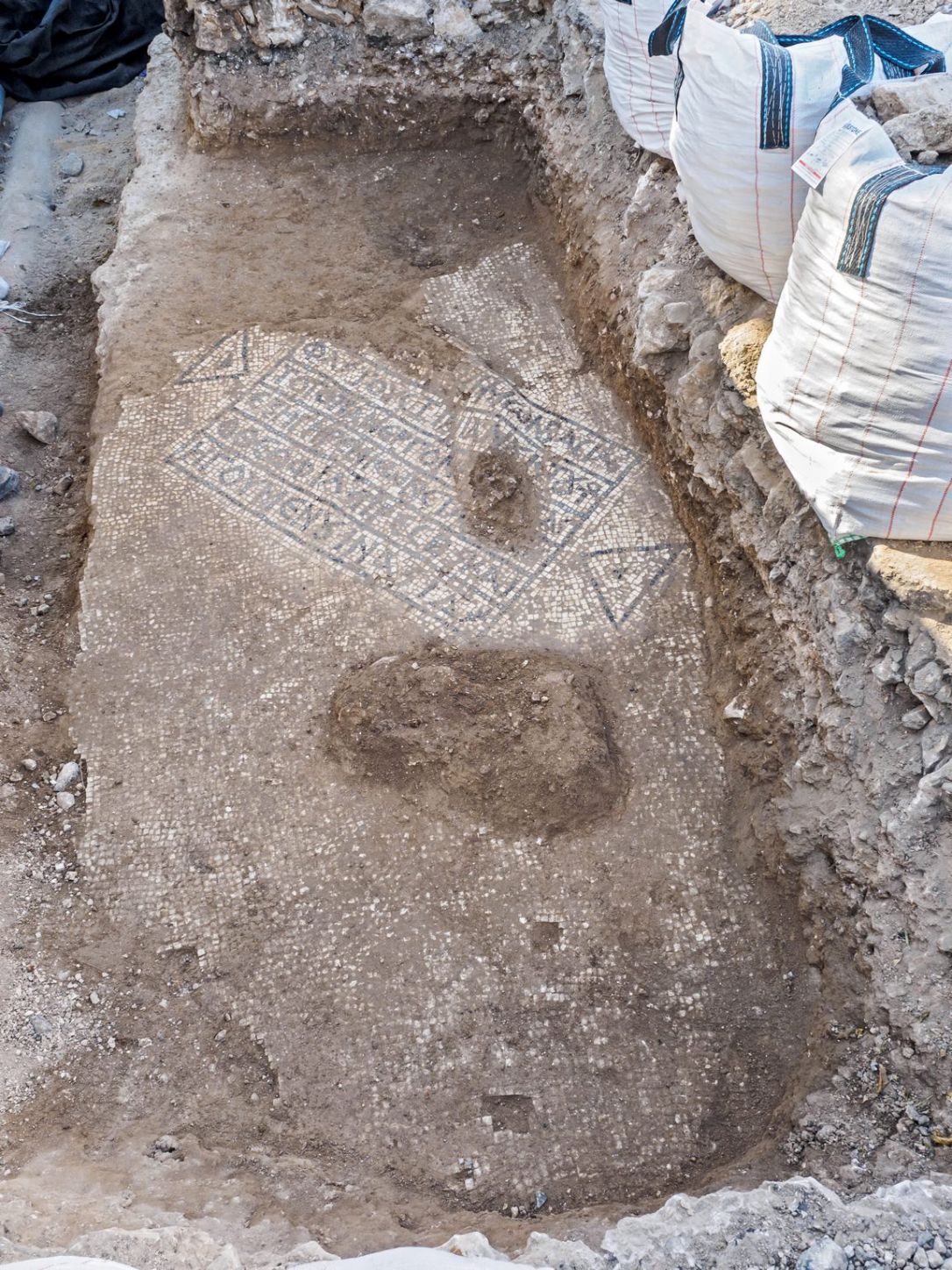
'In the time of our most pious emperor Flavius Justinian, also this entire building Constantine the most God-loving priest and abbot, established and raised, in the 14th indiction' 


(Haaretz)  -  The Nea was the biggest church in Jerusalem and one of the largest in the entire empire, and reportedly included a hospital, monastery and accommodation. Its abbot was Constantine, which explains why he and the emperor were mentioned in the inscription.

The Nea Church was considered so important that it even appears on the famous 6th-century mosaic Madaba Map of ancient Jerusalem (in the upper right corner of the city).

The Nea Church was badly damaged by the Persian invasion of Jerusalem in the year 614. Its remains – at least, the stones that hadn't been repurposed over the ages - were partially excavated in 1970, during archaeological exploration of the ancient Jewish quarter after the Six Day War in 1967.
Emperor Justinian

In one sense, finding the extraordinary mosaic by Damascus Gate was little surprise, say the archaeologists. For centuries, Damascus Gate had been the main northern entry point to Jerusalem, so it would naturally brim with archaeological remains, Gellman explains. 

"In the Byzantine period, with the emergence of Christianity, churches, monasteries and hostels for pilgrims were built in the area north of the gate, and the area became one of the most important and active areas of the city," he says.

"The fact that the inscription survived is an archaeological miracle," Gellman adds. The archaeological remains in that area had been severely damaged by infrastructure groundwork over decades, he explains. "We were about to close the excavation when all of a sudden, a corner of the mosaic inscription peeked out between the pipes and cables. Amazingly, it had not been damaged."

An inscription previously found in the vaults of the Nea Church also mentions both Constantine and the Emperor Justinian.

Justinian would reign from 527 C.E. to 565 C.E., during which time he would become famous for his judicial reforms, many of which seem strikingly modern, including protection for prostitutes, and for wives against extravagant husbands. 

The Nea Church in Jerusalem was far from his only architectural achievement: Justinian is also credited with building Saint Catherine's Monastery in the Sinai, in his very first year of rule, to encompass the chapel of the Burning Bush. Today the site is Greek Orthodox and is a UNESCO World Heritage Site.

And, Justinian is credited with the erection of the magnificent Hagia Sophia basilica in Istanbul. Built on the ruins of previous churches, the Hagia Sophia would be converted into a mosque in 1453, then into the museum it is today in 1935.

Haaretz

Excavating the New Church of Theotokos, also known as Nea Church

Mosaic mentioning Emperor Justinian found by Damascus Gate

Cleaning the mosaic floor of what appears to be a pilgrim's hotel in Jerusalem.

Nea Church in Jerusalem


Ruins of the Nea Church, Jerusalem.
k
Read More:
The Sack of Jerusalem by a Jewish - Persian Army

Monday, May 8, 2017

Farming on Roman Empire Desert Frontier


Olive trees were a major Byzantine frontier crop 

It Takes an Economy to 
Support an Empire

  • I found this wonderful little Internet article on the economy of the desert frontier of the Roman Empire.  Simply, you can't fund an empire and military machine without a strong economy and the tax revenue it generates.
  • So much information on the Eastern Roman economy and society was never written down by contemporaries. We have to use archaeological evidence and work backwards to paint a picture of the world at that time.


(Haaretz)  -  The tiny olive grove sits atop a dry canyon in the middle of the Negev desert, surrounded by barren hills and a few wisps of withering vegetation. Despite the parched setting, the ancient, gnarled trees are alive, their branches heavy with green leaves and ready to bear fruit.

Researchers believe these few trees, located a handful of kilometers outside the ruins of the ancient Byzantine settlement of Shivta, grew there through no fluke of nature. They may be among the last living witnesses to a complex civilization that built prosperous towns and farmed the Negev during the Byzantine period, more than 15 centuries before Zionists started imagining they could make Israel’s desert bloom.

Fresh research is shedding new light on these Byzantine desert dwellers – who were they? How did they shape their environment to such an extent? And why they ultimately, and quite mysteriously, abandon the lands they had fought for so hard?

Wine is still produced in the desert today
just as it was in Roman times.
Researchers say these questions are key not just for historians but for any society, including modern Israel, that wishes to develop and grow sustainably in an extreme environment like the desert.

“This was a complex society, so this question is very relevant to us, because the next time that the Negev was so densely settled was with Zionism and the creation of Israel,” says Haifa University archeologist Guy Bar-Oz. “It is very relevant for us to understand how they did it and what went wrong.”

From frankincense to farming

If we visited the central Negev 1,700 years ago, far from a barren wasteland peopled mainly by nomads and lizards, we would see a countryside dotted with farms and monasteries.

Vast fields of grain, olive groves and fruit orchards lined the wadis; vineyards produced some of the most popular wines in the ancient world. There were also at least seven large towns supporting trade and agriculture in the area.

Although their remains are listed by UNESCO as World Heritage sites, archaeologists have barely scratched the surface in some of them.

The regional capital, Halutza – once the seat of a bishop, public baths, churches and a theater – has largely been left buried under the sand, mostly due to lack of funds and frequent looting by local Bedouins.

The second largest Byzantine town in the area – Ruheibe, also known as "Rehovot in the Negev" – has been partially excavated. But it is difficult to access, including because it is surrounded by an Israeli army firing zone.

Still, archaeologists have managed to glean some information about the people who lived there, says Uzi Dahari, deputy director of the Israel Antiquities Authority, who in January published an article on research in Ruheibe in the Israeli journal Kadmoniot.

Palaestina Salutaris
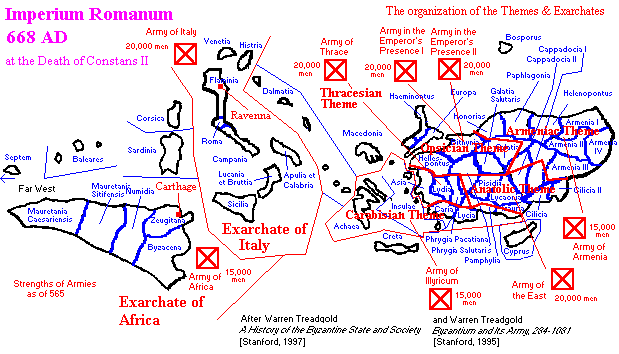
The Eastern Roman province of Palaestina Salutaris covered the area of the NegevSinai (except the north western coast) and south-west of Transjordan, south of the Dead Sea
.
The province, a part of the Diocese of the East, was split from Arabia Petraea in the 6th century and existed until the Muslim Arab conquests of the 7th century.

Tribal population of Nabateans

The inhabitants worshipped in churches and wrote in Greek, the Byzantine empire’s official language. But the architecture of towns like Ruheibe – clusters of small houses and tight winding alleys to keep the sand out and provide shade – point to a local, tribal population, Dahari says.

The names on the tombstones of Ruheibe’s cemetery and the morphology of dozens of skeletons that were dug up, further indicates that most of the inhabitants were Nabateans, Dahari told Haaretz during a visit to the site.

The Nabateans were a semi-nomadic Arab people best known for building the spectacular rock-cut city of Petra and a trade empire that brought spices and luxury goods from the Orient to the Mediterranean. In fact, the Byzantine towns of the Negev started out in pre-Roman times as Nabatean trading posts on the spice route between Petra and the port of Gaza. Later they also profited from the passage of Christian pilgrims between Jerusalem and St. Catherine’s Monastery in Sinai.

So why would rich merchants, fat on the profits from selling frankincense and myrrh, decide to settle down and become farmers?

“Imagine if we stopped using oil: what would happen to the Saudis?” says Dahari. “They could not go back to being nomadic shepherds, also because their numbers have increased, so they would have to use their money to create something else.”

An open-air Byzantine reservoir outside Ruheibe
used to collect winter rain.

How to capture the rain

And that’s probably what the Nabateans did. In the 3rd century C.E., the Roman empire underwent a political and economic crisis that disrupted trade routes. During the next two centuries, the fall of the Western empire and the spread of Christianity throughout the Mediterranean further reduced the demand for the luxury goods that the Nabateans had supplied.

“They could not move north, because during the Byzantine period, the Holy Land was very densely populated. So they had to settle and farm this land, possibly with the support of the Byzantine administration and outside experts,” Dahari explains.

The climate would not have been much different from today, with rainfall averaging around 100 millimeters a year, he says. So, their entire lives were centered on capturing and storing the rains that each year fall in the Negev during brief, violent showers.

The entire city was plastered and paved to channel water toward the cisterns dug in the courtyard of each house. Larger cisterns and open-air reservoirs were built in the surrounding countryside, along with wells that could reach the underground aquifer – up to 63 meters deep, like a 20-story building.

This system would have been just enough to provide water all-year round to satisfy the basic drinking and washing needs of the inhabitants, according to Dahari. But what about the fields?

For this, just around the town of Ruheibe, the inhabitants built 250 kilometers of terraces, dams and canals, using a vast 180,000 cubic meters of stone, according to a survey conducted by Dahari and his team. This system would be used to control the violent floods that usually follow the rare storms in the Negev. Instead of running off into the desert, the water would be channeled into the terraces, where it would soak the ground, helping to keep it moist for the rest of the year.

Parrotfish were imported from the sea to the desert.

Importing parrot fish

Similar systems have been found around other settlements in the area, including at Shivta, where a solitary olive grove still survives atop a stone terrace which, judging from the pottery archaeologists found there, was built in the Byzantine period. (Scientists are still working to try to date the trees).

“Once this system is working, it can provide the equivalent of 500 millimeters of rain instead of the average 100,” explains archaeologist Yotam Tepper. “But it’s very labor intensive. It requires constant maintenance: if one dam is breached, one terrace is damaged, the water escapes, the ground doesn’t get soaked and you lose everything.”

Despite the backbreaking work required, from the 4th to the 7th century C.E., the communities of the Negev did not merely survive, they thrived. Locals could afford to import exotic goods, like parrot fish from the Red Sea, hundreds of kilometers away. Meanwhile, they shipped their produce, including fruits, olive oil and especially wine across the Mediterranean and beyond.

The distinctive amphorae in which the sweet, highly alcoholic wines of the Negev were packaged have been found as far as Italy, France and Britain, says Bar-Oz.

And then, almost overnight, it all ended.

If you walk through the streets of Shivta and other Byzantine desert towns you notice something strange about the crumbling houses: most of the entrances were neatly sealed with large stones.

It’s as if one day the inhabitants packed up their belongings, sealed their homes and left, never to return.
Invading Muslim Arab Warriors may
have collapsed the local economy.

Why that happened remains a mystery, and is one of the key questions behind a project, led by Bar-Oz and funded by the European Union, to investigate the Byzantine Negev using advanced scientific methods.

Go north, young Nabatean?

Many theories have been put forward. It is however too early to draw conclusions, Bar-Oz says.

One preliminary study, based on dating samples from the ancient garbage dumps outside Halutza, suggest that organized refuse collection in the city abruptly ended around the year 540. This could point to a crisis connected to the Plague of Justinian, a pandemic that is estimated to have killed millions in Europe and the Middle East at that very time.

But there is little or no evidence in the area of mass graves or other signs of such a catastrophe, Bar-Oz notes.

Other data from the garbage dumps of Halutza indicates that as the years went on, locals used an ever-increasing amount of low-quality wood as fuel, which may suggest they were facing climate change.

Finally, one theory that historians have long favored, connects the decline of the Nabatean settlement of the Negev to the Muslim conquest in the first half of the 7th century.

However, there are few signs of violence and destruction in the Negev towns associated with the arrival of Mohammed’s followers. Many of the settlements, including Shivta, continued to be inhabited in the early Muslim period – albeit by a smaller population.

Dahari, the archaeologist who dug at Ruheibe, explains it all by theorizing that the Muslim takeover of the Middle East and the collapse of Byzantine control in the region meant the inhabitants of the Negev simply became freer to leave and seek greener pastures in more fertile areas of the Levant.

“You only live in the desert if you have to,” Dahari says. “The inhabitants here were Arabs, just like the new conquerors, so many probably converted to Islam and went north with their brethren.”


Charred grape seeds. (Photo: University of Haifa)
.
Read More:
1,500-Year-Old Charred Byzantine Grape Seeds Discovered in Israel’s Negev Desert


(Haaretz.com)      (Negev)