.

Dedicated to the military history and civilization of the Eastern Roman Empire (330 to 1453)


"Time in its irresistible and ceaseless flow carries along on its flood all created things and drowns them in the depths of obscurity."

- - - - Princess Anna Comnena (1083–1153) - Byzantine historian

Showing posts with label Turks. Show all posts

Monday, January 9, 2023

Defender Of A Byzantine Fort Was Decapitated By The Ottomans


(Forbes)  On the acropolis of ancient Abdera in western Thrace, within the fortress of Polystylon, archaeologists discovered a cemetery dating to the final throes of the battle between local Byzantine occupants and invading Ottoman Turks. A single decapitated skull found in the center of the burials may be evidence of the last human trophy head, removed from a defender of the fort.

In the early 1380s, residents of Polystylon made a stand against the Ottoman Turks encroaching upon their family land. It was the last Byzantine stronghold that the Ottomans vanquished along the shores of western Thrace, after all its neighbors fell to the Turks. 

During the final occupation of Polystylon, a large number of people perished and were buried inside the walls. About two-thirds were kids between the ages of 4 and 11, and almost all the rest were adult men. Although DNA work has not yet been completed, skeletal and dental variations on the bones show biological kinship. One sole female skeleton has been found in the Late Byzantine cemetery at Abdera, due either to the evacuation of women prior to the commencement of fighting or to their capture and removal during warfare.

The cemetery within the fortification walls of Polystylon was discovered in 1991 and contained at least 20 graves, all of which were studied by Anagnostis Agelarakis, a bioarchaeologist at Adelphi University. One particular grave, that of a young child, was found nearly dead center in the cemetery. Rows of nails were all that remained of a simple wooden coffin. The child wore bronze beads that likely formed a bracelet around the left wrist and had every indication of healthy teeth and a good quality diet. Also found next to the child was a single human head, that of a middle-aged adult male.


 PHOTO COURTESY A. AGELARAKIS / ADELPHI UNIVERSITY


"In my 30-plus years of working in bioarchaeology, it was the first time that I have uncovered such a find," Agelarakis tells me. "It's a truly spectacular time capsule of the Late Byzantine period safely preserved in the earth at Polystylon." In a recent report in the journal Byzantina Symmeikta, Agelarakis details the remains he studied and weaves a narrative of the fall of the fortress and decapitation of one of its last occupants.

Agelarakis's investigation of the adult skull revealed a traumatic injury to the front midline of the skull caused by a sharp blow from a heavy weapon that likely fatally penetrated the frontal lobe. The presence of three small neck vertebrae fragments and the jaw suggest that the head was still mostly fleshed at the time it was deposited near the child's grave, but no clear evidence of the location of the decapitation was found.

Because of this information, Agelarakis hypothesizes that the man may have been decapitated and his body unburied for a period of time. While the rest of the body has not been found, it is possible that someone pitied the man and clandestinely buried his head in the Late Byzantine cemetery. A large fragment of utilitarian pottery was found near the two bodies; it may have been used as a shovel, and then was left in the pit with the head after burial.

Beheadings are not commonly found on archaeological sites from this period, which means the timing of the injury and decapitation is particularly interesting. On the one hand, if beheading was the cause of the man's death, then the head trauma would have been the post-mortem mutilation. If the head wound preceded the beheading, though, then the decapitation would represent a post-mortem mutilation of the man's body.

"Historical records," Agelarakis writes, "provide ample narratives of both executions by impalement and beheading of combatants that had surrendered in battle against the Ottomans, and decapitations for the verification through trophy keeping of important individuals who had fallen while resisting Ottoman subjugation."


 A. AGELARAKIS / ADELPHI UNIVERSITY

The importance of the decapitated man may be seen in the trauma he suffered about a decade before his death. Agelarakis notes that he sustained a fracture of his lower jaw that healed, although not particularly well. While the exact mechanism of this injury is unknown, he may have broken his jaw falling from a horse, from being struck by a spear or dagger, or from being hit by a projectile.

To survive and thrive after such an injury suggests some amount of medical care was tendered to the man while he recuperated. It also may suggest that he was important to the people of Polystylon. Cutting off the man's head may therefore have been a "revengeful act of subjugation, a punishment toward worthy opponents, possibly aimed to belittle, dehumanize, and silence him forever," Agelarakis suggests.

Unusual cases of human skeletons are interesting to look at, but in the end, their importance rests with what new information they can provide about life in the past. As an example of healed trauma, the isolated head reveals evidence that practices detailed in the much earlier Hippocratic Corpus were followed, Agelarakis tells me. And as an example of decapitation, he says, "the warrior head adds valuable data to the historical record of the time period and the relative dating of the Polystylon fortress."


Forbes.com

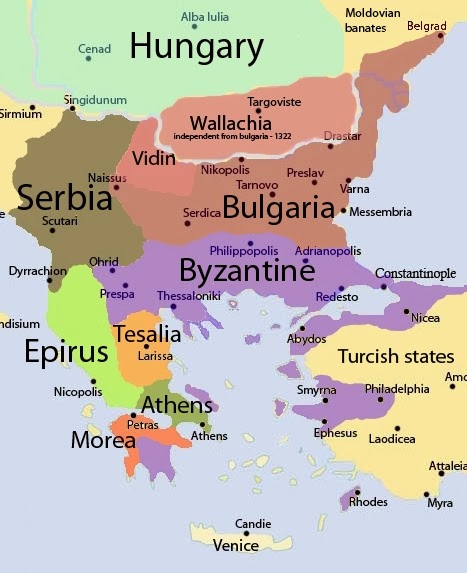
The Byzantine Empire in the early 1300s.


Thursday, August 12, 2021

Battle of Myriokephalon - Seljuks vs Romans (1176AD)


Late Roman / Eastern Empire dart throwing infantry.
While uniforms and armor varied over the centuries the basics changed very little.


A Declining Roman Empire?

Maybe Not.


The Battle of Manzikert in 1071 has always been the point in time historians say marked the decline of the Eastern Roman Empire.

But is that true?

The Roman Republic and Empire had recovered again and again from military defeats. In this article we see over 100 years after Manzikert that the Roman Army was still able to mount major campaigns against the Turks in Anatolia, in the Balkans, in Italy and in Egypt. The Romans held their lands and even expanded.

In my view the "decline" of the Eastern Empire had a lot more to do with the treachery of the Crusaders in 1204 and their sack of Constantinople. The sack of the city happened only 28 years after this battle.

Background

Between 1158 and 1161 a series of Roman campaigns against the Seljuk Turks of the Sultanate of Rûm resulted in a treaty favorable to the Empire, with the Sultan recognizing a form of subordination to the Roman Emperor.

Immediately after peace was negotiated the Seljuk sultan Kilij Arslan II visited Constantinople where he was treated by Emperor Manuel I Komnenos as both an honored guest and an imperial vassal. Following the Sultan's visit there was no overt hostility between the two powers for many years.

BOTTOM LINE - The Turks badly wanted to expand over to the coast, but they took one look at the Roman Army and declined to take action.

The Romans took advantage of this peace to expand their power. 

Emperor Manuel I Komnenos pursued an energetic and ambitious foreign policy. In the process he made alliances with Pope Adrian IV and the resurgent West. He invaded the Norman Kingdom of Sicily, although unsuccessfully, He was the last Eastern Roman emperor to attempt reconquests in the western Mediterranean

In the East, the Emperor recovered Cilicia from local Armenian dynasts and managed to reduce the Crusader Principality of Antioch to vassal status.

The passage of the potentially dangerous Second Crusade through his empire was adroitly managed. Manuel established a Roman protectorate over the Crusader states. Facing Muslim advances in the Holy Land, he made common cause with the Kingdom of Jerusalem and participated in a combined invasion of Fatimid Egypt. Manuel reshaped the political maps of the Balkans and the eastern Mediterranean, placing the kingdoms of Hungary and Outremer under Roman hegemony.

While the Romans were rebuilding their power so were the Turks. 

Kilij Arslan used this peaceful period to destroy the Danishmend emirates of eastern Anatolia and also eject his brother Shahinshah from his lands near Ankara. Shahinshah, who was Manuel's vassal, and the Danishmend emirs fled to the protection of Rome. 

In 1175 the peace between the Empire and the Sultanate of Rûm fell apart when Kilij Arslan refused to hand over to the Romans, as he was obliged to do by treaty, a considerable proportion of the territory he had recently conquered from the Danishmends.

Both side moved to a new war.

Strengthening the Economy

Here is a good spot to review the growing power of the Romans.

Former money changer Michael IV the Paphlagonian (1034–41) assumed the throne in 1034 and began the slow process of debasing the gold coins

The debasement was gradual at first, but then accelerated rapidly. about 21 carats (87.5% pure) during the reign of Constantine IX (1042–1055), 18 carats (75%) under Constantine X (1059–1067), 16 carats (66.7%) under Romanus IV (1068–1071), 14 carats (58%) under Michael VII (1071–1078), 8 carats (33%) under Nicephorus III (1078–1081) and 0 to 8 carats during the first eleven years of the reign of Alexius I (1081–1118).

Under Alexius I Comnenus (1081–1118) the debased solidus (tetarteron and histamenon) was discontinued and new gold coinage of higher fineness (generally .900-.950) was established, commonly called the hyperpyron.

Income to the Roman Treasury is a vital measurement of the strength of the state.

The exact amount of annual income the Roman government received, is a matter of considerable debate, due to the scantiness and ambiguous nature of the primary sources. The following table contains approximate estimates.

YearAnnual Revenue
3059,400,000 solidi/42.3 tonnes of gold
4577,800,000 solidi
5188,500,000 solidi
5335,000,000 solidi
54011,300,000 solidi/50.85 tonnes of gold
5556,000,000 solidi
5658,500,000 solidi
6413,700,000 nomismata
6682,000,000 nomismata
7751,800,000 nomismata
7752,000,000 nomismata
8423,100,000 nomismata
8503,300,000 nomismata
9594,000,000 nomismata
10255,900,000 nomismata
11505,600,000 hyperpyra
13031,800,000 hyperpyra
13211,000,000 hyperpyra

Click to enlarge map
.
A map of the Roman Empire showing the location of Myriokephalon.


The Empire Was NOT in Decline

With 20-20 hindsight historians jump on the decline of the Empire side.

To me three factors show the Empire was not in decline: 

  1. The improved Roman political and military position in the Balkans and in the East; 
  2. The improved value of the nation's gold coins; 
  3. And the steady growth since 775 AD on (above chart) tax income to the treasury.

Yes there were problems, but when did problems not exist for any nation?

While not at a peak of power it is fair to say the Empire had recovered from Manzikert and was growing its power.


A Mamluk soldier by Carle Vernet, 1822.
Mamluk translated as "one who is owned", meaning "slave", is a term most commonly referring to non-Arab, ethnically diverse Muslim slave-soldiers and freed slaves to which were assigned military and administrative duties.


The Roman Army

All sources agree that the Emperor gathered an exceptionally large army to teach the Turks a lesson.

One historian puts Manuel's army at around 35,000 men. The number is derived from the fact that sources indicated a supply train of 3,000 wagons accompanied the army, which was enough to support 30,000–40,000 men.  

The army may have contained 25,000 Roman troops with the remainder composed of an allied contingent of Hungarians sent by Manuel's kinsman Béla III of Hungary and tributary forces supplied by the Principality of Antioch and Serbia.

The main division of the army consisted of the eastern and western Imperial Tagmata Regiments. The vanguard was mostly infantry with some cavalry units. The right wing was largely composed of Westerners led by Baldwin of Antioch (Manuel's brother-in-law). 

Then we have baggage and siege trains. The Roman left wing, led by Theodore Mavrozomes and John Kantakouzenos; then comes the Emperor and his picked troops; and finally the rear division under the experienced general Andronikos Kontostephanos.

The Seljuk Army

Modern historians have estimated that the various Seljuk successor states (such as the Sultanate of Rum) could field at most 10,000–15,000 Turks. 

This is likely a closer estimate for the possible Seljuk strength at Myriokephalon considering the much larger and united Seljuk Empire fielded around 20,000–30,000 men at the Battle of Manzikert in 1071. 

The Sultanate of Rum was much smaller territorially than the Seljuk Empire and probably had smaller armies, for example, its army at the Battle of Dorylaeum in 1097 has been estimated at between 6,000–8,000 men.

The Seljuk army consisted of two main sections: the askars of the sultan and of each of his emirs, and an irregular force of Turkoman tribesmen. The askari (Arabic for 'soldier') was a full-time soldier, often a mamluk, a type of slave-soldier though this form of nominal slavery was not servile. 

They were supported by payments in cash or though a semi-feudal system of grants, called iqta'. These troops formed the core of field armies and were medium to heavy cavalry; they were armored, and fought in coherent units with bow and lance. 

In contrast, the Turkoman tribesmen were semi-nomadic irregular horsemen, who served under their own chieftains. They lived off their herds and served the sultan on the promise of plunder, the ransom of prisoners, for one-off payments, or if their pasturelands were threatened. These tribesmen were unreliable as soldiers, but were numerous, and were effective as light mounted archers, adept at skirmish tactics.


The Battle - September 17, 1176

The Emperor assembled the full Imperial army and marched against the Seljuk capital of Iconium. Manuel's strategy was to prepare the advanced bases of Dorylaeum and Sublaeum, and then to use them to strike as quickly as possible at Iconium.

The battle took place near Lake Beyşehir.

Speed may have been the goal, but Manuel's army of 35,000 men was large and unwieldy. According to a letter that Manuel sent to King Henry II of England, the advancing column was ten miles long.

The Turks destroyed crops and poisoned water supplies to make Manuel's march more difficult. King Arslan harassed the Roman army in order to force it into the Meander valley, and specifically the mountain pass of Tzivritze near the fortress of Myriokephalon.

IMPORTANT - Just outside the entrance to the pass at Myriokephalon, Manuel was met by Turkish ambassadors, who offered peace on generous terms. The Sultan saw a Roman army perhaps three times the size of his own force and offered peace.

The mistake came from the Roman leadership. Most of Manuel's generals and experienced courtiers urged him to accept the offer. The younger and more aggressive members of the court urged Manuel to attack, however, and he took their advice and continued his advance into a narrow pass.

The lack of forage, and water for his troops, and the fact that dysentery had broken out in his army may have induced Manuel to decide to force the pass regardless of the danger of ambush.

Manuel made serious tactical errors, such as failing to properly scout out the route ahead. These failings caused him to lead his forces straight into a classic ambush.


Maria of Antioch with Emperor Manuel I Komnenos

In this matter the Emperor, at a minimum, acted foolishly to pass up a peace proposal and acted recklessly to march a 10 mile long army column into a narrow pass that was not properly scouted.

The Roman vanguard was the first to encounter King Arslan's troops. They went through the pass with few casualties, as did the main division. Possibly the Turks had not yet fully deployed in their positions.

The Roman divisions sent their infantry up onto the slopes to dislodge the Seljuk soldiers, who were forced to withdraw to higher ground. The following divisions did not take this precaution, also they were negligent in not maintaining a defensive formation of closed ranks and they did not deploy their archers effectively.

By the time the first two Roman divisions exited the far end of the pass, the rear was just about to enter; this allowed the Turks to close their trap on those divisions still within the pass.

The Turkish attack, descending from the heights, fell especially heavily on the Roman right wing. This division seems to have quickly lost cohesion and been broken, soldiers fleeing one ambush often running into another. Heavy casualties were sustained by the right-wing and its commander, Baldwin, was killed.

The Turks then concentrated their attacks on the baggage and siege trains, shooting down the draught animals and choking the roadway.

The left-wing division also suffered significant casualties and one of its leaders, John Kantakouzenos, was slain when fighting alone against a band of Seljuk soldiers.

The remaining Roman troops were panicked by the carnage in front of them and the realization that the Turks had also begun to attack their rear. The sudden descent of a blinding dust-storm did nothing to improve the morale or organization of the Roman forces, though it must have confused the Seljuk troops also.

At this point, Manuel seems to have suffered a crisis of confidence and reputedly sat down, passively awaiting his fate and that of his army.

The Emperor was eventually roused by his officers, re-established discipline and organized his forces into a defensive formation; when formed up, they pushed their way past the wreck of the baggage and out of the pass.

Debouching from the pass they rejoined the unscathed van and main divisions, commanded by John and Andronikos Angelos, Constantine Makrodoukas and Andronikos Lampardas. Whilst the rest of the army had been under attack in the pass the troops of the van and main divisions had constructed a fortified encampment. The rear division, under Andronikos Kontostephanos, arrived at the camp somewhat later than the emperor, having suffered few casualties.

The night was spent in successfully repulsing further attacks by Seljuk mounted archers. Niketas Choniates states that Manuel considered abandoning his troops but was shamed into staying by the scathing words of an anonymous soldier and the disapproval of a shocked Kontostephanos. However, this would appear to be hyperbole on the historian's part as Manuel would have placed himself in much greater danger by flight than if he remained in the midst of his army. 

The following day, the Turks circled the camp firing arrows; Manuel ordered two counterattacks, led by John Angelos and Constantine Makrodoukas respectively, but there was no renewal of a general action.


Eastern Empire reenactors. The headwear shows the 
influence of the Arabs they fought for centuries.

Outcome

The Roman siege equipment had been quickly destroyed, and Manuel was forced to withdraw – without siege engines, the conquest of Iconium was now impossible.

Both sides had suffered casualties, though their extent is difficult to quantify. Modern historians have postulated that about half of the Roman army was engaged and around half of those became casualties.

As the Roman army moved back through the pass after the battle it was seen that the dead had been scalped and their genitals mutilated, "It was said that the Turks took these measures so that the circumcised could not be distinguished from the uncircumcised and the victory therefore disputed and contested since many had fallen on both sides."

Also the Seljuk Sultan was keen for peace to be restored as soon as possible; he sent an envoy named Gabras, together with gifts of a Nisaean warhorse and a sword, to Manuel in order to negotiate a truce. As a result of these negotiations, the Roman army was to be allowed to retreat unmolested on condition that Manuel destroy his forts and evacuate the garrisons at Dorylaeum and Sublaeum in the Roman-Seljuk borderlands.

However, despite Kilij Arslan's protestations of good faith, the retreat of the Roman army was harassed by the attacks of Turkoman tribesmen. This, taken with an earlier failure by the sultan to keep his side of a treaty signed in 1162, gave Manuel an excuse to avoid observing the terms of this new arrangement in their entirety. He therefore demolished the fortifications of the less important fortress of Sublaeum but left Dorylaeum intact.

The defeat at Myriokephalon has often been depicted as a catastrophe in which the entire Roman army was destroyed. Manuel himself compared the defeat to Manzikert.

In reality, although a defeat, it was not too costly and did not significantly diminish the Roman army. Most of the casualties were borne by the right wing, largely composed of allied troops commanded by Baldwin of Antioch, and also by the baggage train, which was the main target of the Turkish ambush.

In a message to Constantinople the Emperor: "Then extolled the treaties made with the sultan, boasting that these had been concluded beneath his own banner which had waved in the wind in view of the enemy's front line so that trembling and fear fell upon them." 

It is notable that it was the sultan who initiated peace proposals by sending an envoy to Manuel and not the reverse. The conclusion that Kilij Arslan, though negotiating from a position of strength, did not consider that his forces were capable of destroying the Roman army is inescapable. A possible reason for Kilij Arslan's reluctance to renew the battle is that a large proportion of his irregular troops may have been far more interested in securing the plunder they had taken than in continuing the fight, thus leaving his army seriously weakened.

The limited losses inflicted on native Roman troops were quickly recovered, and in the following year Manuel's forces defeated a force of "picked Turks". John Komnenos Vatatzes, who was sent by the Emperor to repel the Turkish invasion, not only brought troops from the capital but also was able to gather an army along the way. Vatatzes caught the Turks in an ambush as they were crossing the Meander River; the subsequent Battle of Hyelion and Leimocheir effectively destroyed them as a fighting force. 

This is an indication that the Roman army remained strong and that the defensive program of western Asia Minor was still successful. After the victory on the Meander, Manuel himself advanced with a small army to drive the Turks from Panasium, south of Cotyaeum.

Manuel continued to meet the Seljuks in smaller battles with some success, and concluded a probably advantageous peace with Kilij Arslan in 1179. However, like Manzikert, Myriokephalon was a pivotal event and following it the balance between the two powers in Anatolia gradually began to shift, and subsequently, the Eastern Empire was unable to compete for dominance of the Anatolian interior.


This image by Gustave Doré shows the Turkish ambush at the pass of Myriokephalon. This ambush destroyed Manuel's hope of capturing Konya.


Click to enlarge map


(Manuel I Komnenos)    (Byzantine economy)    (Byzantine coinage)

(Myriokephalon)    (Mamluk)


Read More:
.


Monday, April 20, 2020

Romans vs Turks in Anatolia - Anna Comnena


11th Century Eastern Roman Reenactor

Warfare on the Eastern Front
A contemporary historian's account


Military Reform

At the beginning of the Komnenian Dynasty period in 1081, the Eastern Roman Empire had been reduced to the smallest territorial extent in its history. Surrounded by enemies, and financially ruined by a long period of civil war, the empire's prospects had looked grim. 

Through a combination of determination, military reform, and years of campaigning, Alexios I Komnenos, John II Komnenos and Manuel I Komnenos managed to restore the power of the Empire.

During the reign of Alexios I, the field army may have numbered around 20,000 men. By 1143, the entire Roman Army has been estimated to have numbered about 50,000 men. The total number of mobile professional and mercenary forces that the Emperor could assemble was about 25,000 soldiers while the static garrisons and militias spread around the empire made up the remainder. 

During this period, the European provinces in the Balkans were able to provide more than 6,000 cavalry in total while the Eastern provinces of Anatolia provided about the same number. This amounted to more than 12,000 cavalry for the entire Empire, not including those from allied contingents.

The reconstructed Roman Army played an important role in providing the empire with a period of security that enabled Roman civilization to flourish.

The Alexiad of Anna Comnena
Book XV


EDITOR - The "Alexiad" of Anna Comnena is one of only two great histories of the Eastern Roman Empire - the other being "The History of the Wars" by Procopius. 

In Book XV below Anna goes into enormous detail about the battles against the Turks in Anatolia. I had great difficulty editing the content down to a more readable size for the casual military history reader. Those wanting the full chapter can click the link at the bottom. Enjoy.


The doings of the Emperor in Philippopolis and with regard to the Manichaeans were such as I have related; after that a fresh potion of troubles was brewed for him by the barbarians. For the Sultan Soliman was planning to devastate Asia again and assembled his forces from Chorosan and Chalep [*=Berroea (now Aleppo)] to see whether he might possibly be able to resist the Emperor successfully. As the whole of the Sultan Soliman's plan had already been reported to the Emperor, he contemplated advancing as far as Iconium. with his army and there forcing him into a closely contested battle. For that town formed the boundaries of the Sultanicium of Clitziasthlan. Therefore he solicited troops from foreign countries, and a large mercenary force, and called up his own army from all sides. 

Then, whilst these two generals were making preparations against each other, the old trouble in his feet attacked the Emperor. And forces kept coming in from all quarters, but only in driblets, not all together, because their countries were so far away, and the pain prevented the Emperor not merely from carrying out his projected plan, but even from walking at all. And he was vexed at being confined to his couch not so much because of the excessive pain in his feet, but by reason of the postponement of his expedition against the barbarians. The barbarian Clitziasthlan was well aware of this and consequently despoiled the whole of Asia at his leisure during this interval and made seven onslaughts upon the Christians.

After a short interval he was relieved from pain and commenced his projected journey. He ferried over to Damalis, then sailed across the straits between Cibotus and Aegiali, disembarked at Cibotus and went on to Lopadium to await the arrival of his armies and the mercenary army he had engaged. When they were all assembled he moved away from there with all his forces and occupied the fort of Lord George close to the lake outside Nicaea, and thence on to Nicaea. 

Then after three days he returned and encamped on this side of the bridge of Lopadium near the fountain of Caryx as it was called; for he thought best to send the army over the bridge first to pitch their tents in a suitable spot and then to cross himself by the same bridge and erect the imperial tent in company with all the army. 

But the wily Turks were devastating the plain lying at the foot of the Lentianian hills and the place called Cotoeraecia, and on hearing of the Emperor's advance against them, they were terrified and immediately lighted a number of beaconfires, thus giving beholders the illusion of a large army. And the sky was lighted up by these fires and frightened many of the inexperienced soldiers but nothing of all this troubled the Emperor. 


East Roman Reenactors  -  (Twitter)
kk
Emperor Alexios I Komnenos &
wife Empress Irene Doukaina
kk
I have no idea where this image came from. A movie perhaps. A historical festival. The picture gives us a good feel for the period.


Then the Turks collected all the booty and prisoners and went away; and at dawn the Emperor hastened after them to the plain (already mentioned] with the desire of overtaking them on the spot, but he missed his quarry. On the contrary he found a number of Romans still breathing, and many corpses, which naturally enraged him. But he was very anxious to pursue the Turks so as not to lose all his prey, and, as it was impossible for the whole army to follow up the fugitives quickly, he pitched his palisades on the spot near Poemanenum and selecting at once a detachment of brave light-armed soldiers, he entrusted them with the pursuit of the barbarians and told them which road to take after the wretches. 

These soldiers overtook the Turks with all their booty and captives at a place called Cellia by the natives and rushed upon them like fire and soon killed most of them but took a few alive and after collecting all the booty there they returned brilliantly victorious to the Emperor.

After welcoming them and learning of the total destruction of the enemy he returned to Lopadium. When he reached it he stayed in that town for three whole months partly because of the want of water in the districts he would have to pass through (for it was the summer-season and the heat was intolerable) and partly because he was waiting for part of the mercenary army which had not yet arrived. But when they had all assembled, he shifted his camp and quartered his army between the ridges of Olympus and of the mountains called Malagni and himself occupied Aër. 

The Empress meanwhile was lodging at Principus, as from there she could more easily have news of the Emperor after his return to Lopadium. Directly the Emperor went to Aër, he sent the imperial galley to fetch her, firstly because he was always dreading the pain in his feet, and secondly through fear of his bosom enemies who were accompanying him, and thus he wanted her both for the extreme care she took of him, and for her most vigilant eye.

Now my father, the Emperor, sometimes overcame his adversaries by prowess, and at others by his quick wit, for even during a battle he occasionally thought out some clever device and by daringly using it at once carried off the victory. By making use of stratagems on some occasions, and on others by hard fighting he often and unexpectedly set up trophies. If there ever was a man who was fond of danger, it was he, and dangers could be seen continually rising up in his path, and at times he would walk into them bare-headed and come to close quarters with the barbarians, and at others again he would pretend to decline battle, and act the frightened man, if the occasion demanded it and circumstances advised it. 


Eastern Roman Varangian Guard
A Hungarian reenactor's armor and comments
.
"The kit is mainly based on the Alexiad, most notably on the comments of Anna Komnena about the Varangian Guard. This character is of Scandinavian origin, in service of the Byzantine army, rather than the eastern rus contingent of 6000 warriors who formed the core of the Guard later in 988, if I recall correctly. Therefore I based most of the armour and clothing on the Gjermundbu, Birka and Valsgärde finds, with exception of the leather vest. It has a debated origin that byzantine troops used this type of vests along scale and lamellar armour. I refrained to acquire a lamellar armor as the Wisby find turned out to be a "hoax", well not a hoax, only it was originated centuries later. I also looked up on a large number of byzantine manuscripts about guardsmen, but they weren't really helpful aside from the clothing.
.
The kit is still incomplete, as I still miss a shield, a proper shoes (will be also based on Birka) and an authentic belt, but I'll have them as well soon enough...
A limb guards were based on the first misinterpreted Valsgärde find, it's not a complicated design, as you can see..
The gloves, well, those are of course a hoax as we don't have a find or manuscritp up to date about protective gloves from this era. But I'm not too keen to lose a finger or two, or my hand entirely, so I gotta wear something. 
Yeah, I too think the pale leather stands out, and I'm about to dye it darker if I'll have the time and proper materials for it.
(deviantart)

Or to put the whole matter concisely, he prevailed when he fled, and conquered when he pursued, and falling he stood, and dropping down he was erect on the principle of caltrops which always stick upright however you throw them.

As long as the Emperor pitched his tent there (in Nicomedia) he had nothing else to do besides enrolling recruits in the army and training them carefully in the art of stretching the bow, wielding the spear, riding on horseback, and making various formations. 

He also taught the soldiers the new system of marshalling the lines which he had invented himself ; now and again he would ride with them and review the phalanxes and give seasonable suggestions. 

But the sun was now returning from its large circuits, and as the autumn equinox was passed, it was already inclining to the more southern circuits, this seemed a season well-adapted for taking the field, so with all his forces he marched straight for Iconium according to the plan he had originally proposed to himself. Then on reaching Nicaea he detached a body of light troops with experienced leaders from the rest of the army and ordered them to go on ahead and in separate divisions make sallies upon the Turks and go foraging. But, if God gave them the victory and they routed the enemy, he advised them in no case to continue their raid, but be satisfied with the victory given them and at once make an orderly retreat. 

So they all with the Emperor occupied a place situated . . . and locally called Gaita, and there the one lot went off, while he moved on from there with all his forces and held the bridge over the river Pithecas. Then in three days' march by way of Armenocastrum and the so-called Leucae he reached the plains of Doryleum. He saw that these were large enough for marshalling his troops and being anxious to review them all and find out exactly his military strength, he seized this opportune moment and drew up his soldiers, in very reality in the battle-order for which he had so long been yearning and so often described on paper when planning this arrangement (for he was well-versed in Aelian's tactics); and then he set up his camp in the plain. 

For he knew from very long experience that the Turkish battle-order did not agree at all with that of other nations, for with them "shield did not rest upon shield, and helmet upon helmet and man upon man " as Homer says, but the Turks' right and left wing, and centre were quite disconnected and the phalanxes stood as if severed from each other.  Consequently if you attacked the right or left wing, the centre would swoop down upon you and all the rest of the army posted behind it, and like whirlwinds throw the opposing body into confusion. 

Peltistes and Archers
11th Century Eastern Roman military
The 4th and 7th ranks may contain an additional kontaratos, but often these positions and the 5th and 6th ranks are filled by peltistes ( lighter armed missle-throwing (javelin and slingers) or archery soldier). The javelin men also detached sometimes to act as skirmishers.
(kismeta.com)

Now for their weapons of war:-they do not use spears much, as the Franks do, but surround the enemy completely and shoot at him with arrows, and they make this defence from a distance. When he pursues, he captures his man with the bow; when he is pursued he conquers with his darts ; he throws a dart and the flying dart hits either the horse or its rider, and as it has been dispatched with very great force it passes right through the body; so skilled are they in the use of the bow. 

Having noticed this from long experience the Emperor arranged his lines and phalanxes in such a way that the Turks should shoot from the right side, the side on which the shields were advanced, and that our men should shoot from the left, the side on which the Turks' bodies were unprotected. And he himself imagined that this order of battle would be invincible, and marvelled at its strength and looked upon it as an arrangement directly inspired by God and a marshalling due to the angels. And everybody else admired and rejoiced in it and took fresh courage from the Emperor's invention. And when he himself thought about his forces and the plains through which he was soon to pass and reflected that his battle-order was solid and not easily broken, his hopes rose high and he prayed to God to bring them to fulfilment.

. . . . some soldiers came to him and said there were an immense number of barbarians in the small towns situated quite near of the once celebrated hero, Burtzes. Directly the Emperor had heard their report, he repared for action. He instantly summoned a descendant of 1he famous Burtzes, Bardas by name, and George Lebunes, and a Scythian called Pitican in his native tongue, brought up the troops under them to a sufficiently strong force and dispatched them against the Turks, and gave them orders that when they got there they were to send out foragers to lay waste all the neighbouring villages, and then drive out all the natives from their homes and bring them to him. 

So these men at once started on the journey assigned them, but the Emperor, holding to his former purpose, hastened to reach Polybotum and thence hurry on as far as Iconium. With these intentions he was on the point of commencing his task when he received reliable information that the barbarians and the Sultan Soliman himself on hearing of his approach, had set fire to all tile crops and plains in Asia, so that there was no sustenance at all for man or beast. Another incursion of barbarians from the higher countries was heralded too, and the rumour flew quickly throughout Asia. So he was afraid for one thing that during his march to lconium his whole army might fall a prey to famine owing to the lack of food . . . .

As the Turks had not tasted water at all during the fight on the previous day, they now took possession of the banks of the river, and quenched their burning thirsts and then returned to the fight in batches. For while one party continued the battle, the other tired-out party refreshed itself by drinking the water. Burtzes seeing the barbarians' consummate boldness and worried to death by their numbers, felt quite helpless, and so did not send one of the common soldiers to carry news of his straits to the Emperor, but the George Lebunes I have already mentioned. 


Unarmored Skutatos
Byzantine Infantry, 11th Century

kk
The file closer and the one in the 3rd rank may be armored only with a heavy padded coat (kavadion)and felt cap wrapped in a turban. He would likely be within the 3rd-7th rank of a foulhon, but may be front ranker is less well equipped units. This skutatos is also similarly attired to a peltistes (or lighter armed missile-throwing or archery soldier) while the first rank or two of the foulhon  might be hoplites in metal armor. With my shield I am well protected from the front, and the most likely danger to my side or rear - arrow strikes - are fairly well protected against by the padded coat. I might also be called a  kontaratos for my kontarion (or makron) - 16 foot pike, which is wielded 2-handed or one handed.
(www.kismeta.com)


As Lebunes could see no path which was not held by a number of Turks, he threw himself recklessly into the midst of them, pushed his way through and got safely to the Emperor. When the latter heard the news about Burtzes and found out fairly accurately the number of Turks, he realized that Burtzes required a large number of reinforcements, so he speedily got under arms himself and ordered the army to do likewise. Then with the army drawn up in phalanxes he advanced against the barbarians in good order. The front wing was held by Prince [Michael], the right by Bryennius, the left by Gabras and the rear by Cecaumenus. 

As the Turks stood awaiting them at a distance, Nicephorus, the Empress' nephew, who was young and longing to fight, rode on ahead of the line and taking with him a few more devotees of Ares, engaged the first man who attacked him and received a wound in the knee, but struck the man who wounded him in the chest with his spear. And the Turk straightway fell from his horse and lay speechless on the ground, and the others behind him on seeing this at once turned their backs upon the Romans. The Emperor received the brave young man with delight and praised him highly and continued his march to Philomelium.

Next he selected various units from the whole army and placing them under brave leaders dispatched them to villages situated round about Iconium to despoil these and deliver the captives out of the Turks' hands. Accordingly they scattered themselves over the country like wild beasts, brought back the barbarians' prisoners in droves to the Emperor and then returned with the prisoners' baggage after freeing them all. 

EDITOR - This is a great description of a Roman infantry square. The role and power of the Late Roman infantry is at best downplayed and most of the time ignored by historians.

And the inhabitants of those regions who were Romans followed them of their own accord fleeing from servitude to the barbarians; there were women with babies, even men, and children, all rushing to the Emperor as if to a place of refuge. He then drew up his lines in the new formation with all the captives, women and children enclosed in the centre, and returned by the same road as he had come, and whatever places he approached, he passed through with perfect safety. And had you seen it, you would have said a living walled city was walking, when the army was marching in the new formation we have described.

But the Emperor rode before the line like a tower or pillar of fire or some divine and heavenly vision, exhorting his men and bidding them March on in the same formation and be of good cheer, and added that it was not for his own safety that he had undertaken this toilsome business but for the honour and glory of the Roman Empire, and moreover he was quite ready to die on behalf of them all. All took courage at his words and each kept his own place and went on marching at his ease; so much so that to the barbarians they did not even appear to be moving. 


Dekarklos- Skutatos
hh
My armor is complete and shield has a spike and the the 2nd ranker does not have a spike, for fairly obvious reasons.   Hey what's wrong with this picture? ( I am wearing the armor backwards.) 2nd rank might have somewhat lighter armor.
(Kismeta.com)

Throughout the whole of the day the Turks kept attacking the Roman army without any success, for they were unable to break it up either entirely or even partially, so they ran back to the hills without accomplishing anything and lighted a great many bonfires and howled all through the night like wolves and occasionally made jeering remarks at the Romans; for there were some semi-barbarians among them who spoke Greek.

EDITOR - I found the highlighted sections above interesting. The Turkish cavalry tried over and over to break the Roman infantry square without success. 

When Nicephorus saw that the battle had become a hand-to-hand contest, he dreaded a defeat and therefore wheeled round with all his troops and hastened to their aid. Hereupon the barbarians turned their backs and with the Sultan Clitziasthlan himself they fled at full speed and hurried back to the hills. Many fell in the battle on that occasion, but more were captured; and the survivors all scattered. 

The Sultan himself in desperate fear escaped with only his cupbearer and climbed up to a chapel built on a mountain top, round which very tall cypresses stood in rows, as he was hard pressed by three Scythians and the son of Uzas who were pursuing him; there he turned off in another direction, and, as he was not known to his pursuers, he himself escaped, but the cupbearer was seized by the Scythians and offered to the Emperor as a great prize. 

The Emperor rejoiced at this signal victory and in having prevailed over his enemies, but was vexed that the Sultan himself had not fallen into their hands too and been captured, but was saved 'by the skin of his teeth,' as the proverb goes. Evening had now overtaken them so he encamped on the spot, and the barbarians who had survived again mounted to the hilltops, lighted exceedingly many fires and barked the whole night long at the Romans like dogs.

For the Sultan had again collected his forces and now encircled the army and attacked it from every side; yet he did not manage to break through the close ranks of the Romans at any point, but as though he had attacked walls of adamant he had to retire without accomplishing anything. Therefore all through that night in vexation of spirit and despair he took counsel with Monolycus and the rest of the satraps, and when the light of day appeared he sued the Emperor for terms of peace, as all the satraps thought this the best thing to do. 

The Emperor did not reject, but received, their petition and immediately gave the order for the sounding of the recall, but ordered that the men should keep quiet and halt as they were, and not get off their horses or unload the baggage from the sumpter beasts, but halt protected by shield, helmet and spear as they had been throughout the whole journey. This order was given by the Emperor for no other reason but this, that, if confusion [405] arose, the line might perhaps be broken and in that case all could easily be captured. For he feared the host of Turks which be saw was very great, and was afraid they might attack the Roman army from all sides.

(The Emperor and Sultan meet.)  After a short silence he made known to him all he had decided upon, saying, "If you are willing to submit to the Roman Empire and cease your onslaughts on the Christians, you shall enjoy favours and honour and live at peace for the rest of your life in the countries assigned you, where you formerly had your dwellings before Romanus Diogenes took over the reins of government and suffered that terrible defeat when he unfortunately joined battle with the Sultan and was captured by him. 

Therefore you ought to choose peace in preference to war, and keep your hands off the boundaries of the Roman Empire, and be content with your own. And if you listen to my words, who am giving you wise counsel, you will never repent, but even partake of many privileges -if you do not, then be assured that I shall be the destroyer of your race." The Sultan and his satraps readily agreed to these terms . . . .

The Varangian Guard
An elite unit of the Byzantine Army, from the 10th to the 14th centuries,
 whose members served as personal bodyguards to the Byzantine Emperors. They are known for being primarily composed of Germanic peoples, specifically Norsemen (the Guard was formed approximately 200 years into the Viking Age) and Anglo-Saxons (after the Norman Conquest of England created an Anglo-Saxon diaspora, part of which found employment in Constantinople).


The Rus' provided the earliest members of the Varangian Guard.
(pinterest.com)

The Army Marching

Anyone hearing the word 'line of battle' and 'phalanx' or 'captives' and 'booty' or again 'general' and' captains,' will think he is hearing about the things which every historian and poet mentions in his writings. Bat this battle-formation was new and seemed very strange to everybody and was such as had never been seen before or handed down to posterity by any historian. 

For while advancing along the road to Iconium, the army marched in regular order and moved forward in time to the music of a flute. And if you had seen the whole phalanx you would have said it was remaining motionless when in motion and when halting that it was moving. For thanks to the close formation of the shields and the men standing in serried lines it looked like the immovable mountains, and when it changed its route it moved like a very great beast, for the whole phalanx walked and turned as if directed by one mind. 

But after it had reached Philomelium and rescued men on all sides from the hand of the barbarians, as we have related before somewhere, and enclosed all the captives and the women too and the children and the booty in the centre it marched slowly on its return and moved forward leisurely, as it were, and at an ant's pace. 

Moreover since many of the women were with child and many of the men afflicted with disease, whenever a woman's time for bringing forth came, a trumpet was sounded at a nod from the Emperor and made all the men stop and the whole army halted on the instant. And when he knew the child was born, a different call, not the usual one, but provocative of motion, was sounded and stirred them all up to continue the journey. 

And if anyone died, the same procedure took place, and the Emperor would be at the side of the dying man, and the priests were summoned to sing the hymns for the dying and administer the sacraments to the dying. And after the rites for the dead had been duly performed and not until the dead had been put in the earth and buried, was the army allowed to move even a step. 

And when it was the Emperor's time for lunch he invited the men and women who were labouring under illness or old-age and placed the greater part of the victuals before them and invited those who lunched with him to do the same. And the meal was like a complete banquet of the gods for there were no instruments, not even flutes or drums or any disturbing music at all.


The shrunken and battered Eastern Roman Empire
at the accession of 
Alexios I Komnenosc. 1081.

Map of the Eastern Roman Empire under Manuel Komnenos, c. 1170. By this time, the Empire was once again the most powerful state in the Mediterranean, with client states stretching from Hungary to the Kingdom of Jerusalem.

(From prezi.com)
.
Princess Anna Comnena

Anna Comnena, was a Roman Princess, scholar, physician, hospital administrator, and historian. She was the daughter of the Emperor Alexios I and his wife Irene Doukaina.
.
.
Regarding her history the Alexiad, Anna wrote, “My material ... has been gathered from insignificant writings, absolutely devoid of literary pretensions, and from old soldiers who were serving in the army at the time that my father seized the Roman sceptre ... I based the truth of my history on them by examining their narratives and comparing them with what I had written, and what they told me with what I had often heard, from my father in particular and from my uncles … From all these materials the whole fabric of my history – my true history – has been woven.” 

.Beyond just eyewitness accounts from veterans or her male family members, scholars have also noted that Anna used the Imperial archives, which allowed her access to official documents.


(AnnaComnena-Alexiad)    (Komnenos dynasty)    (Komnenian Army)

(Anna Komnene)