.

Dedicated to the military history and civilization of the Eastern Roman Empire (330 to 1453)


"Time in its irresistible and ceaseless flow carries along on its flood all created things and drowns them in the depths of obscurity."

- - - - Princess Anna Comnena (1083–1153) - Byzantine historian

Showing posts with label Limes Tripolitanus. Show all posts

Tuesday, November 1, 2016

The Roman Fort of Qasr Banat in Libya - The Limes Tripolitanus


Qasr Banat, fortified farm entrance


The Limes Tripolitanus

The Limes Tripolitanus was a frontier zone of defence of the Roman Empire, built in the south of what is now Tunisia and the northwest of Libya. It was primarily intended as a protection for the tripolitanian cities of Leptis MagnaSabratha and Oea in Roman Libya.

The Limes Tripolitanus was built after Augustus. It was related mainly to the Garamantes menace. Septimius Flaccus in 50 AD did a military expedition that reached the actual Fezzan and further south.

The first fort on the limes was built at Thiges, to protect from nomad attacks in 75 AD. The limes was expanded under emperors Hadrian and Septimius Severus, in particular under the legatus Quintus Anicius Faustus in 197-201 AD.

Anicius Faustus was appointed legatus of the Legio III Augusta and built several defensive forts of the Limes Tripolitanus in Tripolitania, among which Garbia and Golaia (actual Bu Ngem) in order to protect the province from the raids of nomadic tribes. He fulfilled his task quickly and successfully.

Former soldiers were settled in this area, and the arid land was developed. Dams and cisterns were built in the Wadi Ghirza to regulate the flash floods.  The farmers produced cereals, figs, vines, olives, pulses, almonds, dates, and perhaps melons. Ghirza consisted of some forty buildings, including six fortified farms (Centenaria).

With Diocletian the limes was partially abandoned and the defence of the area was done even by the Limitanei, local soldier-farmers. The Limes survived as an effective protection until Byzantine times.  Emperor Justinian restructured the Limes in 533 AD.

From 665 to 689, a new Muslim Arab invasion of North Africa was launched.  The limes fortifications played little part.


Roman Limes System

The Limes Tripolitanus

Qasr Banat (Qasr Isawi)

Qasr Banat was built by the Romans, who called these buildings centenaria. They were built in the mid-third century, when the Third legion Augusta had been disbanded and the people along the desert frontier (the Limes Tripolitanus) had to start to defend themselves. Because the centenaria were built according to standard designs, the Qasr Banat farm looks a lot like the one at Gheriat esh-Shergia. 
It is situated on a steep hill along the Wadi Nefud, close to the confluence with another wadi. The dams in the wadis are ancient. In the neighborhood, you will also find a well that is often frequented by modern shepherds; there is a white, more recent sanctuary of a Muslim saint about 400 meters east of it. In this direction, you can also see the ancient quarry, where the stones were cut to build the centenarium.
The centenarium remained in use for centuries; in the area surrounding it, you can see medieval walls and several buildings that have, in the meantime, collapsed. The walls of the centenarium, however, has survived in nearly perfect condition.
The nearby mausoleum, which is even better preserved, consists of two rooms. It it of the "temple type" that is also known from Ghirza's northern cemetery. In the lower room, the people were buried, you can still see traces of the ancient decoration. One of the common themes is the fish, which is in this arid zone a predictable symbol of eternal life; it is interesting to notice that the nomadic tribes of the Libyan and Egyptian desert still a very common motif. The upper room was probably used for picknicks; the people gathered, commemorated their ancestors, had a drink, and poured a libation through a hole in the ground, into the room with the tombs.
Qasr Banat, mausoleum

Byzantine North Africa

The frontier civilization of the Limes Tripolitanus survived the Roman Empire, although with some difficulty, because the cities went into decline. However, the rural areas managed to cope with the change. 

In the fifth century, the Tripolitanans had to fight against a new enemy: the Vandals, a European tribe that had fought itself a way through Gaul, Hispania, and Numidia and had settled in Carthage. For the first time since the Tripolitana had been conquered by the Romans, it became a real war zone. Riders on horse had to fight against warriors on dromedaries.


Much of the area was conquered from the Romans and the Vandals set up their North African kingdom from 435 to 534.  

Emperor Constans II
The last Roman Emperor
of Tripolitanus

As part of the re-conquest of Africa the Eastern Roman Emperor Justinian organized an anti-Vandal revolt with the support of Byzantine troops from Egypt and Cyrenaica.  Tripolitana once again returned to Roman rule.


An interesting side note, the historian Procopius (500 – c. AD 565) recorded that an Imperial official was brought from Libya to work in Constantinople.  The official spoke only Latin and naturally had difficulty with the many Greek speakers in the capital.  

This small story tells us a great deal about a still flourishing Latin-Roman civilization in North Africa.

New garrisons were stationed in the Libyan cities. Olive oil production increased and appears to have been larger than ever and the countryside was wealthy, making the Tripolitana an almost natural target for Laguatan and Islamic expansion.

The Roman frontier zone, or Limes Tripolitanus, was designed to protect settlements and cities from desert raids coming from the south.  A Muslim invasion from Egypt was not expected.

In 642–643, the Arabs had seized Cyrenaica and the eastern half of Tripolitania, along with Tripoli

By 698 the Islamic province of Ifriqiya was born. The province would cover the coastal regions of what are today western Libya, Tunisia, and eastern Algeria. Thus ended 800 years of Roman Africa.

Qasr Banat
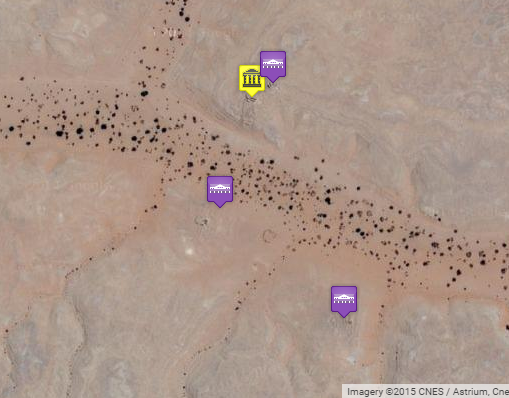
The purple marker on the left is the fortified Roman farm of Qasr Banat.
The bluish marker on the right by the trees is the 
mausoleum.

Qasr Banat, well and sanctuary of a local saint.

Qasr Banat, centenarium

Qasr Banat, surrounding wall

Qasr Banat, mausoleum, lower room

(livius)

Monday, August 17, 2015

Roman Fortress of Suq al-Awty - The Limes Tripolitanus


Thanks to Padfield.com

The Limes Tripolitanus
Tripolitana, the "Land of Three Cities"


The Limes Tripolitanus was a frontier zone of defence of the Roman Empire, built in the south of what is now Tunisia and the northwest of Libya. It was primarily intended as a protection for the tripolitanian cities of Leptis MagnaSabratha and Oea in Roman Libya.

The Limes Tripolitanus was built after Augustus. It was related mainly to the Garamantes menace. Septimius Flaccus in 50 AD did a military expedition that reached the actual Fezzan and further south.

The Romans did not conquer the Garamantes so much as they seduced them with the benefits of trade and discouraged them with the threat of war. The last Garamantes foray to the coast was in AD 69, when they joined with the people of Oea (modern Tripoli) in battle against Leptis Magna. 

The Garamantes started to become a client state of the Roman Empire, but nomads always endangered the fertile area of coastal Tripolitania. Because of this Romans created the Limes Tripolitanus.

The first fort on the limes was built at Thiges, to protect from nomad attacks in 75 AD. The limes was expanded under emperors Hadrian and Septimius Severus, in particular under the legatus Quintus Anicius Faustus in 197-201 AD.

Anicius Faustus was appointed legatus of the Legio III Augusta and built several defensive forts of the Limes Tripolitanus in Tripolitania, among which Garbia and Golaia (actual Bu Ngem) in order to protect the province from the raids of nomadic tribes. He fulfilled his task quickly and successfully.

As a consequence the Roman city of Gaerisa, situated away from the coast and south of Leptis Magna, developed quickly in a rich agricultural area Ghirza became a "boom town" after 200 CE, when the Roman emperor Septimius Severus (born in Leptis Magna) had organized the Limes Tripolitanus.

Former soldiers were settled in this area, and the arid land was developed. Dams and cisterns were built in the Wadi Ghirza to regulate the flash floods.  The farmers produced cereals, figs, vines, olives, pulses, almonds, dates, and perhaps melons. Ghirza consisted of some forty buildings, including six fortified farms (Centenaria).

With Diocletian the limes was partially abandoned and the defence of the area was done even by the Limitanei, local soldier-farmers. The Limes survived as an effective protection until Byzantine times.  Emperor Justinian restructured the Limes in 533 AD.

From 665 to 689, a new Muslim Arab invasion of North Africa was launched.  The limes fortifications played little part.

It began, according to Will Durant, to protect Egypt "from flank attack by Byzantine Cyrene." So "an army of 40,000 Muslims advanced through the desert to Barca, took it, and marched to the neighborhood of Carthage." A defending Byzantine army of 30,000 was defeated in the process.

Next came a force of 10,000 Arabs led by the Arab general Uqba ibn Nafi and enlarged by thousands of others. Departing from Damascus, the army marched into North Africa and took the vanguard. In 670 the city of Kairouan (roughly eighty miles or 160 kilometers south of modern Tunis) was established as a refuge and base for further operations.

This would become the capital of the Islamic province of Ifriqiya, which would cover the coastal regions of what are today western Libya, Tunisia, and eastern Algeria.
 
Thus ended 800 years of Roman Africa.


Olive production and Roman water management.
The Romans and Byzantines built dams and cisterns to capture the limited 
rain fall. Local farmers produced cereals, figs, vines, olives, pulses, almonds, 
dates, and perhaps melons.

Suq al-Awty

The Roman Centenarium of Suq al-Awty
  • A Centenarium is an Ancient Roman fortified farmhouse in the Limes TripolitanusThere were more than 2,000 of these fortifications.  Retired legionaries received plots of land along the wadis, in arid areas and the countryside.


The first "Centenaria" were built during Trajan and Septimius Severus expansions of Roman Libya and Africa Proconsularis, when was created the Limes Tripolitanus.

From around the time of disbandment of the Legio III Augusta in 238 AD, legionaries built around two thousand centenaria in the areas around Leptis Magna and Sabratha. Examples remain at Gherait esh-Shergia and Gasr Banat. Some were characterized by the presence of paleochristian churches.

The "Centenaria" system of production, based on autochthonous berbers who were partially Latinized and often even Christians, was successful and worked very well until Byzantine times. Centenaria remained in use for several centuries after the Arab conquest in the second half of the seventh century, until the system collapsed in the eleventh century.

There is much conjecture about the origin of the word "centenarium".  Probably their Latin name was due to the fact that one hundred men (one hundred is said in Latin "centum") worked each fortified farm, under the orders of a former army "centurion".


The Wadi Bruza and three Roman centenarium fortified farms.

Suq al-Awty

On one of the northern spurs along the wadi is a large complex, known as Suq al-Awty, in which five constructions can be discerned.  Two fortified farms, two cisterns and a church.

The northernmost fortified centenarium (above photo) was measured as 20 x 20m with rooms situated around a small central square.  Ceramics show that the place was settles in the second century and so actually predate the construction of the Limes Tripolitanus.

The southern centenarium (photo 904 below) has an extremely heavy eastern wall and the building is about seventeen meters long.  Access was possible through a vaulted passage.  The outside was decorated.  It is as old as the first building.  These fortified farms were surrounded by huts.

A vaulted cistern was built on the southern slope of the hill.  The structure, made of plastered rubble, must have served to collect the rain water that fell on the hill itself.  It is a pretty deep structure and was erected on, not dug in the slope.

Church  -  The main monument is the church dating from the early Byzantine period.  It is about 23m long, has three barrel-vaulted aisles and is almost 13m wide.  A baptistery has been identified.  Water must have been obtained from the nearby cisterns.  The people who visited the church came in from a wide area including a village some six km to the west.

The church was decorated with sculpture and frescoes.  There are also some graffiti including a representation of a water vessel.  A bit odd in a small village in a desert that produced cereals and olives.
Emperor Constans II
The last Roman Emperor
of Tripolitanus

Suq al-Awty and the two centenaria were abandoned in the second half of the seventh century.  This may have been a direct result of the Arab conquest.  The church may have been a special target.

Across the Wadi  -  There were two fortified farmson the south bank of Wadi Burza.  One of them may have had three stories.  The heavy walls, made of coursed rubble, were about a meter in diameter.  There were many people living here with at least twelve rooms in the building.  There were many cisterns in the neighborhood.

After Rome

Except for a new religion, the predesert civilization that was based on careful water management and constant vigilance remained the same. It was only in the eleventh century, when two Arabian dynasties, the Zirids and the Fatimids, were involved in a major war, that the system collapsed. After the garrisons had been transferred from the cities to the front, nomads of Banu Hillal tribe could capture the qsur. The agricultural production declined rapidly, the cities were no longer fed, and the remaining town dwellers abandoned Lepcis Magna and Sabratha to settle in Oea, which was from now on known as Tripoli.

The twelfth-century Sicilian geographer Muhammad al-Idrisi writes: 

"Until recently, the Tripolitana was well-exploited and covered with fig trees, olives, dates palms, and other fruit trees. But the Arabs have completely destroyed this prosperity. The peasants were forced to leave the country, the orchards were destroyed, and the canals were blocked."  - - - Al-IdrisiRoger's Book, 121.

What had for eight centuries been a wealthy province of the Roman, Byzantine, and Muslim empires, now became a desert again. The decline of the population meant that there was no one who could destroy the ancient cities, the qsur, the watchtowers, the forts. They were simply left as they were, until nine centuries after the collapse, the first archaeologists started to study them.


Map of Wadi Buzra
(Livius.org)

Suq al-Awty  (Bz 904)
(Livius.org)

Suq al-Awty, cistern

Suq al-Awty, church

Suq al-Awty, church

View across the wadi


(Suq al-Awty)      (Tripolitania)      (Centenarium)      (Limes Tripolitanus)

(Limes Tripolitanus)      (Suq al-Awty)      (Roman Libya)

Thursday, February 20, 2014

The Roman-Byzantine Fortress of Gholaia (Bu Njem)


There are many reasons to visit the ruins of ancient Gholaia or, as it is called today, Bu Njem (satellite). Admittedly, the remains don't look impressive when you approach them, but they belong to the most impressive monument of Libya: the Roman frontier zone, or Limes Tripolitanus.

The Emperor Septimius Severus (193-211) ordered the construction of a line of fortifications, which completely changed this part of Libya, Tripolitana.

Emperor Septimius Severus
Lucius Septimius Severus Augustus
Today, this is desert, but the area is not as arid as it seems. In fact, there is sufficient rainfall, but it is highly unpredictable and irregular. However, when the wadis have dams and dikes, the water can be regulated, and the area can be developed for agricultural purposes. This is what happened in the early third century. The first stage was to build forts like Gholaia. This map shows that it was a stereotypical castellum with barracks, a bathhouse, headquarters and a residence for the commander.

It is easy to overestimate the military threat to the Empire's southern boundaries. One single legion, III Augusta, was capable of protecting a frontier zone of 2,500 km: rather less than the four legions that protected the 675 km of the Neckar- Rhine frontier. Nevertheless, nomadic incursions ought to be punished and the Roman government had to protect Tripolitana. In 201, soldiers of the Third started to build forts in the oases of Ghadames, Gheriat el-Garbia, and Bu Njem.

The forts were built by soldiers of the Third Legion Augusta. This can be deduced from the towers near the main gate, which are not square, as is usual, but five-angled. This can only be found in settlements of the Third, which was based in Lambaesis in what is now Algeria. Gates like this can also be seen in Theveste.

The new forts controlled the main roads through the desert, and were situated near oases. On this photo of Gholaia's eastern gate, you can see the Bu Njem oasis in the background. It is about 100 km from the coast. By blocking access to the wells, the forts protected the country that was to be developed against large groups of nomads (e.g., the Garamantes, who lived beyond the Gebel as-Soda).

Against small bands, however, guarding the wells offered insufficient protection, so the farms that were to be built, had to have strong walls to keep invaders out for some time. Examples can be found at Gheriat esh-Shergia, Ghirza, and Qasr Banat. There were also watchtowers that signaled the arrival of intruders. The Limes Tripolitanus was a fine system, and many people settled in Tripolitana as farmers, producing sufficient to make sure that towns like SabrathaOea (modern Tripoli), and Lepcis Magna prospered. Many settlers must have been veterans from the three forts.

The Fortress of Gholaia (Bu Njem)

Photo - Google Earth

Early in 202, the Emperor came to visit the frontier. Lucius Septimius Severus was
born in Lepcis Magna and and had been in charge of the Mediterranean Empire for
almost ten years. His visit to his native country is poorly documented, but the
Historia Augusta tells that 'he freed the Tripolitana, the region of his birth, from
fear of attack by crushing sundry warlike tribes' (Severus, 18.3).

Little is known about the desert war that appears to be implied, but it must have
taken place. Severus had already waged war beyond the Euphrates and was to wage
war north of the Antonine Wall, so a war beyond the imperial frontier in the Sahara
is not impossible, perhaps even likely. However this may be, an expedition against
a potential enemy to inspire fear fits within Rome's grand strategy.

Their culture, based on expert water management and vigilance, survived the Roman Empire. Of course, there were changes.

In the late fifth, early sixth century, there were serious troubles, but the Emperor Justinian reinforced the cities along the coast, built new towns (e.g., Theodorias) and the fortified farms were strengthened. An example is Suq al-Awty, which contains a small Byzantine church.
.
In the seventh century, the population converted to Islam and the Tripolitanan limes culture survived well into the eleventh century, when war between the Fatimid and Zirid dynasties resulted in invasions by the Banu Hillal nomads, who sacked countless settlements. Because many farms were abandoned, agricultural production fell, and the towns along the coast went into decline.
.
As a result, there were less people who could loot the abandoned forts and farms. (Oea is the exception.) The stones were never reused and were covered by desert sands. The settlements were forgotten until Italian archaeologists started to investigate them in the1920's and 30's.
.
The foundations of the Principia have survived reasonably well. Several columns surrounding the square court have been reerected by the French and Libyan archaeologists who studied the site in the 1970's.

The quad may have been used as a market place, because no other site can been identified. There must have been a small prison too; its existence is implied in Ostracon #71. (The ostraca from Bu Njem are sherds on which reports and letters were written. Some of them were discovered in the room you can see in front. A little to the rear is the only scriptorium that has been identified in a Roman fort.)

 Based on building style, the Third Legion
Augusta may have been used to build
forts in the Limes Tripolitanus.
The Principia (HQs) must have looked like the principia elsewhere; these buildings were the same all over the empire. Gholaia also had a square court surrounded by small rooms, a large transverse hall (basilica), and a shrine (sacellum) were the unit's standard was kept and venerated.  The unit's library must have been in one of the adjoining rooms.

The soldiers who served at Gholaia were recruited from all over Africa, like most legionaries of III Augusta. However, in 219, the Emperor Heliogabalus disbanded the Third Legion Gallica, and many soldiers of this unit were added to the African legion. This means that several soldiers in Gholaia were from Syria.

Memos were found that were written in the first half of the third century in Fort Gholaia. It belongs to a collection of more than 146 notes written on sherds that have survived the centuries. They enable us to catch a glimpse of everyday life in the fort. We read about soldiers on leave, about people who are ill, and about men sent to a police station where travelers feed and water their dromedaries.

We read about the arrival of fifty-four recruits, about the return of a soldier who has been on duty during a gladiatorial show, and about soldiers cutting wood for the heating of the fort's bathhouse. 

This last detail will surprise modern visitors of the ruin of Gholaia, near Bu Njem, because it is situated in the desert. The only wood in the neighborhood can be found in the palm grove in the nearby oasis, where cutting trees would be economical suicide. That the soldiers at Bu Njem were able to get wood, proves that in the third century, the country was greener and more fertile than today. The history of the Roman Sahara frontier is, therefore, in the first place a story about human interference with the ecological system.

The Byzantine church at Suq al-Awty in the Wadi Buzra
Roman settlement in the Libyan desert.

Olive production and Roman water management.
The Romans and Byzantines built dams and cisterns to capture the limited
rain fall. Local farmers produced cereals, figs, vines, olives, pulses, almonds,
dates, and perhaps melons.

Byzantine North Africa

The frontier civilization of the Limes Tripolitanus survived the Roman Empire, although with some difficulty, because the cities went into decline. However, the rural areas managed to cope with the change.

In the fifth century, the Tripolitanans had to fight against a new enemy: the Vandals, a European tribe that had fought itself a way through Gaul, Hispania, and Numidia and had settled in Carthage. For the first time since the Tripolitana had been conquered by the Romans, it became a real war zone. Riders on horse had to fight against warriors on dromedaries.

Much of the area was conquered from the Romans and the Vandals set up their North African kingdom from 435 to 534. 

As part of the re-conquest of Africa the Eastern Roman Emperor Justinian organized an anti-Vandal revolt with the support of Byzantine troops from Egypt and Cyrenaica.  Tripolitana once again returned to Roman rule.

Emperor Justinian
Flavius Petrus Sabbatius Justinianus Augustus

An interesting side note, the historian Procopius (500 – c. AD 565) recorded that an Imperial official was brought from Libya to work in Constantinople.  The official spoke only Latin and naturally had difficulty with the many Greek speakers in the capital.  This small story tells us a great deal about a still flourishing Latin-Roman civilization in North Africa.

New garrisons were stationed in the three cities, where the sixth-century walls are still visible. The centenaria remained and some of them even became real palace villas called castra, like the one at Suq al-Awty, where a visitor can not only see the remains of the boundaries of the ancient fields, but also the ruin of a Byzantine church.

The olive oil production increased and appears to have been larger than ever and the countryside was wealthy, making the Tripolitana an almost natural target for Laguatan and Islamic expansion.

The Muslim Invasions

The Roman frontier zone, or Limes Tripolitanus, was designed to protect settlements and cities from desert raids coming from the south.  Invasion from Egypt was not expected.

First Invasion - The first invasion of North Africa, ordered by Caliph Umar, commenced in 647. Some 20,000 Arabs marched from Medina in Arabia, another 20,000 joined them in Memphis, Egypt, and Abdallah ibn al-Sa’ad led them into the Byzantine Exarchate of Africa.

The army took Tripolitania. Count Gregory, the local Byzantine governor, had declared his independence from the Byzantine Empire in North Africa. He gathered his allies, confronted the Islamic invasion force and suffered defeat (647) at the battle of Sufetula, a city 150 miles south of Carthage. With the death of Gregory his successor, probably Gennadius, secured the Arab withdrawal in exchange for tribute. The campaign lasted fifteen months and Abdallah's force returned to Egypt in 648.
Emperor Constans II
The last Roman Emperor
of Tripolitanus.

Second Invasion - Then, from 665 to 689, a new invasion of North Africa was launched.

It began, according to Will Durant, to protect Egypt "from flank attack by Byzantine Cyrene." So "an army of 40,000 Muslims advanced through the desert to Barca, took it, and marched to the neighborhood of Carthage." A defending Byzantine army of 30,000 was defeated in the process.

Next came a force of 10,000 Arabs led by the Arab general Uqba ibn Nafi and enlarged by thousands of others. Departing from Damascus, the army marched into North Africa and took the vanguard. In 670 the city of Kairouan (roughly eighty miles or 160 kilometers south of modern Tunis) was established as a refuge and base for further operations.

This would become the capital of the Islamic province of Ifriqiya, which would cover the coastal regions of what are today western Libya, Tunisia, and eastern Algeria.
 
Thus ended 800 years of Roman Africa.
7th Century Arab warrior

The regime change did not intervene with the economical or social structures. The linguistic change was small: many people still spoke Punic, and for them it was easy to learn Arabic. The centenaria/castra from now on being called qasr, pl. qsur.

Except for a new religion, the predesert civilization that was based on careful water management and constant vigilance remained the same. It was only in the eleventh century, when two Arabian dynasties, the Zirids and the Fatimids, were involved in a major war, that the system collapsed. After the garrisons had been transferred from the cities to the front, nomads of Banu Hillal tribe could capture the qsur. The agricultural production declined rapidly, the cities were no longer fed, and the remaining town dwellers abandoned Lepcis Magna and Sabratha to settle in Oea, which was from now on known as Tripoli.

The twelfth-century Sicilian geographer Muhammad al-Idrisi writes:

"Until recently, the Tripolitana was well-exploited and covered with fig trees, olives, dates palms, and other fruit trees. But the Arabs have completely destroyed this prosperity. The peasants were forced to leave the country, the orchards were destroyed, and the canals were blocked."  - - - Al-Idrisi, Roger's Book, 121.

What had for eight centuries been a wealthy province of the Roman, Byzantine, and Muslim empires, now became a desert again. The decline of the population meant that there was no one who could destroy the ancient cities, the qsur, the watchtowers, the forts. They were simply left as they were, until nine centuries after the collapse, the first archaeologists started to study them.

The excellent state of preservation makes the forts of the Limes Tripolitanus unique. Another reason is that there are few places on this planet where you can see the immense power of a Roman emperor. To protect his home town, Septimius Severus changed an entire ecosystem, and the result lasted for more than eight centuries. For this display of power, world history offers no parallel.


The Limes Tripolitanus
The Limes Tripolitanus was a frontier zone of defense of the Roman Empire, built in the south of what is now Tunisia and the northwest of Libya. It was primarily intended as a protection for the tripolitanian cities of Leptis Magna, Sabratha and Oea in Roman Libya.
.
The first fort on the limes was built at Thiges, to protect from nomad attacks in 75 AD. The limes was expanded under emperors Hadrian and Septimius Severus, in particular under the legatus Quintus Anicius Faustus in 197-201 AD.
.
Former soldiers were settled in this area, and the arid land was developed. Dams and cisterns were built in the Wadi Ghirza (then not dry like today) to regulate the flash floods. The farmers produced cereals, figs, vines, olives, pulses, almonds, dates, and perhaps melons. Ghirza consisted of some forty buildings, including six fortified farms (centenaria). Two of them were really large. It was abandoned in the Middle Ages.


Fortress of Gholaia - East Gate

The fort at Bu Njem; oasis in the distance.

The Cardo (main road)

The Principia

Principia

The basilica in the Principia, seen from the place
where the ostraca were found.


(www.persee.fr/web)      (Septimius Severus)       (Legio III Augusta)

(vfp-archaeologie.uni)      (Umayyad conquest of North Africa)     

(www.livius.org/bu njem)      (Limes Tripolitanus)