|
Vintage photograph of a Tuareg Berber warrior from the Sahara.
The Byzantines could have faced tribal forces of a similar look. |
The Roman Re-Conquest of Africa
Re-gaining full Roman control over Africa was a
project that took decades of fighting.
The Germanic tribe called the Vandals had conquered Roman North Africa in 439 AD. They also controlled the islands of Corsica, Sardinia and the Balearics. The Vandals were fearsome warriors having spread terror wherever they went. In 455 they sacked Rome itself sending shock waves through the ancient world.
The Emperor Justinian was determined to drive out the barbarian invaders holding the western provinces of the Roman Empire. To that end he sent a great army and fleet to invade Africa. The Vandals were defeated at the Battle of Ad Decimum and at the Battle of Tricamarum.
Winning two battles was only the start. Unrest in the army and among the peoples of North Africa made for wars that lasted for decades.
The real result of the endless wars was to leave Roman Africa in ruins.
The Moorish Wars (534 - 548 AD)
From The History of the Later Roman Empire by J.B. Bury
The general idea of the Emperor's scheme for the administration of the African provinces was to wipe out all traces of the Vandal conquest, as if it had never been, and to restore the conditions which had existed before the coming of Gaiseric.
The ecclesiastical settlement, which lay near Justinian's heart, was easy and drastic. All the churches which the conquered Arians had taken for their own worship were restored to the Catholics, and heretics were treated with the utmost intolerance. Vandals, even those who were converted from their religious errors, were excluded from public offices. The rank and file of the Vandal fighting men became the slaves of the Roman soldiers who married the women.
 |
| A 19th century Moor tribal warrior. |
All the estates which had passed into the hands of the barbarians were to be restored to the descendants of the original owners who could establish their claims, — a measure which led to the forgery of titles and endless lawsuits. The ultimate result of the whole policy was the disappearance of the Vandal population in Africa.
The civil governor was invested with the title of Praetorian Prefect of Africa, and enjoyed the corresponding dignity and emoluments. Under him were the governors of the seven provinces: Proconsularis, Byzacena, Tripolitana, Numidia, the two Mauretanias, and Sardinia. But the compass of the Second or Western Mauretania (Caesariensis) was extended so as to include Tingitana, which in old days had belonged to the diocese of Spain.
The military establishment was placed under a Master of Soldiers, a new creation, since in old days the armies of Africa had been under the supreme command of the Master of Soldiers in Italy. The fundamental distinction between the mobile army and the frontier troops was retained. The mobile army consisted of the divisions of the comitatenses who had been sent with Belisarius, of foederati, and of native African troops (gentiles). The frontier troops were distributed in four districts, under dukes, who had authority also over mobile troops stationed in these military provinces. The establishment of this organisation throughout Africa was retarded for some years by wars and mutinies, but it was begun by Belisarius before he departed, and it was gradually carried out, along with an elaborate scheme of fortification against the inroads of the Moorish tribes.
The Moors began hostilities before the Romans had time to make provision for the defence of the country or to organise the new civil administration. The situation was so grave that Justinian, when he sent Solomon in autumn (A.D. 534) to replace Belisarius, united in his hands the supreme civil as well as military authority. Solomon was Praetorian Prefect as well as Master of Soldiers. This appointment struck the note of a change in the principles of provincial administration which had prevailed since Diocletian. We shall see how elsewhere Justinian departed from the general rule of a strict separation of the civil and military powers. In Africa, although the two offices were seldom united, perhaps only on three occasions, there is a tendency from the beginning to subordinate the Praetorian Prefect to the Master of Soldiers, and before the end of the century the Master of Soldiers will become a real viceroy with the title of Exarch.
 |
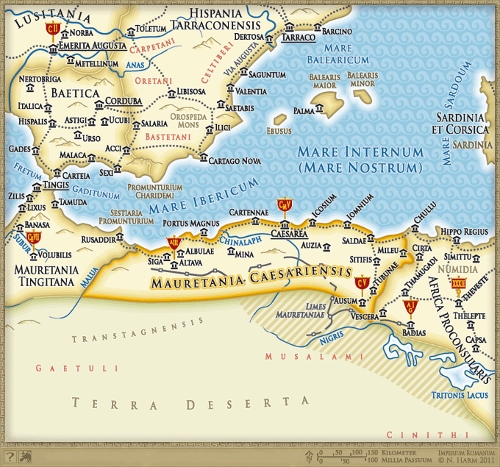
| Roman North Africa - Click to enlarge |
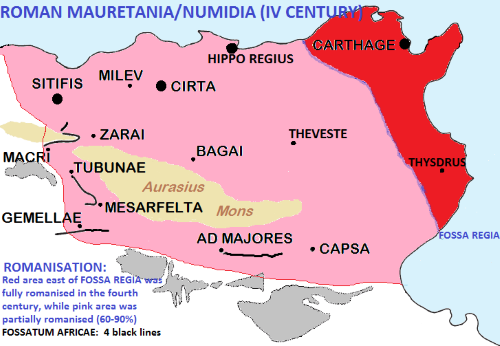
The leading feature of the history of North Africa from the Roman reconquest to the Arab invasion in the middle of the seventh century is a continuous struggle with the Moors, broken by short periods of tranquillity. Each province had its own enemies. Tripolitana was always threatened by the Louata, Byzacena by the Frexi; the townspeople of Numidia lived in dread of the Moors of the Aurasian hills. Mauretania was largely occupied by Berber tribes.
The Roman government never succeeded in effecting a complete subjugation of the autochthonous peoples. It was not an impossible task, if the right means had been taken. But the Roman army was hardly sufficient in numbers to maintain effectively the defence of a long frontier, against enemies whose forces consisted of light cavalry, immensely more numerous.
This numerical inferiority might have mattered little if the troops had been trustworthy. But they were always ready to revolt against discipline, and in war their thoughts were not on protecting the provinces but on
securing booty. They could do work under a commander who knew how to handle them, but such commanders were rare. Most of the military governors found their relations with their own soldiers as difficult a problem as their relations with the Moors.
 |
| Berber Tuareg warriors in 1906. |
Here we touch on a second cause of the failure of the Romans to secure a lasting peace in Africa — the unfitness of so many of their military governors. A succession of men like Belisarius, Solomon, and John Troglita would probably have succeeded, if not in establishing permanent and complete tranquillity, at least in defending the frontiers efficiently. But when a commander of this type had weathered a crisis or retrieved a disaster, he was too often succeeded by an incompetent man, who had no control over the soldiers, no skill in dealing with the Moors, and who undid by his inexperience all that his predecessor had accomplished.
And apart from these weaknesses, it has been remarked with justice that the general military policy was not calculated to pacify the restless barbarians beyond the frontier. It was a policy of strict defence. The elaborate system of fortresses which were speedily erected throughout the provinces stood the inhabitants in good stead, but they did not prevent raids, and the Romans only opposed raids on Roman soil. Far more would have been effected if the Romans had taken the offensive whenever there was a sign of restlessness and sent flying columns beyond the frontier to attack the Moors on their own ground. Finally the want of success in dealing with the Moorish danger may have been partly due to defective and inconsistent diplomacy.
The one fact in the situation which enabled the Romans to maintain their grip on Africa was the disunion among the Moors. On more than one occasion they suffered such crushing disasters that if the Moors had made a determined and united effort the Imperial armies would easily have been driven into the sea. But the jealousies and quarrels among the chieftains hindered common action; and if one began a hostile movement, the Romans could generally depend on the quiescence or assistance of his neighbour.
On his arrival in Africa (A.D. 534) Solomon had immediately
to take the field against Cutsina and other Moorish leaders who descended upon Byzacena, while Iabdas was devastating Numidia. He defeated the former at Mamma, but not decisively; they returned with reinforcements, and were thoroughly beaten in the important battle of Mount Burgaon (early in A.D. 535). An expedition against the Numidian Moors in the following summer was unsuccessful, but Solomon lost no time in setting about the erection of fortified posts along the main roads in Numidia and Byzacena. In A.D. 536 the Emperor regarded peace as established and the Moors as conquered.
 |
| Eastern Roman Reenactors |
A Military Revolt
The task of keeping the natives in check had at least been well begun; but it was interrupted by a dangerous military revolt.
Various causes contributed to the mutiny. The pay of the soldiers had fallen into arrears, because the taxes from which it should have been defrayed had not been paid up. There was dissatisfaction about the division of booty. There were many Arians among the barbarian federates in the army who were ill-pleased at the intolerant religious policy which had been set in motion. Men who had married Vandal women claimed the lands which had belonged to their fathers or husbands and had been confiscated by the State. Above all, Solomon did not understand the art of tempering discipline by indulgence and was not a favourite with either officers or men.
A conspiracy was formed to murder him at Easter (A.D. 536). It miscarried because the courage of those who were chosen to do the deed failed them, and then a great number of the disaffected, fearing discovery, left Carthage and assembled in the plain of Bulla Regia. Those who were left behind soon threw off the pretence of innocence and the city was a scene of massacre and pillage. Solomon, having charged his lieutenants Theodore and Martin to do what they could in his absence, escaped by night, along with his assessor, the historian Procopius, and sailed for Sicily, to invoke the aid of Belisarius, who had just completed the conquest of the island. Belisarius did not lose a moment in setting sail for Carthage, in which he found Theodore beleaguered by the
rebels. They were about 9000 strong and under the command of Stotzas, who was one of the private retainers of Martin. The design of this upstart was to form an independent kingdom in Africa for himself.
 |
| Emperor Justinian I |
Theodore was on the point of capitulating when Belisarius arrived, and on the news of his appearance the rebels hastily raised the siege and took the road for Numidia. It was a high compliment to the prestige of the conqueror of the Vandals. With the few troops who had remained loyal in Carthage, and a hundred picked men whom he had brought with him, Belisarius overtook Stotzas at Membressa and defeated him. The rebels fled, but they did not submit. Belisarius could not remain: news from Sicily imperatively recalled him. He arranged that Solomon should withdraw from the scene, and that two officers, Theodore and Ildiger, should assume responsibility until the Emperor appointed Solomon's successor. Soon after his departure the situation became worse, for the troops stationed in Numidia, who had been moved to cut off the retreat of Stotzas, declared in his favour. Two-thirds of the army were now in rebellion.
Justinian was happily inspired at this grave crisis. He sent the right man to deal with it, his cousin Germanus, the patrician, who already had had experience of warfare on the Danube, as Master of Soldiers in Thrace. He was appointed Master of Soldiers of Africa, with extraordinary powers, and it was hoped that his prestige as a member of the Imperial family would have its influence in recalling the rebels to a sense of loyalty.
His first act was to proclaim that he had come not to punish the mutineers, but to examine and rectify their grievances. This announcement was at once effective. Many of the soldiers left the camp of the rebels and reported themselves at Carthage. When it was known that they were handsomely treated and that they received arrears of pay even for the weeks during which they were in rebellion, large numbers deserted the cause of Stotzas, and Germanus found himself equal in strength to the
insurgents. Stotzas, seeing that his only chance was to strike quickly, advanced on Carthage. A desperate battle was fought at Scalas Veteres (Cellas Vatari) in the spring (A.D. 537), and the rebels were defeated. Moorish forces, under Iabdas and other chiefs, who had promised to support Germanus, were spectators of the combat, but according to their usual practice they took no part till the victory was decided, and then they joined in the pursuit, instead of falling on the exhausted victors.
 |
| North African Berber |
Germanus remained in Africa for two years and succeeded in re-establishing discipline in the army. Then the experienced Solomon was sent out to replace him A.D. 539) and to complete the military organisation of the provinces and the system of defence, in which Justinian took a keen personal interest. He began by weeding out of the army all those whom he suspected as doubtful or dangerous, sending them to Italy or the East, and he expelled from Africa the Vandal females who had done much to instigate the mutiny. After successful campaigns against the Aurasian Moors, he established his power solidly in Numidia and Mauretania Sitifensis, and carried out the vast work of strengthening the defences of the towns and build hundreds of forts. Africa enjoyed a brief period of peace to which, amid subsequent troubles, the provincials looked back with regret.
The Emperor, who gratefully recognised the services and abilities of Solomon, appointed his nephew Sergius duke of Tripolitana. It was a thoroughly bad appointment. Sergius was incompetent, arrogant, and debauched; he was not even a brave soldier; and he proved a governor of the well-known type who cannot avoid offending the natives. An insolent outrage committed against a deputation of the Louata provoked that people to arms; and by an unfortunate coincidence Solomon at the same time succeeded in offending the powerful chief Antalas, who had hitherto been friendly. The Moors joined forces, and in the battle of Cillium (A.D. 544) the Romans were utterly defeated and Solomon was slain.
The Imperial rule in Africa was again in grave danger. The news of the defeat stirred the Berber tribes all along the frontier; even the Visigoths seized the occasion to send forces across the straits, and unsuccessfully besieged Septum. Stotzas, who since his defeat by the Germans had lived with a handful of followers in the wilds of Mauretania, now reappeared upon the scene and joined the Moors of Antalas. . . (Roman forces) were severely defeated at Thacia, between Sicca Veneria (el‑Kef) and Carthage (end of A.D. 545). After this disaster Sergius was relieved of his post.
The situation was deplorable. The ravages of the Moors
during the last three years had exhausted and depopulated the provinces. At last Justinian made a happy appointment. John Troglita, who had served with distinction under Belisarius and Solomon and was thoroughly acquainted with the conditions of the country, was recalled from the East, where he had given new proofs of military talent, and sent to take command of the armies of Africa (end of A.D. 546).
Happily the Moors were divided, and John was a diplomatist as well as a general. He was able to secure the help of Moorish contingents in his campaigns. Early in A.D. 547 he inflicted a decisive defeat on the most dangerous of his opponents, Antalas. But the troubles of Africa were not yet over. A few months later, the Berbers of Tripolitana rose under Carcasan, and won a crushing victory over the Imperial troops in the plain of Gallica.
 |
| 19th century oil paintings of North African medieval Muslims (Moors) who conquered Spain, France and Sicily. With a few adjustments the Moorish tribes that the Byzantines faced could have had a similar look. |
General John Troglita
John Troglita was the general finally able to end the Moorish Wars.
Troglita was a 6th-century Byzantine
general. He participated in the Vandalic War
and served in North Africa as a regional military governor during the years 533–538, before being sent east to the wars with the Sassanid Persians
.
John Troglita is first mentioned as having participated in the Vandalic War
(533–534) under Belisarius
. Troglita remained in the province of Africa after Belisarius's departure in 534, and participated in the expeditions of Solomon against the Moors
in 534–535. At the time, he was probably the local military governor (dux) in either Byzacena or, more probably, Tripolitania
, for he is mentioned as leading successful expeditions against the Leuathae tribe.
Troglita also fought against the mutinous army under the renegade Stotzas, participating in the first victory under Belisarius at Membresa in 536, and then, under Solomon's successor Germanus, in the decisive battle at Scalas Veteres in spring 537. In this battle, he was one of the commanders of the cavalry on the Byzantine army's right wing, which according to the historian Procopius was defeated and driven off by Stotzas's men, losing its standards in the process. Nevertheless, the battle resulted in an imperial victory. In 538, Troglita distinguished himself in the Battle of Autenti, probably in the Byzacena.
At some point after 538, Troglita was sent to the Eastern frontier, where by 541 he was appointed dux Mesopotamiae, one of the most important military commands of the region.
High Command in Africa
During Troglita's absence from Africa, the situation had been turbulent. Germanus had remained in the province until 539, and succeeded in restoring discipline in the army and pacifying the core territories of Africa Proconsularis and Byzacena. He was succeeded by Solomon, who began his second tenure with great success, defeating the Moors of the Aurès Mountains
and establishing control over Numidia
and Mauretania Sitifensis
.
However, the Moorish revolt flared up again in 543 and Solomon was killed in the Battle of Cillium in 544. His successor, his nephew Sergius
, was incompetent. He was defeated by the Moors, recalled and replaced with the senator Areobindus, who was murdered in spring 546 in another military revolt led by the general Guntharic
. The latter intended to declare himself independent of Constantinople, but was soon murdered by the Armenian
Artabanes.
The need for a new and capable leader in Africa was apparent to Constantinople. After a truce was signed with Persia in 546, Emperor Justinian recalled Troglita from the East. After having him report on the situation there in Constantinople, the Emperor placed him at the head of a new army and sent him to Africa as the new magister militum per Africam in late summer 546.
 |
| 6th Century Eastern Roman Cavalry |
Battle of Marta
In late 546, when John Troglita reached Carthage
, the situation was dire: the imperial troops, under Marcentius the dux of Byzacena and Gregory the Armenian in Carthage, were few in number and demoralized. They held out in the coastal cities, blockaded by the Moors of Byzacena under their chieftain Antalas, while the Leuathae and Austurae tribes from Tripolitania were raiding Byzacena with impunity. Diplomatic efforts, however, secured the allegiance of the Moorish leaders Cutzinas
and Ifisdaias, who joined the imperial army with several thousands of their men. In addition, the tribesmen of the Aurès Mountains under Iaudas
withdrew to Numidia on learning of Troglita's arrival and pursued a course of armed neutrality.
Upon his arrival in Carthage, Troglita reorganized his troops, bolstering the local forces with the veterans he had brought with him – mostly horse archers and cataphracts – and marched out to meet the rebels. At Antonia Castra, emissaries from Antalas presented themselves, but Troglita rejected their terms and imprisoned them. The Byzantine army marched into Byzacena, relieved the beleaguered cities and joined up with Marcentius.
The Moors, taken by surprise by the imperial army's swift advance, withdrew again to the mountainous and wooded interior, where they gathered their forces under the leadership of Ierna of the Leuathae and Antalas. Corippus suggests that they hoped that Troglita would not maintain his pursuit in the midst of winter, and that they would have the advantage over the imperial army in this terrain. Troglita encamped near the Moorish positions and dispatched an envoy, Amantius, to bring Antalas his terms: the general offered amnesty in exchange for submitting to imperial authority again.
Corippus narrates the subsequent battle at length, but his imitation of Virgilian
verse provides little concrete detail: it is clear that it was a long, indecisive, and bloody conflict, which probably took place to the south or east of Sbeitla in late 546 or early 547. Eventually, the Byzantines prevailed and drove back the Moors, breaking through their defences and storming their camp. According to Corippus, Ierna, who was the chief priest of the god Gurzil, was killed while trying to protect an image of the god. Many other tribal leaders fell, and the remainder scattered. The remains of the Tripolitanian tribes abandoned Byzacena, and Antalas was forced to lay down arms. In addition, many prisoners were released from the Moorish camp, and among the treasures captured there were the military standards lost by Solomon at Cillium in 544. These were dispatched to Constantinople, while Troglita held a triumphal entry into Carthage.
 |
| 19th Century Moor Warrior |
With this victory, the war seemed won, and peace re-established in Africa. A few months later, however, the tribes of Tripolitania reassembled and formed a coalition under the king of the Ifuraces, Carcasan. After raiding Tripolitania, they turned west to raid Byzacena again. Notified of this by Rufinus, the dux of Tripolitania, Troglita marched out to meet them.
The Byzantine army had been weakened in the meantime by the need to reinforce Belisarius against the Goths in Italy: of the nine regiments Troglita had brought with him from Constantinople, three were dispatched to Italy.
The Moors under Antalas remained hostile but did not immediately join the conflict for the moment, but the Byzantines were deprived of the services of Ifisdaias, who refused to commit his men. Despite the hot summer, Troglita marched his men quickly to the southern limit of Byzacena, along the edge of the desert, hoping to meet the Moors there and prevent the long-suffering province from being ravaged again. The Moors initially withdrew into the arid interior, hoping to shake him off, but Troglita's army, accompanied by a caravan with water and provisions, followed them into the desert. Both armies suffered from thirst and hunger, and discontent spread among the Byzantine soldiers. Finally, a near mutiny erupted when an epidemic killed off a large part of the army's horses, forcing Troglita to turn again north towards the coast.
There, Troglita positioned himself between the Matmata plateau and the coast, and awaited the Moors. He also sent for ships to bring supplies, but adverse winds made this impossible. When the Moorish army appeared nearby it was likewise exhausted from hunger and made for some sources of water, which Troglita set out to reach first.
The Byzantines camped at Marta in the district of Gallica, where battle was joined. It was a disastrous defeat for the Byzantines, whose army broke and fled. Corippus, possibly in an attempt to exculpate his hero Troglita, attributes the defeat to the indiscipline of some soldiers, who attacked the enemy before the army was ready, leading to a disorganized piecemeal engagement. According to Corippus's account, the Moorish allies of the Byzantines panicked first and retreated, causing the entire army to disintegrate, despite the personal intervention of Troglita and the other Byzantine leaders.
Following this defeat, Troglita fled to Iunci, where he began regrouping the survivors. The losses were so high and the army's morale so low, however, that he was soon forced to withdraw further north to the fortress of Laribus, where he started mustering his army. Learning of the battle, Antalas immediately rose up again and joined the Tripolitanian tribes, while the Byzantines' allies, Cutzinas and Isfidaias, were quarreling among themselves. Throughout the remainder of 547, the Moors were free to raid across Africa, even reaching the vicinity of Carthage itself.
Battle of the Fields of Cato
Troglita did not remain inactive: from Carthage, the praetorian prefect Athanasius and Troglita's young son organized reinforcements and supplies for the camp at Laribus, while Troglita himself succeeded not only in reconciling Cutzinas and Isfidaias, but also in gaining the allegiance of King Iaudas and his tribe.
In the spring of 548, Troglita, having regrouped his forces, met with his Moorish allies at the plain of Arsuris on the northern limits of Byzacena. Corippus gives extraordinary numbers for the native contingents provided by each chief: 30,000 for Cutzinas, 100,000 for Isfidaias, and 12,000 under Iaudas's brother. Whatever the real numbers, it seems clear that Troglita's regular troops formed the lesser portion of the imperial army.
The tribes, under the leadership of Carcasan and Antalas, had encamped in central Byzacena, in the plain of Mamma or Mammes. Carcasan, confident after his victory the previous year, wanted to confront the imperial army immediately, but as it happened he gave way to Antalas, who advocated the more cautious and well-tried Moorish tactic of withdrawing and drawing the Byzantines into the interior, forcing them to march far from their supply bases and through a devastated country, thus exhausting and demoralizing them. The rebels thus retreated south and east, reaching Iunci after ten days.
Troglita's army pursued them at some distance, only exchanging a few blows with the tribes' rearguard. Once the Byzantine army reached the plain before Iunci and laid camp, however, the Moors again withdrew into the mountainous interior. Having been informed by a spy of his enemy's strategy, Troglita refused to follow, and remained encamped near the port of Lariscus, from where he could be easily resupplied. Nevertheless, discontent grew among the soldiers, who did not understand their leader's reluctance to fight: the army mutinied and attacked the tent of Troglita, who was barely able to escape. Thanks to the allied Moorish contingents, who remained steadfast, Troglita was able to reimpose control over his men.
Troglita now moved his army to confront the enemy, who were encamped at a plain called the Fields of Cato. The Moorish camp had been heavily fortified, and Troglita was reluctant to launch a direct assault. He therefore blockaded it, hoping that hunger would force the Moors to fight him in open battle. To further encourage them, he restrained his men, feigning a reluctance to fight.
Troglita's plan worked: encouraged by sacrifices to their gods and hoping to catch the imperial army unprepared, the Moors attacked the Byzantine camp on a Sunday. The battle hung long in the balance, with many dead on both sides, but eventually the Byzantines gained the upper hand. At this point, Carcasan rallied his forces and launched a fierce counterattack, but was killed by Troglita himself. Seeing their leader fall, the Moors broke and fled.
The battle was a resounding success for the Byzantines: seventeen of the Moors' principal leaders were dead, the Tripolitanian tribes were decimated and withdrew to the desert, and Antalas and his followers submitted to Troglita. Byzacena, Numidia, and Tripolitania were finally secured, and a period of peace was inaugurated that lasted for the next fourteen years, until 562.
Aftermath
At about this time, Troglita seems to have been promoted to the honorific court rank of patricius, as attested by the 6th-century historian Jordanes. He remained in command in Africa for at least another four years, beginning the difficult work of reconstruction. Troglita re-established the civil administrative apparatus as originally envisaged by Emperor Justinian in 533, sharing his authority with the prefect Athanasius. The provincial fortifications built by Solomon were restored, and the subdued Moorish tribes carefully returned to a status of vassalage as imperial foederati.
Troglita's record in re-establishing order and tranquility in the troubled province make him, along with Belisarius and Solomon, "the third hero of the Imperial reoccupation of Africa".
 |
The Fortification of the Provinces
.
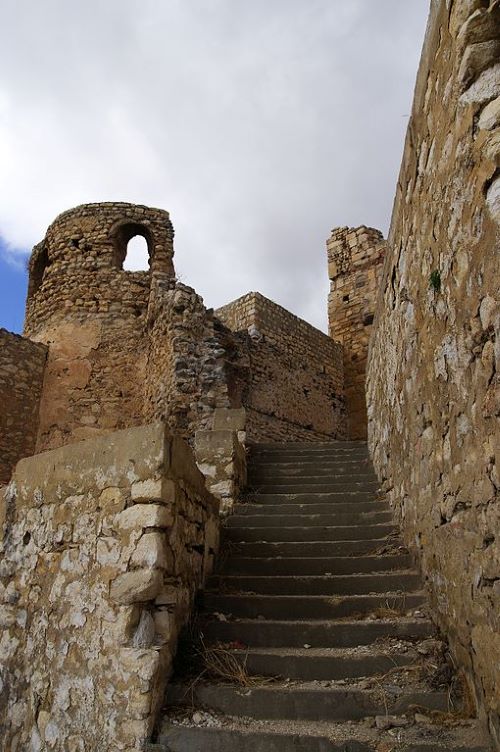
Ruins of the Byzantine walls of Theveste, one of the many sites restored
and fortified under the Eastern Empire General Solomon.
.
While Solomon was fighting with the Moors, he was at the same time engaged in carrying out a large scheme of defensive fortification to protect the African provinces against the incursions of the barbarians. The building of fortresses was one of the notable features of Justinian's policy.
.
Fortified towns, connected by a chain of small forts, formed the first frontier defence. Behind this there was a second barrier, larger towns with larger garrisons, which were all to afford a refuge to the inhabitants of the neighbourhood in case of an invasion. When the watchmen in the frontier stations discerned menacing movements of the tribes, they transmitted the alarm by the old system of fire signals by night or smoke signals by day, so that the people of the villages might have time to find refuge in the walled towns and the garrisons of the inland places might be prepared.
.
In many cases the towns were entirely surrounded by walls, and in some had the additional defence of detached forts. In other cases they were open, and protected by the citadel. The neighbouring strongholds of Theveste, Thelepte, and Ammaedera on the frontier of Byzacena present good examples of the three types. The features of a fully fortified town were a wall with towers, an outer wall, and a fosse; the space between the two walls being large enough to accommodate the refugees who flocked in from the open country in a time of danger. But this scheme is not invariably found; sometimes there was no outer wall, sometimes there was no ditch. These variations depended upon local circumstances, as the form of the fortress depended on the nature of the ground. A rectangular shape was adopted when it was possible, but very irregular forms were sometimes required by the site. Theveste is a well-preserved example of the large fortress, rectangular, measuring about 350 by 305 yards, with three gates, and frontier towers; Thamugadi of the smaller castle (about 122 by 75 yards), with a tower at each corner and in the centre of each side. Small forts, like Lemsa, had a tower at each of the four angles.
.
From Capsa (Gafsa) in the Byzacene province to Sabi Justiniana and Thamalla in Mauretania Sitifensis the long line of fortresses can be traced round the north foothills of the Aurasian mountains. Thelepte, Theveste, with Ammaedera behind it to the north, Mascula and Bagai, Thamugadi, Lambaesis, Lambiridi, Cellae, and Tubunae were the principal advanced military stations, which were connected and flanked by small castles and redoubts. When invaders from the south had penetrated this line, the inhabitants might seek shelter in Sufes (Sbiba) and Chusira (Kessera) in Byzacena; in Laribus (Lorbeus), Sicca Veneria (Kef), Tubursicum Bue (Tebursuk), Thignica (Aïn Tunga) in the Proconsular Province; Madaura (Mdaurech), Tipasa (Tifech), Calama (Guelma), Tigisis (Aïn el‑Borj) in Numidia, to mention a few of the military posts in the interior.
.
The Mauretanian provinces were more lightly held. It is interesting to observe that Justinian took special care to strengthen by impregnable walls the fortress of Septum on the straits of Gades. This ultimate outpost of the Empire was to be a post of observation. He gave express directions that it should be entrusted to a loyal and judicious commander, who was to watch the straits, gather information as to political events in Spain and Gaul, and send reports to his superior the duke of Mauretania. (From J.B. Bury)
|
 |
A
Fortress of Ksar Lemsa in Tunisia.
This fine fortress with its strikingly well-preserved walls (except for the SE side) can be seen from afar dominating the valley in the middle of a field of ruins. A gushing stream flows down the mountainside next to it. The citadel probably was built by the patrician Salomon in the reign of Justinian, who established his country-wide system of fortifications in the first half of the 6th c. Built with materials from the monuments of the ancient city.
Byzantine North Africa under Justinian |
(Penelope.uchicago.edu) (Procopius, History of the Wars) (Cutzinas)
(John Troglita)