.

Dedicated to the military history and civilization of the Eastern Roman Empire (330 to 1453)


"Time in its irresistible and ceaseless flow carries along on its flood all created things and drowns them in the depths of obscurity."

- - - - Princess Anna Comnena (1083–1153) - Byzantine historian

Showing posts with label Jordan. Show all posts

Saturday, September 9, 2017

Battle for the Middle East - Muslims Invade Roman Palestine


The Arab Legion in 1948
The last thing either the Persian or Roman Empires expected was invasion from the south by desert-wise soldiers infused with fanatical religious doctrine.

Part III
The Coming Maelstrom
Putting The Chess Pieces in Place


The Middle East has always been a bubbling cauldron of war, terrorism, conquest, hate and insanity. But the period from the start of the last Persian-Roman War in 602 AD to the end of the initial Muslim conquest in 638 was epic insanity on the most grand of scales.

For 26 years the Roman and Persian Empires had been in the death grip war of all death grip wars.  The 700 years of war between the two empires came down to this one life and death conflict.  Only one empire would survive the encounter and it was Rome.

There may have finally been "peace" between Rome and Persia, but it was a disastrous peace.  The Persians sank into dynastic anarchy while the Romans were financially, militarily and politically exhausted.

The two great empires of the world were at their weakest point at just the moment a militant and militaristic Islam appeared.


Late Roman Empire Cavalry
The basic look of the Roman cavalry during the Arab invasions would have not changed all that much. The heavy Cataphract units would have more armor and other units would have less for better mobility. The armored cavalry would act as the mailed fist of any Roman field army.
(Roman Empire.net)

After consolidating his base in Arabia we saw Mohammad in 629 send a force of 3,000 men to the Roman province of Palaestina Salutaris to punish the Christian Arabs who killed Muslim emissaries.

A Roman Army of 10,000 men defeated this initial Muslim assault at Mota (Mu'tah). The Arabs were mauled, but retreated in an orderly manner. On the other side, the Romans did not just call it a day and go home. They continued aggressive contact with the Muslims over several days. This was a solid Roman victory.

Meanwhile at the other end of the Middle East we see the Persian Empire was imploding. 

The Persians who faced the invading Arab Muslim armies were bankrupted from the long war, militarily exhausted and still had Roman troops still in their country. Political anarchy existed with 10 kings and queens in just a 4 year period.

The Muslims took advantage. Muslim commander Khalid ibn al-Walid had at best 3,500 warriors available to him. More troops may have come from Arabia as time went on.

In battle after battle Khalid marched up the Euphrates River through Persian Mesopotamia finally coming within 100 miles of the Roman frontier at Firaz.

There a combined army of Persians, Romans and Christian Arabs joined forces to face the threat of Khalid. Sadly the allies were defeated at the Battle of Firaz.

With the Persians largely knocked out of the war, we see Arab forces massed for an invasion of Roman Palestine.
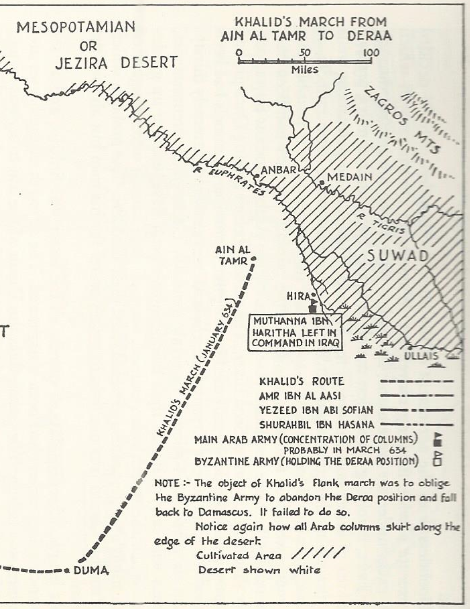
Muslim commander Khalid ibn al-Walid won a string of victories against the Persians along the Euphrates River front. Then in January 634 orders came for Khalid to join in the battle for Roman Palestine. He took his troops on a brutal march of 600+ miles across the waterless Arabian desert up through Palestine and into Roman Syria in order to flank entrenched Roman troops at Derra.

Organized into three columns Arab forces invade Roman Palestine from the south while Khalid's troops from the Persian front try to draw Roman troops from their prepared positions on the Yarmouk River.

Invasion

In 632 General Muhammad (prophet if you like) died. After a short time of "reorganization" the new Caliph ordered an invasion of Roman lands.

The Caliph appealed to the tribes around Mecca, Medina and Taif for recruits. He then appointed three commanders and in the tradition of Muhammad gave to each a banner.

The three commanders were Amr ibn al Aasi, Shurahbil ibn Hasana and Yezeed ibn abi Sofian. It is not clear why the army was divided into three columns. Perhaps the lack of water in the desert forced them to move in separate detachments. Also with no system of supply this could have made it easier to live off the land. Dividing the army might have meant harassing raids rather than invasion, but Arab warfare was wild and unpredictable in this period.

Column one under Amr ibn al Aasi was instructed to advance into southern Palaestina Salutaris through Aila (Aqaba) in the direction of Gaza. Column two under Yezeed ibn abi Sofian was to march up the east side of the Dead Sea . Column three under Shurahbil ibn Hasana was to march even further east in the direction of Busra and Damascus. If any column met strong opposition the other two columns were to come to its assistance.

How many Arab troops were sent? We do not know. We know that Khalid initially attacked Persia with perhaps 3,500 men.  It is fair to say the Arabs would not have mounted this major attack on Rome with less men than that, and the army might have been much higher.

Battle of Dathin  (634 AD)

With the Muslim invasion of Persia one would think Roman troops would have been active and in place on the Palestine border. But no.

It appears the Dux Sergius located 125 kilometers away up on the coast in Caesarea heard about the first Arab column and was the only Roman official to react.

Sergius gathered what troops he could find in the immediate area and marched south. How many men he had we do not know. We can assume his quickly assembled strike force was numerically inferior to the invading Muslims.

A swift march of 125 kilometers would have exhausted his men and horses. So we have a smaller worn out army taking on a larger invading army. As one would expect it did not turn out well.

The two forces met at the village of Dathin outside of Gaza on February 4, 634.

Sergius was driven back and pursued by the Muslims. Overtaken again Sergius himself was killed along with 300 of his men. How many escaped we do not know.

At this point the Arab force fanned out over southern Palestine reaching as far north as Lydda and Jaffa.

Dealing with Arab Cavalry
Starting in September, 629 AD the Eastern Roman Empire came in contact with an enemy like none they had faced before: rapidly moving fanatic Islamist armies from the deserts of Arabia.  
.
Unlike the slower moving conventional armies of the Persian and Roman Empires, the Arab cavalry forces were extremely nimble and moved swiftly over the harsh conditions of the Roman-Persian desert frontiers.


The Muslim Blitzkrieg and Terrorism

Now the Muslim commander in Persia started his lightning march to help the invading Arab armies in Palestine.

Khalid ibn al-Walid's rapid movements are easily compared to Blitzkrieg warfare created by Heinz Guderian in World War II.  The slower moving conventional armies of the Persians and Romans were at a distinct disadvantage.

Khalid first moved south to the desert town of Duma to put down a revolt against the Caliph. Khalid quickly captured the town. The leaders of the revolt were put to death, one Arab chief was crucified and the prisoners massacred.  The surviving women and children were shipped off to Medina.

Islamic terrorism as a weapon was nothing new to Khalid. After an early victory in Persia the ruthless Khalid ordered that all enemy prisoners be beheaded. Arab historians claim that thousands were butchered over a three day period.

Khalid now moved northwest into the Batn as Sirr Valley taking him within a 5 to 6 day march of Arab forces already operating in the Jordan Valley. He could have easily joined them. He did not do so because they were being held up by a Roman army which was manning prepared defenses near the town of Daraa.

The two Arab columns under Sofian and Hasana had joined forces to confront the Roman army but were unable to dislodge it. The two sides were deadlocked.

The prepared Roman positions in the Daraa Gap were protected on the left by the deep gorges created by the Yarmouk River and on the right by the lava mountains of Jebel Hauran.

Click map to enlarge

"The Daraa Gap"

The Arab and Roman armies deadlocked in what could be called the "Daraa Gap" is a good place to stop and ask the question: "Why?"

The Holy Grail of this war is a book written in 1964 by Lieutenant-General Sir John Bagot Glubb called The Great Arab Conquests.  The maps on this page are from his book.

The book is a military historian's gold mine. Glubb Pasha was fluent in Arabic, served as commander of the Arab Legion in Jordan and personally campaigned over the very ground the Romans and Arabs fought over.

His observations on the geography and forces involved concluded that the Emperor Heracilus had drawn up a brilliant battle plan to crush the Muslim invaders.  It is worth quoting him at length below.

Glubb Pasha:   "The records of the fighting which occurred between the Arabs and the Byzantine army in Syria are extremely confusing. Our sources are virtually restricted to the Arab historians who wrote more more than a century after the events . . . and who themselves were obviously ignorant of, or indifferent to, the course of the military operations. It was purely by accident that I discovered what appears to me now to be the key to the comprehension of the Arab campaigns in Syria, namely the narrow defile between the Yarmouk River and the Jebel Druze at Derra. . . .
Glubb Pasha

In July 1941 . . . it was feared that the German army, which had seized the Balkans, would attack Turkey and move southwards through Syria and Palestine to Egypt. . . . It was important to discover all the available narrow defiles, where armoured mechanized forces would be at a disadvantage . . . . to hold up German mechanized columns. . . . I myself was employed to examine the area round Deraa.

The Yarmouk River . . . . has cut a deep gorge down which it falls into the Jordan valley . . . . This gorge begins near the town of Deraa. East and northeast of Deraa lies a large group of mountains formed by extinct volcanoes, all the slopes of which are strewn with large black boulders of lava. In place, movement in this area is difficult even to men on foot, while horses and camels are almost immobilized and wheels entirely so. The lava-strewn spurs run down into the plain very nearly to the point at which the Yarmouk becomes an impassable gorge. . . . In 1941, we named this narrow defile the "Deraa gap". We decided to dig an anti-tank ditch across it and to build an entrenched position for an infantry brigade to close the gap.

All the European historians of the Muslim conquest of Syria complain of the vagueness and inaccuracy of the Arab records. Again and again the rival armies are reported to be facing one another on the Yarmouk. Then they disperse again without result. Were there several encounters on the Yarmouk, and why does that name keep recurring? It was only when I myself reconnoitered the area for a military purpose that, all of a sudden, the veil fell, as it were, from my eyes. Useful as this defile would be to prevent a German attack from the north, it was obvious to me that it would be  of even great importance in resisting an army coming up from the south. In so far as invasion from Arabia was concerned, the Deraa gap would be the Thermopylae of Syria.

In 1941, the Germans were invincible at their lightning mechanical warfare. . . . The only way to oppose these mechanized-avalanche tactics was to fight in close country, in mountains, in passes in narrow gaps . . . .

The Muslims were extremely light and mobile, and their tactics consisted of a wild charge . . . retreat and turning movements, cutting communications and supplies. In the open plain, the heavy slow-moving Byzantine troops could not compete with this mobility. But the Arabs could not fight a close-order infantry battle, by push of pike as it were. They had not sufficient body-armour, they were not trained to fight in close, well disciplined ranks. More over they had no heavy support weapons. A cloud of arrows was their only covering fire. Thus they easily overran the deserts and plains of Trans-Jordan and southern Palestine but were afraid of the mountains and defiles.

Dreading the Arab blitzkrieg, the Byzantine army in 634, like the British army in 1941, established an entrenched camp near Deraa in the gap between the Yarmouk's gorge and the lava beds. The Arabs would sometimes skirmish in front of this camp and sometime withdraw, but their lack of military science made it difficult for them to assault it. Khalid's operations round Palmyra and Damascus would thus have the object of persuading the Byzantines to withdraw from Deraa, a result, however, which they failed to achieve."

T E Lawrence and the Arab Revolt 1916 - 1918.  Camel mounted Arab troops on the march in the desert near Jebel Serd. The Romans would have faced similar forces during the battles in Palestine and Syria.

Khalid Marches North

Once you have read Glubb Pasha's books you become physically ill when so-called "historians" wave their hand and say how the Romans gave up the Middle East without a real fight. The polar opposite is the truth. The Battle for the Middle East was a seven year long slugfest from 629 to 636 AD involving multiple battles, sieges and huge armies operating over hundreds of square miles from the Persian front on the Euphrates to Gaza.

As we have seen above the Arab forces came to a standstill when faced with the entrenched Roman army in the Daraa Gap.

Doubtless with the agreement of the other Arab commanders at Daraa, Khalid executed a wide flanking movement of hundreds of miles through waterless desert to threaten Damascus and force the Romans to withdraw from Daraa to protect the city. This action was both daring and extremely dangerous. There are no permanent wells through most of that area. 

It is claimed Khalid took 9,000 men with him on the march. This can be considered to be the usual military inflation. No doubt he took a strong force. Perhaps several thousand men, but this was not a march of conquest. It was an overgrown raid to try and draw Roman troops away from their positions and open Syria to invasion.

Wells were vital in waterless desert warfare.

He watered at Qaraqir, a well which still exists today. Before leaving Khalid adopted a Bedouin device. A number of camels were starved of water and then allowed to drink their fill. With full bladders camels could be slaughtered along the way for their water and meat. In the desert lack of water was a more feared enemy than soldiers, and Khalid had many men and their horses to water daily.

The army advanced in March 634 finally coming to a place called Suwa. After five days of marching all the water was gone and all the water-carrying camels slaughtered. Both the men and horses were failing fast. A guide told Khalid of a hidden desert well marked by a thorn bush. They searched and searched, and the entire force was in danger.

Finally the bush was found and in digging the Muslims discovered a hidden water supply.

With his army saved Khalid went on the attack and captured Palmyra. Turning west he sacked Qaryatein.

The march through the desert was not detected by the Romans. Khalid's arrival in the Palmyra area would thus have been a complete surprise. But as he moved closer to Damascus the Romans reacted.

Battle of Marj Rahit  (Easter Sunday, 634)

About 15 miles east of Damascus Khalid engaged the Ghassanid Christian Arab allies of Rome.

The town was filled with refugees fleeing the Muslims, and they were in the middle of Easter celebrations.

It was claimed the Ghassanids had 15,000 men. No doubt that was far too many just like the 9,000 men of Khalid. I would easily cut both numbers by 50% or more.

The Ghassanids had positioned a strong screen of warriors in front of the town, but it was shattered by a determined Muslim cavalry charge. The Ghassanids pulled back. The Muslims then raided the town collecting booty and captives. They then retreated back to their camp.

Arab historians naturally claimed a "victory" at Marj Rahit. That is doubtful. A raid for booty is hardly a victory. And the fact of the matter is Khalid immediately left the battlefield. We do not know why but the Ghassanid army may have been reforming and local Roman troops might have been getting ready to join them. We do see that Khalid was not eager to stick around to find out who he would have to fight. . . . a sign of weakness.

The Romans and their allies, not the Muslims, were in possession of the field of battle. If Khalid had truly been victorious at Marj Rahit he could have pressed an attack on Damascus and forced the Roman army to withdraw from Daraa to protect the city.

But there was no Arab attack on Damascus and the Romans were still holding the Daraa Gap. Khalid's wide flanking march through the desert had failed. So he abandoned his efforts and rejoined the other Arab forces at Daraa.

Roman Emperor Heraclius
Crowned Caesar in 610 Heraclius had saved the empire from total collapse. Now he organized a major counter attack against the Muslim invaders.

The Chess Pieces Are in Place

So here we are at about April of 634 and there is a stalemate on the Palestine front.

The Roman army has totally blocked the Muslims at Daraa from moving north. Plus the Muslim column in the Gaza area is not strong enough to make any significant advances north.

We see the hand of the Emperor Heraclius in these movements. A frontline commanding general himself, the Emperor had personally spent time in Palestine and Syria and knew the land. The army at Daraa was obviously assigned to its position in order to block the invaders.

While holding the Muslims in Palestine the Emperor had gathered to him a second large army as well as the Roman navy.

All the pieces are now in place. The Roman counter attack begins.

See you later in Part IV.

Roman Cavalry
.
The Battle for the Middle East
.
Read More:
.
Part I - Roman Empire vs Islam - First Contact
.
Part II - A Persian-Roman Army Fights Muslim Invaders


(Dathin)      (Khalid)      (Marj Rahit)

Friday, July 1, 2016

Roman Empire vs Islam - First Contact


19th century photo of an Arab warrior. The Arabs invading the
Roman Empire might have looked much like this warrior.

Battle for the Middle East, Part I
Violent Islam roars in 
from the desert


In 629 AD the Roman Empire was enjoying a much deserved period of peace.  No one in Constantinople had any idea that a fresh invasion from the southern deserts would happen in a matter of months.

For 26 years the Roman and Persian Empires had been in the death grip war of all death grip wars.  The 700 years of war between the empires came down to this one life and death conflict.  Only one empire would survive the encounter.

The Roman Empire nearly ceased to exist. The Persians conquered massive territories in the east, south and in Africa. Meanwhile the Avars and Slavs overran the Balkans and with the help of the Persians laid siege to Constantinople itself in 626.

Things were so bad that the Emperor Heracilus considered abandoning Constantinople and moving the capital to Carthage in Africa. The Patriarch Sergius convinced the Emperor to stay and put the wealth of the church at the service of the state to finance the wars.

Roman Emperor Heraclius
Crowned Caesar in 610. Latin was still the official
language of the military and government. The Emperor
faced invasions by Persians, Avars and Muslim Arabs.

The Persian Empire in 621 AD.
The Persians nearly destroyed the Roman Empire by conquering large parts of Anatolia up to Constantinople itself as well as taking Syria, Mesopotamia, Georgia, Palestine and Egypt. Though Persia was finally defeated, the weakened Roman state became an easier target for the coming Muslim Arab invasions.

With financing from the church, Emperor Heracilus raised additional armies and hired Khazar Turk allies to invade Persia with him.

By 628 the Persian Empire had been totally crushed, Shah Khosrow II was murdered by his own son and the Persian armies were withdrawn from Egypt, Syria and other Roman provinces.

There may have finally been "peace" between Rome and Persia, but it was a disastrous peace.  The Persians sank into dynastic anarchy while the Romans were financially, militarily and politically exhausted.

The two great empires of the world were at their weakest point at just the moment a militant and militaristic Islam appeared.

Islam Appears

The 620s saw the birth of Islam deep in Arabia.  General Mohammad, or prophet if you like, was simultaneously a military commander, ruler and prophet. The emotional appeal of religion was combined with terrorist methods and assassinations to clear the way for gathering territory for the faith.

As the battles of General Mohammad progressed the base of Arabia was secured for Islam and Muslim eyes started to look north to the Roman Empire for expansion.

In the year 628 Mohammad dispatched messages to the Shah of Persia, the Roman Emperor, the Governor of Egypt and the Prince of Abyssinia asking them to accept Islam.

The Shah was said to have torn up the message with contempt. Emperor Heracilus accepted his letter and simply inquired who the author was. The Governor of Egypt excused himself from changing religions, but sent as gifts a horse, a mule, a riding ass and two Egyptian girls. If the Prince of Abyssinia got the message at all there is no record of a reply.

Heracilus gave orders that he wanted to interview a traveler from the area. One Abu Sofian was brought to Jerusalem and asked about the "disturbances" in Arabia.  Sofian told the Emperor that the followers of Mohammad consisted of the poorer classes and of adolescent youth. All men of substance opposed him.

The Emperor gathered intel, but did not act. The internal goings on among poor desert tribes did not require much attention.

19th century photo of Arab warriors

The Battle of Mota (Mu'tah)
3,000 Arabs vs 10,000 Romans


In 629 a number of minor raids and expeditions were sent out from Arabia.  Some were defeated and others returned with booty.

In September, 629 a more important expedition was organized. Tradition says the raid was to punish a chief of Rome's ally the Arab Ghassanid tribe for killing Muslim emissaries in the area. Revenge rather than conquest appears to be the motive.

A Muslim camp was formed a few miles north of Medina where volunteers were instructed to assemble.  Zeid ibn Haritha, the adopted son of Mohammad, was given command. He set out with 3,000 men marching to what is today southern Jordan. It was the first Muslim raid of this size going far from Arabia.

Muslim commanders still relied on religious spirit rather than military skill and had neglected to send out spies to scout the land they were invading.
Eastern Roman Soldier

It was not until they reached Maan that they found out there was a large force of Romans gathered to meet them. A halt was called and the Muslim leaders spent two days arguing whether to advance or retreat. The deciding voice came from an early convert who demanded "Victory or martyrdom and paradise." The order was given to advance.

The Muslim army move north with the rocky hills of Moab on their left. When they crossed the lower foothills of the mountains the Muslims suddenly found themselves in the presence of a Roman army several times larger that their own, perhaps about 10,000 men.

A majority of the Roman force appears to have been made up of Christian Arab allies of the Empire. Some proportion of the army (how much?) was reinforced by regular Roman troops, perhaps from a local garrison.

It is likely that the Roman commander was Theodore, the brother or half brother of the Emperor. Theodore had extensive experience as a Kouropalates and leading general in the Persian wars. An army this large would have required a senior office such as Theodore.

There is a small plain near the village of Mota. It was decided to give battle there.

Zeid ibn Haritha seized the white banner given to him by Mohammad.  He then a wild charge of his men into Roman ranks until he fell transfixed by their spears. Another Muslim grabbed the banner from the dying Zeid, raised it aloft and cried "Paradise! Paradise!" until he was killed by a Roman soldier.

Fighting in the ranks new Muslim convert Khalid ibn al-Walid came to the rescue at this point.  Perhaps a little less anxious for Paradise, he assumed control. The white banner was planted in the ground and the disorganized, battered Muslims gathered to that point. Under Khalid's leadership they retired methodically from the battlefield.

Khalid continued to engage the Romans in skirmishes, but he avoided a pitched battle. One night Khalid completely changed his troop positions. The rearguard was given new banners to give the impression that reinforcements had arrived from Medina.

On another night he had his cavalry retreat behind a hill hiding their movements. He then had the cavalry return during the day when the battle resumed raising as much dust as possible to give the impression of fresh troops arriving.

Information on the battle is minimal. Still we can read between the lines. The Arabs were mauled, but retreated in an orderly manner. On the other side, the Romans did not just call it a day and go home. They continued aggressive contact with the Muslims over several days.

Casualties are unknown, but this first contact was a solid Roman victory.

Aftermath

When the defeated Muslims approached Medina, Mohammad and the people went out to meet them. The citizens began to throw dirt on the defeated soldiers crying, "You runaways, you fled in the way of God."  Mohammad said they were not runaways but could fight again for the cause.

In spite of the disaster at Mota, throughout the rest of 629 many Bedouin tribes sent deputations to Mohammad seeking friendship and alliance.

Mohammad sent a force to the Roman province of Palaestina Salutaris
to punish the Christian Arabs who killed Muslim emissaries.

Bedouin, Warriors 1890s

Map from The Great Arab Conquests (1964)
by
Lieutenant-General Sir John Bagot GlubbKCBCMGDSOOBEMC
.
As far as I am concerned Glubb Pasha's book is the Holy Grail on the 
Arab invasions. Glubb was fluent in Arabic and able to read original
documents. In addition he was commander of the British Arab Legion
and personally campaigned on the very ground the Romans and
Muslims fought over.


(John Bagot Glubb)      (Bagot-Glubb)      (Ghassanids)      (Mutah)

(Byzantine-Sasanian War)

Tuesday, June 16, 2015

Azraq Fortress - The Limes Arabicus


Azraq Fortress

The Limes Arabicus
Defending the eastern borders of Rome


The Limes Arabicus was a desert frontier of the Roman Empire, mostly in the province of Arabia Petraea. It ran northeast from the Gulf of Aqaba for about 1,500 kilometers (930 mi) at its greatest extent, reaching Northern Syria and forming part of the wider Roman limes system.

The defensive Limes was to protect the Roman province of Arabia from attacks of the barbarian tribes of the Arabian desert and to protect the commercial lines from desert-based robbers.

Next to the Limes Arabicus the Emperor Trajan built a major road, the Via Nova Traiana, from Bostra to Aila on the Red Sea, a distance of 267 miles/430 kilometres. Built between 111 and 114 AD, its primary purpose may have been to provide efficient transportation for troop movements and government officials as well as facilitating and protecting trade caravans emerging from the Arabian peninsula. It was completed under Hadrian.

Usually, Roman auxiliary troops were sufficient to deter any group of barbarians. Only rarely was it necessary to employ the legions, the backbone of their army. Still, they were the ultimate weapon.

We can discern two main types of military base:
  1. Castra: the fortresses of the legions. At the end of the reign of Trajan (98-117), there were thirty legions in twenty-eight bases. Almost all of these were close to the border, at some distance of each other.
  2. Castella: the forts of the auxiliary troops, which were usually infantry, sometimes cavalry, and sometimes mixed units. Typically, they were no less than twenty kilometer from each other. Along the road between the castella were watchtowers.

In Arabia there were castra every 100 kilometres (62 mi) with the purpose to create a line of protection and control.

Troops were progressively withdrawn from the Limes Arabicus in the first half of the 6th century and replaced with native Arab foederati, chiefly the Ghassanids. After the Arab conquest the Limes Arabicus was left to disappear.


Azraq was built and manned by the Romans in
the early 4th century AD.
(Photo - Roman Empire.net)


The Fortress of Qasr Azraq

The Roman province of Arabia Petraea would have been a somewhat quite sector of the Empire.  Though subject to eventual attack and deprivation by the Persians and Palmyrenes, it had nothing like the constant incursions faced in other areas on the Roman frontier, such as Germany and North Africa, nor the entrenched cultural presence that defined the other, more Hellenized, eastern provinces.

Petra served as the base for Legio III Cyrenaica and the governor of the province.

There are no histories of major battles involving the smaller fortresses of the Limes Arabicus.  The bulk of the major military campaigns were further north in Syria and Anatolia.  The fortresses on the Limes were mostly used to control bandits and maintain law and order among the locals.

Qasr al-Azraq (Arabic for "Blue Fortress") is a large fortress located in present-day eastern Jordan. It is one of the desert castles, located on the outskirts of present-day Azraq, roughly 100 km (62 mi) east of Amman.
6th Century Roman Soldier

The name of the fortress and associated town came from these. The settlement was known in antiquity as Basie and the Romans were the first to make military use of the site.

The castle is constructed of the local black basalt and is a square structure with 80 metre long walls encircling a large central courtyard.  At each corner of the outer wall, there is an oblong tower. The main entrance is composed of a single massive hinged slab of granite, which leads to a vestibule where one can see carved into the pavement the remains of a Roman board game.

Although very heavy — 1 ton for each of the leaves of the main gate, 3 tons for single the other — these stone doors can quite easily be moved, thanks to palm tree oil. The unusual choice of stone can be explained by the fact that there is no close source of wood, apart from palm tree wood, which is very soft and unsuitable for building.

The strategic significance of the castle is that it lies in the middle of the Azraq oasis, the only permanent source of fresh water in approximately 12,000 square kilometres (4,600 sq mi) of desert. Several civilizations are known to have occupied the site for its strategic value in this remote and arid desert area.

The area was inhabited by the Nabataean people and around 200 CE fell under the control of the Romans. The Romans built a stone structure using the local basalt stone that formed a basis for later constructions on the site, a structure that was equally used by the Byzantine and Arab empires.

The Roman Empire was heavily pressed by invasions in both the Balkans and Anatolia.  That resulted in the somewhat quite sector of Arabia being drained of troops to help more threatened sectors.  Christian Arab foederati such as the Ghassanids were paid to patrol the southern frontiers.  

Because of the local wetlands the Azraq fortress would have still been considered important.  But there are no records on troop levels or military activity.

With the invasions by Muslim Arabs in the 630s the Romans lost control of all their border fortifications as they retreated north to Syria never to return.

Later, the fort would be used by the Ottoman armies during that empire's hegemony over the region. During the Arab RevoltT.E. Lawrence based his operations here in 1917–18, an experience he wrote about in his book Seven Pillars of Wisdom. The connection to "Lawrence of Arabia" has been one of the castle's major draws for tourists.


The Roman Frontier in Jordan - Part I


Azraq Wetlands
Water in a desert made the Fort of Azraq an important stronghold for Rome.  The wetlands were created some 250,000 years ago as a result of being fed by aquifers that corresponded with geological changes. Azraq has, since ancient times, been the crossroads of both human trade routes and bird migrations. Millions of cubic meters of freshwater attracted camels caravans.

Azraq Fort


Qasr el-Azraq, praetorium

Qasr el-Azraq, south tower

Qasr el-Azraq, south tower, room

Qasr el-Azraq, inner court from south tower

Qasr el-Azraq, inner court


In AD 106 the Romans under Emperor Trajan achieved control of the region east of the Jordan River, which was previously ruled by the Nabataeans. Until then, the Nabataean kingdom had provided a buffer between the Roman Empire and the threat of enemies to the east. Historians do not know how and why the Romans took direct control. Perhaps the lack of a legitimate successor to the deceased Nabataean king resulted in a power vacuum. The Romans annexed the area and called it Provincia Arabia. It was governed by a senatorial legate appointed by the emperor, and its capital was Bostra (or Bosra) in southern Syria.


(Azraq Wetland Reserve)      (livius limes)      (livius.org)      (Azraq fort)

(Arabia Petraea)      (Limes Arabicus)      (desert castles)      (Qasr Azraq)

Tuesday, August 21, 2012

The Byzantine Fortress of Qasr Bashir


The Roman - Byzantine Fortress of Qasr Bashir in Jordan.

The Limes Arabicus
A chain of forts protecting Roman lands from Arab raids


The Limes Arabicus was a desert frontier of the Roman Empire, in the province of Arabia Petraea. It ran -at its biggest extension- for about 1,500 km, from Northern Syria to Southern Palestine and northern Arabia, forming part of the wider Roman limes system. It had several forts and watchtowers.

The reason of this defensive "Limes" was to protect the Roman "Province of Arabia" from attacks of the barbarian tribes of the Arabian desert. 

Next to the limes arabicus Trajan built a major road, the Via Nova Traiana, from Bostra to Aila on the Red Sea, a distance of 267 miles. Built between 111 and 114 AD, its primary purpose may have been to provide efficient transportation for troop movements and government officials. It was completed under Hadrian.

During the Severan dynasty (AD 193-235), the Romans strengthened their defenses on the Arabian frontier. They constructed several forts at the northwest end of the Wadi Sirhan, and they repaired and improved roads.

Qasr Bashir
Reproduced from: Campbell DB, Roman Auxiliary forts 27 BC - AD 378. Fortress Series 83. Osprey Military Publishing, 2009. P. 58.
(xlegio.ru/fortification/limes-arabicus)

Jordan


In Jordan there was no natural boundary other than desert all the way down to the Red Sea. Major communication routes here tended to run between oases and along the seasonal wadis. Linking Syria to the Arabia, the cities of the Decapolis, Petra and the ultimately the Gulf of Aqaba was the route known in the Bible as the King's Highway, parts of which came to be incorporated in the via nova Traiana, across which the Roman military presence was distributed.

Indeed the frontier here has long been recognised as more a zone than a delineated line and where the environment played an important part in the settlement pattern. In the province of Arabia there was the less tangible but increasingly important rise of tribal confederations of nomads with whom Rome had to treat and who in time became partners in the defence of the later empire.
Emperor Leo I
Ruler of the Eastern Empire from 457 to
474.  The Roman forts in Jordan were
still being funded and staffed with troops
during his reign.

With the annexation of Nabataean Arabia The Romans transferred the Legio III Cyrenaica from Egypt to the new province with auxiliaries. In 106 the unit was maybe based in Bostra, with the likelihood that smaller vexillations with other auxiliary units were distributed among the various cities and towns of Nabataea.

At the same time some new forts were erected together with the construction of a well-known pre-Roman road, the via nova Traiana, which linked Aqaba on the Arabian Gulf to the province of Syria in the north. Various units were stationed along and behind the desert line east of this main transfer road. In the early 3rd century significant construction work was done, probably in the Severan period. Pushing out in to the desert regions in north-east Arabia to control the oases with the erection of new forts and new road building.

The emperor Diocletian's army reform around 300 also affected the form and distribution of Roman military installations. About this time the Roman army constructed three new but smaller legionary sites in Betthorus-Lejjun, Adrou-Udruh and Aila-Aqaba and smaller sized other forts. Most of those garrisons were still maintained in many of the locations into the 4th century and only successively reduced to be compensated with greater use of control exerted through diplomacy and subsidy with the leaders of the local nomadic population.


In AD 106 the Romans under Emperor Trajan achieved control of the region east of the Jordan River, which was previously ruled by the Nabataeans. Until then, the Nabataean kingdom had provided a buffer between the Roman Empire and the threat of enemies to the east. Historians do not know how and why the Romans took direct control. Perhaps the lack of a legitimate successor to the deceased Nabataean king resulted in a power vacuum. The Romans annexed the area and called it Provincia Arabia. It was governed by a senatorial legate appointed by the emperor, and its capital was Bostra (or Bosra) in southern Syria.

Qasr Bashir


Qasr Bashir is an extremely well preserved Roman fortress that lies in the Jordanian desert. Unlike many Roman remains, Qasr Bashir is exceptionally well preserved, having never been re-built by later civilizations.

Qasr Bshir belongs to the chain of forts and watchtowers that is known as the Limes Arabicus and was meant to protect the province of Arabia against roaming desert nomads. They were not extremely dangerous or exceptionally violent, but their dromedaries made them swift, and if trouble arose, they could pillage large parts of the Roman countryside. The Limes Arabicus had to counter this threat, and Mobene was one of the fortifications.

Built at the beginning of the fourth Century AD and known as Mobene, the walls of Qasr Bashir still stand intact, at a height of up to 20 feet in places, while the main entrance remains to this day. The huge corner towers still rise up two stories from the ground.

It is likely that Qasr Bashir was originally home to an auxiliary cavalry unit, charged with defending the Roman frontier and keeping the peace in the surrounding area. 

The courtyard, which has two cisterns, is on all sides surrounded by rooms, twenty-three in number, which have been identified as stables. There was a second story, where the soldiers must have slept. The roof of these barracks reached the same height as the rampart walk, creating a really wide fighting platform. One room, opposite the main gate, may have been the headquarters, some kind of sanctuary, or both.

Because each of the twenty-three stables was used by three horses, and because a cavalry unit of frontier soldiers appears to have numbered between 120 and 150 men.

The Roman Limes defense system.


The Roman Frontier in Jordan, Part I
The short film The Roman Frontier in Jordan is part of the multimedia DVD-project Frontiers of the Roman Empire. The aims of the film are to show fascinating pictures from the Roman frontier in the Middle East and to connect people from different countries through their common history and archaeology. The Roman fort of Qasr Bshir is one of the best preserved installation of the Roman army known today.


Southern tower


Inscribed above the gate.

The central gate, which faces the shallow valley to the southwest, is flanked by two towers that are about half as large as the corner towers. The building inscription of the fort, a rarity in this part of the limes, survives and mentions the emperors of the First Tetrarchy
.
Optimis maximisque principibus nostris Caio Aurelio
Valerio Diocletiano Pio Felici Invicto Augusto et
Marco Aurelio Valerio Maximiano Pio Felici Invicto Augusto et
Flavio Valerio Constantio et Galerio Valerio Maximiano
nobilissimis Caesaribus Castra Praetorii Mobeni fossamentis
Aurelius Asclepiades praeses provinciae Arabiae
perfici curavit
.
In honor of our best and greatest rulers, Gaius Aurelius Valerius Diocletian, our pious, lucky, and unconquered emperor, and Marcus Aurelius Valerius Maximian, our pious, lucky, and unconquered emperor, and to Flavius Valerius Constantius and Galerius Valerius Maximianus, our noblest caesars, has Aurelius Asclepiades, praeses of the province of Arabia, ordered to build Castra Praetorium Mobene from its foundations.

This inscription allows us to date the construction of the fort to 293-305, when the Romans constructed more forts in this sector of the frontier.


The End of the Roman Frontier in Arabia

The Roman military presence in Arabia began to decline in the mid-400s when forces were diverted to other threatened frontiers. In the early 500s, Justinian turned over the defense of the southeastern frontier to the Ghassanids, a Christian Arab tribe. Around AD 530, the troops were withdrawn and the limes Arabicus ceased to exist.

The forts of el-Lejjun, Khirbet el-Fityan, Rujm Beni Yasser, Qasr Bshir, and Da'janiya were abandoned at this time. The numerous watchtowers provide no evidence of occupation in the sixth or early seventh centuries. At least by the early 600s, the fortified frontier system in Palestine and Transjordan no longer existed. This withdrawal of defenses paved the way for the eventual Muslim conquest of the region in the 600s.

Sources:   (livius.org/q/qasr_bshir)      (gla.ac.uk)      (amanfrommoab-fort-bashir)


The frontier zone south of Wadi al-Hasa was called the limes Palaestina, which extended to the Red Sea at Aila ('Aqaba). In this region, ten castella and a legionary camp have been identified.
(vkrp.org)


Qasr Bashir


Cistern


Qasr Bashir


The Roman Frontier in Jordan, Part II


Roman Forts on the Arabian Frontier


Diocletian engaged in a major military expansion in the region, building a number of forts (castella), watchtowers, and fortresses along the fringe of the desert just east of the Via Nova. The term used for this north-to-south line of military installations is limes Arabicus, which means "Arabian frontier." This line of defense extended from south of Damascus to Wadi al-Hasa. The region from Wadi Mujib to Wadi al-Hasa contained four castella and a legionary camp.