.

Dedicated to the military history and civilization of the Eastern Roman Empire (330 to 1453)


"Time in its irresistible and ceaseless flow carries along on its flood all created things and drowns them in the depths of obscurity."

- - - - Princess Anna Comnena (1083–1153) - Byzantine historian

Showing posts with label Army. Show all posts

Thursday, May 21, 2020

Latin Speaking Africa


Brutus and Cassius in HBO's Rome

Language Follows Military Power


It is rather simple, language follows military conquest and economic power.

We saw the Greek language take hold in much of Egypt with the conquest by Alexander the Great. The same is true in North Africa. With the fall of Carthage to Rome in 146 BC we saw Roman military colonies and economic activity spread the Latin language along coastal Libya, Tunisia, Algeria and Morocco.

The populations of Roman North Africa that had a Romanized culture and used to speak their own variety of Latin as a result. Latin continued to be used for centuries after the fall of the Western Empire in 476 AD. 

The Latin speaking local population went on during the conquest by the Germanic Vandal tribes and on into the re-conquest period by the Eastern Roman Empire.

What happened to African Latin following the Arab conquest in 696-705 AD is difficult to trace, though it was soon replaced by Arabic as the primary administrative language. At the time of the conquest a the Latin language was probably spoken in the cities and Berber languages were also spoken in the region.
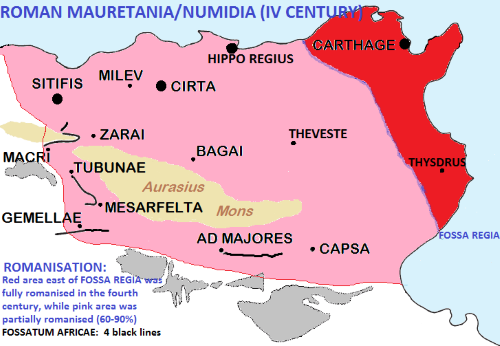
Romanization of Africa in 4th century CE
Red Latin, Pink 60 to 90% Latin


North African Roman Provinces
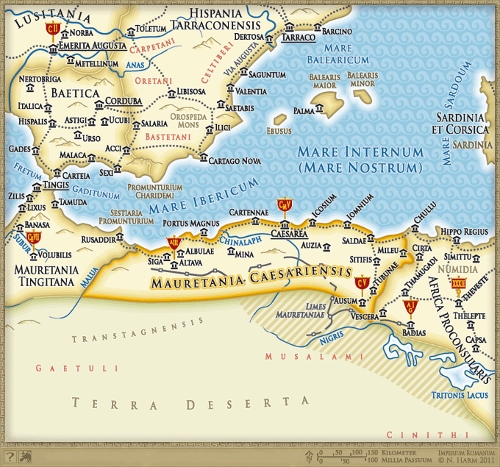
The province of Mauretania Caesariensis existed from 42 AD to the 7th Century. During and after the Fall of the Western Roman Empire in the 5th century, most of the hinterland area was lost, first to the Vandal Kingdom and later to the Mauro-Roman Kingdom, with Roman administration limited to the capital of Caesarea.
.
The land was reconquered by Rome during the reign of 
Justinian. In the late 580s, under the emperor Maurice, all of the Maghreb was granted to the Exarchate of Africa, and Mauretania Caesariensis became part of a new province, Mauretania Prima. The Muslim conquest of the Maghreb in the late 600s brought an end to Roman rule.
.
Over time the use of Latin would have moved closer and closer to the coast.

Arch of Caracalla (Triumphal Arch)
In 
Volubilis, Roman Morocco
The city fell to local tribes around 285 and was never retaken by Rome because of its remoteness and indefensibility on the south-western border of the Roman Empire. It continued to be inhabited for at least another 700 years, as a Latinised Christian community.  The Eastern Empire retained a small island of control on the Moroccan coast until the Arab conquest.

Roman Military Colonies

Latin speaking Roman Africans lived in all the coastal cities of contemporary TunisiaWestern LibyaAlgeria and Morocco.

The Roman Africans were generally local Berbers or Punics, but also the descendants of the populations that came directly from Rome itself or the diverse regions of the Empire as legionaries and senators.

The African province was amongst the wealthiest regions in the Empire (rivaled only by Egypt, Syria and Italy itself) and as a consequence people from all over the Empire migrated into the province. Large numbers of Roman Army veterans settled in Northwest Africa on farming plots promised for their military service.

Since the second half of the first century BC and as a result of increasing communities of Roman citizens living in the North African centers, Rome started to create colonies in North Africa.

  1. The main reason was to control the area with Roman citizens, who had been legionaries in many cases. 
  2. The second reason was to give land and urban properties to the Roman military troops who had fought for the Roman Empire and so decrease the demographic problem in the Italian peninsula
  3. The third reason was to facilitate the Romanization of the area and so the integration of the local Berbers -through marriage and other relationships- in the Roman Empire's social and cultural world.

Emperor Septimius Severus
From
 Leptis Magna in the Roman province of AfricaSeptimius Severus grew up in Leptis Magna. He spoke the local Punic language fluently, but he was also educated in Latin and Greek, which he spoke with a slight accent.


Under Theodosius the area east of the Fossa regia was fully Romanized with one third of the population made of Italian colonists and their descendants. The other two thirds were Romanized Berbers, who were all Christians and nearly all Latin speaking.

Called the "Granary of the Empire", Romano-berber North Africa produced one million tons of cereals each year, one-quarter of which was exported. Additional crops included beans, figs, grapes, and other fruits. By the second century, olive oil rivaled cereals as an export item. In addition to the cultivation of slaves, and the capture and transporting of exotic wild animals, the principal production and exports included the textiles, marble, wine, timber, livestock, pottery such as African Red Slip, and wool.

Berber Africa -from northern Morocco to Tripolitania- had a population of more than 3 million inhabitants in the third century.

Nearly 40% were living in more than 500 cities. But in the sixth century -after the Byzantine reconquest- the population was reduced to less than 2.5 millions and after the Arab conquest in the eighth to tenth centuries there remained only one million.

There were 20 cities in the territory of actual Tunisia with the title and privileges of "Roman Coloniae" or similar, while in Algeria there was nearly the same amount and in Morocco and Libya only a few. 
The most important was the "capital" new Carthago, with more than 300,000 inhabitants during Septimius Severus times (who enhanced Leptis Magna -where he was born- to be the second city of Berber Africa with nearly 100,000 inhabitants).  
The verified "Roman Coloniae" in Africa were:


 A mosaic on the floor ‘Labors of Hercules house’
in Volubilis, near Meknes, Morocco.

The End of Latin

The Muslim conquest of North Africa in the late 600s and early 700s did not end Latin. Local Latin speaking communities appear to have gone on for many centuries.

Spoken Latin is attested in the city of Gabès by Ibn Khordadbeh (died 912), in BéjaBiskraTlemcen and Niffis by al-Bakri (died 1094) and in Gafsa and Monastir by al-Idrisi (died 1165). 

The latter said of Gafsa that "its inhabitants are Berberised, and most of them speak the African Latin tongue."

The Normans, when they were acquiring their African kingdom in the 12th century, received help from the remaining Christian populations of Tunisia, and some historians argue that those Christians still spoke a Romance language.

The language existed until the arrival of the Banu Hilal Arabs in the 11th century and probably until the beginning of the fourteenth century. According to one historian, "Christian communities, generally labelled Afariqa or Ajam in the Arab sources and speaking a Latin dialect ... are known to have survived until the fourteenth century."

Virginie Prevost pinpointed that -between the Berbers of Afrikiya- the African Romance language was linked to Christianity, that survived in north Africa until the XIV century and according to the testimony of Mawlâ Aḥmad probably until the early XVIII century in Touzeur (south of Gafsa). 

The Arab Mawla Ahmad wrote that in 1709 "the inhabitants of Tazeur are what remains of the Christians who were once in Afrikiya, before the Arab conquest".


Click to enlarge
Languages of the Eastern Roman Empire

Portrait of the Roman African poet Terentius
Terentius may have been born in or near Carthage. He may have lived in the territory of the Libyan tribe called by the Romans Afri. 

Roman Emperor Heraclius
Heraclius brought an army from Latin speaking Carthage to Constantinople to overthrow the Emperor Phocas. He was crowned Caesar Flavius Heraclius Augustus in 610.


(Roman Africans)    (Languages)    (African Romance)

(Kingdom of Africa)    (Roman colonies)

Wednesday, August 1, 2018

Army - Unjust Treatment of the Soldiers


Roman heavy infantry
(Pinterest)

Corruptus in Extremis


The great weakness in the Empire was the decline of the different Roman assemblies so the people had no way of peacefully changing their government. 

By the time of Justinian the eastern Senate had become a rubber stamp institution with little power. The Emperor of the moment could trample on the rights of the people at will.

In this chapter below from Procopius' Secret History we get yet another example of Imperial corruption right at the top in the Royal Palace.

Short of a military coup there was nothing anyone in the Empire could do.


By Procopius of Caesarea
500 - 554 AD
The Secret History


UNJUST TREATMENT OF THE SOLDIERS


I must not pass over his treatment of the soldiers, over whom he appointed paymasters with instructions to hold out as much of their money as they found possible, on the understanding that one twelfth of what they thus collected was theirs. 

Their method each year was as follows. It was the regulation that different ranks in the army receive different pay: the young and newly enlisted received less, those who had seen hard service and had advanced half way up the list received more, and the veterans who should soon retire from service had a still higher rating, so that they could live on their savings as private citizens, and when their span of life was complete, might be able to leave some consolation to their families. In this way, the soldiers step by step arose in rank as their older comrades died or retired, and each man's pay fitted his degree of seniority.
But the paymasters forbade the erasing from the lists of the names of soldiers who died, even when many perished together, as frequently happened in the constant wars. Nor did they fill the vacancies in the lists, even after considerable time.
The result of this was that the number of soldiers grew continually less, and those who survived their dead comrades were deprived of their proper advancement in rank and pay; while the paymasters handed over to Justinian the money that should have gone to these soldiers all this time.
Furthermore, they fined the soldiers for other personal and unjust reasons, as a reward for the perils they underwent in the battlefield: on the charge that they were Greeks, as if none of that nation could be brave; or that they were not commissioned by the Emperor to serve, even when they showed his signature to that effect, which the paymasters did not hesitate to question; or that they had been absent from duty for a few days.


Eastern Roman Guard
Troops were expected to put their lives on the line while the Emperor cheated them of their pay.

(Pinterest)

Later, some of the palace guards were sent throughout the whole Roman Empire to investigate how many on the military lists were unfit for service; and some were relieved of their uniform for being old and use less, so that for the rest of their lives they had to beg their meals of the charitable in the public Forum, exhibiting their tears and lamentations to passersby; and the rest, lest they might suffer a similar fate, handed over their savings as a bribe, with the result that all the soldiers lost heart for their profession, were reduced to poverty, and had no further enthusiasm for campaigning.
This was ruinous to the Romans and their authority in Italy; and the paymaster Alexander, sent thither, had the audacity to reproach the soldiers for their poor morale; while he exacted further money from the Italians, on the pretext of punishing them for their negotiations with Theodoric and the Goths. The common soldiers, indeed, were not the only ones to be reduced to poverty and helplessness by these commissioners; for all the staff officers, under the generals, who had formerly been in high esteem, were utterly impoverished and in danger of famine, as they had no money left with which to buy their customary provisions.
Speaking of the soldiers reminds me to add further details. The Roman emperors hitherto had stationed large armies on all frontiers of the State to protect its boundaries; and particularly in the East, to repel incursions of the Persians and Saracens. These border troops Justinian used so ill and meanly from the start that their pay became four or five years overdue; and when peace was declared between the Romans and Persians, these poor men, instead of sharing in the fruits of peace, were forced to contribute to the public treasury whatever was owed them; after which they were summarily discharged from the army. Thereafter the boundaries of the Roman Empire were unguarded, and the soldiers were left suddenly on the hands of charity.
Another corps of not less than three thousand, five hundred other soldiers, originally mustered for the palace guard, and called the Scholars, had always received higher pay from the public treasury than the rest of the army. Originally they were chosen to this preferred company by special merit, from the Armenians; but from the time when Zeno became Emperor, it was possible for anyone, no matter how poor or cowardly a soldier, to wear this uniform. 

Now when Justin came to the throne, this Justinian distributed the honor among a large number upon their paying him a considerable price for it. And when he saw there was no further possible vacancy, he enrolled two thousand more, whom he called Supernumeraries. When he himself took over the throne, he immediately disbanded the Supernumeraries, without giving them back any of the money they had paid him.
This, however, is what he schemed with reference to the Student Corps. Whenever an army was about to be sent against Libya, Italy, or the Persians, he ordered them to pack for service with the regulars, though he knew well they were utterly unfit for the campaign. And they, trembling at the possibility of active service, surrendered their pay for the period of the war. The Students had this unpleasant experience more than once. Also Peter, during all the time he was Master of Offices, worried them daily with unheard-of thefts.
For he was a gentle seeming and unassuming man, but the biggest thief alive, and simply bursting with sordid meanness. It was this Peter whom I mentioned before as responsible for the murder of Amasalontha, Theodoric's daughter.
There were also others in the palace guard of much higher rank; and the more they paid into the treasury for their commissions, the higher was their military rating. These were called Domestics and Protectors, and had always been exempt from active service. Only as a matter of form they were listed in the palace guard. Some of them were regularly stationed in Constantinople, others had always been assigned to Galatia or other provinces. Justinian scared these, too, in the same way, into forfeiting their pay to him.
Finally, it was the law that every five years the Emperor should give each soldier a bonus of a fixed sum in gold. And every five years commissioners had been sent over all the Roman Empire to give each soldier five gold staters. Not to comply with this custom was simply unthinkable. Yet from the time that this man managed the State, he never once did this, nor had any idea of doing it, though he reigned for thirty-two years: so that the very custom was finally forgotten by everyone.


Empress Theodora 
by Jean-Joseph Benjamin-Constant (1887)
kk

"Now when the Emperor and Theodora dismissed John of Cappadocia, they wished to appoint a successor to his office, and agreed to choose a still baser rogue; so they looked everywhere for such an instrument of tyranny, examining all manner of men that they might be able to ruin their subjects the faster. 

For the time being, they appointed Theodotus to the office: a man who was by no means good, but still not bad enough to satisfy them; and meanwhile they continued their general search till finally, almost to their surprise, they discovered a banker named Peter, a Syrian by birth, surnamed Barsyames; who, after years of sitting at the copper money-changer's table had made himself rich by thievish malpractices, being gifted at stealing obols, which he could filch under the eyes of customers by the quickness of his fingers. He was not only smart at this sleight-of-hand thievery, but if he were ever detected, would swear it was a mistake, covering up the sins of his hands with the impudence of his tongue.

Enlisting in the Pretorian guard, he behaved so outrageously that Theodora was delighted with him, and decided he could most easily serve her in the worst of her nefarious schemes. So Theodotus, who had succeeded the Cappadocian, was straightway removed from office and Peter appointed in his place; and he did everything to their taste. Cheating all the soldiers of -their due pay, without the slightest shame or fear, he also offered offices for sale to a greater extent than ever to those who did not hesitate to engage in this impious traffic for dishonored positions; and he openly licensed those who bought these offices to use as they wished the lives and substance of their subjects. For he claimed himself, and granted to whoever paid the price of a province, the right to destroy and ravage without restriction."
Procopius

Eastern Roman Soldier


(sourcebooks.fordham)

Thursday, March 8, 2018

Roman and Byzantine Marching Camps


Late Roman Reenactment 3rd - 5th century AD


Byzantine armies maintained the Roman practice of making fortified camps while marching. Laid out in a square, the camps would be made defensible, especially when an enemy force was in the area, with a ditch. The earth from the ditch was used to make a wall reinforced by a shield palisade. 

On the march, the square formation of the camp translated into a square infantry formation guarding the baggage train and guarded, in turn, by cavalry units. If a battle threatened, the infantry square became the focus of the army’s deployment, with the baggage sent to the rear and the cavalry now shielded inside the infantry.

Marching-camps were also of strategic defensive value. They were vital to the control of conquered land. Having been originally built on defensive ground, many were transformed from temporary entrenched sites into permanent fortified positions. As such, they became not only centers of territorial administration but also troop staging areas and strongpoints protecting vital lines of communications.

In the tactical realm, marching-camps were essential to the success of Roman military campaigns in a number of ways. As a medium of protection they granted the troops who sheltered in them a psychological reassurance. The late 4th-century Roman military commentator Vegetius wrote in Epitome of Military Science that a camp “gave the soldiers a place of safety … as if they were carrying a walled city with them.”

The outline of the camp was usually marked by a ditch, with the resulting spoil used to make a rampart thrown up on the camp’s inner edge. This was then reinforced with earthen sod and strengthened by palisades. The latter items were fashioned from local timber or stakes carried by the troops. Vegetius notes that the average camp ditch was five feet wide and three feet deep. 

Josephus, the historian of the Jewish War (ad 66-73), mentions that the soldiers who created the camps used saws, axes, sickles, chains, ropes, and baskets in their construction and that each worker carried one of each of these tools.

The camps were usually square or rectangular and had four gates with the commander’s tent placed in the center. The camp streets were arranged in definite lines, and coded symbols showed directions to each avenue, storage area, stable, cooking house, etc., on the site. Assembly points for the different legionary infantry cohorts, cavalry tumas, and auxiliary troops were also marked. 

When a camp was being constructed out of reach of an enemy, the entire force, except for a small picket, would participate in the building process. When the enemy was near at hand, the precaution was that half the infantry and all the cavalry would be drawn up in battle order to guard the workers building the camp. The first legion on the scene would take up defensive positions and the actual work on the camp would not begin until the arrival of the next legion in the line of march.


Late Roman Cavalry
Some 6,000 cavalry and 10,000 infantry would have been sheltered inside a massive fortified camp in the invasion of North Africa.


"Camping" in North Africa

The historian Procopius tells of the creation of the Roman fortified camp during the invasion of North Africa in 533 AD by General Belisarius.

The size of the Roman camp would have been massive. 

The invasion force had 10,000 infantry, another 5,000 cavalry and two additional bodies of Allied Troops: 600 Huns and 400 Heruls, all mounted horse archers. In addition thousands of sailors were brought ashore to assist the combat troops with construction and unloading supplies and extra horses and pack animals for this huge force. 

What you have here is a small city. Feeding, watering and protecting this city was a major military and engineering project.


  • "When Belisarius had said this, the whole assembly agreed and adopted his proposal, and separating from one another, they made the disembarkation as quickly as possible, about three months later than their departure from Byzantium. And indicating a certain spot on the shore the general bade both soldiers and sailors dig the trench and place the stockade about it. And they did as directed. And since a great throng was working and fear was stimulating their enthusiasm and the general was urging them on, not only was the trench dug on the same day, but the stockade was also completed and the pointed stakes were fixed in place all around. Then, indeed, while they were digging the trench, something happened which was altogether amazing. A great abundance of water sprang forth from the earth, a thing which had not happened before in Byzacium, and besides this the place where they were was altogether waterless. Now this water sufficed for all uses of both men and animals. And in congratulating the general, Procopius said that he rejoiced at the abundance of water, not so much because of its usefulness, as because it seemed to him a symbol of an easy victory, and that Heaven was foretelling a victory to them. This, at any rate, actually came to pass. So for that night all the soldiers bivouacked in the camp, setting guards and doing everything else as was customary, except, indeed, that Belisarius commanded five bowmen to remain in each ship for the purpose of a guard, and that the ships-of-war should anchor in a circle about them, taking care that no one should come against them to do them harm."

The "as was customary" remark by Procopius tells what we need to know about the standards of the Roman army on campaign.

  • After a march in the direction of Carthage Procopius said we "were going on to Decimum. And Belisarius, seeing a place well adapted for a camp, thirty-five stades distant from Decimum, surrounded it with a stockade which was very well made, and placing all the infantry there . . . Belisarius left his wife and the barricaded camp to the infantry, and himself set forth with all the horsemen. For it did not seem to him advantageous for the present to risk an engagement with the whole army . . . "


In the account above by Procopius a wooden stockade was used to secure their fortified camp in North Africa. Naturally the available local materials helped dictate the type of fortification to be built.
.
These photos are of Fort Ligonier in the French and Indian Wars of the 18th century.

Sharpened wooden stakes would break the charge
of any enemy infantry or cavalry.


The Grand Strategy of the Byzantine Empire
Here is a marching camp segment from the book


The Roman castrum was certainly one of the secrets of Roman military success—a secret not lost in Byzantium: the tenth-century work known as De Re Militari, newly edited as “Campaign Organization and Tactics,” begins with the detailed layout of a marching camp.

By constructing an entrenched and palisaded camp for themselves, if necessary each and every night when marching through insecure territories, the Romans and the Byzantines after them not only guarded against dangerous night assaults, but also ensured a calm sleep undisturbed by harassment raids or infiltrators.

When thousands of soldiers and horses are crowded inside a fortified perimeter, which must be as short as possible to be well guarded, a tightly defined layout of the tents, baggage, and horses, unit by unit, with clear passages between them, leading to broad “streets,” is the only alternative to chaos, congestion, and confusion in the event of a enemy attack, or simply an urgent exit from the camp. Moreover, it is the only way to keep latrines well separated and downhill from streams or wells.

Click to enlarge
Ideal reconstruction of a Roman marching camp in Austria. Ground-penetrating radar and aerial photography have helped scientists from the Ludwig Boltzmann Institute for Archaeological Prospection and Virtual Archaeology and the Central Institute for Meteorology and Geodynamics discover what is thought to be the earliest Roman military encampment at the Archaeological Park Carnuntum, located on the Danube River in lower Austria. The Austrian Times reports that while investigating the area outside the western gate of the Roman town, the team found the encampment, which was fortified with a ditch, beneath the traces of a large village along the Roman road to Vindobona (Vienna). 
(archaeology.org)
(archaeologie-online.de)


In the fundamental Byzantine military manual known as the Strategikon of (emperor) Maurikios, night attacks on their camps are suggested (Book XI, 1, 31) when fighting the Sasanian Persians; otherwise highly competent, the Sasanians were lacking in their camps. Although they too entrenched and guarded a perimeter, they did not enforce a disciplined internal layout unit by unit—the troops camped where it suited them.

The camp described in De Munitionibus Castrorum is very large indeed—too large, most would have been far smaller—for it assigns places for three complete legions, four cavalry alae miliariae of 1,000 men each with more than 1,000 horses, five alae quingenariae of 500 men each, and thirty-three more legionary detachments and auxiliary units, with a broad panoply of unit types represented, including 1,300 marines or assault-boatmen (500 classici misenates and 800 classici ravvenates), 200 scouts (exploratores), 600 Moorish and 800 Pannonian light cavalry, and many more, for an impossible total of more than 40,000 troops and 10,000 horses.

Evidently this was a design exercise, and there are specific places for each unit in the layout: the cohorts of legionary heavy infantry are tented in the outer perimeter, which they would be the first to defend, and the usual twin headquarters the Quaestorium and the Praetorium are in a spacious central segment. In its small compass, the work is highly instructive, and it may well have sustained the marching-camp concept that we know was studied and practiced for at least another seven hundred years.

For the Byzantines, Roman military literature, whether in Latin or Greek, could not be classical—only the texts of ancient Greece could aspire to that status, starting with the impeccably antique fourth-century BCE Aeneas, usually known as Tacticus, on the defense of fortified positions. The surviving text is only part of a longer work cited and quoted by Polybius in Book X, 44, with faint praise for the method of signaling suggested by Aeneas.

The Remains of a marching camp in England.
(domainsofthechosen)


(Fortified camp)      (Marching camps)      (Military camp)      (Grand strategy)

(Fortified camps)      (Romanmilitary.net)

Monday, August 8, 2016

The Last Roman Legion - Legio V Macedonica


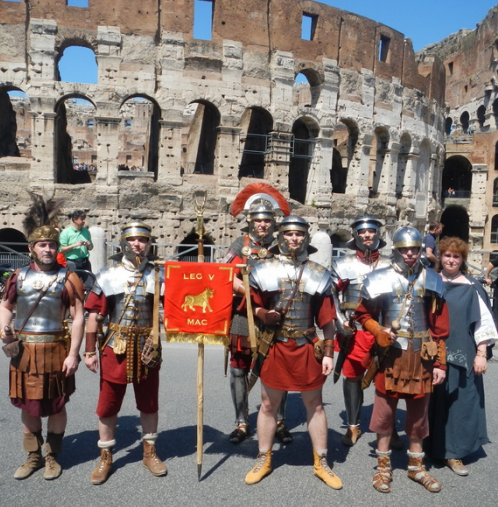
Legio V Macedonica reenactors
Photo Roman Army Talk.com

Rome's Longest Lived Legion
The life of Legio V Macedonica spanned 680 years 
from 43 BC to 637 AD.


For centuries historians have been excited by the very idea of the Roman Legions. The fact that the legions were organized as identifiable individual units made battles far more interesting.  The lack of proper military histories on the Eastern Roman/Byzantine period stems not just from the lack of records, but also from the lack of these identifiable military units.  Without legions history became a bit less "sexy" for the public.

Legio V Macedonica wins the history "award" for the longest legion in existence. But was it?

Proper records of military events become fewer and fewer as you go deeper into the Byzantine period. In one form or another it is very possible that multiple Roman Legions survived into the 600s just as Legio V did.  We simply do not know.

As far as we can tell Legio V Macedonica was first organized about 43 BC by consul Gaius Vibius Pansa Caetronianus and Octavian.  The symbol of the unit was the bull, but the eagle was also used.

There are no records of the first decades of the legion's existence. We do know two other legions, the V Urbana and the V Gallicia, that might have been connected to our unit or even early names for the unit.

Legio V was most likely fighting in 31 BC at the key Battle of Actium.  The unit was then moved to the Roman province of Macedonia where is gained its name.

In addition to Macedonia the legion also provided troops for bases in the provinces of Moesia and Dacia.

In 62 AD some units (Vexillationes) were sent to Armenia to fight against the Persians. After the Roman defeat at Rhandeia the entire legion was shipped east along with three other legions in the victorious was against the Persians.

The legion was still in the east with the Great Jewish Revolt took place in 66 AD.  Emperor Nero assigned legion V Macedonica, X Fretenisi and XV Apollinaris to put down the revolt under the command of Titus Flāvius Vespasiānus.

V Macedonica conquered Mount Gerizim from the rebels. The legion stayed in the Emmaus area for some time to insure the peace. Tombstones of several members of the legion have been found. After their commander Vaspasian was declared emperor the legion finally returned to their base in Moesia after being gone for 10 years.

In 101 the legion moved north into Dacia to help in Emperor Trajan's war on conquest. In 106 at the war's end the legion was stationed in Troesmis near the Danube Delta to keep an eye on one of the restless tribes in the area.

Over the years sub-units of the legion were detached to fight again against the Persians and again to Judea to put down another Jewish revolt.

Units of V Macedonica with units from I Italica and XI Claudia took turns guarding Roman towns in the Crimea.

Workers in the gold mines of Dacia revolted and hired a mercenary army. V Macedonica defeated the rebels. For their reward in 185 or 187 the Emperor Commudus awarded the legion the title of Pia Constans (Faithful and reliable) or Pia Fedelis (Faithful and loyal).

Click map to enlarge.
.
Legio V was sent to the eastern front to fight in the
Roman-Parthian War 58 - 63 AD to help force back the
growing power of the Persians in Armenia.

Legio V Macedonica
Fifth Macedonian Legion
 (Legio V Macedonica) from the city of St. Petersburg, Russia was founded in 2002 in order to reconstruct not only the daily life of the Roman legionaries and civil society, but also the atmosphere of ancient Rome

Photo  -  legvmac.ru

Uniform of a soldier from the later Eastern Roman Period.

Middle Roman Period

Entering politics the V Macedonica backed Septimius Severus in his military overthrow of the government and supported him as Emperor until his reign ended in 211.  A mixed unit of our legion and XIII Gemina accompanied Severus to Rome and fought with him against rebels and against the Persians.

During the third century the legion earned many honors. The Emperor Valerian (253-260) awarded the legion the title Pia III Fidelis III (Thrice faithful and loyal). This means they has already been awarded Pia II but we do not know when. Valerian's son Gallienus gave them the title Pia VII Fidelis VII.

The unit may have earn these honors for their mobile cavalry unit which fought against usurpers and in Gaul defeating the Gallic Emperor Victorinus.
Shield pattern of Legio V Macedonica
in the early 5th century

In 274 AD when the Emperor Aurelian gave up Dacia the legion returned to their Balkans base of Oescus for the third time. The legion helped man other limes forts such as Cebro, Sucidava and Variniana.

The cavalry unit of the legion was assigned by the Emperor Diocletian to be part of a central mobile reserve of the Roman Army.

In 293 the cavalry unit was sent to Memphis, Egypt. But when the Romans were defeated by the Sasanian Persians in 296 the unit was rushed to invade southern Mesopotamia.

After the peace treaty was signed the unit returned to Egypt where it stayed until the early 400s.

Eastern Roman Period

On January 17, 395 AD Emperor Theodosius died and we see the birth of the Eastern Roman Empire.  The death of the Emperor led to the final split of the Empire into two political entities, the West (Occidentale) and the East (Orientale). 

No longer would V Macedonica be called upon to campaign in Gaul or Italy. Orders now came exclusively from Constantinople and the defense of the east was the primary concern.

There was no sudden change. For many decades to come the Eastern Roman Army would not have looked or acted much different from its Western counterpart fighting off the barbarian invasions in Gaul and Italy.  Any changes in unit structure, uniforms and tactics would have been very gradual.  The Eastern Roman military evolution would have been based on changes the economy and the types of enemies they faced.

Section of legionary fortress wall
Oescus - Home of V Macedonica
With a population of 100,000 the fortress city of Oescus on the Danube River was home 
for Legio V Macedonica and a major economic and military strong point for the empire.

At this point in Roman history the records of military actions and individual units become thin at best.  We know that the V Macedonica went on but details of wars and fighting vanish.

The legion would have become a Comitatenses unit under the Magister Militum per Orientis. They were not considered just garrison limes troops. They were used as mobile troops that could be rushed to danger points.

Join the army and see the world. Nothing appears to have changed under Constantinople. After 400 AD troops from the legion are now found in Syria.

The legion's main base of Oescus was on the Danube which was also ground zero for endless barbarian invasions by Huns, Avars and other tribes.

Once again we lack any proper military histories from this period, and the fighting along the Danube by Legio V would have made interesting reading.

In 411 AD the Balkans was invaded by the Huns.  These barbarians descended on Legio V's base in Oescus and destroyed the city. And that simple statement on a major event is all history tells us.

Based on previous reports Legio V's units were spread out manning several different fortresses. So we can assume at least part of the legion was destroyed in the city or forced to retreat in the face of the Huns. Other units would have survived.

Legio V Macedonica is mentioned in Egyptian inscriptions in the cities of Antaeapolis and Heliopolis.

The last inscription is dated 635 or 636 AD.

The Fate of Legio V Macedonica

So we have a period from the Hun invasion to this point in Egypt where 225 years have passed with zero information on the campaigns of the legion.

If the main body of the legion in the Balkans survived the Hun invasion its individual units may have been absorbed by other Roman border forces. If the legion continued on more or less intact we have no record of it.

The most appealing possible story is this last Roman Legion gathering its forces in Egypt to fight their last fight against militant Muslim Arab invaders in 637.

The imagination soars thinking of these outnumbered men holding their bull banner high and marching to their deaths in a last defense of western civilization and the Roman Empire.

Legio V Macedonica


Sestertius minted in 247 by Philip the Arab to celebrate Dacia province and its legions, V Macedonica and XIII Gemina. Note the eagle and the lion, V's and XIII's symbols, in the reverse.

Legio V Macedonica
Photo:  legvmac.ru
The legion was based on the Danube River but fought in campaigns in 
Gaul, Italy, Greece, Dacia, Crimea, Armenia, Judea, Mesopotamia and Egypt.

Legio V Macedonica
Photo:  legvmac.ru


(Roman Legions)      (Oescus)      (Roman-Parthian War)      (Roman legions)

(Legio V Macedonica)      (Legio V Macedonica)