.

Dedicated to the military history and civilization of the Eastern Roman Empire (330 to 1453)


"Time in its irresistible and ceaseless flow carries along on its flood all created things and drowns them in the depths of obscurity."

- - - - Princess Anna Comnena (1083–1153) - Byzantine historian

Showing posts with label Italy. Show all posts

Sunday, July 4, 2021

Column of Phocas


The Column of Phocas is a Roman monumental column in the Roman Forum of RomeItaly, built when Rome was part of the Eastern Roman Empire after reconquest from the Kingdom of the Ostrogoths

Erected in front of the Rostra and dedicated or rededicated in honour of the Eastern Roman Emperor Phocas on August 1, 608 AD, it was the last addition made to the Forum Romanum. The fluted Corinthian column stands 13.6 m (44 ft) tall on its cubical white marble socle. On stylistic grounds, the column seems to have been made in the 2nd century for an unknown structure, and then recycled for the present monument. Likewise, the socle was recycled from its original use supporting a statue dedicated to Diocletian; the former inscription was chiselled away to provide a space for the later text.

The base of the column was uncovered in 1813, and the inscription is in Latin. The English translation is as follows:

  • To the best, most clement and pious ruler, our lord Phocas the perpetual emperor, crowned by God, the forever august triumphator, did Smaragdus, former praepositus sacri palatii and patricius and Exarch of Italy, devoted to His Clemency for the innumerable benefactions of His Piousness and for the peace acquired for Italy and its freedom preserved, this statue of His Majesty, blinking from the splendor of gold here on this tallest column for his eternal glory erect and dedicate, on the first day of the month of August, in the eleventh indiction in the fifth year after the consulate of His Piousness.

The precise occasion for this signal honour is unknown, though Phocas had formally donated the Pantheon to Pope Boniface IV, who rededicated it to all the martyrs and Mary (Sancta Maria ad Martyres). 

Atop the column's capital was erected by Smaragdus, the Exarch of Ravenna, a "dazzling" gilded statue of Phocas (which probably only briefly stood there). 

Rather than a demonstration to mark papal gratitude as it is sometimes casually declared to be, the gilded statue on its column was more likely an emblem of the imperial sovereignty over Rome, which was rapidly fading under pressure from the Lombards, and a personal mark of gratitude from Smaragdus, who had been recalled by Phocas from a long exile and was indebted to the Emperor for retrieving his position of power at Ravenna.

In October 610, Phocas was overthrown and killed; his statues everywhere were overthrown.


Gold solidus of Heraclius and his father in consular robes, struck during their revolt against Phocas.


Revolt against Phocas and Accession

The Emperor Maurice was murdered by Phocas at the harbor of Eutropius on 27 November 602. The deposed emperor was forced to watch his five younger sons executed before he was beheaded himself. 

Empress Constantina and her three daughters were temporarily spared and sent to a monastery. The palace eunuch Scholasticus aided their escape to St. Sophia, but the church turned them over to Phocas, who sent them back to the monastery. A few years later, they were all executed at the harbor of Eutropius when Constantina was found guilty of a conspiracy against Phocas.

Phocas was widely regarded as an incompetent leader, by both much of the ruling class and army.

In 608, Heraclius the Elder renounced his loyalty to the Emperor Phocas, who had overthrown Maurice six years earlier. The rebels issued coins showing both Heraclii dressed as consuls, though neither of them explicitly claimed the imperial title at this time.

Heraclius the Elder, the Exarch of Carthage, began to prepare to invade, by cutting off the supply of grain to Constantinople and assembling a large army and navy.

Heraclius's younger cousin Nicetas launched an overland invasion from Carthage into Egypt; by 609, he had defeated Phocas's general Bonosus and secured the province. Meanwhile, the younger Heraclius sailed eastward with another force via Sicily and Cyprus.

As he approached Constantinople, he made contact with prominent leaders and planned an attack to overthrow aristocrats in the city, and soon arranged a ceremony where he was crowned and acclaimed as Emperor. 

When he reached the capital, the Excubitors, an elite Imperial Guard unit led by Phocas's son-in-law Priscus, deserted to Heraclius, and he entered the city without serious resistance. 

When Heraclius captured Phocas, he asked him "Is this how you have ruled, wretch?" Phocas's reply—"And will you rule better?"—so enraged Heraclius that he beheaded Phocas on the spot. 

He later had the genitalia removed from the body because Phocas had raped the wife of Photius, a powerful politician in the city.


Column of Phocas

Exarchate of Ravenna


Wednesday, January 1, 2020

General Belisarius in Sicily and Constantinople


General Belisarius in Syracuse, Sicily
(Illustration of Mile Jakubiec, drawn for the book "Ancient Generals").

One of Rome's Greatest Generals


This beautiful painting of General Belisarius during his conquest of Sicily caught my eye.

Belisarius, December 31, 535

Procopius of Caesarea, "History of Wars"

(...) because, having received the dignity of the consulate because of his victory against the vandals, while he had that honor, and after having won all Sicily, on his last day of consulate, he marched to Syracuse, being applauded by The Army and the Sicilians and throwing gold coins to all of them. That coincidence, however, did not intentionally come out of him, but it was something happy for that man, who after having recovered the whole island for the Romans left to Syracuse on that particular day; and even though he was not in the Senate of Byzantium, as usual, delivered the mandate of the consuls and became ex-Consul. Therefore, that gave good fortune to Belisario ".


Belisarius then refused to accept the western imperial crown offered by the Ostrogoths in Italy. Not only that, but led to Constantinople the crown crown to offer it to Justinian.

Although it seems amazing, the history of Sicily was repeated 621 years later there and in Southern Italy when the imperial army was launched to the reconquest of Southern Italy and Sicily in 1156. The citizens of Bari opened their doors And they welcomed Emperor Manuel Komnenos as a liberator.


Thanks to Facebook: Life in the Eastern Roman Empire


Artist conception of Vandal and Alan warriors
defeated by Belisarius in North Africa.


By Procopius of Caesarea
(AD 500 – c. AD 565)

After the re-conquest of North Africa, General Belisarius war given a Triumph in the Hippodrome of Constantinople where he was awarded the office of Consul.


A Triumph in Constantinople
January 1, 535 A.D.

Belisarius, upon reaching Byzantium with Gelimer and the Vandals, was counted worthy to receive such honours, as in former times were assigned to those generals of the Romans who had won the greatest and most noteworthy victories. And a period of about six hundred years had now passed since anyone had attained these honours, except, indeed, Titus and Trajan, and such other emperors as had led armies against some barbarian nation and had been victorious.

For he displayed the spoils and slaves from the war in the midst of the city and led a procession which the Romans call a "triumph," not, however, in the ancient manner, but going on foot from his own house to the hippodrome and then again from the barriers until he reached the place where the imperial throne is.

And there was booty,—first of all, whatever articles are wont to be set apart for the royal service,—thrones of gold and carriages in which it is customary for a king's consort to ride, and much jewelry made of precious stones, and golden drinking cups, and all the other things which are useful for the royal table.

And there was also silver weighing many thousands of talents and all the royal treasure amounting to an exceedingly great sum (for Gizeric had despoiled the Palatium in Rome, as has been said in the preceding narrative), and among these were the treasures of the Jews, which Titus, the son of Vespasian, together with certain others, had brought to Rome after the capture of Jerusalem.


The Hippodrome of Constantinople
Image from Istanbul Life.org

And one of the Jews, seeing these things, approached one of those known to the emperor and said: "These treasures I think it inexpedient to carry into the palace in Byzantium. Indeed, it is not possible for them to be elsewhere than in the place where Solomon, the king of the Jews, formerly placed them. For it is because of these that Gizeric captured the palace of the Romans, and that now the Roman army has captured that the Vandals." When this had been brought to the ears of the Emperor, he became afraid and quickly sent everything to the sanctuaries of the Christians in Jerusalem.


And there were slaves in the triumph, among whom was Gelimer himself, wearing some sort of a purple garment upon his shoulders, and all his family, and as many of the Vandals as were very tall and fair of body.

And when Gelimer reached the hippodrome and saw the emperor sitting upon a lofty seat and the people standing on either side and realized as he looked about in what an evil plight he was, he neither wept nor cried out, but ceased not saying over in the words of the Hebrew scripture: "Vanity of vanities, all is vanity." And when he came before the emperor's seat, they stripped off the purple garment, and compelled him to fall prone on the ground and do obeisance to the Emperor Justinian.

This also Belisarius did, as being a suppliant of the emperor along with him. And the Emperor Justinian and the Empress Theodora presented the children of Ilderic and his offspring and all those of the family of the Emperor Valentinian with sufficient sums of money, and to Gelimer they gave lands not to be despised in Galatia and permitted him to live there together with his family. However, Gelimer was by no means enrolled among the patricians, since he was unwilling to change from the faith of Arius.

A little later the triumph was celebrated by, Belisarius in the ancient manner also. For he had the fortune to be advanced to the office of consul, and therefore was borne aloft by the captives, and as he was thus carried in his curule chair, he threw to the populace those very spoils of the Vandalic war. For the people carried off the silver plate and golden girdles and a vast amount of the Vandals' wealth of other sorts as a result of Belisarius' consulship, and it seemed that after a long interval of disuse an old custom was being revived.

These things, then, took place in Byzantium in the manner described.


Belisarius and his Staff
(Johnny Shumates Portfolio)
kk
Read More:
kk
Battle of Callinicum - Romans vs Persians

Monday, January 15, 2018

Byzantium Invades The Kingdom of Italy - The Gothic War Begins


Goth Warriors
(Pinterest)
m
Adding Rome back into
the Roman Empire


The Gothic War between the Eastern Roman Empire and the Ostrogothic Kingdom of Italy took place from 535 until 554. The war had its roots in the ambition of the East Roman Emperor Justinian I to recover the provinces of the former Western Roman Empire, which the Romans had lost to invading barbarian tribes in the previous century.

In 533, utilizing a dynastic dispute, Justinian had sent his most talented general, Belisarius, to recover the North African provinces held by the Vandals. The Vandalic War produced an unexpectedly swift and decisive victory for the Roman Empire. 

Now another dynastic dispute gave Justinian an excuse to invade Italy. Amalasuntha (c. 495 – 30 April 534/535) was a regent of the Ostrogoths during the minority of her son from 526 to 534, and ruling queen regnant from 534 to 535. Amalasuntha had allowed the Roman fleet to use the harbors of Sicily, which belonged to the Ostrogothic Kingdom, as bases of operation against the Vandals.

Seeking support, she chose her cousin Theodahad, to whom she offered the kingship. It was a fatal move, as Theodahad lost little time in having her arrested and then, in early 535, executed.

Through his agents, Justinian tried to save Amalasuntha's life, but to no avail. Her death, in any case, gave him cause for war with the Goths. As Procopius writes: "as soon as he learned what had happened to Amalasuntha, being in the ninth year of his reign, he entered upon war."

Command of the seas.  Initially at the start of Justinian's wars of re-conquest the Western Mediterranean was controlled by the fleet of the Vandal Kingdom in North Africa. With the collapse of the Vandals all of the Mediterranean from Palestine to the Pillars of Hercules became a Roman Lake.

The military importance of this control cannot be overstated. With the Vandals gone the Roman fleet was able to transport troops and supplies at will to almost any location. 

The navy allowed for the conquest and resupply of towns all along the North African coast, the capture of Corsica, Sardinia, the Balearic Islands and Spain.

The navy was a vital if unsung component in the Gothic War. In Dalmatia the navy was at the side of Roman land troops as they marched north.

In Sicily the navy was a major factor. The fleet transported 7,500 Roman troops, their horses, pack animals and supplies in an amphibious operation to capture a huge island from the Goths.

As always we are privileged to view events directly through the eyes of Procopius who was at the side of General Belisarius during these campaigns.


The Roman Navy was vital in the campaigns of reconquest.
_________________________


By Procopius of Caesarea
500 - 554 AD

History of the Wars, Book V


Theodatus confined Amalasuntha and kept her under guard. But fearing that by this act he had given offence to the emperor, as actually proved to be the case, he sent some men of the Roman senate, Liberius and Opilio and certain others, directing them to excuse his conduct to the emperor with all their power by assuring him that Amalasuntha had met with no harsh treatment at his hands . . . 

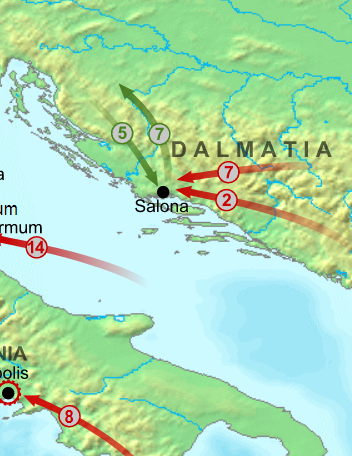
And the emperor, upon learning what had befallen Amalasuntha, immediately entered upon the war, being in the ninth year of his reign. And he first commanded Mundus, the general of Illyricum, to go to Dalmatia, which was subject to the Goths, and make trial of Salones. 

The Emperor Justinian attacked the Ostrogothic Kingdom of Italy on two fronts at the same time. One army marched north from the Roman Balkan frontier invading the Gothic controlled Dalmatian coast.
.
As was done against the Vandals in Africa another Roman army was transported by the navy and mounted an amphibious operation landing in Sicily.

The Sicily Campaign
#1) Belisarius lands in Sicily the summer of 535.  #3) The conquest of Sicily is complete with the capture of Pamormus in December of 535.  #4) Belisarius sails to Carthage to put down a rebellion by the army (March-April 536).  #6) Belisarius crosses into Italy and captures Rhegium (June 536).  #8) Belisarius advances to Naples (Autumn 536).


Two Invasions


Now Mundus was by birth a barbarian, but exceedingly loyal to the cause of the emperor and an able warrior. 

Then he sent Belisarius by sea with four thousand soldiers from the regular troops and the foederati, and about three thousand of the Isaurians. 

And the commanders were men of note: Constantinus and Bessas from the land of Thrace, and Peranius from Iberia which is hard by Media, a man who was by birth a member of the royal family of the Iberians, but had before this time come as a deserter to the Romans through enmity toward the Persians; and the levies of cavalry were commanded by Valentinus, Magnus, and Innocentius, and the infantry by Herodian, Paulus, Demetrius, and Ursicinus, while the leader of the Isaurians was Ennes. And there were also two hundred Huns as allies and three hundred Moors. 

Emperor Justinian

But the general in supreme command over all was Belisarius, and he had with him many notable men as spearmen and guards. And he was accompanied also by Photius, the son of his wife Antonina by a previous marriage; he was still a young man wearing his first beard, but possessed the greatest discretion and shewed a strength of character beyond his years. 

And the emperor instructed Belisarius to give out that his destination was Carthage, but as soon as they should arrive at Sicily, they were to disembark there as it obliged for some reason to do so, and make trial of the island. And if it should be possible to reduce it to subjection without any trouble, they were to take possession and not let it go again; but if they should meet with any obstacle, they were to sail with all speed to Libya, giving no one an opportunity to perceive what their intention was.

And he also sent a letter to the leaders of the Franks as follows: "The Goths, having seized by violence Italy, which was ours, have not only refused absolutely to give it back, but have committed further acts of injustice against us which are unendurable and pass beyond all bounds. For this reason we have been compelled to take the field against them, and it is proper that you should join with us in waging this war, which is rendered yours as well as ours not only by the orthodox faith, which rejects the opinion of the Arians, but also by the enmity we both feel toward the Goths." Such was the emperor's letter; and making a gift of money to them, he agreed to give more as soon as they should take an active part. And they with all zeal promised to fight in alliance with him.

Now Mundus and the army under his command entered Dalmatia, and engaging with the Goths who encountered them there, defeated them in the battle and took possession of Salones. 

As for Belisarius, he put in at Sicily and took Catana. And making that place his base of operations, he took over Syracuse and the other cities by surrender without any trouble; except, indeed, that the Goths who were keeping guard in Panormus, having confidence in the fortifications of the place, which was a strong one, were quite unwilling to yield to Belisarius and ordered him to lead his army away from there with all speed. 

But Belisarius, considering that it was impossible to capture the place from the landward side, ordered the fleet to sail into the harbour, which extended right up to the wall. For it was outside the circuit-wall and entirely without defenders. 

Now when the ships had anchored there, it was seen that the masts were higher than the parapet. Straightway, therefore, he filled all the small boats of the ships with bowmen and hoisted them to the tops of the masts. And when from these boats the enemy were shot at from above, they fell into such an irresistible fear that they immediately delivered Panormus to Belisarius by surrender. 

As a result of this the emperor held all Sicily subject and tributary to himself. And at that time it so happened that there fell to Belisarius a piece of good fortune beyond the power of words to describe. For, having received the dignity of the consulship because of his victory over the Vandals, while he was still holding this honour, and after he had won the whole of Sicily, on the last day of his consulship, he marched into Syracuse, loudly applauded by the army and by the Sicilians and throwing golden coins to all. 

This coincidence, however, was not intentionally arranged by him, but it was a happy chance which befell the man, that after having recovered the whole of the island for the Romans he marched into Syracuse on that particular day; and so it was not in the senate house in Byzantium, as was customary, but there that he laid down the office of the consuls and so became an ex-consul. Thus, then, did good fortune attend Belisarius.

Belisarius and his Staff
(Johnny Shumates Portfolio)

Late Roman Infantry
(Pinterest)

#2) General Mundus conquers Dalmatia in the summer of 535.  #5) The Goths counter attack, Mundus is killed and the Roman army withdraws.  #7)  A new Roman army under Constantinianus drives the Goths out of Dalmatia in June-July 536 forcing them to fall back into Italy.

Roman Re-Conquest of Dalmatia

But meantime, while the emperor was engaged in these negotiations and these envoys were travelling to Italy, the Goths, under command of Asinarius and Gripas and some others, had come with a great army into Dalmatia. 

And when they had reached the neighbourhood of Salones, Mauricius, the son of Mundus, who was not marching out for battle but, with a few men, was on a scouting expedition, encountered them. A violent engagement ensued in which the Goths lost their foremost and noblest men, but the Romans almost their whole company, including their general Mauricius. 

And when Mundus heard of this, being overcome with grief at the misfortune and by this time dominated by a mighty fury, he went against the enemy without the least delay and regardless of order. The battle which took place was stubbornly contested, and the result was a Cadmean victory for the Romans. For although the most of the enemy fell there and their rout had been decisive, Mundus, who went on killing and following up the enemy wherever he chanced to find them and was quite unable to restrain his mind because of the misfortune of his son, was wounded by some fugitive or other and fell. 

Thereupon the pursuit ended and the two armies separated. And at that time the Romans recalled the verse of the Sibyl, which had been pronounced in earlier times and seemed to them a portent. For the words of the saying were that when Africa should be held, the "world" would perish together with its offspring. This, however, was not the real meaning of the oracle, but after intimating that Libya would be once more subject to the Romans, it added this statement also, that when that time came Mundus would perish together with his son. For it runs as follows: "Africa capta Mundus cum nato peribit." But since "mundus" in the Latin tongue has the force of "world," they thought that the saying had reference to the world. So much, then, for this. 

As for Salones, it was not entered by anyone. For the Romans went back home, since they were left altogether without a commander, and the Goths, seeing that not one of their nobles was left them, fell into fear and took possession of the strongholds in the neighbourhood; for they had no confidence in the defences of Salones, and, besides, the Romans who lived there were not very well disposed towards them.

But when the Emperor Justinian heard these things and what had taken place in Dalmatia, he sent Constantianus, who commanded the royal grooms, into Illyricum, bidding him gather an army from there and make an attempt on Salones, in whatever manner he might be able; and he commanded Belisarius to enter Italy with all speed and to treat the Goths as enemies. 

So Constantianus came to Epidamnus and spent some time there gathering an army. But in the meantime the Goths, under the leadership of Gripas, came with another army into Dalmatia and took possession of Salones; and Constantianus, when all his preparations were as complete as possible, departed from Epidamnus with his whole force and cast anchor at Epidaurus which is on the right as one sails into the Ionian Gulf. 

Now it so happened that some men were there whom Gripas had sent out as spies. And when they took note of the ships and the army of Constantianus it seemed to them that both the sea and the whole land were full of soldiers, and returning to Gripas they declared that Constantianus was bringing against them an army of men numbering many tens of thousands. And he, being plunged into great fear, thought it inexpedient to meet their attack, and at the same time he was quite unwilling to be besieged by the emperor's army, since it so completely commanded the sea; but he was disturbed most of all by the fortifications of Salones (since the greater part of them had already fallen down), and by the exceedingly suspicious attitude on the part of the inhabitants of the place toward the Goths. 

And for this reason he departed thence with his whole army as quickly as possible and made camp in the plain which is between Salones and the city of Scardon. And Constantianus, sailing with all his ships from Epidaurus, put in at Lysina, which is an island in the gulf. Thence he sent forward some of his men, in order that they might make enquiry concerning the plans of Gripas and report them to him. Then, after learning from them the whole situation, he sailed straight for Salones with all speed. 

And when he had put in at a place close to the city, he disembarked his army on the mainland and himself remained quiet there; but he selected five hundred from the army, and setting over them as commander Siphilas, one of his own bodyguards, he commanded them to seize the narrow pass which, as he had been informed, was in the outskirts of the city. And this Siphilas did. And Constantianus and his whole land army entered Salones on the following day, and the fleet anchored close by. 

Then Constantianus proceeded to look after the fortifications of the city, building up in haste all such parts of them as had fallen down; and Gripas, with the Gothic army, on the seventh day after the Romans had taken possession of Salones, departed from there and betook themselves to Ravenna; and thus Constantianus gained possession of all Dalmatia and Liburnia, bringing over to his side all the Goths who were settled there. 

Such were the events in Dalmatia. And the winter drew to a close, and thus ended the first year of this war, the history of which Procopius has written.

6th Century Eastern Empire Cavalry


(History of the Wars)      (Gothic War)

Friday, January 6, 2017

The missing Byzantine column of Venice


A gift to Venice from the Eastern Empire.
The famous bronze winged lion atop the column on Piazzetta San Marco, where the piazza opens onto the end of the Grand Canal and the bacino—probably a Hellenistic work of the 4th or 3rd century BC, taken from a tomb in Tarsus or Cilicia. (Photo by Jakub HaÅ‚un)  
(reidsitaly.com)

Venice and the Empire


There are no surviving historical records dealing directly with the founding of Venice, but the area itself had been under Roman control for centuries.

Some late Roman sources reveal the existence of fishermen on the islands in the original marshy lagoons. They were referred to as incolae lacunae ("lagoon dwellers"). The traditional founding is identified with the dedication of the first church, that of San Giacomo on the islet of Rialto (Rivoalto, "High Shore") — said to have taken place at the stroke of noon on 25 March 421.

Roman defenses were overthrown in the early 5th century by the Visigoths and, some 50 years later, by the Huns led by Attila. The last and most enduring immigration into the north of the Italian peninsula, that of the Lombards in 568, left the Eastern Roman Empire a small strip of coast in the current Veneto, including Venice.

The Roman/Byzantine territory was organized as the Exarchate of Ravenna, administered from that ancient port and overseen by a viceroy (the Exarch) appointed by the Emperor in Constantinople, but Ravenna and Venice were connected only by sea routes; and with the Venetians' isolated position came increasing autonomy. New ports were built, including those at Malamocco and Torcello in the Venetian lagoon. The tribuni maiores, the earliest central standing governing committee of the islands in the Lagoon, dated from c. 568.

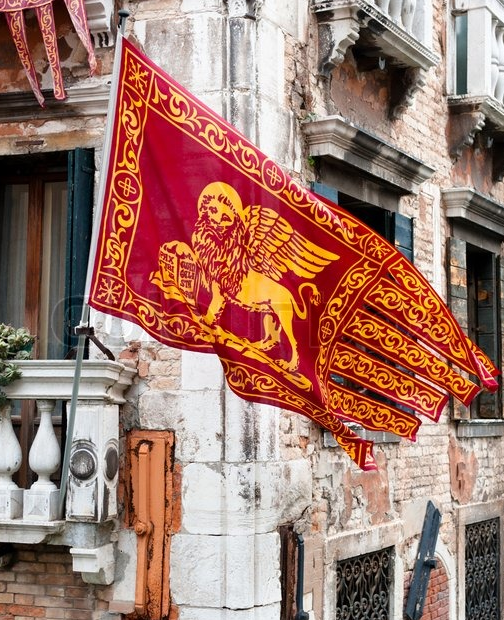
Flag of the Republic of Venice
The coat of arms of the Region is set in a square in the 
center of the flag: the Lion of Saint Mark.

The traditional first doge of VenicePaolo Lucio Anafesto, was actually Exarch Paul, and his successor, Marcello Tegalliano, was Paul's magister militum (General: literally, "Master of Soldiers"). In 726 the soldiers and citizens of the Exarchate rose in a rebellion over the iconoclastic controversy at the urging of Pope Gregory II. The Exarch was murdered and many officials put to flight in the chaos.

An agreement between the Western Emperor Charlemagne and the Byzantine Emperor Nicephorus in 814 recognized Venice as Byzantine territory and granted the city trading rights along the Adriatic coast.

In 828 the new city's prestige increased with the acquisition of the claimed relics of St Mark the Evangelist from Alexandria, which were placed in the new basilica. (Winged lions, visible throughout Venice, symbolize St Mark.) 

As the community continued to develop and as Byzantine power waned, its autonomy grew, leading to eventual independence.
___________________________

The Mystery of the Missing
Byzantine Column
The lost Byzantine column may be at the 
bottom of the Venetian lagoon.


(London Telegraph)  -  A group of explorers hopes to solve one of Venice’s most enduring mysteries – the fate of a giant triumphal column that is believed to have disappeared nearly 1,000 years ago.

The huge granite column was one of three that were delivered to Venice by boat in 1172.

Brought from Constantinople, they were a gift from the Byzantine Empire in recognition of Venice’s help in the Second Crusade. 

But, according to historical accounts, during the difficult process of transferring them from the boats to dry land, the pillar toppled overboard, sinking beneath the waves of the Venetian lagoon.

The two surviving columns were eventually erected and still stand at one end of St Mark’s Square, which Napoleon famously described as “the drawing room of Europe”.

On top of one of them is a winged lion – the symbol of Venice – while on top of the other is a statue of St Theodore, who was once the city’s patron saint until being supplanted by St Mark, holding a spear and with a crocodile at his feet – a representation of the dragon that he is said to have vanquished.

Now a team of researchers plans to embark on a search for the missing third column, which if recovered could one day take its place between the two existing columns.

They believe it is lies on the lagoon floor, a few hundred yards from the banks of St Mark’s Square.

Europe in 814 AD at the 
death of Charles the Great.
At this point Venice and the coastal zone is still part of the Eastern Roman Empire.
As Roman power faded in Italy we see the new Republic of Venice 

break off and become independent.
(Read More)

Piazza San Marco or St. Mark’s Square.
(talesmaze.com)


“If the lagoon floor had been muddy, the column would have sunk without trace and would be impossible to recover,” said Roberto Padoan, a diver and mariner who leads the project. “But in the area in front of St Mark’s the lagoon floor is made of clay. I’m convinced the column is down there.” 

He believes that the column may rest at a comparatively shallow depth – perhaps 30ft beneath the surface of the water. 

According to contemporary accounts, it was topped with a statue of a nobleman wearing a “corno ducale” or doge’s cap, a tribute to Venice’s rulers. 

Venice’s cultural heritage department is expected to give the green light to a non-invasive search of the lagoon floor this week. 

A network of 20 electronic sensors, to be installed on the canal banks, will emit sonar waves to try to detect the column beneath the mud. 

Mr Padoan has teamed up with two Italian companies that specialise in underwater exploration, ground-penetrating radar and seismic studies.

The area to be searched is relatively small – a stretch of water between the Marciana Library and the Ponte della Paglia, which looks onto the more famous Bridge of Sighs. 

A Venetian War Galley 
The galley above had 186 oars, 62 tri-stations. Venice became a major military power and often helped the Eastern Empire in its wars against Islam. As early as the mid-500s Venice twice sent its fleet to help Constantinople.
(modelshipmaster.com)

“Finding the column would be an incredible discovery,” Mr Padoan told La Repubblica newspaper. “If we manage it, we’d have to do everything possible to raise it from the lagoon.”

Raising the column would be a very costly operation, involving barges, cranes and steel cables, and the researchers are seeking funds from private sponsors. 

The recovery operation would affect a stretch of the canal bank that is used by gondolas and water taxis.

The surviving two columns frame the grand entrance to St Mark’s Square and provided an imposing first sight of the city for visitors arriving by boat. 

Although they were delivered to Venice in the 12th century, it was not until decades later that they were erected, such were the technical challenges of the job. 

In the end the task was achieved by an Italian engineer, Niccolo Barattieri, who, in return, asked for the right to set up gambling tables between them. 

The doge agreed, but the gambling soon got out of control, and to put a dampener on proceedings Venice’s rulers decided to use the pillars to string up local criminals. 

Superstitious Venetians still avoid walking between the two columns.

The story of the lost column is one of Venice’s oldest legends, but is almost certainly based on fact, a historian said.

“It is cited by all the sources, including the very oldest, which were written shortly after the disembarkation of the columns in 1172,” said Alberto Toso Fei, an author and journalist.

“I’m convinced that it’s based on a historical event because when a story is repeated down the centuries, it always contains some truth.

“What is not possible to know with any certainty is whether the third column was as large as the other and whether it, like them, had a symbol of Venice on top. And we don’t know from the sources if it sank near St Mark’s or in another part of the lagoon. But it wouldn’t surprise me if it really is there, lying under the mud.”

The column of St. Theodore in Venice.
The column was a gift to Venice in the 12th century from the Eastern Roman Emperor for the Republic's help in the Second Crusade.

Also in Venice
The Horses of Saint Mark, also known as the Triumphal Quadriga, is a set of Roman bronze statues of four horses, originally part of a monument depicting a quadriga (a four-horse carriage used for chariot racing).

.
The horses, along with the quadriga with which they were depicted, were long displayed at the Hippodrome of Constantinople. They were still there in 1204, when they were looted by Venetian forces as part of the sack of the capital of the Byzantine Empire in the Fourth Crusade


(Telegraph)      (Horses of Saint Mark)      (modelshipmaster)      (Venice)


Thursday, May 19, 2016

Byzantine Castello Baradello in Italy


Byzantine Castello Baradello near the Alps

Defending Byzantine Italy

  • With the Frankish Kingdom close by, the Castello Baradello was one of many border fortifications that protected the frontier of the Roman Empire.


The Gothic Wars

In an attempt to reconquer the Western Roman Empire the Emperor Justinian invaded the Ostrogothic Kingdom of Italy in 535 AD.

In a vicious war lasting 19 years much of Italy was largely destroyed.

Some historians claim Justinian's conquest was a Pyrrhic victory that drained national resources. To that I would disagree. Though the invading Germanic Lombard tribes took large sections of Italy, huge portions remained under the control of the Eastern Empire for another 500 years.

With the end of the war in 554 Justinian began projects to rebuild Italy and repair or begin new military fortifications to defend the frontiers.  Castello Baradello was one of those fortresses.

The Castello Baradello 

The castle is a military fortification located on a 430 m (1,410 ft) high hill next to the city of Como, northern Italy.  The castle has breathtaking views: from here, you can admire the city, the lake, the Po Valley, the peaks of the Alps and even the Apennines. The name itself, in its origin, means "high place".

The castle occupies the ancient site of Comum Oppidum, the original settlement of Como, dating from the 1st millennium BC.  Later it was one of the last Byzantine strongholds in the area, surrendering to the Lombards in 588.

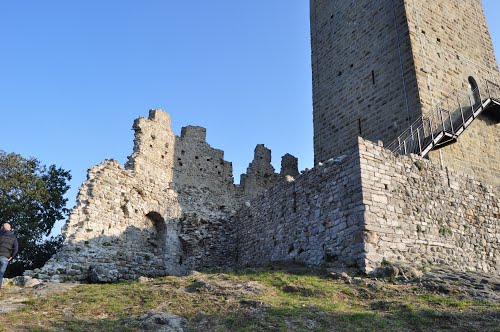
Castello Baradello near Como, Italy.

The best-preserved structure in the whole complex is undoubtedly the Romanesque square tower, whose base measures approximately 8 meters on each side. Its overall height is about 28 meters. The lower part is about 19 and a half meters high, it rests its foundation on the rock and it was formerly adorned with Guelph battlements; the upper part, which is also the most recent one, it’s 8 meters high and it was formerly crenellated with Ghibelline battlements. The battlements is now gone.

The first order of walls surrounding the tower dates back to the Byzantine era, to the Sixth or Seventh century, thus representing the castle’s oldest structure. We find mention of them already in the early Seventh century, thanks to the historian George of Cyprus, who described a complex defensive system called “Byzantine Limes”. Another wall, a newer one, surrounds these walls; it is contemporary with the raising of the tower and the inner walls. It is accessible through a charming and fascinating pointed doorway.

Nothing is the left of the other structures being part of the castle, except for their foundations; however, it was possible to reconstruct the whole layout. There was the chapel of St. Nicholas, which according to studies and researches is contemporary with the primitive walls; therefore, it dates back to the Sixth century. According to tradition, Napo Torriani was buried here, but no bones were ever found.

According to historical records, this castle served as a place of refuge for the population during the wars between Como and Milan. Thanks to subsequent agreements, Emperor Frederick Barbarossa rebuilt the city walls and Castel Baradello in 1158, strengthening it with the new tower. The following year the castle was home to the emperor and his wife, Beatrice of Burgundy, and on that occasion, the victory over Milan was celebrated with a Palio, that is still relived annually.

Castel Baradello was demolished in 1527 by the Spanish captain Cesareo don Pedro Arias on the orders of the governor of Milan, Antonio de Leyva, to prevent it from being conquered by French troops. Only the tower remained standing.


The Western Roman Empire in 565 AD
In yellow are the lands re-conquered by the Emperor Justinian
and returned to the Roman Empire.
.
Up against the Alps, the Castle of Baradello was one of the
most northern posts of the Roman Empire.

The most preserved element is a square tower, measuring 8.20 m × 8.35 m (26.9 ft × 27.4 ft) at the base, and standing at 27.50 m (90.2 ft). It once had Guelph-type merlons. The walls are of Byzantine origin (6th-7th century); these were later heightened and provided with Guelph merlons, while another external line of walls was added.
.
Also from the 6th century are the Chapel of St. Nicholas and quadrangular tower (4.40 m × 4.15 m (14.4 ft × 13.6 ft) at the base), which was used as the 
castellan's residence. Napoleone della Torre was buried in the Chapel of St. Nicholas.


(wevillas.com)      (Gothic War)      (Baradello)