.

Dedicated to the military history and civilization of the Eastern Roman Empire (330 to 1453)


"Time in its irresistible and ceaseless flow carries along on its flood all created things and drowns them in the depths of obscurity."

- - - - Princess Anna Comnena (1083–1153) - Byzantine historian

Showing posts with label Ostrogoths. Show all posts

Monday, January 15, 2018

Byzantium Invades The Kingdom of Italy - The Gothic War Begins


Goth Warriors
(Pinterest)
m
Adding Rome back into
the Roman Empire


The Gothic War between the Eastern Roman Empire and the Ostrogothic Kingdom of Italy took place from 535 until 554. The war had its roots in the ambition of the East Roman Emperor Justinian I to recover the provinces of the former Western Roman Empire, which the Romans had lost to invading barbarian tribes in the previous century.

In 533, utilizing a dynastic dispute, Justinian had sent his most talented general, Belisarius, to recover the North African provinces held by the Vandals. The Vandalic War produced an unexpectedly swift and decisive victory for the Roman Empire. 

Now another dynastic dispute gave Justinian an excuse to invade Italy. Amalasuntha (c. 495 – 30 April 534/535) was a regent of the Ostrogoths during the minority of her son from 526 to 534, and ruling queen regnant from 534 to 535. Amalasuntha had allowed the Roman fleet to use the harbors of Sicily, which belonged to the Ostrogothic Kingdom, as bases of operation against the Vandals.

Seeking support, she chose her cousin Theodahad, to whom she offered the kingship. It was a fatal move, as Theodahad lost little time in having her arrested and then, in early 535, executed.

Through his agents, Justinian tried to save Amalasuntha's life, but to no avail. Her death, in any case, gave him cause for war with the Goths. As Procopius writes: "as soon as he learned what had happened to Amalasuntha, being in the ninth year of his reign, he entered upon war."

Command of the seas.  Initially at the start of Justinian's wars of re-conquest the Western Mediterranean was controlled by the fleet of the Vandal Kingdom in North Africa. With the collapse of the Vandals all of the Mediterranean from Palestine to the Pillars of Hercules became a Roman Lake.

The military importance of this control cannot be overstated. With the Vandals gone the Roman fleet was able to transport troops and supplies at will to almost any location. 

The navy allowed for the conquest and resupply of towns all along the North African coast, the capture of Corsica, Sardinia, the Balearic Islands and Spain.

The navy was a vital if unsung component in the Gothic War. In Dalmatia the navy was at the side of Roman land troops as they marched north.

In Sicily the navy was a major factor. The fleet transported 7,500 Roman troops, their horses, pack animals and supplies in an amphibious operation to capture a huge island from the Goths.

As always we are privileged to view events directly through the eyes of Procopius who was at the side of General Belisarius during these campaigns.


The Roman Navy was vital in the campaigns of reconquest.
_________________________


By Procopius of Caesarea
500 - 554 AD

History of the Wars, Book V


Theodatus confined Amalasuntha and kept her under guard. But fearing that by this act he had given offence to the emperor, as actually proved to be the case, he sent some men of the Roman senate, Liberius and Opilio and certain others, directing them to excuse his conduct to the emperor with all their power by assuring him that Amalasuntha had met with no harsh treatment at his hands . . . 

And the emperor, upon learning what had befallen Amalasuntha, immediately entered upon the war, being in the ninth year of his reign. And he first commanded Mundus, the general of Illyricum, to go to Dalmatia, which was subject to the Goths, and make trial of Salones. 

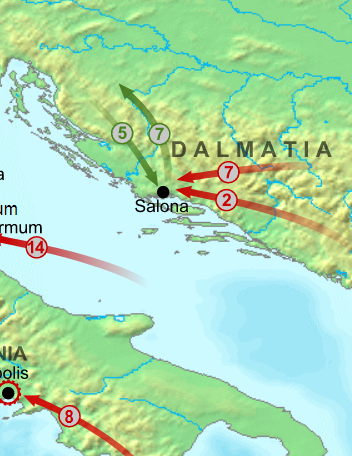
The Emperor Justinian attacked the Ostrogothic Kingdom of Italy on two fronts at the same time. One army marched north from the Roman Balkan frontier invading the Gothic controlled Dalmatian coast.
.
As was done against the Vandals in Africa another Roman army was transported by the navy and mounted an amphibious operation landing in Sicily.

The Sicily Campaign
#1) Belisarius lands in Sicily the summer of 535.  #3) The conquest of Sicily is complete with the capture of Pamormus in December of 535.  #4) Belisarius sails to Carthage to put down a rebellion by the army (March-April 536).  #6) Belisarius crosses into Italy and captures Rhegium (June 536).  #8) Belisarius advances to Naples (Autumn 536).


Two Invasions


Now Mundus was by birth a barbarian, but exceedingly loyal to the cause of the emperor and an able warrior. 

Then he sent Belisarius by sea with four thousand soldiers from the regular troops and the foederati, and about three thousand of the Isaurians. 

And the commanders were men of note: Constantinus and Bessas from the land of Thrace, and Peranius from Iberia which is hard by Media, a man who was by birth a member of the royal family of the Iberians, but had before this time come as a deserter to the Romans through enmity toward the Persians; and the levies of cavalry were commanded by Valentinus, Magnus, and Innocentius, and the infantry by Herodian, Paulus, Demetrius, and Ursicinus, while the leader of the Isaurians was Ennes. And there were also two hundred Huns as allies and three hundred Moors. 

Emperor Justinian

But the general in supreme command over all was Belisarius, and he had with him many notable men as spearmen and guards. And he was accompanied also by Photius, the son of his wife Antonina by a previous marriage; he was still a young man wearing his first beard, but possessed the greatest discretion and shewed a strength of character beyond his years. 

And the emperor instructed Belisarius to give out that his destination was Carthage, but as soon as they should arrive at Sicily, they were to disembark there as it obliged for some reason to do so, and make trial of the island. And if it should be possible to reduce it to subjection without any trouble, they were to take possession and not let it go again; but if they should meet with any obstacle, they were to sail with all speed to Libya, giving no one an opportunity to perceive what their intention was.

And he also sent a letter to the leaders of the Franks as follows: "The Goths, having seized by violence Italy, which was ours, have not only refused absolutely to give it back, but have committed further acts of injustice against us which are unendurable and pass beyond all bounds. For this reason we have been compelled to take the field against them, and it is proper that you should join with us in waging this war, which is rendered yours as well as ours not only by the orthodox faith, which rejects the opinion of the Arians, but also by the enmity we both feel toward the Goths." Such was the emperor's letter; and making a gift of money to them, he agreed to give more as soon as they should take an active part. And they with all zeal promised to fight in alliance with him.

Now Mundus and the army under his command entered Dalmatia, and engaging with the Goths who encountered them there, defeated them in the battle and took possession of Salones. 

As for Belisarius, he put in at Sicily and took Catana. And making that place his base of operations, he took over Syracuse and the other cities by surrender without any trouble; except, indeed, that the Goths who were keeping guard in Panormus, having confidence in the fortifications of the place, which was a strong one, were quite unwilling to yield to Belisarius and ordered him to lead his army away from there with all speed. 

But Belisarius, considering that it was impossible to capture the place from the landward side, ordered the fleet to sail into the harbour, which extended right up to the wall. For it was outside the circuit-wall and entirely without defenders. 

Now when the ships had anchored there, it was seen that the masts were higher than the parapet. Straightway, therefore, he filled all the small boats of the ships with bowmen and hoisted them to the tops of the masts. And when from these boats the enemy were shot at from above, they fell into such an irresistible fear that they immediately delivered Panormus to Belisarius by surrender. 

As a result of this the emperor held all Sicily subject and tributary to himself. And at that time it so happened that there fell to Belisarius a piece of good fortune beyond the power of words to describe. For, having received the dignity of the consulship because of his victory over the Vandals, while he was still holding this honour, and after he had won the whole of Sicily, on the last day of his consulship, he marched into Syracuse, loudly applauded by the army and by the Sicilians and throwing golden coins to all. 

This coincidence, however, was not intentionally arranged by him, but it was a happy chance which befell the man, that after having recovered the whole of the island for the Romans he marched into Syracuse on that particular day; and so it was not in the senate house in Byzantium, as was customary, but there that he laid down the office of the consuls and so became an ex-consul. Thus, then, did good fortune attend Belisarius.

Belisarius and his Staff
(Johnny Shumates Portfolio)

Late Roman Infantry
(Pinterest)

#2) General Mundus conquers Dalmatia in the summer of 535.  #5) The Goths counter attack, Mundus is killed and the Roman army withdraws.  #7)  A new Roman army under Constantinianus drives the Goths out of Dalmatia in June-July 536 forcing them to fall back into Italy.

Roman Re-Conquest of Dalmatia

But meantime, while the emperor was engaged in these negotiations and these envoys were travelling to Italy, the Goths, under command of Asinarius and Gripas and some others, had come with a great army into Dalmatia. 

And when they had reached the neighbourhood of Salones, Mauricius, the son of Mundus, who was not marching out for battle but, with a few men, was on a scouting expedition, encountered them. A violent engagement ensued in which the Goths lost their foremost and noblest men, but the Romans almost their whole company, including their general Mauricius. 

And when Mundus heard of this, being overcome with grief at the misfortune and by this time dominated by a mighty fury, he went against the enemy without the least delay and regardless of order. The battle which took place was stubbornly contested, and the result was a Cadmean victory for the Romans. For although the most of the enemy fell there and their rout had been decisive, Mundus, who went on killing and following up the enemy wherever he chanced to find them and was quite unable to restrain his mind because of the misfortune of his son, was wounded by some fugitive or other and fell. 

Thereupon the pursuit ended and the two armies separated. And at that time the Romans recalled the verse of the Sibyl, which had been pronounced in earlier times and seemed to them a portent. For the words of the saying were that when Africa should be held, the "world" would perish together with its offspring. This, however, was not the real meaning of the oracle, but after intimating that Libya would be once more subject to the Romans, it added this statement also, that when that time came Mundus would perish together with his son. For it runs as follows: "Africa capta Mundus cum nato peribit." But since "mundus" in the Latin tongue has the force of "world," they thought that the saying had reference to the world. So much, then, for this. 

As for Salones, it was not entered by anyone. For the Romans went back home, since they were left altogether without a commander, and the Goths, seeing that not one of their nobles was left them, fell into fear and took possession of the strongholds in the neighbourhood; for they had no confidence in the defences of Salones, and, besides, the Romans who lived there were not very well disposed towards them.

But when the Emperor Justinian heard these things and what had taken place in Dalmatia, he sent Constantianus, who commanded the royal grooms, into Illyricum, bidding him gather an army from there and make an attempt on Salones, in whatever manner he might be able; and he commanded Belisarius to enter Italy with all speed and to treat the Goths as enemies. 

So Constantianus came to Epidamnus and spent some time there gathering an army. But in the meantime the Goths, under the leadership of Gripas, came with another army into Dalmatia and took possession of Salones; and Constantianus, when all his preparations were as complete as possible, departed from Epidamnus with his whole force and cast anchor at Epidaurus which is on the right as one sails into the Ionian Gulf. 

Now it so happened that some men were there whom Gripas had sent out as spies. And when they took note of the ships and the army of Constantianus it seemed to them that both the sea and the whole land were full of soldiers, and returning to Gripas they declared that Constantianus was bringing against them an army of men numbering many tens of thousands. And he, being plunged into great fear, thought it inexpedient to meet their attack, and at the same time he was quite unwilling to be besieged by the emperor's army, since it so completely commanded the sea; but he was disturbed most of all by the fortifications of Salones (since the greater part of them had already fallen down), and by the exceedingly suspicious attitude on the part of the inhabitants of the place toward the Goths. 

And for this reason he departed thence with his whole army as quickly as possible and made camp in the plain which is between Salones and the city of Scardon. And Constantianus, sailing with all his ships from Epidaurus, put in at Lysina, which is an island in the gulf. Thence he sent forward some of his men, in order that they might make enquiry concerning the plans of Gripas and report them to him. Then, after learning from them the whole situation, he sailed straight for Salones with all speed. 

And when he had put in at a place close to the city, he disembarked his army on the mainland and himself remained quiet there; but he selected five hundred from the army, and setting over them as commander Siphilas, one of his own bodyguards, he commanded them to seize the narrow pass which, as he had been informed, was in the outskirts of the city. And this Siphilas did. And Constantianus and his whole land army entered Salones on the following day, and the fleet anchored close by. 

Then Constantianus proceeded to look after the fortifications of the city, building up in haste all such parts of them as had fallen down; and Gripas, with the Gothic army, on the seventh day after the Romans had taken possession of Salones, departed from there and betook themselves to Ravenna; and thus Constantianus gained possession of all Dalmatia and Liburnia, bringing over to his side all the Goths who were settled there. 

Such were the events in Dalmatia. And the winter drew to a close, and thus ended the first year of this war, the history of which Procopius has written.

6th Century Eastern Empire Cavalry


(History of the Wars)      (Gothic War)

Tuesday, December 1, 2015

Battle of Mons Lactarius - The end of the Gothic Wars


While not a Goth this Celtic/Gaulish Warrior Reenactor
might have looked much like the troops faced by the Romans.(From Pinterest)


The Gothic War (535 - 554 AD)

The Gothic War had its roots in the ambition of East Roman Emperor Justinian to recover the provinces of the former Western Roman Empire, which had been lost to invading barbarian tribes in the previous century.

The Gothic War between the Eastern Roman Empire and the Ostrogothic Kingdom of Italy was fought from 535 until 554 in ItalyDalmatiaSardiniaSicily and Corsica. It is commonly divided into two phases. 

The first phase lasted from 535 to 540 and ended with the fall of the Ostrogothic capital of Ravenna and the apparent reconquest of Italy by the Byzantines. During the second phase (540/541–553), the Goths' resistance was reinvigorated under Totila and put down only after a long struggle by Narses, who also repelled the 554 invasion by the Franks and Alamanni. Several cities in northern Italy continued to hold out, however, until the early 560s.

By the end of the conflict Italy was devastated and considerably depopulated.
Emperor Justinian I

Bogged Down in Italy

The Gothic War had become a slugfest lasting for years on end with neither side able to claim victory.

The new Goth King Totila reversed the tide of war, recovering by 543 almost all the territories in Italy that the Eastern Roman Empire had captured.

Totila was favored in his intention to restore the Gothic realm by three factors: the outbreak of the Black Death that devastated and depopulated the Roman Empire in 542, the beginning of a new Roman-Persian War, and the incompetence and disunity of the various Roman generals in Italy.

A new Italian campaign was organized under Justinian's nephew Germanus Justinus. With the death of Germanus in 551, Narses took on Totila.

A court eunuch, Narses, was appointed the new commander of the army, given supreme command and returned to Italy where twelve years previously he had been recalled. Many historians believe that Narses was put in command because of his old age, so that he would never be able to rebel successfully against Justinian. Narses had considerable military experience in Italy dating back to 538.

Narses' greatest asset in his newfound position was to have access to the Emperor’s financial resources. With the treasury, Narses was able to amass anywhere between 20,000 and 30,000 troops. Narses also seemed to be well liked by many of the soldiers of fortune, as he had treated them “especially well”. Procopius reported that Narses had built an army that in the requirement of men and arms was “worthy of the Roman Empire”. The army reflected many of Narses' previous commands, in that most of the troops were barbarians.

At the Battle of Taginae (552) Narses defeated and killed Totila.

Narses marched to Rome after the Battle of Taginae and had to conduct a short siege of the city. Narses attacked on one side with a large contingent of archers, while another part of the walls was attacked. From Rome, Narses would work to remove all of the remaining Ostrogothic forces from Italy.


The Battle of Mons Lactarius

The Battle of Mons Lactarius

Parts of the Roman army were sent throughout the country to deal with Teias, (the son of Totila, and the new Gothic king). Teias followed the example set by Narses on his march into Italy and around the Imperial Army. After engaging Narses in small skirmishes for nearly two months, Teias retreated into the mountains. 

The Goths maneuvered onto Mons Lactarius, where they soon faced death from starvation.

From: History of the Later Roman Empire
By J.B. Bury (1889)

The first act of Narses after his great success, for which he piously ascribed all the credit to the Deity, was to dismiss his savage allies, the Lombards, who, as soon as the victory was won, were devoting themselves to the congenial occupations of arson and rape. He rewarded them with large sums of gold, and committed to Valerian the task of conducting them to the Italian frontier. The remnant of Totila's army had fled with Teïas northward to Ticinum. There Teïas was elected king, and he hoped with the help of the Franks to restore the fortunes of his people. He had at his disposal the treasures which Totila had prudently left in Ticinum.

The Goths now showed themselves, without any reserve, in their true colours. (1) In Campania they put to death the senators who had been sent there by Totila and now proposed to return to Rome. (2) Before Totila went forth to meet Narses he had selected three hundred boys from Roman families of repute and sent them to the north of Italy as hostages. Teïas seized them and slew them all.
6th Century Roman Soldier

Teïas succeeded in getting into touch with his fleet and it was able to supply him with provisions. The situation was changed when Imperial warships which Narses summoned began to come in great numbers from Sicily and other places. The Gothic naval commander, anticipating their arrival, surrendered his fleet. The food-supply of the army was thus cut off.

At the same time it began to suffer from the play of the engines which Narses installed in wooden towers along his bank of the stream. Teïas broke up his camp and retreated to the shelter of the mountain which overlooks the valley. This mountain, belonging to the St. Angelo range, was known as Mons Lactarius and still retains the name as Monte Lettere. On the slope of this hill the Goths were safe from attack, which the nature of the ground would have rendered too dangerous an enterprise, but they found themselves worse off for food, and they soon repented their change of ground. At length they resolved to make a surprise attack upon their foes. It was their only chance.

They appeared so unexpectedly in the valley that the Romans had no time to form themselves in the regular array prescribed by military handbooks. The Goths had left their horses behind and advanced as a solid mass of infantry. The Romans received them in the same formation.

In the battle there was no room for tactic, it was a sheer trial of personal strength, bravery, and skill. The Gothic king, a few warriors by his side, led the assault, and, the Romans recognising him and thinking that if he fell his followers who were formed in a very deep phalanx would not continue the contest, he became the mark for their most dexterous lancers and javelin-throwers.

It was a Homeric combat, and the historian has described it vividly. Teïas stood covered by his shield, which received the spears that were hurled or thrust at him, and then suddenly attacking laid many of his assailants low. When he saw that the shield was full of spears he gave it to one of his squires, who handed him another. He is 
said to have fought thus for a third part of the day, then his strength failed. There were twelve spears sticking in his shield, and he found he could not move it as easily as he would. Without retreating a foot or moving to right or left, smiting his foes with his right hand, he called the name of a squire. A new shield was brought, but in the instant in which he was exchanging it for the old his chest was exposed, and a lucky javelin wounded him mortally.
Ostrogoth Warrior

The head of the fallen hero was at once severed from his body and raised aloft on a pole that all his host might know that he had fallen. But the expectation of the Romans that their enemies would abandon the struggle was not fulfilled. The Goths did not flee like fawns, nor lay down their arms. They were animated by a spirit of desperation, and in a very different temper from that which they had displayed in the last battle of Totila. They fought on till nightfall, and on the next day the fray was resumed, and again lasted till the evening. 

Then, seeing that they could not win and recognising that God was against them, they sent some of their leaders to Narses to announce that they would yield, not, however, to live in subjection to the Emperor, but to retire somewhere outside the Roman frontiers where they could live independently. They asked to be allowed to retire in peace, and to take with them any money or belongings that they had individually deposited in Italian fortresses.

On the advice of John, who made a strong plea for moderation, these conditions were accepted, on the undertaking of the Goths that they would not again make war on the Empire.

Aftermath

Though the Ostrogoths were essentially defeated and driven out of Italy for good, Narses soon had to face other barbarians who were invading the Byzantine-occupied borders of northern Italy and southern Gaul. In 554, a massive army of about thirty thousand Franks and Alemanni invaded northern Italy and met the Byzantine army on the banks of the river Volturnus

The Roman legions under Narses formed up the central defenses, while several detachments of Herulian mercenaries controlled the flanks. In the Battle of Volturnus, the Franks and Alemanni were driven back, suffering heavy losses.

The somewhat pyrrhic victory of the Gothic War drained the Byzantine Empire of much-needed resources that might have been employed against more immediate threats in the East. In Italy, the war was devastating to the urbanized society that was supported by a settled hinterland. The great cities of Rome and her allies were abandoned as Italy fell into a long period of decline. 

The impoverishment of Italy and the drain on the Empire made it difficult for the Byzantines to hold Italy. Imperial gains were fleeting: only three years after the death of Justinian, many of the the mainland Italian territories fell into the hands of a Germanic tribe, the Lombards.

But even so, large parts of Italy remained part of the Empire until the final Siege of Bari in April, 1071.


The Gothic Wars
After his amazing conquest of North Africa the great General Belisarius organized the invasion of Italy. In 535 Belisarius landed his army in Sicily while General Mundus (magister militum per Illyricum) invaded Goth held Dalmatia and captured its capital Salona.  By 536 the Goths had permanently left, and Dalmatia was again in Roman hands.
.
In 536 Belisarius marched up Italy capturing Naples, Rome and Ravenna, but the Goths refused to be conquered and the war dragged on until 554.


(Gothic War)      (Mons Lactarius)      (Mons Lactarius)      (Narses)

(Pinterest.com)      (Pinterest.com)

Tuesday, August 16, 2011

Battle of Taginae - 552 AD

Battle of Taginae  -  The battle to the death between the Ostrogothic Kingdom of Italy and
the Eastern Roman Empire.

General Narses vs. King Totila and the death of the Ostrogothic Kingdom


The Battle of Taginae brought an end to the long struggle between Byzantium and the Ostrogothic Kingdom in Italy.

During 550-51 Eastern Roman Emperor Justinian I started gathering a large expeditionary force totaling 20,000 or possibly 25,000 men.  The Byzantine army was mostly cavalry, with some 8000 Byzantine foot archers.  It was assembled at Salona on the Adriatic, comprising regular Byzantine units and a large contingent of foreign allies, notably Lombards, Heruls and Bulgars.

The imperial chamberlain (cubicularius) Narses was appointed to command in mid 551.

Narses moved down the Via Flaminia, heading for Rome. The Ostrogothic king, Totila, advanced with a smaller force of perhaps 13,000 men to intercept him at Taginae (the modern Gualdo Tadino). He arrived in time to force Narses to fight, or else make a perilous retreat back over the Apennines.

Roman Emperor Justinian I

Totila, aware that he was outnumbered, and awaiting reinforcement of 2,000 addition troops on the way.  At first the king negotiated with Narses, then advanced on the Byzantines, hoping to take them by surprise.

Narses enjoyed superiority in numbers, but deployed his army in a strong defensive position.

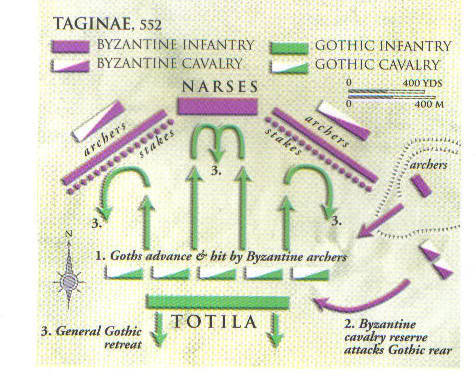
Narses ordered his 10,000 barbarian foederati to dismount, and form a deep phalanx in the center.  The archers were divided into two sections, which were placed on either wing of the infantry. Then, the Byzantine cavalry was divided into two main wings, placed to the rear of the archers. Finally, a further 1500 horsemen were placed at the far left wing of the army; these men would be used to outflank the Gothic army, if the opportunity presented itself.

The Ostrogothic cavalry was drawn up into a long line, which probably accounted for over half of the entire army. Totila probably thought he could break the Byzantine center with a single cavalry charge. The Gothic foot soldiers, originally archers, were positioned in a single block behind the cavalry. The historian Procopius noted that Totila gave the unusual order that he entire army could only fight with their spears. Why he gave this command is one of history's mysteries.

Video of the Battle of Taginae


The Battle

On one flank was a small hill that offered the prospect of turning the Byzantine left, but Narses got to it first, occupying it with just fifty men, who held a defile there. Totila sent cavalry against them but the Byzantine infantry succeeded in holding off multiple attacks by Ostrogothic cavalry.

Again, King Totila played for time.  There was even an individual challenge between warriors from both side out in no man's land between the armies. 

Finally Totila's reinforcements arrives.  Now Totila had his troops break for lunch. 
Byzantine Infantry

Narses fearing a trick permitted his troops to refresh themselves without leaving their positions. Totila, apparently hoping to take his enemy by surprise, launched a sudden large-scale mounted assault upon the Byzantine center. Ancient and modern authors have accused him of folly, but Totila probably sought to close with the enemy as fast as possible in order to avoid the effects of the formidable Byzantine archery.

Narses was prepared for such a move, however, and ordered the archers massed on his flanks to incline their front towards the center so that his battle-line became crescent-shaped. Caught in the enfilading fire from both sides, the Ostrogothic cavalry sustained high casualties and their attack faltered.

The Goths who reached the infantry block were repelled with heavy losses. Totila sent wave after wave of troops that became so disorganized by the raining arrow storm, by the time they met the dismounted infantrymen they were completely broken. This folly continued through the afternoon.

The Gothic infantry never even engaged in actual combat as they hesitated to advance far enough to actually become effective. They were kept in the rear of the advance, fearing that Narses' horsemen would outflank them.

The Byzantine center began to push Totila's cavalry backwards onto their own line of infantry, At that critical moment, sometime in the early evening, Narses charged with his own cavalry – nearly all of them Byzantine heavy cavalry – that had been held in reserve. The retreat quickly turned into a rout, as the Gothic cavalry in their haste ran right over their own infantry, who joined them in the withdrawal.

The only casualty figures given for this battle were by Procopius, who said that 6,000 Ostrogothic cavalry were slain in the battle.  The majority of the Byzantine casualties were sustained by their foederati, who bore the brunt of the initial fighting.

King Totila was either killed on the battlefield or killed shortly afterward after fleeing with several followers.

6th Century Eastern Roman Cavalry 


The Roman Empire at the end of the Gothic Wars.

Gothic warriors that could have faced Narses in Italy.