.

Dedicated to the military history and civilization of the Eastern Roman Empire (330 to 1453)


"Time in its irresistible and ceaseless flow carries along on its flood all created things and drowns them in the depths of obscurity."

- - - - Princess Anna Comnena (1083–1153) - Byzantine historian

Showing posts with label Morocco. Show all posts

Thursday, May 21, 2020

Latin Speaking Africa


Brutus and Cassius in HBO's Rome

Language Follows Military Power


It is rather simple, language follows military conquest and economic power.

We saw the Greek language take hold in much of Egypt with the conquest by Alexander the Great. The same is true in North Africa. With the fall of Carthage to Rome in 146 BC we saw Roman military colonies and economic activity spread the Latin language along coastal Libya, Tunisia, Algeria and Morocco.

The populations of Roman North Africa that had a Romanized culture and used to speak their own variety of Latin as a result. Latin continued to be used for centuries after the fall of the Western Empire in 476 AD. 

The Latin speaking local population went on during the conquest by the Germanic Vandal tribes and on into the re-conquest period by the Eastern Roman Empire.

What happened to African Latin following the Arab conquest in 696-705 AD is difficult to trace, though it was soon replaced by Arabic as the primary administrative language. At the time of the conquest a the Latin language was probably spoken in the cities and Berber languages were also spoken in the region.
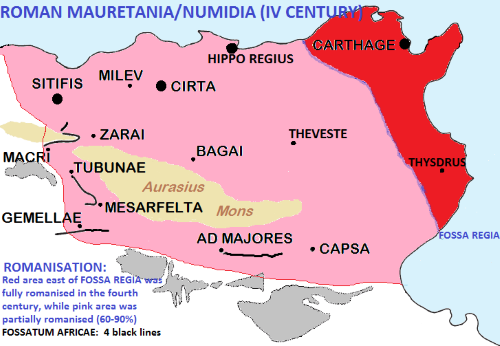
Romanization of Africa in 4th century CE
Red Latin, Pink 60 to 90% Latin


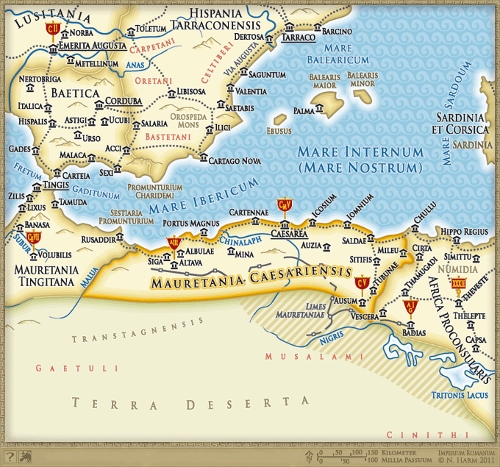
North African Roman Provinces
The province of Mauretania Caesariensis existed from 42 AD to the 7th Century. During and after the Fall of the Western Roman Empire in the 5th century, most of the hinterland area was lost, first to the Vandal Kingdom and later to the Mauro-Roman Kingdom, with Roman administration limited to the capital of Caesarea.
.
The land was reconquered by Rome during the reign of 
Justinian. In the late 580s, under the emperor Maurice, all of the Maghreb was granted to the Exarchate of Africa, and Mauretania Caesariensis became part of a new province, Mauretania Prima. The Muslim conquest of the Maghreb in the late 600s brought an end to Roman rule.
.
Over time the use of Latin would have moved closer and closer to the coast.

Arch of Caracalla (Triumphal Arch)
In 
Volubilis, Roman Morocco
The city fell to local tribes around 285 and was never retaken by Rome because of its remoteness and indefensibility on the south-western border of the Roman Empire. It continued to be inhabited for at least another 700 years, as a Latinised Christian community.  The Eastern Empire retained a small island of control on the Moroccan coast until the Arab conquest.

Roman Military Colonies

Latin speaking Roman Africans lived in all the coastal cities of contemporary TunisiaWestern LibyaAlgeria and Morocco.

The Roman Africans were generally local Berbers or Punics, but also the descendants of the populations that came directly from Rome itself or the diverse regions of the Empire as legionaries and senators.

The African province was amongst the wealthiest regions in the Empire (rivaled only by Egypt, Syria and Italy itself) and as a consequence people from all over the Empire migrated into the province. Large numbers of Roman Army veterans settled in Northwest Africa on farming plots promised for their military service.

Since the second half of the first century BC and as a result of increasing communities of Roman citizens living in the North African centers, Rome started to create colonies in North Africa.

  1. The main reason was to control the area with Roman citizens, who had been legionaries in many cases. 
  2. The second reason was to give land and urban properties to the Roman military troops who had fought for the Roman Empire and so decrease the demographic problem in the Italian peninsula
  3. The third reason was to facilitate the Romanization of the area and so the integration of the local Berbers -through marriage and other relationships- in the Roman Empire's social and cultural world.

Emperor Septimius Severus
From
 Leptis Magna in the Roman province of AfricaSeptimius Severus grew up in Leptis Magna. He spoke the local Punic language fluently, but he was also educated in Latin and Greek, which he spoke with a slight accent.


Under Theodosius the area east of the Fossa regia was fully Romanized with one third of the population made of Italian colonists and their descendants. The other two thirds were Romanized Berbers, who were all Christians and nearly all Latin speaking.

Called the "Granary of the Empire", Romano-berber North Africa produced one million tons of cereals each year, one-quarter of which was exported. Additional crops included beans, figs, grapes, and other fruits. By the second century, olive oil rivaled cereals as an export item. In addition to the cultivation of slaves, and the capture and transporting of exotic wild animals, the principal production and exports included the textiles, marble, wine, timber, livestock, pottery such as African Red Slip, and wool.

Berber Africa -from northern Morocco to Tripolitania- had a population of more than 3 million inhabitants in the third century.

Nearly 40% were living in more than 500 cities. But in the sixth century -after the Byzantine reconquest- the population was reduced to less than 2.5 millions and after the Arab conquest in the eighth to tenth centuries there remained only one million.

There were 20 cities in the territory of actual Tunisia with the title and privileges of "Roman Coloniae" or similar, while in Algeria there was nearly the same amount and in Morocco and Libya only a few. 
The most important was the "capital" new Carthago, with more than 300,000 inhabitants during Septimius Severus times (who enhanced Leptis Magna -where he was born- to be the second city of Berber Africa with nearly 100,000 inhabitants).  
The verified "Roman Coloniae" in Africa were:


 A mosaic on the floor ‘Labors of Hercules house’
in Volubilis, near Meknes, Morocco.

The End of Latin

The Muslim conquest of North Africa in the late 600s and early 700s did not end Latin. Local Latin speaking communities appear to have gone on for many centuries.

Spoken Latin is attested in the city of Gabès by Ibn Khordadbeh (died 912), in BéjaBiskraTlemcen and Niffis by al-Bakri (died 1094) and in Gafsa and Monastir by al-Idrisi (died 1165). 

The latter said of Gafsa that "its inhabitants are Berberised, and most of them speak the African Latin tongue."

The Normans, when they were acquiring their African kingdom in the 12th century, received help from the remaining Christian populations of Tunisia, and some historians argue that those Christians still spoke a Romance language.

The language existed until the arrival of the Banu Hilal Arabs in the 11th century and probably until the beginning of the fourteenth century. According to one historian, "Christian communities, generally labelled Afariqa or Ajam in the Arab sources and speaking a Latin dialect ... are known to have survived until the fourteenth century."

Virginie Prevost pinpointed that -between the Berbers of Afrikiya- the African Romance language was linked to Christianity, that survived in north Africa until the XIV century and according to the testimony of Mawlâ Aḥmad probably until the early XVIII century in Touzeur (south of Gafsa). 

The Arab Mawla Ahmad wrote that in 1709 "the inhabitants of Tazeur are what remains of the Christians who were once in Afrikiya, before the Arab conquest".


Click to enlarge
Languages of the Eastern Roman Empire

Portrait of the Roman African poet Terentius
Terentius may have been born in or near Carthage. He may have lived in the territory of the Libyan tribe called by the Romans Afri. 

Roman Emperor Heraclius
Heraclius brought an army from Latin speaking Carthage to Constantinople to overthrow the Emperor Phocas. He was crowned Caesar Flavius Heraclius Augustus in 610.


(Roman Africans)    (Languages)    (African Romance)

(Kingdom of Africa)    (Roman colonies)

Friday, September 20, 2013

Byzantine North Africa under Justinian


The 6th century Byzantine fortress of Kelibia in Tunisia. 

Byzantine North Africa


Editor  -  The Eastern Roman re-conquest of Vandal North Africa for the Empire was one of the great military campaigns of all time.  But military conquest was only the beginning.  The Emperor Justinian had to put down endless rebellions by his own troops and constant wars with the Moors.

In addition to the wars, Justinian spent a huge amount of money on buildings and fortifications from the Libyan border all the way to Morocco.

The great historian Procopius traveled with General Belisarius on his campaign in Africa.  That gave him a unique first hand knowledge of the area when he later wrote his book The Buildings of Justinian.  Below is the portion of his book that deals with Roman western Africa.


By Procopius   
The Buildings of Justinian
Written in the 550s AD

After Tripolis and the Syrtes, let us go on to the rest of Libya.  We must begin from Carthage, which chances to be the largest and the most noteworthy of the cities in this region, prefacing our account with the remark that when Gizericb and the Vandals acquired Libya, a device occurred to them which was both pernicious and worthy of barbarians.

They reasoned that they would be better off if all the towns of the region should be without walls, so that the Romans might not capture any of them and thus be able to harm the Vandals.  So they immediately tore down all the walls to the ground.

Emperor Justinian
All the barbarians, as a general thing, are very keen in planning damage to the Romans, and they are very swift in executing whatever they decide upon.  Only Carthage and a few other places were left by them just as they were, for they declined to concern themselves with these, and left them for time to destroy.

But the Emperor Justinian (although no man approved of his purpose and all actually shuddered at the undertaking, and only God furthered the project and promised help and support) sent Belisarius and an army against Libya; and he broke the power of Gelimer and the Vandals, killing many and making the rest captives, as I have recounted in the Books of the Wars.  He restored all the dismantled strongholds in Libya, every one of them, and he also added a great many new ones himself.

First, then, he cared for Carthage, which now, very properly, is called Justinianê, rebuilding the whole circuit-wall, which had fallen down, and digging around it a moat which it had not had before.  He also dedicated shrines, one to the Mother of God in the palace, and one outside this to a certain local saint, Saint Prima.

Furthermore, he built stoas on either side of what is called the Maritime Forum, and a public bath, a fine sight, which they have named Theodorianae, after the Empress.  He also built a monastery on the shore inside the circuit-wall, close to the harbour which they call Mandracium, and by surrounding it with very strong defences he made it an impregnable fortress.

Ruins of the Roman aqueduct in Carthage, Tunisia

These things, then, were done by Justinian at modern Carthage. In the surrounding region, which is called Proconsularis, there was an unwalled city, Vaga by name, which could be captured not only by a planned attack of the barbarians, but even if they merely chanced to be passing that way.  This place the Emperor Justinian surrounded with very strong defenses and made it worthy to be called a city, and capable of affording safe protection to its inhabitants.  And they, having received this favour, now call the city Theodorias in honour of the Empress.  He also built in this district a fortress which they call Tucca.

In Byzacium there is a city on the coast, Adramytus by name, which has been large and flourishing from ancient times, and for this reason it won the name and rank of metropolis of the region, since it chances to be first in point of size and, in general, of prosperity.

The Vandals had torn the circuit-wall of this city down to the ground, so that the Romans might not be able to use it against them. And it lay conveniently exposed to the Moors when they overran that region.  Nevertheless, the Libyans who lived there tried to make provision, so far as they could, for their own safety, and so they made a barricade out of the ruins of the walls and joined their houses together;  and from these they would fight against their assailants and try to defend themselves, though their hope was slight and their position precarious.  So their safety always hung by a hair and they were kept standing on one leg, being exposed to the attacks of the Moors and to the neglect of the Vandals.

However, when the Emperor Justinian became master of Libya by conquest, he put an exceedingly massive wall about the city and stationed there an adequate garrison of troops, thus giving the inhabitants assurance of safety and enabling them to disdain all enemies.  For this reason they now call the place Justinianê, thus repaying the Emperor for their deliverance and displaying their gratitude simply by the adoption of the name, since they had no other means by which they could requite the Emperor's beneficence, nor did he himself wish other requital.

There was also a certain other town on the coast of Byzacium which the inhabitants used to call Caputvada. At that point the Emperor's fleet landed and there the troops first set foot on the land of Libya, when they made the expedition against Gelimer and the Vandals.  In that place also God revealed that marvellous and indescribable gift to the Emperor which I have described in the Books on the Wars. For although the locality was exceedingly arid, so that the Roman army was very hard pressed by lack of water, the ground, which previously had been completely dry, sent up a spring at the place where the soldiers were building their stockade,  for as they dug, the water began to gush forth.

Ruins of the Byzantine walls of Theveste
This city in Algeria is one of the many sites restored and fortified under Solomon, a general of Emperor Justinian.  Solomon fought in the Vandalic War and the Moorish Wars.


So the earth threw off the drought which prevailed there, and transforming its own character became saturated with drinking-water.  Because of this circumstance they built a satisfactory camp in that place and spent that night there; and on the next day they prepared for battle and, to omit what intervened, took possession of Libya.  So the Emperor Justinian, by way of bearing witness to the gift of God by means of a permanent testimony — for the most difficult task easily yields to his wish — conceived the desire to transform this place forthwith into a city which should be made strong by a wall and distinguished by its other appointments as worthy to be counted an impressive and prosperous city; and the purpose of the Emperor has been realized.

For a wall has been brought to completion and with it a city, and the condition of a farm land is being suddenly changed.  And the rustics have thrown aside the plough and lead the existence of a community, no longer going the round of country tasks but living a city life.  They pass their days in the market-place and hold assemblies to deliberate on questions which concern them; and they traffic with one another, and conduct all the other affairs which pertain to the dignity of a city.

This then was done in Byzacium on the sea. In the interior of this land and to its farther parts, where barbarian Moors live hard by, he built very powerful outposts against them, because of which they are no longer able to overrun the Roman dominion.  He surrounded each one of the cities with very strong walls, since they stand on the rim of the territory; these bear the names Mammes, Teleptê and Cululis. He also constructed a fort which the natives call Aumetra, and in these places he stationed trustworthy garrisons of troops.

In the same way he assured the safety of the land of Numidia by means of fortifications and garrisons of soldiers, each one of which I shall now mention.  There is a mountain in Numidia which is called Aurasius, such as chances to be found nowhere else at all in the civilized world.  For this mountain rises steeply to a towering height and its perimeter extends to a distance of about three days' journey. It offers no path as one approaches it, having no ascent except over cliffs.


Fortress of Ksar Lemsa in Tunisia.
This fine fortress with its strikingly well-preserved walls (except for the SE side) can be seen from afar dominating the valley in the middle of a field of ruins. A gushing stream flows down the mountainside next to it. The citadel probably was built by the patrician Salomon in the reign of Justinian, who established his country-wide system of fortifications in the first half of the 6th c. Built with materials from the monuments of the ancient city.
(fr.wikipedia - Ksar Lemsa)
 

But after one gets to the top there is deep soil and level plains and easy roads, meadows good for pasture, parks full of trees and plough-land everywhere.  Springs bubble out from the cliffs there, their waters are placid, there are rippling rivers which flow chattering along, and strangest of all, the grain-fields and the trees on this mountain produce crops which are double in size compared with those which are wont to grow in the rest of Libya. Such is the condition of Mt. Aurasius. 

The Vandals held it originally along with the rest of Libya, but the Moors wrested it from them and settled there.  The Emperor Justinian, however, expelled from there the Moors, and Iaudas who ruled over them, and added this mountain to the rest of the Roman Empire.  As a precaution in order that the barbarians might not again make trouble by getting a foothold there, he fortified cities about the mountain which he found deserted and altogether unwalled. I refer to Pentebagae and Florentianae and Badê and Meleum and Tamugadê, as well as two forts, Dabusis and Gaeana; also he established there sufficient garrisons of soldiers, thus leaving to the barbarians there no hope of attacking Aurasius.

Ceuta, Spanish Morocco
Called Septum by the Romans, this fort stood near the Pillars of Hercules.  The
remnants of the city walls are arguably Ceuta’s most interesting historical
monument. The fortifications were originally built by the Byzantines and later
improved on by the Portuguese and Spanish in the 16th, 17th and 18th centuries.

The district beyond Aurasius, which had not been under the Vandals at all, he wrested from the Moors. There he walled two cities, Fricê and Sitifis. At the cities situated in the rest of Numidia, the names of which follow, he set up impregnable defences: Laribuzuduôn, Paraturôn, Cilana, Siccaveneria, Tigisis, Lamfouaomba, Calamaa, Medara, Medela;  besides these, two forts, Scilê and Foscala. So much, then, for this.

There is a city on the island Sardô, which is now named Sardinia, called by the Romans Traiani Forum.  This Justinian has supplied with a wall which it did not have before, but instead it lay exposed to the island Moors, who are called Barbaricini, whenever they wished to plunder it.

And at Gadira, at one side of the Pillars of Heracles, on the right side of the strait, there had been at one time a fortress on the Libyan shore named Septum; this was built by the Romans in early times, but being neglected by the Vandals, it had been destroyed by time.  Our Emperor Justinian made it strong by means of a wall and strengthened its safety by means of a garrison.  There too he consecrated to the Mother of God a noteworthy church, thus dedicating to her the threshold of the Empire, and making this fortress impregnable for the whole race of mankind.
 
So much for these things. There can be no dispute, but it is abundantly clear to all mankind, that the Emperor Justinian has strengthened the Empire, not with fortresses alone, but also by means of garrisons of soldiers, from the bounds of the East to the very setting of the sun, these being the limits of the Roman dominion.

As many, then, of the buildings of the Emperor Justinian as I have succeeded in discovering, either by seeing them myself, or by hearing about them from those who have seen them, I have described in my account to the best of my ability.  I am fully aware, however, that there are many others which I have omitted to mention, which either went unnoticed because of their multitude, or remained altogether unknown to me.  So if anyone will take the pains to search them all out and add them to my treatise, he will have the credit of having done a needed work and of having won the renown of a lover of fair achievements.


Roman Carthage
After the conquest, a new Roman city of Carthage was built on the same land, and by the 1st century AD it had grown to the second largest city in the western half of the Roman Empire, with a peak population of 500,000.  It was the center of the Roman Province of Africa, which was a major "breadbasket" of the Empire.
.
See more at Roman Carthage.

Ancient Carthage
Two views of what Carthage harbor could have looked like.
(mahdi-jwini.blogspot - carthage-harbors)


Praetorian Prefecture of Africa
With the capital based at Carthage, the Praetorian Prefecture of Africa (Latin: praefectura praetorio Africae) was a major administrative division of the Eastern Roman Empire.  It was established after the re-conquest of northwestern Africa from the Vandals in 533-534 by Emperor Justinian I. It continued to exist until the late 580s, when it was replaced by the Exarchate of Africa.
.
Political subdivisions include:
Zeugitana, Byzacena, Numidia, Mauretania Sitifensis, Mauretania Caesariensis, and Mauretania Tingitana.
.
Also see The Praetorian Prefecture of Africa.


(Forts in Tunisia)            (Procopius - Buildings in Africa)          (Solomon - Byzantine General)
 

Tuesday, October 2, 2012

Byzantine Morocco


Ceuta, North Africa
The remnants of the city walls are arguably Ceuta’s most interesting historical monument. The fortifications were originally built by the Byzantines and later improved on by the Portuguese and Spanish in the 16th, 17th and 18th centuries.


Roman and Byzantine Morocco

The Romans controlled all or part of the Morocco area from about 42 AD until the last Byzantine outpost fell about 710 AD.

Roman rule was interrupted for about 100 years by the invasion of the Vandals from Europe.  When Eastern Roman rule was restored it was mostly along the coastal zone.


The Walls of Ceuta, North Africa
The ancient Royal Walls originally date back to the 5th century.  Ceuta's location has made it an important commercial trade and military way-point for many cultures, beginning with the Carthaginians in the 5th century BC, who called the city Abyla. It was not until the Romans took control of the region in AD 42 that the port city, then named Septa, assumed an almost exclusive military purpose. It changed hands again approximately 400 years later, when Vandal tribes ousted the Romans. It then fell into the hands of the Visigoths, and finally become an outpost of the Eastern Roman Empire.
.
Around 710, as Muslim armies approached the city, its Byzantine Governor, Julian changed his allegiance, and exhorted the Muslims to invade the Iberian Peninsula.


The Roman Province of Mauretania Tingitana

Mauretania Tingitana was a Roman province located in northwestern Africa, coinciding roughly with the northern part of present-day Morocco and Spanish cities of Ceuta and Melilla. The province extended from the northern peninsula, opposite Gibraltar, to Chellah (or Sala) and Volubilis to the south, and as far east as the Oued Laou river. Its capital city was the city of Tingis (Berber name: Tingi) which is the modern city of Tangier. Other major cities of the province were Iulia Valentia Banasa and Lixus.

After the death of Ptolemy of Mauretania, the last king of Mauretania in AD 40, Roman emperor Claudius changed the kingdom Mauretania into two Roman provinces: Mauretania Caesariensis and Mauretania Tingitana.

The Roman Province of Mauretania Tingitana.

The Roman occupation did not extend very far into the continent. In the far west, the southern limit of imperial rule was Volubilis, which was ringed with military camps such as Tocolosida slightly to the south east and Ain Chkour to the north west, and a fossatum or defensive ditch. On the Atlantic coast Sala Colonia was protected by another ditch and a rampart and a line of watchtowers.

This was not a continuous line of fortifications: there is no evidence of a defensive wall like the one that protected the turbulent frontier in Britannia at the other extremity of the Roman Empire. Rather, it was a network of forts and ditches that seems to have functioned as a filter. The limes– the word from which the English word “limit” is derived – protected the areas that were under direct Roman control by funnelling contacts with the interior through the major settlements, regulating the links between the nomads and transhumants with the towns and farms of the occupied areas.

The same people lived on both sides of these limes, although the population was quite small.

Volubilis had perhaps twenty thousand inhabitants at most in the second century. On the evidence of inscriptions, only around ten to twenty per cent of them were of European origin, mainly Spanish; the rest were local.


End of the Roman Road, Volubilis; Morocco
Morocco's most impressive and atmospheric ancient site is the roman city of Volubilis.  Originally a Carthaginian trading post in the 3rd century BC, Volubilis gradually became distant Roman base in the 1st century AD and marked the farthest extent of the Imperial road.


During the reign of Juba II, Emperor Augustus had already founded three colonias (with Roman citizens) in Mauretania close to the Atlantic coast: Iulia Constantia Zilil, Iulia Valentia Banasa and Iulia Campestris Babba.

This western part of Mauretania was to become the province called Mauretania Tingitana shortly afterwards. The region remained a part of the Roman Empire until 429, when the Vandals overran the area and Roman administrative presence came to an end.

The most important city of Mauretania Tingitana was Volubilis. This city was the administrative and economic center of the province in western Roman Africa. The fertile lands of the province produced many commodities such as grain and olive oil, which were exported to Rome, contributing to the province's wealth and prosperity. Archaeology has documented the presence of a Jewish community in the Roman period.


Roman Triumphal Arch in Volubilis


The principal exports from Mauretania Tingitana were purple dyes and valuable woods; Tingitana also supplied Rome with agricultural goods and animals, such as lions and leopards. The native Mauri were highly regarded and recruited by the Romans as soldiers, especially as light cavalry. Clementius Valerius Marcellinus is recorded as governor between 24 October 277 and 13 April 280.

The Notitia Dignitatum shows also, in its military organisation, a Comes Tingitaniae with a field army composed of two legions, three vexillations, and two auxilia palatina. Flavius Memorius held this office (comes) at some point during the middle of the fourth century. However, it is implicit in the source material that there was a single military command for both of the Mauretanian provinces, with a Dux Mauretaniae (a lower rank) controlling seven cohorts and one ala.

The Germanic Vandals established themselves in the province of Baetica in 422 under their king, Gunderic, and, from there, they carried out raids on Mauretania Tingitana. In 427, the Comes Africae, Bonifacius, rejected an order of recall from the Emperor Valentinian III, and he defeated an army sent against him. He was less fortunate when a second force was sent in 428. In that year, Gunderic was succeeded by Gaiseric, and Bonifacius invited Gaiseric into Africa, providing a fleet to enable the passage of the Vandals to Tingis. Bonifacius intended to confine the Vandals to Mauretania, but, once they had crossed the straits, they rejected any control and marched on Carthage, inflicting grievous suffering.


Volubilis Capitol

Volubilis Basilica

The Byzantine Fortress of Monte Hacho
The main entrance to Monte Hacho Fortress, a Byzantine fort which is now an off-limits military base in Ceuta.
.
Monte Hacho is a low mountain that overlooks the Spanish city of Ceuta, on the north coast of Africa. Monte Hacho is positioned on the Mediterranean coast at the Strait of Gibraltar opposite Gibraltar, and along with the Rock of Gibraltar is claimed by some to be one of the Pillars of Hercules.  According to the legend Hercules pushed apart the two mountains and created a link between the Mediterranean and the atlantic.
.
In classical civilization it was known as Mons Abila.  Monte Hacho is located on the Península de Almina and topped by a fort, the Fortaleza de Hacho, which was first built by the Byzantines, before being added to by the Arabs, Portuguese and Spanish.


Byzantine Morocco

The Romans evacuated most of Morocco at the end of the 3rd century AD, but unlike some other Roman cities, the Volubilis area was not abandoned. However, it appears to have been destroyed by an earthquake in the late fourth century AD.

It was reoccupied in the sixth century, when a small group of tombstones written in Latin shows the existence of a community that still dated its foundation by the year of the Roman province. Coins show that it was occupied under the Abbasids.

In 533, the Byzantine general Belisarius reconquered the former Diocese of Africa from the Vandals on behalf of the Emperor Justinian I.

All the territory west of Caesarea had already been lost by the Vandals to the Mauri, but a re-established Dux Mauretaniae kept a military unit at Septem (modern Ceuta). This was the last Byzantine outpost in Mauretania Tingitana; the rest of what had been the Roman province was united with the Byzantine part of Andalusia, under the name, Prefecture of Africa.

Most of the North African coast was later organised as the civilian Exarchate of Carthage, a special status in view of the outpost defense needs.  Mauretania Tingitana was effectively reduced to the city of Septum (Ceuta), was combined with the citadels of the Spanish coast (Spania) and the Balearic islands to form "Mauretania Secunda".

When the Umayyads conquered all of Northern Africa, replacing Christianity and Paganism with Islam, both Mauretanias were reunited as the province of al-Maghrib (Arabic for 'the West', and still the official name of the Sherifian kingdom of Morocco). This province also included over half of modern Algeria.

The local Latin language survived for centuries, and was not replaced before the Arabs conquered North Africa in the late 7th century.
.
.
(Wikipedia - Ceuta)      (Byzantine Spania)      (Mauretania Tingitana)
.
(thisotherworld.co.uk/ceuta)


.
The Eastern Roman Provinces of Spania and North Africa.
.
Aside from the southern parts of the provinces of Baetica and Carthaginiensis (the southern Levante), the Byzantines also held Ceuta in North Africa across from the Gibraltar and the Balearic Islands, which had fallen to them along with the rest of the Vandal kingdom.
.
Ceuta, though it had been Visigothic and was destined to be associated with the Iberian peninsula for its subsequent history, was attached to the province of Mauretania Secunda. The Balearics with Baetica and Carthaginiensis formed the new province of Spania. By the year 600 Spania had dwindled to little more than Málaga and Cartagena.


Morocco Volubilis Roman ruins


The walls close to the top of Monte Hacho belong to Byzantine Monte Hacho Fortress, now an off-limits military base - Ceuta


'House of Orpheus’ marble mosaic floor detail, Volubilis


House of Orpheus, Volubilis


A mosaic on the floor of the ‘Knight’s house’ in Volubilis, near Meknes, Morocco. Bacchus finds Ariadne asleep, Theseus having wandered off.


 ‘Labours of Hercules house’ in Volubilis, near Meknes, Morocco.

(mosaicartsource.wordpress.com)