|
Cataphract Cavalry used at Callinicum
Both the Persian Sassanid (above) and the Eastern Roman Empires used highly trained Cataphract armored horse archers. These highly mobile troops would let fly a deadly barrage of arrows into an enemy to break up their formation and then charge in for the kill. |
The
Battle of Callinicum (April 19, 531 AD) was the last of a series of battles between the armies of the Eastern Roman Empire and the Sassanid Persian Empire in the
Iberian War that lasted from 526 – 532 AD.
The Iberian War
After the
Anastasian War, a seven-year truce was agreed on, yet it lasted for nearly twenty years. Even during the war in 505, Emperor Anastasius I had already started
fortifying Dara as a counter to the Persian fortress city of
Nisibis for a looming conflict. In 524/525, the Persian shah Kavadh I (r. 488–531) proposed that Roman Emperor Justin I adopt his son, Khosrau I; the priority of the Persian king was to secure the succession of Khosrau, whose position was threatened by rival brothers and the Mazdakite sect.
The proposal was initially greeted with enthusiasm by the Roman Emperor and his nephew, Justinian, but Justin's
quaestor, Proculus, opposed the move. Despite the breakdown of the negotiations, it was not until 530 that full-scale warfare on the main eastern frontier broke out. In the intervening years, the two sides preferred to wage war by proxy, through Arab allies in the south and Huns in the north.
Tensions between the two powers were further heightened by the defection of the
Iberian king Gourgen to the Romans. According to Procopius, Kavadh I tried to force the Christian Iberians to become Zoroastrians, who in 524/525 under the leadership of Gourgen rose in revolt against Persia, following the example of the neighboring Christian kingdom of
Lazica. Gourgen received pledges by Roman Emperor Justin I that he would defend Iberia; the Romans indeed recruited Huns from the north of the Caucasus to assist the Iberians.
By 526-527, overt fighting between the two empires had broken out in the Transcaucasus region and upper Mesopotamia.
 |
The Iberian War saw the Persian and Roman Empires in a fight
from the Caucasus to the upper Mesopotamia region. |
Battle of Callinicum
The Byzantines’ eastern borders, especially the area of Syria and along the Tigris and Euphrates rivers, were under constant dispute with the Persians. One of the ways the Persians gave the Eastern Romans fits was raiding this disputed area during time of war.
Generally, a substantial Sassanian military force – 10,000 to 20,000 men, usually all cavalry – would be sent into Byzantine territory to temporarily capture some forts, towns or cities, take any valuables they could carry, and beat a hasty retreat back to Sassanian territory. Usually by the time a sufficient Byzantine military response could be formed, the raiders slipped away with their loot.
In April 531, a Persian force under
Azarethes, numbering about 15,000 cavalry, with an additional group of 5,000
Lakhmid Arab light horse allies under their King Al-Mundhir, crossed the frontier at Circesium on the Euphrates and marched north.
 |
The Roman - Persian Wars
For over 700 years, from 92 BC to 629 AD,
the two great empires fought wars for
the control of western Asia. |
As the Persians neared
Callinicum in modern day Syria, Belisarius, who commanded the local Roman troops, set out to follow them as they advanced westwards.
Belisarius was the Magister Militum per Orientum (the commander of all Roman forces east of Constantinople) reacted swiftly to the Persian thrust. Belisarius was riding the wave of a stunning victory over a Persian army twice his size at
the Battle of Dara just a year before and was an experienced commander.
Belisarius had gathered his forces, beginning his pursuit within days of the Persian crossing of the Euphrates. His force initially consisted of 5,000 Byzantine cavalry and 5,000
Ghassanid Arab light cavalry. Part of his army had been left to secure Dara and other border towns against Persian attack.
Belisarius was expecting reinforcements as he continued shadowing the Persian raiders.
After a few days, Belisarius received some reinforcements from nearby Roman provinces, as well as directly from the Byzantine capital. These men were led by
Hermogenes, the Roman Emperor’s
Magister Officiorum.
The additional troops swelled Belisarius’ force to 9000 infantry, 12,000 Byzantine cavalry and the 5,000 Ghassanid light horsemen. At least two thousand of the troops were Isaurians under the command of Longinus and Stephanacius. The commanders of cavalry were all the same ones who had previously fought the Battle at Dara with Mirranes and the Persians, while the infantry were commanded by one of the body-guards of the Emperor Justinian, named Peter.
Belisarius' army began to approach the invading Persians. Once word reached the Persians that it was Belisarius who was coming for them
they immediately decided to retire back to Persia. Through a series of forced marches, Belisarius kept his men moving, barely missing contact with the fleeing Sassanid force on several occasions.
At dawn on the morning of April 19 – the day before Easter – the Roman army came upon the Sassanids still encamped on the southern bank of the Euphrates, across the river from the town of Callinicum
 |
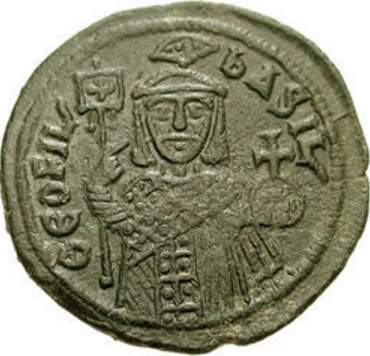
Kavadh I
Persian King of Kings.
Image of Kavadh I on one of his coins. |
General Belisarius was also not interested in a head to head fight with the fleeing Persians. He really had nothing to gain, and he also probably realized that his army was tired from the forced marches. In addition, the army was probably hungry from the enforced Holy Week fasting. Finally, the Persian camp was well fortified, with a defensive ditch as well as anti-cavalry caltrops sown around its perimeter.
The Byzantine troops, however, were restless, and clamored for battle. The strategy of just pushing the Persians out of Roman lands did not sit well with many of the commanders, especially Hermogenes, who seems to have wanted to prove his bona fides as a military man. Perhaps the senior Roman officers wanted to punish the Persians for their incursion; or, maybe they were still flushed with the glow of victory from battles in the previous year.
According to Procopius: “…
the army began to insult [Belisarius], not in silence nor with any concealment, but they came shouting into his presence, and called him weak and a destroyer of their zeal; and even some of the officers joined with the soldiers in this offence…” Seeing that his men were determined to fight the Sassanians, Belisarius – against his better judgment – began deploying his army for battle.
Events like this are recorded over and over. They show that military discipline was minimal if the troops, and even the officers, had no fear of their own generals.
 |
The Euphrates River
Belisarius anchored his infantry on the river with an island mid-river in view
and the Roman town of Callinicum on the far shore. |
 |
The Byzantine left was anchored on the Euphrates River with the
Roman town of Callinicum located just across the river. The Persian
left mounted a strong attack on the 5,000 Ghassanid Arab light cavalry
on the Roman right. The Ghassanids fled without firing a shot allowing
the Persians to attack the rear of the Roman cavalry in the center. |
The Armies Meet at the Euphrates
The two armies met outside Callinicum on 19 April 531. Both groups formed up differently.
Belisarius chose an "odd" formation that confused his opposing general. In this case he anchored his left flank on the bank of the river with the Roman infantry and put the Ghassanid Arab allies on his far right flank on slopping ground. He then placed several ranks of Roman heavy cavalry, the
armored cataphracts, in the center of the front line.
By anchoring his infantry on the Euphrates perhaps Belisarius was trying to prevent his troops from being flanked by the more mobile Persians as well as creating a sense of security to any prevent panic.
Most of these infantry spearmen would have worn metallic armor – at least the front few ranks – metal helmets and carried large shields, possibly with greaves to protect their legs. They were probably arranged 5 to 10 ranks deep. The remainder of the infantry consisted of 2,000-3,000 bowmen, likely lined up behind the spearmen, or possibly mixed in among them. All of the infantrymen, spearmen and archers, were armed with a sword as a secondary weapon, with the bowmen probably having a small round shield for more protection.
 |
Infantry Officer in the era of Justinian
(6th century AD) |
The Roman cavalry in the center divided into three divisions. Next to the left wing he placed his limitanei cavalry; to their right were the comitatensis horsemen, then the limitanei cavalry.
These units would have lined up 10 files deep in battle. The first two files would have been armed with lances and swords, the next two files with have been armed with bows and swords, and the remaining files would have had some bows, most probably were armed with javelins and swords. The lancers probably had the most metal armor, with helmets and small round shields, while the other men probably were limited to leather or padded armor.
To the right of the cavalry was a 2,000-man contingent of infantry, newly raised by Hermogenes as he rode to link up with Belisarius. These men were not well trained, probably not well equipped, and armed with little more than javelins.
Completing the Byzantine deployment, the 5,000-strong Ghassanid Arab horsemen were stationed on the upward sloping ground, guarding the army’s right flank. These men would be lightly armored, armed with light spears, javelins, swords and some bows.
It is probable that lined up behind the Byzantine center was a 1,000-man reserve commanded by Belisarius and Hermogenes, consisting of their bucellari, their personal retainers. These men, sworn to the personal service of the general and the bureaucrat, would have worn the best armor possible, complete with small round shields, and probably greaves. However, they probably didn’t have any protection for their horses. These men were probably mostly Goths or Thracians.
The
Sassanid deployment is a bit simpler, but most of the Persian sources don’t give quite as much detail. The 15,000 Persian cavalry was divided into three divisions, placed on the right and center of their battleline, with their Lakhmid Arab allies on the left facing their traditional enemies the Ghassanids.
The other 5,000-man Persian division was lined up behind the center as a tactical reserve.
The sources stated that the Sassanid army was marching under a “royal standard,” probably meaning that these were the closest thing to “regulars” that the Persians had to offer. It can be further assumed that the majority of the army consisted of the elite riders of the Persians, the cataphracts: heavily armored, well-trained horsemen armed with lances, bows, and swords or maces. Their horses were also well-protected, and could logically be referred to as the “tanks” of the sixth century battlefield.
These warriors probably comprised the front two or three ranks of each Persian division, with the remainder consisting of light Parthian or Hunnic horsemen armed with bows. The Persians usually fired their bows to disrupt their enemy’s formations, then sent the heavy horsemen in deep wedges to pound them into submission.
 |
| 6th Century Roman Infantry |
For much of the day,
the battle was a stalemate, with the Persians and Romans trading arrows and cavalry charges.
The historian Procopius says the battle was exceedingly fierce and went on for hours. The arrows, shot from either side in very great numbers, caused great loss of life in both armies, while some placed themselves in the interval between the armies and made a display of valorous deeds against each other, and especially among the Persians they were falling by the arrows in great numbers.
The Persians began a series of attacks along the Byzantine line, using the treasured tactic of attacking and feigning retreat in hopes of drawing out the Romans to pursue them. Apparently, the Romans’ discipline held fast.
After several hours, probably now late afternoon, the Persians gathered their heavy cavalry into a single unit. They marched to attack the Roman right flank made up of some 5,000 Ghassanid Arab light cavalry. With the Persians approaching Procopius says the Arabs simply turned and fled the battlefield without even trying to fight.
The entire Roman right wing had instantly vanished.
The advancing Persians swung around and attacked the Roman center from both the rear and the front. At this point the Romans were exhausted by the long marches and the day long battle. Most of the troops rapidly left the battlefield right into the Euphrates River to try and take shelter on the islands offshore.
But many other Romans stayed to fight. One was Ascan who, after killing many of the notables among the Persians, was gradually hacked to pieces and finally fell, and with him eight hundred others perished after showing themselves brave men in this struggle. Almost all the untrained militia-style Isaurians fell with their leaders, without even daring to lift their weapons against the enemy.
The infantry commander Peter still had a large force available though most of his men had fled. Belisarius and his cavalry had been with Ascan. When that warrior and his men fell the general retreated to Peter's infantry phalanx. Belisarius commanded all his men to give up their horses and join the infantry to fight on foot. There would be no retreat from this spot.
The Romans under Belisarius and Peter turned their backs to the river in what was probably a half circle so the Persians could not flank them.
 |
Belisarius' Shield Wall Holds Firm.
Roman infantry re-enactors (above) do a shield wall to repel a cavalry
attack. Belisarius and his men put their backs to the Euphrates River to
form a phalanx of shields and spears to fight off the endless charges
of the elite Persian cavalry units. |
The Persians attacked the Roman wall of shields again and again with no results. Belisarius and his smaller force was taking on the entire Persian army. Procopius reports that the Romans stood shoulder to shoulder in a tight formation with shields in an unyielding barricade. Every time the Persians attacked
the Romans poured arrow fire into their ranks creating huge numbers of casualties and confusion.
This last phase of the battle appears to have lasted for hours. The Persians did not give up their endless assaults on Belisarius until nightfall. Only then did the Persians withdraw to their fortified camp.
Belisarius with a few men then found a small freight-boat and crossed to the island in the middle of the river that many other Romans had reached by swimming.
On the following day many freight-boats were brought to the Romans from the city of Callinicus to ferry the remaining troops across the Euphrates. The Persians, after despoiling the dead, departed homeward.
Exact casualties are not known, but both sides suffered badly in the encounter.
And After the Battle
The direct outcome of the battle was something of a stalemate; the Byzantine army had lost many soldiers and would not be in fighting condition for months, but the Persians had taken such heavy losses that it was useless as to its original purpose, the invasion of Syria.
The leadership on both sides were unhappy with the battle results.
Upon return, Emperor
Kavadh I removed General Azarethes from command and stripped him of his honors due to the general's actions in the battle. When Belisarius returned to Constantinople, he was brought before a review board and dismissed from his position.
Justinian's envoy, Hermogenes, visited Kavadh immediately after the Battle of Callinicum to re-open negotiations but without success. Justinian therefore took steps to bolster the Roman position, trying, at the same time, to engage Kavadh diplomatically. Kavadh died shortly afterwards, and in spring 532 new negotiations began between the Roman envoys and the new Persian king, Khosrau I, who needed to devote his attention to secure his own position.
The two sides finally came to an agreement, and the
Eternal Peace, which lasted less than eight years, was signed in September 532. Both sides agreed to return all occupied territories and the Romans to make a one-off payment of 110
centenaria (11,000 pounds of gold). The Romans recovered the Lazic forts, Iberia remained in Persian hands, but the Iberians who had left their country were allowed to remain in Roman territory or to return to their native land.
 |
| Persian Cavalry Reenactment |
 |
Sassanid Persian Cataphract
Sassanian Elite Savaran Persian Cavalry |
History of the Wars: Book I
The Persian War
By Procopius of Caesarea
(AD 500 – c. AD 565)
Procopius was with Belisarius on the eastern front at the Battle of Callinicum in AD 531. Here is his eyewitness account of the battle.
At the opening of spring a Persian army under the leadership of Azarethes invaded the Roman territory. They were fifteen thousand strong, all horsemen. With them was Alamoundaras, son of Saccice, with a very large body of Saracens. But this invasion was not made by the Persians in the customary manner; for they did not invade Mesopotamia, as formerly, but the country called Commagene of old, but now Euphratesia, a point from which, as far as we know, the Persians never before conducted a campaign against the Romans.
. . . . This man's suggestion at that time therefore pleased Cabades, and he chose out fifteen thousand men, putting in command of them Azarethes, a Persian, who was an exceptionally able warrior, and he bade Alamoundaras lead the expedition.
So they crossed the River Euphrates in Assyria, and, after passing over some uninhabited country, they suddenly and unexpectedly threw their forces into the land of the so-called Commagenae. This was the first invasion made by the Persians from this point into Roman soil, as far as we know from tradition or by any other means, and it
paralyzed all the Romans with fear by its unexpectedness.
 |
| 6th Century Eastern Roman reenactor |
And when this news came to the knowledge of Belisarius, at first he was at a loss, but afterwards he decided to go to the rescue with all speed. So he established a sufficient garrison in each city in order that Cabades with another hostile army might not come there and find the towns of Mesopotamia utterly unguarded, and himself with the rest of the army went to meet the invasion; and crossing the River Euphrates they moved forward in great haste.
Now the Roman army amounted to about twenty thousand foot and horse, and among them not less than two thousand were Isaurians. The commanders of cavalry were all the same ones who had previously fought the battle at Daras with Mirranes and the Persians, while the infantry were commanded by one of the body-guards of the Emperor Justinian, Peter by name. The Isaurians, however, were under the command of Longinus and Stephanacius. Arethas also came there to join them with the Saracen army. When they reached the city of Chalcis, they encamped and remained there, since they learned that the enemy were in a place called Gabboulon, one hundred and ten stades away from Chalcis.
When this became known to Alamoundaras and Azarethes, they were terrified at the danger, and no longer continued their advance, but decided to retire homeward instantly. Accordingly they began to march back, with the River Euphrates on the left, while the Roman army was following in the rear. And in the spot where the Persians bivouacked each night the Romans always tarried on the following night. For Belisarius purposely refused to allow the army to make any longer march because
he did not wish to come to an engagement with the enemy, but he considered that it was sufficient for them that the Persians and Alamoundaras, after invading the land of the Romans, should retire from it in such a fashion, betaking themselves to their own land without accomplishing anything. And because of this all secretly mocked him, both officers and soldiers, but not a man reproached him to his face.
Finally the Persians made their bivouac on the bank of the Euphrates just opposite the city of Callinicus. From there they were about to march through a country absolutely uninhabited by man, and thus to quit the land of the Romans; for they purposed no longer to proceed as before, keeping to the bank of the river.
The Romans had passed the night in the city of Sura, and, removing from there, they came upon the enemy just in the act of preparing for the departure. Now the feast of Easter was near and would take place on the following day; this feast is reverenced by the Christians above all others, and on the day before it they are accustomed to refrain from food and drink not only throughout the day, but for a large part of the night also they continue the fast.
Then, therefore, Belisarius, seeing that all his men were passionately eager to go against the enemy, wished to persuade them to give up this idea (for this course had been counselled by Hermogenes also, who had come recently on an embassy from the emperor); he accordingly called together all who were present and spoke as follows:
 |
Byzantine Armor
Manufactured by Dimitrios
Dumbarton Oaks Research Library and Collection. |
"O Romans, whither are you rushing? and what has happened to you that you are purposing to choose for yourselves a danger which is not necessary? Men believe that there is only one victory which is unalloyed, namely to suffer no harm at the hands of the enemy, and this very thing has been given us in the present instance by fortune and by the fear of us that overpowers our foes. Therefore it is better to enjoy the benefit of our present blessings than to seek them when they have passed. For the Persians, led on by many hopes, undertook an expedition against the Romans, and now, with everything lost, they have beaten a hasty retreat. So that if we compel them against their will to abandon their purpose of withdrawing and to come to battle with us, we shall win no advantage whatsoever if we are victorious,—for why should one rout a fugitive?—while if we are unfortunate, as may happen, we shall both be deprived of the victory which we now have, not robbed of it by the enemy, but flinging it away ourselves, and also we shall abandon the land of the emperor to lie open hereafter to the attacks of the enemy without defenders. Moreover this also is worth your consideration, that God is always accustomed to succour men in dangers which are necessary, not in those which they choose for themselves. And apart from this it will come about that those who have nowhere to turn will play the part of brave men even against their will, while the obstacles which are to be met by us in entering the engagement are many; for a large number of you have come on foot and all of us are fasting. I refrain from mentioning that some even now have not arrived."
So spoke Belisarius.
But
the army began to insult him, not in silence nor with any concealment, but they came shouting into his presence, and called him weak and a destroyer of their zeal; and even some of the officers joined with the soldiers in this offence, thus displaying the extent of their daring. And Belisarius, in astonishment at their shamelessness, changed his exhortation and now seemed to be urging them on against the enemy and drawing them up for battle, saying that he had not known before their eagerness to fight, but that now he was of good courage and would go against the enemy with a better hope.
He then formed the phalanx with a single front, disposing his men as follows: on the left wing by the river he stationed all the infantry, while on the right where the ground rose sharply he placed Arethas and all his Saracens; he himself with the cavalry took his position in the centre. Thus the Romans arrayed themselves.
And when Azarethes saw the enemy gathering in battle line, he exhorted his men with the following words: "Persians as you are, no one would deny that you would not give up your valour in exchange for life, if a choice of the two should be offered. But I say that not even if you should wish, is it within your power to make the choice between the two. For as for men who have the opportunity to escape from danger and live in dishonour it is not at all unnatural that they should, if they wish, choose what is most pleasant instead of what is best; but for men who are bound to die, either gloriously at the hands of the enemy or shamefully led to punishment by your Master, it is extreme folly not to choose what is better instead of what is most shameful. Now, therefore, when things stand thus, I consider that it befits you all to bear in mind not only the enemy but also your own Lord and so enter this battle."
After Azarethes also had uttered these words of exhortation, he stationed the phalanx opposite his opponents, assigning the Persians the right wing and the Saracens the left. Straightway both sides began the fight, and the battle was exceedingly fierce. For the arrows, shot from either side in very great numbers, caused great loss of life in both armies, while some placed themselves in the interval between the armies and made a display of valorous deeds against each other, and especially among the Persians they were falling by the arrows in great numbers.
 |
Vandoforos (Ensign) Klivanarios horseman of the time of Justinian
(6th century AD.)
The horseman depicted represents one of the elite units of the early Byzantine army. Bring complex defensive armor of metal plates that protect the ends, scaly lorikio and chained chest. Bring style helmet with chain spagenhelm hood and uses a small round shield painted over with religious representations. The elite cavalry of the time were trained to fight with all types Mêlée and ranged weapons like the Persians counterparts.
|
For while their missiles were incomparably more frequent, since the Persians are almost all bowmen and they learn to make their shots much more rapidly than any other men, still the
bows which sent the arrows were weak and not very tightly strung, so that their missiles, hitting a corselet, perhaps, or helmet or shield of a Roman warrior, were broken off and had no power to hurt the man who was hit. The Roman bowmen are always slower indeed, but inasmuch as their bows are extremely stiff and very tightly strung, and one might add that they are handled by stronger men, they easily slay much greater numbers of those they hit than do the Persians, for no armour proves an obstacle to the force of their arrows.
Now already two-thirds of the day had passed, and the battle was still even. Then by mutual agreement all the best of the Persian army advanced to attack the Roman right wing, where Arethas and the Saracens had been stationed. But they broke their formation and moved apart, so that they got the reputation of having betrayed the Romans to the Persians. For without awaiting the oncoming enemy they all straightway beat a hasty retreat. So the Persians in this way broke through the enemy's line and immediately got in the rear of the Roman cavalry.
Thus the Romans, who were already exhausted both by the march and the labour of the battle,—and besides this they were all fasting so far on in the day,—now that
they were assailed by the enemy on both sides, held out no longer, but the most of them in full flight made their way to the islands in the river which were close by, while some also remained there and performed deeds both amazing and remarkable against the enemy.
Among these was Ascan who, after killing many of the notables among the Persians, was gradually hacked to pieces and finally fell, leaving to the enemy abundant reason to remember him. And with him eight hundred others perished after shewing themselves brave men in this struggle, and almost all the Isaurians fell with their leaders, without even daring to lift their weapons against the enemy. For they were thoroughly inexperienced in this business, since they had recently left off farming and entered into the perils of warfare, which before that time were unknown to them. And yet just before these very men had been most furious of all for battle because of their ignorance of warfare, and were then reproaching Belisarius with cowardice. They were not in fact all Isaurians but the majority of them were Lycaones.
 |
| Persian Cavalry |
Belisarius with some few men remained there, and as long as he saw Ascan and his men holding out, he also in company with those who were with him held back the enemy; but when some of Ascan's troops had fallen, and the others had turned to flee wherever they could, then at length
he too fled with his men and came to the phalanx of infantry, who with Peter were still fighting, although not many in number now, since the most of them too had fled. There he himself gave up his horse and commanded all his men to do the same thing and on foot with the others to fight off the oncoming enemy.
And those of the Persians who were following the fugitives, after pursuing for only a short distance, straightway returned and rushed upon the infantry and Belisarius with all the others. Then the Romans turned their backs to the river so that no movement to surround them might be executed by the enemy, and as best they could under the circumstances were defending themselves against their assailants.
And again the battle became fierce, although the two sides were not evenly matched in strength; for foot-soldiers, and a very few of them, were fighting against the whole Persian cavalry. Nevertheless the enemy were not able either to rout them or in any other way to overpower them. For standing shoulder to shoulder they kept themselves constantly massed in a small space, and they formed with their shields a rigid, unyielding barricade, so that they shot at the Persians more conveniently than they were shot at by them. Many a time after giving up, the Persians would advance against them determined to break up and destroy their line, but they always retired again from the assault unsuccessful. For their horses, annoyed by the clashing of the shields, reared up and made confusion for themselves and their riders.
Thus both sides continued the struggle until it had become late in the day. And when night had already come on, the Persians withdrew to their camp, and Belisarius accompanied by some few men found a freight-boat and crossed over to the island in the river, while the other Romans reached the same place by swimming. On the following day many freight-boats were brought to the Romans from the city of Callinicus and they were conveyed thither in them, and the Persians, after despoiling the dead, all departed homeward. However they did not find their own dead less numerous than the enemy's.
When Azarethes reached Persia with his army, although he had prospered in the battle, he found Cabades exceedingly ungrateful, for the following reason. It is a custom among the Persians that, when they are about to march against any of their foes, the king sits on the royal throne, and many baskets are set there before him; and the general also is present who is expected to lead the army against the enemy; then the army passes along before the king, one man at a time, and each of them throws one weapon into the baskets; after this they are sealed with the king's seal and preserved; and when this army returns to Persia, each one of the soldiers takes one weapon out of the baskets. A count is then made by those whose office it is to do so of all the weapons which have not been taken by the men, and they report to the king the number of the soldiers who have not returned, and in this way it becomes evident how many have perished in the war. Thus the law has stood from of old among the Persians.
Now when Azarethes came into the presence of the king, Cabades enquired of him whether he came back with any Roman fortress won over to their side, for he had marched forth with Alamoundaras against the Romans, with the purpose of subduing Antioch. And Azarethes said that he had captured no fortress, but that he had conquered the Romans and Belisarius in battle. So Cabades bade the army of Azarethes pass by, and from the baskets each man took out a weapon just as was customary. But since many weapons were left, Cabades rebuked Azarethes for the victory and thereafter ranked him among the most unworthy. So the victory had this conclusion for Azarethes.
(Iberian War) (Radpour.com) (Gutenberg.org - Procopius)
(Battle of Callinicum) (Burnpit.legion.org) (eclass31.weebly.com)