.

Dedicated to the military history and civilization of the Eastern Roman Empire (330 to 1453)


"Time in its irresistible and ceaseless flow carries along on its flood all created things and drowns them in the depths of obscurity."

- - - - Princess Anna Comnena (1083–1153) - Byzantine historian

Showing posts with label Danube Limes. Show all posts

Monday, February 12, 2018

Roman Fortress of Viminacium in Serbia


Late Roman Infantry
(pinterest)


Viminacium, the capital of the Roman province of Moesia Superior, was one of the most important Roman cities and military camps in the period from 1st to 4th centuries. Its exceptional strategic importance was reflected both in the defense of the northern border of the Roman empire and in turn of communications and commercial transactions.

At its peak it is believed the city had 40,000 inhabitants, making it one of the biggest cities of that time. It lies on the Roman road Via Militaris.  The archaeological site occupies a total of 450 hectares (1,100 acres), and contains remains of temples, streets, squares, amphitheatres, palaces, hippodromes and Roman baths.


There was virtually no Roman emperor who did not pass through Viminacium or spend some time there. Among visits by Roman emperors, mention should certainly be made of Hadrian’s residency when hunts were organized for him at Viminacium on two occasions; the Emperor Septimus Severus visited twice; later on other emperors stayed there: Gordian III, Phillip the Arab, Trebonius Gallus, Hostilian, Diocletian, Constantine The Great, Constans I and Julian. Gratian was the last emperor known to have visited Viminacium.

Castrum

The Roman fort (castrum) at Viminacium was built in the first decades of the 1st century AD. The existence of an earthwork fortification, although not archaeologically confirmed, was very likely built as early as the beginning of that century.

The camp’s dimensions have been determined by geophysical methods and by analysis of digital soil sampling. They were 443 metres by 387 metres. These methods determined that the original camp was twice that size and that there is reason to believe that two legions were probably stationed there, most likely until Domitian’s edict of 86 AD. That year the order was issued that due to the threat posed to the Roman Empire, it was prohibited to station two legions at the same place. 

The remnants of the entrance gate with massive tiling, cesspool and lavishly decorated architectural elements point to the powerful defensive system for which the camp was built on the then northern frontier of the Empire. The unearthed store of bronze coins dating back to the beginning of the 4th until the middle of the 5th centuries AD indicates the time of the destruction of the camp which, after the Hun invasion in 441 AD was abandoned and had never since been restored to its former glory. 

Aerial pictures, as well as geo-radar and geomagnetic filming carried out on the site of the former castrum, provide a true picture of the camp with its ramparts, gates, turrets, the legion’s headquarters and barracks lying beneath the fertile cultivated fields.


Viminacium was the permanent base of the Seventh Legion Claudia.
(Pinterest)

The Romans became interested in the region during the Illyrian Wars. It has been argued that the Fourth Legion Scythica stayed in Viminacium (or the neighborhood) during the first half of the reign of the emperor Augustus

Another unit that may have stayed here for a short while, is the Fourth Legion Flavia Felix, which took part in Domitian's war against the Dacians after 86. However, it would soon find its permanent base in Singidunum (Belgrade), and Viminacium was to be the permanent base of the Seventh Legion Claudia.


In the legion camp, 6.000 soldiers were stationed, and 30-40.000 lived nearby. A cavalry unit was stationed here, and it appears that the city was the place where the prefect of the Danube Fleet had his office.

In the first half of then the 3rd century the city was in full development, as evidenced by the fact that at that time it acquired the status of a Roman colony, and the right to coin local money.


Byzantine Era  (395AD to 600?)

In 395 AD the Empire permanently split into east and west and Viminacium come under the rule of Constantinople. 

Then in 441 Viminacium was completely destroyed by the Attila the Hun.  Shortly after in 476 AD the Western Empire fell.  But destroyed or not the strategic importance of Viminacium was not lost to the Eastern Emperors.


In addition is reconquering Africa, Spain and Italy the Emperor Justinian (r527-565) began a major building project in the Balkans. Up and down the Roman frontier Justinian built and re-built fortifications.

Viminacium was re-built and fortifications strengthened. In 535 the city had a bishop and was raised to the rank of archdiocese. 

Some historical sources say the city was again destroyed by Avars during their invasion in 582.


I have my doubts that the city was destroyed. 

Records are nearly non-existent about the state of the city, but the actions of both the Avars and Romans suggest the city still stood.

In 599 the Romans sent an army to the city and set up camp. It was noted that the commanders spent time in the city. The Avars and Romans then fought a series of three battles around Viminacium resulting in a major Roman victory.

It is fair to say that the Emperor would not send an important general (Priscus) and an army to defend a pile of rubble. Nor would the Avars send a large army to attack Romans who were defending rubble. 

So the city was still active at some level. Since the battles resulted in Roman victories it is reasonable to say that Viminacium continued to exist to some degree into the 600s. 

The 600s continued to see endless barbarian invasions over the Danube. With the Roman-Persian War of 602–628 all military focus was directed to the east to defend Anatolia, Syria and Egypt. Protecting the Balkan cities far from Constantinople was about as low a military priority as you could have.

We can safely say that it was during this period that Viminacium finally fell never to be rebuilt again.


Click to enlarge
Viminacium map. Excavations of Mihailo Valtrovic in 1882


Viminacium was a Legion outpost and capital
of the Eastern Roman province of Moesia.
h

Think of the word "Porous"

The Danube Limes was not a solid wall defending the Empire's frontier.  Rather it a was a series of fortified cities, small forts and watchtowers.  The Danube River itself was the most dominant element of the frontier system, used as a demarcation line against the Barbarian world to the north and as a fortified transport corridor.

The Limes was porous with assorted invading Slavs, Huns or Avars pouring through on raids dedicated to looting or conquest.  In theory the Roman/Byzantine strongpoints would slow down invaders allowing for troops stationed close by to push the enemy back over the border.
 

Model of Viminacium

Roman Legion camp of Viminacium

Viminacium


Viminacium Roman Aqueduct

Re-Building The Danube Limes


By Procopius of Caesarea
500 - 554 AD
Procopius - Buildings

Thus did the Emperor Justinian fortify the whole interior of Illyricum. I shall also explain in what manner he fortified the bank of the Ister River, which they also call the Danube, by means of strongholds and garrisons of troops.  

The Roman Emperors of former times, by way of preventing the crossing of the Danube by the barbarians who live on the other side, occupied the entire bank of this river with strongholds, and not the right bank of the stream alone, for in some parts of it they built towns and fortresses on its other bank.  However, they did not so build these strongholds that they were impossible to attack, if anyone should come against them, but   they only provided that the bank of the river was not left destitute of men, since the barbarians there had no knowledge of storming walls.  In fact the majority of these strongholds consisted only of a single tower, and they were called appropriately "lone towers," and very few men were stationed in them.  

At that time this alone was quite sufficient to frighten off the barbarian clans, so that they would not undertake to attack the Romans.  But at a later time Attila invaded with a great army, and with no difficulty razed the fortresses; then, with no one standing against him, he plundered the greater part of the Roman Empire.  But the Emperor Justinian rebuilt the defences which had been torn down, not simply as they had been before, but so as to give the fortifications the greatest possible strength; and he added many more which he built himself.  In this way he completely restored the safety of the Roman Empire, which by then had been lost. And I shall explain how all this was accomplished.
Emperor Justinian

The River Ister flows down from the mountains in the country of the Celts, who are now called Gauls; and it passes through a great extent of country which for the most part is altogether barren, though in some places it is inhabited by barbarians who live a kind of brutish life and have no dealings with other men.  

When it gets close to Dacia, for the first time it clearly forms the boundary between the barbarians, who hold its left bank, and the territory of the Romans, which is on the right.  Consequently the Romans apply the term Ripesia to this part of   Dacia, for ripasignifies bank in the Latin tongue.  Accordingly they had made a beginning by building on the bank there in ancient times a city, by name Singidunum.  This the barbarians captured in time, and they immediately razed it, leaving the place quite destitute of inhabitants.  They did precisely the same thing to most of the other strongholds.  

But the Emperor Justinian restored the entire city and surrounded it with a very strong fortification, and thus made it once more a famous and important city.  And he set up another new fortress of exceptional strength about eight miles distant from Singidunum, which they call by the appropriate name of Octavus.  

Beyond it was the ancient city of Viminacium, which the Emperor rebuilt entire and made new, for it had long before been ruined down to its uttermost foundations.

As one goes on from Viminacium there chance to be three strongholds on the bank of the Ister, Pinci and Cupi and Novae.  These were formerly both single in construction and when named were single towers. But now the Emperor Justinian has greatly increased the number of the houses and enlarged the defences at these places, and thereby has properly given them the rank of cities.  

And opposite Novae in the mainland on the other side of the river, had stood from ancient times a neglected tower, by name Literata; the men of former times used to call this Lederata.    This the present Emperor transformed into a great fortress of exceptional strength.  After Novae are the forts of Cantabaza, Smornês, Campsês, Tanata, Zernês, and Ducepratum. And on the opposite side he built a number of other forts from their lowest foundations. 

Farther on is the so‑called Caput Bovis, the work of the Roman Emperor Trajan, and beyond this is an ancient town named Zanes.  And he placed very strong defences around all these and so made them impregnable bulwarks of the State.  And not far from this Zanes there is a fort, Pontes by name. The river throws out a sort of branch there, and after thus passing around a certain small portion of the bank, it turns again to its own stream and is reunited with itself.  It does this, not of its own accord, but compelled by human devices.  The reason why the place was called Pontes, and why they made this forced diversion of the Ister at this point, I shall now make clear.


(Procopius Buildings)      (Viminacium)      (Moesia)

(Viminacium)      (Viminacium)      (Viminacium)

Friday, July 22, 2016

Roman - Byzantine Fortress of Sucidava


Sucidava fort Archaeological site in Romania.

Protecting the Roman Balkans


Sucidava is the complex late Roman fort dating from the 2nd to the 6th century AD, which had a strategic, economic and commercial importance and was situated opposite the Roman colony of Oescus (Gigen, Bulgaria). 
Before the Roman conquest, Sucidava was an important political and administrative center of the Daina tribe of Suci. The late Roman fort of Sucidava was built in the reign of Emperor Gallienus and was in use between the 3th and the 6th century AD.
After 275 AD Sucidava was a permanent military fortification, where parts of units from the V legion Macedonica were in garrison. After 324 AD the headquarter (praefectura) of the legion V Macedonica was established here. Inside the fort a large building with heating system and a paleo-Christian basilica dating from the 6th century AD was discovered.
Roman Troops manned forts along the Danube.

Near the fort there are remains of the 2400 m long bridge, which was built over the Danube in the period of the Emperor Constantine and inaugurated in 328 AD. The late Roman fort was included in the province of Dacia Ripensis as the most northern bastion of the new Late Roman province.
Systematic excavations from 1936 to 1964 at the site of Sucidava (Sykibida Procopius), situated 3 km west of modern Corabia on the north bank of the Danube, have brought to light the remains of a fortified civilian settlement of 25 ha and, at a distance of only 100 m to the south-east, the remains of a separate citadel measuring about 2 ha.
Emperor Maurice
(r. 582 - 602)
Roman troops pulled out
of the fort in 600AD.
There is also a secret underground fountain which flows under the walls of the town to a water spring situated outside. 
The civilian settlement evolved on the site of a Roman garrison at the end of the 2nd century, or the beginning of the 3rd century A.D., while the citadel was built by Constantine the Great (324-337); a stone bridge connecting the citadel with Palatiolon (ancient Oescus), on the other side of the Danube, was constructed simultaneously. 
The coins found at Sucidava site show an uninterrupted series from Aurelian (270-275) to Theodosios II (408-450). In the mid-5th century the Sucidava site suffered from attacks by the Huns, but was again restored, probably under Emperor Justin I or by Emperor Justinian l (527-565). 
On the basis of the numismatic profile, the Byzantine garrison seems to have departed from Sucidava around A.D. 600.
Near the fort there are remains of the 2400 m long bridge, which was built over the Danube in the period of the Emperor Constantine and inaugurated in 328 AD.


Foundation of the church, the first Christian church north of the Danube.

Entrance to the fort's well.

A well in the fort. From a tourist:
"The clay pot is supposedly original. The guide was happy to offer us a drink."


Sucidava, Roman fortress on the Danube


The Roman Limes System
.
The Latin word Limes was initially used by the ancient Romans to indicate the limit between two areas, for example - the limit between two pastures. Even so, several ancient authors used this word, referring to the frontiers of the Roman Empire. Historians of today use this term in a wider sense, to describe the defense system, diplomatic and military issues, but also economic, religious and other issues involved.
The Roman Empire Limes has known its greatest expansion in the A.D. 2-nd century, having a length of over 5000 km. It was reaching from the Atlantic shores of Scotland, cutting across Europe, touching the Black Sea and continuing on to the Red Sea, travelling through North Africa to the coast of the Atlantic Ocean.
The frontiers were a symbol of the power, ambition and culture of the Roman Empire, promoting the Roman way of life, all across the Empire.
Today, the signs of the Limes are to be found in the built walls, ditches, earthen ramparts, castra, fortresses, signal towers and civilian settlements.
The limes physical structure differs along its path, from the walls, earthen ramparts, palisades, to the rivers, desert, and mountains. And so, its purpose also differs, across time, the limes was a control area and point of passing the information, commerce area and migration, as well as an area with a defensive role.
See more:


(Danubian Limes)      (danubelimesbrand)      (panacomp.net)      (sucidava)

(Sucidava)      (superlative-fortress)

Thursday, August 21, 2014

The Danube Limes - Protecting the Roman Balkans


Reconstruction of a Limes tower in Germany.

The First Line of Defense - The Limes


A limes was a border defence or delimiting system that marked the boundaries of the Roman Empire.

The Latin noun limes had a number of different meanings: a path or balk delimiting fields, a boundary line or marker, any road or path, any channel, such as a stream channel, or any distinction or difference. In Latin, the plural form of limes is limites.

The word limes was utilized by Latin writers to denote a marked or fortified frontier. This sense has been adapted and extended by modern historians concerned with the frontiers of the Roman Empire: e.g. Hadrian's Wall in the north of England is sometimes styled the Limes Britannicus, the frontier of the Roman province of Arabia facing the desert is called the Limes Arabicus, and so forth.

It would be a misunderstanding that there ever was one limes system of defense. There was a difference between the solid limes of Britain ("Hadrian's Wall"), and the more open system of forts in Syria. Still, there are some similarities. 

The most important one is the easiest to ignore: the grand strategy of the empire was, on the whole, defensive. The Sahara, Euphrates, Danube, and Rhine were natural frontiers, and it was exceptional when the Romans launched new campaigns of conquest. If territory was added, it was to shorten the frontier, or to improve a vulnerable part of the frontier. The exception that proves the rule is Trajan's conquest of Dacia.

The basic principle of defense was deterrence: wherever the enemy attacked, he would always find a professional, heavily armed Roman force that often outnumbered him. Except for the desert frontier, the limes usually consisted of a clear line where the enemy had to stay away from (e.g., Hadrian's Wall or the river Danube).

However, sometimes the line was attacked. The soldiers in the watchtowers signaled the invasion to the nearby forts. The watchtowers themselves were lost, but the invaders would immediately have to face with Roman forces from nearby forts.

Almost always, this was sufficient to deal with the situation. If the attackers were able to reach and loot a city, they would be massacred on their way home. The final act of every attempt to attack the empire was Roman retaliation against the native population.

A combination of force and diplomacy was used to control the border. 


Photo: Danube Limes Project

Think of the word "Porous"
The Danube Limes was not a solid wall defending the Empire's frontier.  Rather it a was a series of fortified cities, small forts and watchtowers.  The Limes was porous with assorted invading Slavs, Huns or Avars pouring through on raids dedicated to looting or conquest.  In theory the Roman/Byzantine strongpoints would slow down invaders allowing for troops stationed close by to push the enemy back over the border. 


The Danube Limes

The frontier of the Roman Empire, from the Danube to the Black Sea, played a crucial role in making and breaking emperors and protecting Roman society along its course.

Along the Danube from Bavaria to the Black Sea there is a frontier system with fortresses and fortlets built by the Roman army such as Carnuntum (Austria), Aquincum (Budapest, Hungary), Viminacium (near Belgrade, Serbia) or Novae (Svistov, Bulgaria). Together with hundreds of watchtowers and large urban settlements they are part of an impressive military machine.

The river itself was the most dominant element of the frontier system, used as a demarcation line against the Barbarian world to the north and as a fortified transport corridor.

The forts, situated mostly on the right side of the river, acted as check-points to control traffic in and out of the empire. Their ruins, above and below ground, visible or non-visible, are often in remarkable shape and well integrated in the landscape.

Some of the early Limes defenses were built in the early Empire period.

The fall of the Western Empire impacted the ability to man the Danube Limes to a degree.  But the Eastern Empire still needed to defend their Balkan borders from invading tribes.

In the east the original Roman Limes system would slowly melt away.  It would be replaced by an Eastern Roman line of fortified towns and strongpoints.

The Byzantines struggled for centuries to maintain anything like a recognizable Balkan border.  Invading tribes from Central Asia were constantly pouring over the Danube River and conquering Roman territory all the way down into Greece and up to the walls of Constantinople itself.

The Byzantines sometimes saw their strongpoints fall almost as fast as they could be built.  A truly permanent Limes system was rare.  But a system of fortifications of one kind or another was used through 1204.


The Limes Fortress of Novae
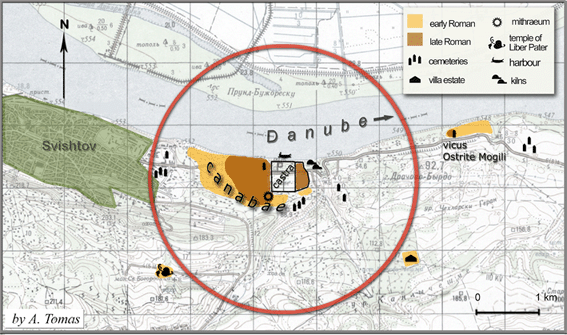
The legionary fortress in Novae (modern Bulgaria) on the Danube River. The fortress, the same as other military bases, was surrounded by the civilian settlement (canabae) which constituted with its camp a specific settlement structure. Topography and planning of settlements of this kind is not well-recognized, since only a few have been excavated so far, mainly in the western part of the Empire.

Fortress of Novae
The Roman military fortress at Novae was established in AD 45 (46) by Legio VIII Augusta. The Legio I Italica was stationed there in AD 69 and until the second quarter of the 5th century AD Novae was its main camp. Up until now within the camp have been investigated the headquarters of the legion, one of the residences of the senior officers – the tribunes, the military hospital and the legion’s thermae, upon which the episcopal complex was erected in the second quarter of the 5th century AD.
.
In the late 5th and 6th centuries Novae was a bishopric. The cathedral and neighbouring buildings were built west of the former legionary headquarters. The last period of prosperity was during the reign of Justinian (527-565) when the defensive walls were rebuilt and reinforced. The town existed until the early 7th century AD, when it was destroyed by the attacks of Avars and Slavs.


Roman Limes:
Frontier line of the Roman Empire in the Iron Gate area


By Vladimir Kondić
Former director of the Institute of Archaeology of the Serbian Academy of Sciences and Arts.  Below are a few excerpts from the much longer article that apply to the Byzantine period.


Although it is very probable that Valentinian and Valens undertook reconstruction work on a larger scale because of the Gothic threat, the archaeologically most noticeable phase is the period of horrible destruction and fire immediately following the battle of Harianople. But, basic fortification elements like walls, gates, and lowers remained almost unchanged.

In the following period, under new conditions, when units of foederati protected the frontier, all the ruins were filled in and levelled, making a platform where the limitanei built the wattle and daub homes which are so evident at Pontes and Diana. This period in the history of the frontier lasted until the middle of the fifth century. Thanks to the fortunate discovery of five solidi (the latest an issue of 443) of Theodosius II we know the exact termination date of the Iron Gate Roman limes.

The Huns’ invasion from the direction of Niš (Naissus) caused such destruction that Procopius correctly described the situation as disastrous. Fortifications were razed to the ground, and at Diana the south wall with its gate and the fourth-century porticoed building were destroyed. Thick layers of burnt rubble, building debris and ash covered most of the fortress and mark the end of the five centuries of its existence. Other fortresses suffered a similar fate. This period was the terminal phase of the restored, late Roman limes and the northern frontier of the empire. The final renaissance of the Danubian limes occurred under Justinian I.

The significant testimony of Procopius concerning the renovation and reinforcement of the Danubian frontier has been confirmed in its entirety by our recent archaeological research.

Procopius paid considerable attention to construction work on the Iron Gate frontier (limes) and provided at times rather detailed information about the former Roman frontier. The sequence in which he comments on the fortifications in those sectors which have been investigated make it possible to identify the Roman and early Byzantine toponyms for some sites whose ancient names were not known previously (e.g. Kantabaza, Smyrna, Campsa).

Furthermore, excavations in the Iron Gate gorge have demonstrated that Justinian’s builders in the early Byzantine period entirely retained the disposition of fortifications from the former Roman frontier. Some elements of the earlier Roman castella were altered, most likely because of the requirements of a new defensive strategy, and at locations which were in greater danger because of their topographic circumstances completely new fortifications were constructed. Now it is possible with complete certainty to reconstruct the composition of the Justinianic limes on this part of the Danube.

The fortresses can be divided typographically into the following groups:
  1. Renovated Roman auxiliary and other minor forts.
  2. Renovated late Roman burgus – forts (from the Diocletian and Constantine periods).
  3. New early Byzantine forts built around renovated late Roman burgus-forts.
  4. Completely new early Byzantine forts.
After the Huns’ invasion in 443 AD damages to the forts were not repaired until the early sixth century, which for this sector of the Danubian limes is the only period devoid of any traces of activity. Then in the early Byzantine period all the auxiliary bases on the limes were renovated. The former Roman forts for the most part were renovated on the basis of their original plans. The most frequent alterations which can be observed are the closing-off of gates. These were either walled up or replaced by large rectangular or circular towers. Usually the corner towers were completely rebuilt.

At the fortress Diana (early Byzantine Zanes) at the southeast corner a new tower was built in a horseshoe-shape with an apsidal termination, and two fortification walls were joined together in a point to form a type of bastion. The southern wall and gate, which had been razed to their foundations by the Huns, were rebuilt in exactly the same plan as before and the gate remained the only one in use. In the interior of the fortress, without any type of regular disposition, buildings of wood, earth and courses of poorly joined stones were erected.

At Novae (early Byzantine Nobas) the former Roman south gate was completely closed-off and new circular towers were built in place of the earlier east and west gates. All the towers in this fortress were built afresh, with circular plans. The situation is similar at other forts. Everywhere fortification walls were significantly reinforced, most often from the inside. At the former Roman quadriburgium Campsa, the alterations were somewhat more radical. The south gate was closed-off and two new U-shaped towers were added there. Additionally, all of the auxiliary bases contained solidly built, single-nave churches.

Reconstruction of a Limes strongpoint.

The second category of renovation was the least complicated. The Diocletian-Constantine period castella received reinforced fortification walls (cc. one meter thick), and new entrances without towers, features not previously present in these complexes, were constructed. Certainly the most interesting form of renovation consisted of the erection of completely new and characteristically early Byzantine fortification walls around the former burgi. In these situations the renovated burgi functioned as watch towers.

Two outstanding fortifications of this type are Glamija and Donje Butorke. The latter has a more complex plan, with piers on two of the towers and one rectangular tower with an apsidal termination. This type of fortification recalls in a certain sense an inaccurate statement of Procopius (De Aedificiis, 4.1) in which he states that Pincum, Cuppae, and Noveae were formerly only Roman towers around which Justinian caused buildings to be erected and to which he granted municipal status after their defenses were strengthened. As mentioned above, during the Roman period civilian settlements of a type which did not exist in Justinian’s time developed around the auxiliary bases. Could it be that Procopius in his exaggeration of credit to the emperor actually had in mind the construction of new fortresses around earlier Roman towers?

Finally, the last group consists of purely Justinianic castella which were completely new constructions. Up to date six of these have been discovered on the Iron Gate section of the limes. Saldum (Kantabaza) in plan is an irregular rectangular with three circular towers and a single elongated one with an apsidal termination. The fort at Bosman is the only complex with a triangular plan on this part of the Danube and is skillfully into the restricted space between the mountain range and the river. The eastern fortification wall, located right on the river, was laid out in a convex line so that high water levels on the river would not be able to damage it seriously.

The fort at Hajdučka Vodenica was constructed on the site of an earlier tower which was not renovated in the sixth century. It is situated high on the river bank, and from each and of its northwest perimeter wall extends a fortification wall with a tower at its end to protect a small river harbour. The forts at Milutinovac and at the mouth of the Slatinska river are very similar in both construction and size (55 x 55 m.). They are defended by circular towers with square foundations on defensive walls which are turned toward the river and form the foundation for an upper-level entrance.

In almost all of the fortresses of Justinian time one layer of ash and destruction debris can be observed which can be dated to 580 AD when a forceful Slavic incursion on this part of the Danube was recorded. However, the fortresses themselves did not experience such significant destruction that they could not be once again renovated after the passage of that crisis. However, even this strong system of fortifications could not withstand a disastrous attack by combined forces of Slavs and Avars in 596 AD, and it was then that the Justinianic limes was definitively destroyed.

Full article

Castra Capidava, Romania
During the 2nd and 3rd century AD a Roman fort was built in the area, later overbuilt by a Late Roman fort, which lasted from the 4th to the 6th century AD.  The fort functioned as a guard of the Danube River and ford. At the banks of the Danube a massive harbour wall, 2.50 m thick and 60 m long, was found.
.
The fortified settlement played an important role in the Roman defensive system belonging to the series of camps and fortifications raised during the reign of Emperor Trajan, in the early 2nd century, as part of the measures to organize the Danubian limes. Capidava being part of the Limes Moesiae.  Destroyed by Goths in the 3rd century, the fortifications were rebuilt in the next century. 
.
Sources between the 4th to 6th centuries talk about cavalry units.  The fort was abandoned in 559 after the invasion of the Cutriguri.  the city was rebuilt by the Byzantines in the 10th century.  In the spring of 1036, an invasion of the Pechenegs devastated large parts of the region, destroying the forts at Capidava and Dervent and burning the settlement in Dinogeţia.

Fortress of Viminacium
Viminacium, in modern Serbia, was a major city and military camp and the capital of Moesia Superior.  The city dates back to the 1st century AD, and at its peak it is believed to have had 40,000 inhabitants, making it one of the biggest cities of that time. It lies on the Roman road Via Militaris.
.
Viminacium was devastated by Huns in the 5th century, but was later rebuilt by Justinian. It was completely destroyed with the arrival of Slavs in the 6th century. Today, the archaeological site occupies a total of 450 hectares (1,100 acres), and contains remains of temples, streets, squares, amphitheaters, palaces, hippodromes and Roman baths.


Roman Balkans in the 6th century.
Click to enlarge.

The Eastern Romans faced invasion by an endless series
of tribes pouring in from Central Asia.

(Borders of the Roman Empire)      (livius.org)      (Limes)

(castrumandquonset)      (provinces.uw.edu)      (icpdr.org)

(danube-cooperation.com)      (latvany-terkep.hu)      (danube-limes)

(danubelimesbrand.org)      (bnr.bg/en)      (historyfiles.co.uk)