.

Dedicated to the military history and civilization of the Eastern Roman Empire (330 to 1453)


"Time in its irresistible and ceaseless flow carries along on its flood all created things and drowns them in the depths of obscurity."

- - - - Princess Anna Comnena (1083–1153) - Byzantine historian

Monday, July 19, 2021

Gold Coin Hoard Pinpoints Persian Destruction of Jerusalem


Photo 3. One of the Heraclius gold solidi from the Givati parking lot. Photo by Clara Amit of the IAA.


"The use of coins welds together our whole life, and is the basis of all our transactions. Whenever anything is to be bought or sold, we do it all through coins."
John Chrysostom
Archbishop of Constantinople


(Coin Week)  If a hoard of 264 Byzantine gold solidi suddenly appeared and careful examination showed that every coin in the hoard was struck from the SAME dies–a die set never before identified–experts would be quick to suggest the possibility of forgery. (Photo 1)

Photo 1: The Givati parking lot gold hoard in situ. Photo Israel Antiquities Authority (IAA).

Real life, however, can be stranger than fiction.

One of the great numismatic stories of the last 50 years revolves around just such a hoard of coins that was excavated a dozen years ago at the Givati parking lot in Jerusalem. The lot is just outside of the Old City’s Dung Gate, on the north-western side of the City of David excavations. The latest report on this hoard was published in an article by my long-time friend Gabriella Bijovsky, a senior numismatist at the Israel Antiquity Authority. (IAA Reports 66, 2020, Chapter 5, “A Hoard of Solidi of Heraclius.”)

The coins were found in the remains of a large Byzantine building. Their location within the building suggested that they “were originally arranged in rows, and were most likely wrapped in a cloth or in a purse, which was not preserved. The excavators suggest that the coins were stored on a shelf…”

At the time these coins were discovered, they received quite a lot of publicity. But the story behind the story, which is quite remarkable, is summarized by Bijovsky, who was responsible for studying the coins.

There were 264 gold solidi with the portrait of Heraclius in the Givati hoard. Heraclius ruled the East Roman Empire from 610 to 641 CE. None of the coins are clipped, carry graffiti, or have any other significant signs of use. At first look, the coins all appear to be from the early Heraclius solidi series struck from 610 through 613. In fact, however, they are more likely part of an emergency issue struck at a Jerusalem mint, Bijovsky explains. (Photo 2)


Photo 2. The Givati hoard after cleaning at the laboratories of the Israel Antiquities Authority. Photo by Clara Amit of the IAA.

The Givati hoard coins are an unpublished variant of the 610-613 series. The obverse legend is dNAERACLI-ЧS. PP AVC• with an A instead of the usual h and a small dot after the “S” of Heraclius.

“The last letter C of the obverse legend is inclined and is followed by a small dot to its right. A short, curved stroke of dots is visible on the upper left side of the emperor’s crown. The reverse inscription ends with the letter Δ, unknown in the original series (Grierson 1959:145), and a tiny star is attached to the exergue inscription: CONOB*.” (Photo 3)

Bijovsky concludes that all of the coins were produced by the same pair of dies. The gold content of 41 of the solidi was studied using X-ray fluorescence (XRF) at the Weitzman Institute of Science. “The results showed a uniform composition deviation, clearly indicating that all the coins were produced from the same load of gold.” Hence, the minting process for this group was “a single event.”

On first glance, Bijovsky explains, “the mintmark, fabric, and style of these coins seem to suggest that this series was issued by the imperial mint of Constantinople. Indeed, the style of the bust die appears standard to this mint and is even better executed than many other official dies of the same general type.”

In the late Roman period, coins were minted in a number of cities, mainly because of the danger and cost of moving large quantities of precious metal from place to place. This system was inherited by Byzantium, and in the 6th century there were six mints in the Eastern Empire (Constantinople, Nicomedia, Cyzicus, Antioch [Theoupolis], Alexandria and Thessalonica) and three in the Western provinces that Justinian had reconquered from the Vandals and the Ostrogoths (Carthage, Rome and Ravenna).

Gold coins were minted mainly in the capital and consequently have the mint mark CON (for Constantinople), with OB added on the solidi to show that they were minted of pure gold.


“On the other hand, the obverse inscription of our solidi showing the name AERACLIVS seems to be a misspelling based on Latin phonetics. Is this an indication about the origin of the die engraver? Still, it seems very improbable that a state official in Constantinople would write incorrectly the name of the emperor on a gold coin,” Bijovsky says. Thus, these coins are more likely a ‘provincial’ issue.

Even though all of the Givati hoard solidi coins appear to be uncirculated, there is an unusual variance of the standard weight (4.55 g for the Byzantine solidus during this period) from as light as 3.97 g to 4.69 g.

“It is hard to believe that the official mint of Constantinople would have tolerated imperial solidi being officially struck without control of an accurate weight standard,” Bijovsky writes. She also asks, “Who would be interested in striking gold coins that contain more precious metal than required by the standard?”

Bijovsky further cites Michael Hendy, and points out that “hoards characterized by heavy concentrations of coins struck from the same pair, or from a limited number of dies, or that contain coins from a single officina, ‘probably tend to have derived at no great distance from bodies of coins dispatched from the mint in purses.’”

The Givati hoard is singularly homogeneous, and Bijovsky concludes that “during this time (608-615 CE), and especially after the capture of Antioch by the Persians in 611 and until 613, the presence of a Byzantine military garrison in Jerusalem could explain the operation of a temporary mint in order to pay the troops and emphasize Byzantine sovereignty over the city… Given the fact that all Antioch surrendered to the Persians in 610, Emesa and Apamea in 611, and Damascus in 613, Jerusalem remained the only major Byzantine stronghold in the region capable of coin production.”

Archaeological remains associated with the Persian conquest are quite sparse in Jerusalem. The archaeologists believe that the Givati hoard is correctly identified as an ‘emergency’ hoard that was “concealed during times of imminent danger, siege, or war. These hoards usually reflect the coinage in current circulation at the time of their deposition.”

This hoard is all the more remarkable because it “proves the need for an emergency coinage, a new series of Heraclian solidi which has been exceptionally struck in Jerusalem under hasty conditions… the combination of both numismatic features and historical circumstances provides solid evidence for the existence of a temporary mint in Jerusalem that functioned during the first years of the reign of Heraclius.”

The Givati parking lot excavations “have shed new light upon Jerusalem at the close of the Byzantine period. The Persian conquest of Palestine in 614 CE, one of the dramatic events that mark the ‘beginning of the end’ of the Byzantine domination in Palestine in the early seventh century seems to be well reflected in the archaeological record at this site,” Bijovsky explains.

Before the discovery of the Givati coin hoard, there were very few coin finds in Jerusalem from during the time of the Persian conquest. Seven mass burials have been discovered around Jerusalem and are generally believed to be from the Persian devastation of the city in 614. According to historic sources, the Persian conquest cost many lives and caused great damage. The conquest and the subsequent 14 Sassanid rulers left few other significant remains. It appears that the large Byzantine building in the Givati parking lot was deliberately destroyed during the Persian invasion of Jerusalem and, unlike the city’s other damaged but surviving buildings, including churches, it was never rebuilt or repaired.

Summing up, Bijovsky notes that “the Givati hoard presents several features that tell us quite explicitly the story of its concealment. The uniform date and the character of the hoard reveal that it was an ‘emergency hoard’ concealed at a time of imminent danger, siege, or war. Such hoards usually reflect the coinage in circulation at the time of their deposition.”

(Coinweek.com)

Gold solidus of Romanos I with his eldest son, Christopher Lekapenos.  Romanos I Lekapenoswas an Armenian who became a Roman naval commander and reigned as Emperor from 920 until his deposition on December 16, 944.
.
Read More:


Sunday, July 4, 2021

Column of Phocas


The Column of Phocas is a Roman monumental column in the Roman Forum of RomeItaly, built when Rome was part of the Eastern Roman Empire after reconquest from the Kingdom of the Ostrogoths

Erected in front of the Rostra and dedicated or rededicated in honour of the Eastern Roman Emperor Phocas on August 1, 608 AD, it was the last addition made to the Forum Romanum. The fluted Corinthian column stands 13.6 m (44 ft) tall on its cubical white marble socle. On stylistic grounds, the column seems to have been made in the 2nd century for an unknown structure, and then recycled for the present monument. Likewise, the socle was recycled from its original use supporting a statue dedicated to Diocletian; the former inscription was chiselled away to provide a space for the later text.

The base of the column was uncovered in 1813, and the inscription is in Latin. The English translation is as follows:

  • To the best, most clement and pious ruler, our lord Phocas the perpetual emperor, crowned by God, the forever august triumphator, did Smaragdus, former praepositus sacri palatii and patricius and Exarch of Italy, devoted to His Clemency for the innumerable benefactions of His Piousness and for the peace acquired for Italy and its freedom preserved, this statue of His Majesty, blinking from the splendor of gold here on this tallest column for his eternal glory erect and dedicate, on the first day of the month of August, in the eleventh indiction in the fifth year after the consulate of His Piousness.

The precise occasion for this signal honour is unknown, though Phocas had formally donated the Pantheon to Pope Boniface IV, who rededicated it to all the martyrs and Mary (Sancta Maria ad Martyres). 

Atop the column's capital was erected by Smaragdus, the Exarch of Ravenna, a "dazzling" gilded statue of Phocas (which probably only briefly stood there). 

Rather than a demonstration to mark papal gratitude as it is sometimes casually declared to be, the gilded statue on its column was more likely an emblem of the imperial sovereignty over Rome, which was rapidly fading under pressure from the Lombards, and a personal mark of gratitude from Smaragdus, who had been recalled by Phocas from a long exile and was indebted to the Emperor for retrieving his position of power at Ravenna.

In October 610, Phocas was overthrown and killed; his statues everywhere were overthrown.


Gold solidus of Heraclius and his father in consular robes, struck during their revolt against Phocas.


Revolt against Phocas and Accession

The Emperor Maurice was murdered by Phocas at the harbor of Eutropius on 27 November 602. The deposed emperor was forced to watch his five younger sons executed before he was beheaded himself. 

Empress Constantina and her three daughters were temporarily spared and sent to a monastery. The palace eunuch Scholasticus aided their escape to St. Sophia, but the church turned them over to Phocas, who sent them back to the monastery. A few years later, they were all executed at the harbor of Eutropius when Constantina was found guilty of a conspiracy against Phocas.

Phocas was widely regarded as an incompetent leader, by both much of the ruling class and army.

In 608, Heraclius the Elder renounced his loyalty to the Emperor Phocas, who had overthrown Maurice six years earlier. The rebels issued coins showing both Heraclii dressed as consuls, though neither of them explicitly claimed the imperial title at this time.

Heraclius the Elder, the Exarch of Carthage, began to prepare to invade, by cutting off the supply of grain to Constantinople and assembling a large army and navy.

Heraclius's younger cousin Nicetas launched an overland invasion from Carthage into Egypt; by 609, he had defeated Phocas's general Bonosus and secured the province. Meanwhile, the younger Heraclius sailed eastward with another force via Sicily and Cyprus.

As he approached Constantinople, he made contact with prominent leaders and planned an attack to overthrow aristocrats in the city, and soon arranged a ceremony where he was crowned and acclaimed as Emperor. 

When he reached the capital, the Excubitors, an elite Imperial Guard unit led by Phocas's son-in-law Priscus, deserted to Heraclius, and he entered the city without serious resistance. 

When Heraclius captured Phocas, he asked him "Is this how you have ruled, wretch?" Phocas's reply—"And will you rule better?"—so enraged Heraclius that he beheaded Phocas on the spot. 

He later had the genitalia removed from the body because Phocas had raped the wife of Photius, a powerful politician in the city.


Column of Phocas

Exarchate of Ravenna


Sunday, June 6, 2021

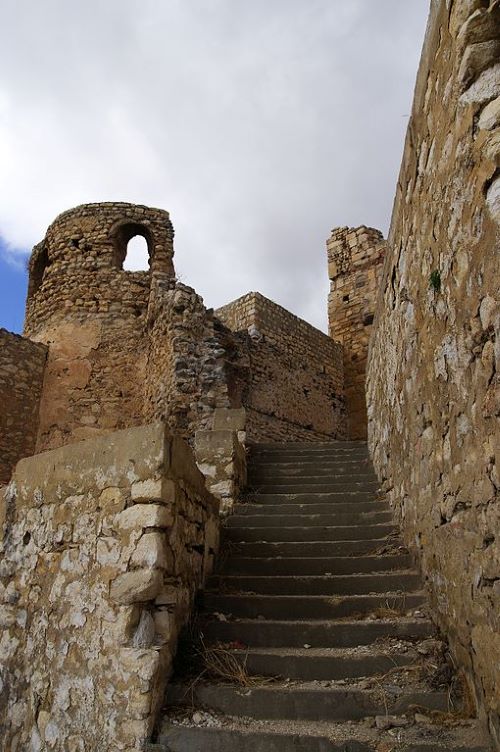
The African Roman Fortress of Vaga


Vaga
Defending Roman North Africa


VagaVecca or Theodorias is an ancient city in Tunisia built by the Berbers and ruled sequentially by the Carthaginians, the Numidians, the Romans, the Vandals and the Byzantines until it was captured by the Arabs who changed its name to the present day Béja. The town was the capital of the Numidian Kingdom during the rule of Jugurtha.

The Vaga fortress was built in the 2nd century BC and still exists till today which makes it one of oldest citadels in the region.

The fortress was built on the top of a hill of 305 meters, and this site was chosen so the castle can overlook the city and its surrounding plains and countryside.

Little is known about the date of the foundation of Vaga, but it's sure that it was before the foundation of Carthage.

In 14 BC, the Romans demolished the old Carthaginian citadel and built a new one on the ruins of the previous and built also fortifications with walls and 22 towers. 

The Romans erected many other monuments which some of them still exist today. And in 105 BC under the rule the Emperor Trajan, the Romans began the building of the bridge near Vaga, the constructions lasted nearly 25 years and event ended only under the reign of Emperor Hadrian and which become known as the Trajan bridge.

Vaga, still flourishing, was promoted by Emperor Septimius Severus to the rank of Roman colonia under the name of Colonia Septimia Vaga. The city continues its prosperity for nearly two centuries till the Vandal invasion of Africa.

The Vandals in 429 and under the leadership of Genseric stormed the Roman province of Africa and made it in 435 as their new kingdom, in their route they destroyed several cities, within them Vaga which was devastated. In 442, the Western Roman Emperor Valentinian III made peace with the Vandals giving them the land between the sea and the three cities of ThevesteSicca Veneria and Vaga. And in 448 Genseric destroyed the fortifications of the city and dismantled its castle.


The Roman Fortress of Vaga

Rule By The Eastern Roman Empire

In 533, has the Eastern Roman Emperor Justinian I restored Africa as a Roman province and put an end to the Vandalic rule, and with that Vaga became a flourishing town again, as the Emperor charged the Count Paulus to leads the works to restore the fortress of the city back. 

But the Emperor didn't only rebuilt the castle, but he also rebuilt the entire city which was ruined by the Vandal rule, and he enlarged, embellished and repopulate the city like it was before, and to be grateful for his actions, the townspeople had renamed their city after the Empress Theodora, Theodorias.

Because of the endless wars and incursions by the Moors Justinian ordered the building of a chain of forts along the frontier. 

Behind this first line was a second barrier of larger towns and stronger garrisons. Watchmen on the first line used signal fires to alert the larger towns of barbarian invasions for locals could seek refuge inside the walled cities.   Vaga was part of this system.

With the Muslim conquest of north Africa the new rulers of the country gave fortress the name "Kasbah" and made it the official center of their representatives of the northern-region.

The Ottomans too contributed to the expansion of the citadel by establishing a flanking tower that protected the southern parts of the Kasbah and Janissary garrison, and in 1677 the Tunisian monarch Ali I Bey supported the garrison by a battalion of 500 Spahis.

After the French occupation of Tunisia in 1881, the Kasbah become a Gendarmerie barracks from September 21, 1888 till the independence of the country in 1957.


Vaga was one of many North African fortifications that protected coastal Roman cities from desert raiders. A number of the forts were built by the Patrician Solomon.

Byzacena was a Late Roman province in the central part of Roman North Africa, which is now roughly Tunisia, split off from Africa Proconsularis. Vaga is located to the left of Carthage.


By Procopius    
The Buildings of Justinian
Written in the 550s AD


These things, then, were done by Justinian at modern Carthage. In the surrounding region, which is called Proconsularis, there was an unwalled city, Vaga by name, which could be captured not only by a planned attack of the barbarians, but even if they merely chanced to be passing that way.  This place the Emperor Justinian surrounded with very strong defenses and made it worthy to be called a city, and capable of affording safe protection to its inhabitants.  And they, having received this favour, now call the city Theodorias in honour of the Empress.  He also built in this district a fortress which they call Tucca. 

In Byzacium there is a city on the coast, Adramytus by name, which has been large and flourishing from ancient times, and for this reason it won the name and rank of metropolis of the region, since it chances to be first in point of size and, in general, of prosperity.

The Vandals had torn the circuit-wall of this city down to the ground, so that the Romans might not be able to use it against them. And it lay conveniently exposed to the Moors when they overran that region.  Nevertheless, the Libyans who lived there tried to make provision, so far as they could, for their own safety, and so they made a barricade out of the ruins of the walls and joined their houses together;  and from these they would fight against their assailants and try to defend themselves, though their hope was slight and their position precarious.  So their safety always hung by a hair and they were kept standing on one leg, being exposed to the attacks of the Moors and to the neglect of the Vandals.

However, when the Emperor Justinian became master of Libya by conquest, he put an exceedingly massive wall about the city and stationed there an adequate garrison of troops, thus giving the inhabitants assurance of safety and enabling them to disdain all enemies.  For this reason they now call the place Justinianê, thus repaying the Emperor for their deliverance and displaying their gratitude simply by the adoption of the name, since they had no other means by which they could requite the Emperor's beneficence, nor did he himself wish other requital. 

(Kasbah)     (Vaga)

Friday, May 7, 2021

Byzantine Land Mines


Now That is Going To Hurt


The "landmine" called a caltrop is an area denial weapon made up of two or more sharp nails or spines arranged in such a manner that one of them always points upward from a stable base. Historically, caltrops were part of defenses that served to slow the advance of troops, especially horseschariots, and war elephants and were particularly effective against the soft feet of camels.

In Roman Republic warfare the caltrop was being used against enemy war elephants as early as 279BC in the Battle of Asculum.

Archaeological excavations around Alesia show the use of caltrops by Caesar's legions. 

The late Roman writer Vegetius, referring in his work De re militari to scythed chariots, wrote:

The armed chariots used in war by Antiochus and Mithridates at first terrified the Romans, but they afterwards made a jest of them. As a chariot of this sort does not always meet with plain and level ground, the least obstruction stops it. And if one of the horses be either killed or wounded, it falls into the enemy's hands. The Roman soldiers rendered them useless chiefly by the following contrivance: at the instant the engagement began, they strewed the field of battle with caltrops, and the horses that drew the chariots, running full speed on them, were infallibly destroyed. A caltrop is a device composed of four spikes or points arranged so that in whatever manner it is thrown on the ground, it rests on three and presents the fourth upright.

A Roman historian mentions their use against Persian cavalry in the 5th century. 

In the 6th century the Roman historian Procopius tells how the general Belisarius used caltrops to defend open gates during the siege of Rome.

As cavalry rose in importance the use of caltrops gained in importance to hamper an enemy cavalry attack or to restrict movement.

In an anonymous 6th century Roman treatise caltrops are presented as a full-fledged war stratagem.

He said the caltrops should be used to protect the Roman fortified camp. The caltrops would be laid along the ditch some 12.5 meters in length. The commander of each unit would be responsible to gather them for their re-use and to prevent them from injuring their own troops when they leave camp.

Rear guard soldiers were told to have a supply of caltrops available to delay or wound any enemy in pursuit.


In the Emperor Maurice's war manual the Strategikon, the caltrop is also shown to protect the camp as well as for use on the battlefield. A light wagon was assigned to Roman units with "caltrops tied together with light cords attached to an iron peg so they can be easily collected." If attacked from the rear the caltrops can be thrown from the wagon into the path of an enemy.

When part of the army is forced to leave the main force they are told to bring caltrops along.

Maurice called for a "minefield of calthrops" on the battlefield. Unobserved by the enemy, Roman troops were to spread calthrops along the entire field of battle 100 feet deep. In four or five places there would be 300 foot wide gaps that would allow Roman troops to go and return unhurt. These passages would be market with tree branches or piles of stone. If an enemy was enticed into this minefield they would be confused and more easily destroyed.

The Taktika of Emperor Leo VI written in the 9th and 10th centuries reaffirms the use of calthrops. Almost word for word Leo repeats Maurice's writings on calthrop use in camps or the battlefield.

Leo is original in urging calthrops be thrown on to the decks of enemy ships to hamper the movement of the crews.

In the 10th century work by Heron of Byzantium he suggested wooden soled shoes to protect the infantry and farm rakes to clear a path of calthrops.

In 1082 Emperor Alexios Komnenos used fields of calthrops against Norman cavalry in the Balkans - - - - but the Normans avoided the calthrops by flanking the Roman line.

From the Alexiad: "There he [Alexios I Komnenos] assembled his regiments and mercenaries again and started on his march against Bohemund, with a new device in his head for overcoming the Franks. For he prepared iron caltrops, and on the eve of the day on which he expected a battle, he had them spread over the intermediate part of the plain, where he guessed the Frankish cavalry would make their fiercest onslaught, thus aiming to break the first irresistible attack of the Latins by piercing the feet of their horses." 

But nothing lasts forever.

At the end the Empire's population was exhausted, their wealth was spent, their economy was shattered and perhaps worst of all they were mostly alienated from Western Europe who had come to their aid in the previous centuries. 

A few competent rulers in a row would have helped them more than caltrops or maybe just a few competent diplomats.


(Caltrop)    (BYZANTINE LANDMINE)


Saturday, March 27, 2021

The Fall of Jerusalem and Antioch Ends Rome in the Middle East


Artwork by Alexander Groznov
Eastern Roman Soldier


The Roman Middle East Ends
The Arab Consolidation
Battle for the Middle East Part X


Here we are at Part X of the titanic Battle for the Middle East.

Where Eastern Roman military history is addressed at all there are casual references to a single Battle of Yarmouk in 636 AD. "Historians" effectively say the Arabs just magically showed up one day at Yarmouk and defeated a weak Roman Empire.

Nothing could be further from the truth.  This series details a Roman-Muslim slug fest taking place over many years and many battles over a huge geographical area.

In 629 AD the Roman Empire was enjoying a much deserved period of peace after a brutal 26 year long war of all wars with the Persian Empire.  Finally there was peace.  No one in Constantinople had any idea that a fresh invasion from the southern deserts would happen in a matter of months.

After years and years of fighting the Muslims the Romans finally lost Syria and Palestine due to a freak sand storm at the The 2nd Battle of Yarmouk.

The Fighting Goes On and On

Yarmouk did not end the fighting. The Romans fought on for another two years doing their best to hold off the invasion and even drive the Muslims back.

The problem is a near total lack of any detailed information on the campaigns. 

So I am using Part X of this series to rapidly wrap up the final Muslim conquest and consolidation of the Roman Middle East.

Map from The Great Arab Conquests (1964)
The initial problem for the Muslims was as they moved north into Syria they were leaving active Roman armies behind them in Jerusalem and in coastal cities like Caesarea, Tyre, Sidon, Beirut and Tripoli.

Roman troops were in short supply after their defeat at the 2nd Battle of Yarmouk. So the Emperor Heraclius ordered a general redeployment of his remaining soldiers from Syria and Palaestina Salutaris to the Taurus Mountains region to better defend Anatolia. 

The Roman garrisons holding out in the coastal cities had been supplied by the Roman Navy. Those troops were slowly withdrawn to the north. The port city of Caesarea was put under a Muslim siege. However Caesarea would not be taken until 640 (four years after Yarmouk), when at last, the garrison surrendered to the Muslim governor of Syria. 


The 6 Month Siege of Jerusalem

After the 2nd Battle of Yarmouk the Muslim commanders held a council of war in early October 636 to discuss future plans. Opinions of objectives varied between the coastal city of Caesarea and Jerusalem. The Muslim commander Abu Ubaidah could see the importance of both these cities, which had resisted all Muslim attempts at capture. Unable to decide on the matter, he wrote to Caliph Umar for instructions. In his reply, the caliph ordered them to capture the latter. The Muslims arrived at Jerusalem around early November, and the Roman garrison withdrew into the fortified city.

Jerusalem had been well-fortified after Heraclius recaptured it from the Persians. After the Roman defeat at Yarmouk, Sophronius, the Patriarch of Jerusalem, repaired its defenses. 

The Muslims had so far not attempted any siege of the city. However, since 634, Saracen forces had the potential to threaten all routes to the city. Although it was not encircled, it had been in a state of siege since the Muslims captured the towns of Pella and Bosra east of the Jordan River. After the 2nd Battle of Yarmouk, the city was severed from the rest of Syria, and was presumably being prepared for a siege that seemed inevitable. 

When the Muslim army reached Jericho, Sophronius collected all the holy relics including the True Cross, and secretly sent them to the coast to be taken to Constantinople. The Muslim troops besieged the city some time in November 636. Instead of relentless assaults on the city, they decided to press on with the siege until the Romans ran short of supplies and a bloodless surrender could be negotiated.

After six months, the Patriarch Sophronius agreed to surrender, on condition that he submit only to the Caliph. According to tradition, in 637 or 638, Caliph Umar traveled to Jerusalem in person to receive the submission of the city.

This 19th Century Arab warrior might have looked much like the Muslims fighting the Romans.

Battle of Hazir  (June 637)

Marching into northern Syria Muslim Generals Abu Ubaidah and Khalid moved towards Chalcis, which was strategically the most significant Roman fort in the area. Through Chalcis the Romans would be able to guard Anatolia, Heraclius' homeland of Armenia, and the regional capital, Antioch. Abu Ubaidah sent Khalid with his mobile guard towards Chalcis.

The virtually impregnable fort was guarded by Roman troops under Menas, reportedly second in prestige only to the Emperor himself. Menas, diverting from conventional Roman tactics, decided to face Khalid and destroy the leading elements of Muslim army before the main body arrived.

The battle began on a plain three miles east to the east. Khalid deployed his Mobile Guard into its fighting formation for battle. Menas arranged his army in one center and two wings and was himself in the front ranks leading the army like Khalid. Soon fierce clashes broke out at Hazir. The battle was still in its early stages when Menas was killed. 

As the news of his death spread among his men, the Roman soldiers went wild with fury and savagely attacked to avenge their leader's death. Khalid took a cavalry regiment and maneuvered from the side of one of the wings to attack the Roman army from the rear. Soon the entire Roman army was encircled and defeated.

Abu Ubaidah soon joined Khalid at Chalcis, which surrendered some time in June. With this strategic victory, the territory north of Chalcis lay open to the Muslims.

Aleppo’s Citadel
Aleppo The "Jewel of Syria"
The Citadel is a focal point of the entire city, it was a fortress used to protect the city and all of it’s inhabitants. The design of the walls allowed archers to fire their arrows down into any mass of troops.


Siege of Aleppo  (August–October 637)

The Muslims marched northward deeper into Syria. After taking many small and large cities, both Abu Ubaidah and Khalid met and marched to Aleppo. 

There a strong garrison under a Roman general named Joachim held the fort. Aleppo consisted of a large walled city and a smaller but virtually impregnable fort outside the city atop a hill, a little more than a quarter of a mile across, surrounded by a wide moat.

Rather than stay inside this powerful fortress the Roman commander Joachim, met the Muslim army in the open outside the fort. He was defeated and hastily retreated back inside. He boldly launched many sallies to break the siege but failed every time. Joachim received no signs of any help from the Emperor Heraclius (who could indeed send none). Consequently, around October 637, the Romans surrendered on terms according to which the soldiers of the garrison were allowed to depart in peace.

In an unusual move Joachim converted to Islam. He would prove himself a remarkably able and loyal officer to the caliphate and would fight gallantly under various Muslim generals.

Click to Enlarge
A beautiful reconstruction of Roman Antioch

Antioch was the center of the Seleucid kingdom until 64 BC, when it was annexed by Rome and was made the capital of the Roman province of Syria. It became the third largest city of the Roman Empire in size and importance (after Rome and Alexandria) and possessed magnificent temples, theatres, aqueducts, and baths.


Battle of the Iron Bridge  (October 637)

Before marching towards the great city of Antioch, Khalid and Abu Ubaidah decided to isolate the city from Anatolia. They accordingly sent detachments north to eliminate all possible Roman forces and captured the garrison town of Azaz, some 30 miles from Aleppo.

The capture and clearance of Azaz was essential to ensure that no large Roman forces remained north of Aleppo, from where they could strike at the flank and rear of the Muslim army during the operation against Antioch.

After Azaz the Muslims moved on Antioch. The resulting battle took place about 12 miles from the city. Its name came from a nearby nine-arch stone bridge spanning the Orontes River which had gates trimmed with iron.

Again, we have ZERO real information on events so the claims of troop levels for both sides is largely a fantasy.

The Muslims are said to have had 17,000 troops. Who knows? The Romans perhaps 20,000. Again who knows? Certainly Roman troops from captured cities were allowed to leave. It is logical that most of them would end up in Antioch to bolster defenses.

Why did the Romans fight a major battle outside the city walls?  

At best this was an act of total and complete stupidity. These troops should have manned the the city walls which were partly protected by the Orontes River.

Khalid played a prominent role with his Mobile guard. The Roman forces suffered heavy losses and were defeated. The claim is that Roman casualties in this battle were the third highest in the Muslim conquest of Syria, only exceeded by the battles of Ajnadayn and the 2nd Yarmouk. The remnants of the defeated Roman force fled to Antioch. 

The Muslim army later moved up and laid siege to Antioch. The city surrendered almost at once on 30 October, 637. According to the pact the defeated Roman soldiers were again allowed to depart in peace.

Late Roman Reenactors


A Major Roman Counter Attack  (638)

Here is where historians are driven insane. Literally mountains of books have been written about Gettysburg and D-Day, but we have as close to ZERO information as possible about operations in northern Syria.

I will have to speculate.

Emperor Heraclius must have been super angry at his idiot general surrendering Antioch in spite of him having a fairly large Roman Army at his disposal. So I assume the Emperor planned this double attack on the Muslims on two different fronts - one attack the coast and another attack inland.


One was a Roman Amphibious Attack to recapture Antioch.  We see the Roman Navy landing an army on the coast in the Spring of 638 and march the 20 miles inland to take Antioch. 

The cleverness and power of this attack cannot be overstated. The navy landed what must have been a large Roman Army behind enemy lines to attack a major walled fortress. That means this was not just a raid. The army had to be large enough to not only defend itself but to attack and capture a large enemy held city. 

The navy might have consisted of several hundred troop transport and and supply ships bringing everything from soldiers, horses, weapons, food etc. The number of troops is only a guess. Certainly no less than 5,000 men and perhaps more. The mix of cavalry and infantry is unknown.

An enemy held city would not surrender to a small force. So this army had to be on the larger side.

The details are lost to us. It appears no meaningful battle was fought. The Muslims abandoned Antioch. The Romans walked into the city and restored their government.

In support of the coastal attack on Antioch we see Roman Christian Arab Allies attack the Muslims inland. The Christian Arabs assembled from Upper Mesopotamia and from Circesium and Hīt.

The Muslim commander Abu Ubaidah suddenly found himself between Christian Arabs moving toward Homs and a Roman army on the coast. 

Based on the actions of those involved the situation must have been serious. 

Abu Ubaidah withdrew all his forces from northern Syria to Emesa, and the Christians laid in a siege. In response the Caliph ordered 4,000 men to leave the active Persian war front and to march into Syria. Muslims attacked Hīt, which they found to be well fortified; thus, they left a fraction of the army to impose a siege on the city, while the rest went after Circesium. 

When the Christians received the news of the Muslim invasion of their homeland, they abandoned the siege and hastily withdrew there. At this point Khalid and his mobile guard came out of the fort and devastated their army by attacking them from the rear.

The Muslim column from the Persian front then moved north and "pacified" the Christian Upper Mesopotamian region ending Roman rule.

Seeing the defeat of their allies the Romans withdrew from Antioch. There are no reports of battles. I suspect the Romans simply boarded their ships and returned to the Taurus Mountains to bolster the defenses against Muslim invasion.

Reports are these operations ended by mid-summer. So the entire Roman campaign might have lasted 3 to 5 months.

The Middle East was now officially lost to the Empire.

Limitanei static frontier guard troops existed 
through the Persian Wars and the Arab Conquest.

.

k

Part IX - The 2nd Battle of Yarmouk


Click to Enlarge

Muslims Invade Roman Armenia
After the Roman collapse in Syria the Muslims push north taking the whole of Armenia up to Ararat and raided northern and central Anatolia.
.
 In 641 Emperor Constantine III decided to recapture Syria. A full-scale invasion was planned and a large force was sent to reconquer Syria. Muawiyah I, the governor of Syria, called for reinforcements and defeated the Roman army in Northern Syria.
.
In 645–646, Sufyan bin Mujib Al-Azdi managed to seize Tripoli and captured the last Roman stronghold on the Levantine coast.


(Great Arab Conquests)   (Muslim Conquest)