.

Dedicated to the military history and civilization of the Eastern Roman Empire (330 to 1453)


"Time in its irresistible and ceaseless flow carries along on its flood all created things and drowns them in the depths of obscurity."

- - - - Princess Anna Comnena (1083–1153) - Byzantine historian

Showing posts with label Armenia. Show all posts

Thursday, October 15, 2020

The Roman Limes in Armenia & Arabia - The Eastern Front


Persian Cavalry  

Rome vs Persia - The Eternal War


Though not spoken of, when you have 700 hundred years of war with the Persian Empire it only makes sense that a line of fortifications was built on the Eastern Front.

So while surfing the net I found a 2013 article titled "Military Infrastructure in the Eastern Roman Provices."  If you have trouble sleeping at night then articles like this are the cure. Still it brought forward some ignored information on a forgotten Roman Limes system in Armenia.

Rome's eastern defenses were remodeled from the 3rd century on to cope with the growing power of the Persian Empire under the Sassanid Dynasty.

The defensive system adapted to meet the terrain with fortified cities, fortresses, forts and fortified highland redoubts. All of these were supported by a series of Roman roads to speed the movement of troops.

Over time the Roman military focused more to the north in Armenia and the desert south was left to Christian Arab allied tribes. 

Very little infrastructure remains - - - What exists is largely tiny amounts of rubble.

The fortifications served two functions:  1) They provided a barrier against Persian invasion and 2) bases for offensive Roman military action against Persia.

The System of Roman Limes
War with Persia was the one constant of the Roman Republic and Empire. The Roman-Persian Wars lasted nearly 700 years from 54BC to 628AD.

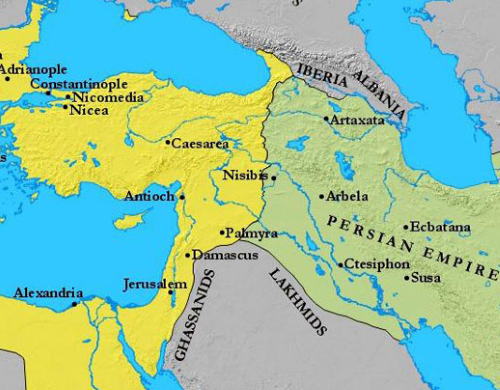
But notice in the map above there is a giant hole in the Armenia/Eastern Anatolia sector where a limes system of fortifications should be listed. An article I ran across on Roman Military Infrastructure helped fill in that gap of a missing limes system.

In an article I found on military infrastructure in the Eastern Provinces we see a Limes system of fortresses (in yellow) facing Persia supported by Roman roads to speed the movement of troops.

Roman Road in Anatolia
The Roman road system in the east helped troops rapidly respond to the Persians but also stimulated the local economy.


Over the centuries Rome spent mountains of gold in the east building every possible type of defensive structure to hold off a Persian invasion.

The big problem is almost NOTHING remains to be seen. The limes system has virtually turned to dust.

The city of Satala in central Anatolia is a good example of the Anatolia Limes system of eastern fortifications.

As a frontline fortress against Persia, Satala was the Roman legionary base, used by XVI Flavia Firma and XV Apollinaris.

After the conquest of Mesopotamia by Septimius Severus in the last decade of the second century, Satala was still a front city, but the Armenian province across the Euphrates, the district known as Sophene, posed no direct military threat. However, occupation of this site remained vital, because Satala still was the main connection between the Black Sea, the river and Antioch near the Mediterranean in the south.

The border wars both larger and smaller continued on and on for centuries with little real change in the border.

Satala Fortress East Gate
Yes, I said the same thing, "That's a gate? How do they know?"
I guess when the Persians destroy a fortress they really destroy a fortress.  
From Livius.org


Satala shows us the vanished Armenian limes. and the endless money needed to keep the forts repaired.

The site was fortified again in 529 by the emperor Justinian. His historian Procopius writes:

  • "The city of Satala had been in a precarious state in ancient times. For it is situated not far from the land of the enemy and it also lies in a low-lying plain and is dominated by many hills which tower around it, and for this reason it stood in need of circuit-walls which would defy attack. Nevertheless, even though its surroundings were of such a nature as this, its defenses were in a perilous condition, having been carelessly constructed with bad workmanship in the beginning, and with the long passage of time the masonry had everywhere collapsed. But the Emperor tore all this down and built there a new circuit wall, so high that it seemed to overtop the hills around it, and of a thickness sufficient to ensure the safety of its towering mass. And he set up admirable outworks on all sides and so struck terror into the hearts of the enemy."

The fortress of Satala survived for almost a century after Procopius wrote, but was eventually captured and destroyed in 607/608 by the Sasanian King Khusrau II (r.590-628).


Roman fortresses (in yellow) on the Armenian eastern front up against the Persian Empire.


The Northern Most Limes Fortress
Ruins of the fortress Petra north of Armenia in Georgia. In the 6th century, under the Emperor Justinian I, it served as an important Eastern Roman outpost in the Caucasus and, due to its strategic location, became a battleground of the 541–562 Lazic War between Rome and Persia.

The name of Petra, literally, "rock" in Greek, was a reference to the rocky and precipitous coast where the city was built. Its location between the sea and the cliffs rendered the city inaccessible, except for a narrow and rocky stretch of level ground, which was defended by a defensive wall with two towers.


The Roman Fortress of Qasr Bashir in Jordan

The Limes Arabicus was a desert frontier of the Roman Empire, in the province of Arabia Petraea. It ran -at its biggest extension- for about 1,500 km, from Northern Syria to Southern Palestine and northern Arabia, forming part of the wider Roman limes system. It had several forts and watchtowers.

The reason of this defensive "Limes" was to protect the Roman "Province of Arabia" from attacks of the barbarian tribes of the Arabian desert.

It is likely that Qasr Bashir was originally home to an auxiliary cavalry unit, charged with defending the Roman frontier and keeping the peace in the surrounding area.

The soldiers at a limes were referred to as limitanei. Compared to the regular Roman military, they tended to be more likely to be of local descent, be paid less, and be overall less prestigious. However, they were not expected to win large scales wars, but rather deter small-to-medium-sized raiders.


Limes Arabicus
Selected forts are highlighted in yellow.

Until the Persian invasion of the 600s this southern sector of Rome's Eastern Front was largely a quiet backwater. But even so money was spent to fortify the area and man the sector with troops.

Troops were progressively withdrawn from the Limes Arabicus in the first half of the 6th century and replaced with native Arab foederati, chiefly the Ghassanids. After the Muslim Arab conquest, the Limes Arabicus was largely left to disappear, though some fortifications were used and reinforced in the following centuries.

See More:


https://www.academia.edu/4385960/Military_Infrastructure?email_work_card=thumbnail

https://www.livius.org/articles/place/satala-sadak/

https://en.wikipedia.org/wiki/Limes_(Roman_Empire)


Friday, March 20, 2020

The Empire Strikes Back - Battle for the Middle East Part VIII


Late Empire Roman Cavalry Horse-Archer
(pinterest)

The Roman Army Marches South
Battle for the Middle East Part VIII


Here we are at Part VIII of the titanic Battle for the Middle East.

Where Eastern Roman military history is addressed at all there are casual references to the Battle of Yarmouk in 636 AD. "Historians" effectively say the Arabs just magically showed up one day at Yarmouk and defeated a weak Roman Empire.

Nothing could be further from the truth.  This series details a Roman-Muslim slug fest taking place over many years and many battles over a huge geographical area.

In 629 AD the Roman Empire was enjoying a much deserved period of peace after a brutal 26 year long war of all wars with the Persian Empire.  Finally there was peace.  No one in Constantinople had any idea that a fresh invasion from the southern deserts would happen in a matter of months.

Part I  -  In Part I of this series we saw the first military contact between Romans and Muslim Arabs at the Battle of Mota (Mu'tah) in the Roman province of Palaestina Salutaris.  In 629 AD a force of Romans and their Christian Arab allies mauled the invading Muslim army forcing them to return to Medina.

Part II  -  In Part II we saw the Muslims turn their attention to a weakened Persian Empire. Muslims defeated the Persians in a series of battles. In 634 the Muslims marched up the Euphrates River through Persian Mesopotamia finally coming within 100 miles of the Roman frontier at Firaz. 


Firaz was at the outermost edge of the Persian Empire but it still contained an undefeated Persian garrison. There the Persians joined forces with the local Roman garrison and with Christian Arabs to take on the invaders. They were soundly defeated.
Byzantine cataphract
(pinterest)

Part III  -  In Part III we have the Emperor Heraclius organizing the defense of Palaestina Salutaris.  Muslims made a wide flanking movement of hundreds of miles through waterless deserts to threaten Damascus.

The Romans held their own in eastern Syria against this attack and effectively defeated the Arabs at the Battle of Marj Rahit in 634. They drove the Arabs south away from Damascus. The Romans had also dug in at the Daraa Gap fortifications in eastern Palestine and held their positions against Arab attacks.

But the Romans were defeated in southwest Palestine allowing Muslim forces to fan out reaching as far north as Lydda and Jaffa.

Part IV  -  Battle of Ajnadayn 634. The Romans were dug in at Daraa in Syria and were successfully holding off the invading Muslim army. Emperor Heraclius sent a second army down coastal Palestine with the support of the Roman Navy. The goal was to defeat the smaller Muslim army at Beersheeba and then block the lines of communications to Mecca of the Muslim army at Daraa forcing them to retreat back to Arabia.

Part V  -  1st Battle of Yarmouk (634 AD).  In a huge multi-day battle the Roman Army is pushed out of their prepared defenses at the Daraa Gap. The Romans began to withdraw and made an orderly retreat north to Damascus and other walled cities.

The door to Syria had been forced open.


Part VI  -  After a siege lasting for six months Damascus falls to Muslim invaders who lacked any siege equipment. Traitor Christians inside the city opened the gates and allowed the Muslim troops to enter the city. Damascus was sort of a great victory for the Arabs. After months of a siege the Muslims could not carry the city's defenses and needed Christian traitors within the walls to win the day.

The Muslims may have opened the door to Syria, but victory was a long way off. There were Roman armies operating all over Palestine and Syria and holding walled cities such as Jerusalem, Caesarea, Tyre and Tripoli. The coastal cities could also be resupplied and reinforced by the Roman Navy.


Part VII  -  After the fall of Damascus, Syria Muslim forces started their move north. Escaping Roman civilians and soldiers were massacred at Maraj-al-Debj in September of 635. Many survivors were sold into slavery by the Muslims.

The Muslims went on to lay Siege to the city of Homs from December 635 to March 636. After the fall of Homs the Muslims set out once again for the north, intending to take the whole of Northern Syria this time, including Aleppo and Antioch. They went past Hama and arrived at Shaizar

There they stopped as they faced a new Roman army raised by the Emperor Heraclius.

Map from The Great Arab Conquests (1964)
As the Muslims moved north into Syria they were leaving active Roman armies behind them in Jerusalem and in coastal cities like Caesarea, Tyre, Sidon, Beirut and Tripoli.

The Roman Army Gathers

By the winter of 635 AD the Muslim forces had conquered most of Syria.

The Muslims were just a march away from Aleppo, a Roman stronghold, and Antioch, where Heraclius resided. Seriously alarmed by the series of setbacks, Heraclius prepared for a counterattack to reacquire the lost regions.

In 635 Yazdegerd III, the Emperor of Persia, sought an alliance with the Roman Emperor. Heraclius married off his daughter Manyanh to Yazdegerd III, to cement the alliance. While Heraclius prepared for a major offensive in the Levant, Yazdegerd was to mount a simultaneous counterattack in Iraq, in what was meant to be a well-coordinated effort. 

The Emperor had not been idle on the southern front. Heraclius directed the Roman garrisons in Syria and Palestine to stand their ground.

After his past experiences, Heraclius now avoided pitched battle with the Muslim army. His plans were to send massive reinforcements to all the major cities, isolate the Muslim corps from each other, and then separately encircle and destroy the Muslim armies.

So as the Muslims moved north into Syria they were leaving active Roman armies behind them in Jerusalem and in coastal cities like Caesarea, Tyre, Sidon, Beirut, and Tripoli. The coastal cities could easily be resupplied by the Roman Navy. With Roman forces in their rear the Muslims were always looking over their shoulder. 

Muslim troops had to be pealed off from the northern invasion just to keep Roman garrisons bottled up in the cities.

With Roman garrisons in their rear, the somewhat smaller Muslim armies had advanced north into Syria about as far as they could go. While in a holding pattern word reached the Muslims of a new Roman army gathering around the Emperor based in Antioch.

Roman Emperor Heraclius
Crowned Caesar Flavius Heraclius Augustus in 610. Latin was still the official language of the military and government. The Emperor faced invasions by Persians, Avars, Spanish Visigoths and Muslim Arabs. The Emperor personally commanded Roman troops in an invasion into the heart of Persia.  He crushed their Empire and forced Persian troops to evacuate the conquered Roman provinces of Egypt, Palestine, Syria and Mesopotamia.


The exact size and composition of the Roman Army and its units in the Yarmouk campaign is a matter of considerable debate due to the scantness and ambiguous nature of the primary sources.

I laugh out loud reading "modern estimates" of an army ranging from 100,000 to 150,000 men. Those kinds of numbers had not been seen in centuries of Roman warfare. By the 630s the entire Roman Army from Carthage to Italy to Egypt to the Danube may have been 109,000 men.

A typical Eastern Empire field army often numbered 15,000 to 20,000 men. It is possible that this being a major effort to recapture Syria and Palestine then all stops might have been pulled out. I would put my guess at an army of 30,000 plus.

The endless battles and defeats were beginning to take a serious toll on the Romans. This was partly due to financial setbacks resulting in the Empire's treasury failing to provide salaries for some of the troops.

To help solve this problem the Emperor appointed Theodore Trithyrius as perhaps Commander-in-Chief in the newly raised army. Trithyrius was a Greek Christian and Roman Treasurer working for Emperor Heraclius and extremely loyal to the Emperor himself. He enjoyed supremacy under his title of sacellarius, usually appointed to the state treasurer.

Trithyrius's role with the army served as a constant reassurance. A certain lassitude had filled the air because Heraclius had to disband many regiments for economy's sake. There was no enthusiasm towards joining the army, however the presence of the Imperial paymaster encouraged recruitment.


Symbol of Secunda Armeniaca
Legio II Armeniaca (from Armenia) was a legion of the late Roman Empire. The Legion survived the fall of the Western Empire in 476 and went on to serve in the East. Armenian units were sent to fight the Muslims in Syria. Legio II Armeniaca may have been among them. 

Many Imperial regiments had been destroyed or badly mauled in recent campaigns. So the Emperor looked east to Armenia for the bulk of his troops. With the Persians defeated Armenia would have been a quiet front well able to spare frontier troops for Syria. 

Thus perhaps two-thirds of the new army were Armenians. 

This does not mean the Armenians were mercenaries. Far from it. While some Armenians may have signed on just for this campaign the history of Armenian Legions in the Roman Army goes back centuries. It is possible many of the Armenian troops were trained professionals or maybe partly trained militia that were called into service.

The units in the other one-third of the army varied. Roman ally Jabalah ibn al-Aiham, King of the Ghassanid Arabs, commanded an exclusively Christian Arab force. Other army contingents consisted of SlavsFranks and Georgians. Buccinator, a Slavic prince, commanded the Slavs. 

Byzantine sources mention Niketas the Persian, son of the Persian general Shahrbaraz, among the commanders. With Persia and Rome allied against the Muslims did Niketas bring with him a contingent of Persian troops? or did he command Romans? We do not know.

These different units coming together under one commander would not be new for the Romans. Foreign troops during the late Roman period were known as the Foederati ("allies") in Latin and often supplemented the regular army units.

There is little real historical information on just about anything. What kind of mix were the troops? What percent were cavalry, infantry or archers? Were they full timers or militia? Were there artillery units? etc.


The lack of meaningful information extends to the different commanders. 

The Commander-in-Chief in the army may have been Trithyrius. But Trithyrius was basically a bean counter from the Treasury. His level of military experience is unknown.  Vahan, an Armenian and the former garrison commander of Emesa, was in command of his Armenian units and may have had some command over the non-Armenian troops. . . . or perhaps command was partly shared with a somewhat joint council of the leaders of the different units.

Late Roman cohort reenactment group
(www.twcenter.net)

The Romans March South

Word had spread among the Muslims of this large new army. Now in the early months of 636 the Empire stuck back.

We may not know the exact size or makeup of the Roman Army. All we can do is judge the reaction of the Muslim forces facing them.

Simply, the Muslims abandoned all their gains and ran south as fast as possible.

The great walled cities of Damascus and Homs captured with months of siege warfare and much blood were abandoned without a single arrow fired. The story was the same for all the other towns and villages. The Muslims ran.

That reaction tells us two things:

  • 1) The Muslims were spread thin across Palestine and Syria and did not have the manpower to do open battle or even man the walls of the large cities. 
  • 2) As untrained wild raiders from the desert the Muslims still feared the organized Roman Army.

Under their king the mobile and nimble Christian Arabs acted as an ideal cavalry screen in front of the main Roman Army and pushed the Muslims almost totally out of Syria.

The Muslims fell back to the Daraa Gap where in the 1st Battle of Yarmouk (September 634) they had forced the Romans to leave their prepared fortifications.

The Muslims passed through the Gap with the Romans hot on their heals. The Romans re-occupied their old defenses and slammed shut the Door to Syria.

Heraclius' policy was to stonewall.

Syria was safe as long as the Yarmouk-Daraa Maginot Line held firm.

The Arabs with their fear of close country and mountains would never invade Syria to the west through Tiberias. To the east there was the dry desert that nearly killed the Muslims two years earlier when they threatened and failed to capture Damascus.

This was a stunning, total and virtually bloodless Roman victory.

Heraclius must have heaved a sigh of relief when he heard that the Daraa Gap had been reoccupied and the Muslims had been pushed out into the desert beyond. Syria, he must have thought, was saved. Now he could concentrate on the recapture of Palestine.

Map from The Great Arab Conquests (1964)
When faced with a new Roman Army the Muslim forces in northern Syria abandoned all their gains.  Without firing a shot they ran as fast as they could run far to the south through the Daraa Gap into the desert.

Limitanei static frontier guard troops existed 
through the Persian Wars and the Arab Conquest.

.


Bedouin Warrior.
The Romans may have faced troops much like this man.

(flickr.com)


(Great Arab Conquests)    (Levant)    (Yarmouk)


Thursday, July 2, 2015

Armenian Legions in the Roman and Byzantine Army


Byzantium a Greco-Armenian Empire?
  • Armenians were everywhere in the Eastern Empire from Emperors, Generals, rank and file troops, Clergy and in business.

The Byzantine Empire was not a Greek Empire.  Although it is true that Greek was used as the language of the Empire, that can not be taken as proof that the empire was 'Greek.'  Latin was the original official language, imposed by the Romans who established and ruled the Roman Empire.

In 395 A.D. when the Roman Empire split into western and eastern (Byzantine), Latin continued to be used as the official language but in time it was replaced by Greek as that language was already widely spoken among the Eastern Mediterranean nations as the main trade language.

Yet the Emperors, the Church clergy, the army, and the artists, although they spoke Latin and Greek, where not exclusively of Greek ethnicity.  The Empire was made up of many nationalities - Thracians, Egyptians, Macedonians, Illyrians, Bythinians, Carians, Phrygians, Armenians, Lydians, Galatians, Paphlagonians, Lycians, Syrians, Cilicians, Misians, Cappadocians, etc.  The Greeks composed only a small portion of this multi-ethnic Empire.

The earlier Byzantine Emperors were Romans but in time people of different ethnic backgrounds ruled this multi-ethnic empire.  It is known that the empire reached its zenith while it was ruled by the Macedonians while the Macedonian Dynasty was in power for almost two centuries.  Other dynasties that ruled were the Syrian, Armenian, Phrygian (Amorian), and other emperors were of various nationalities." - Even this "Macedonian Dynasty” founded by Basil I who was of Armenian descent.

The collective Armenian role in Constantinople escalated in the seventh and eighth centuries as hundreds of Armenian nobles were forced to seek haven in the Byzantine Empire during the Arab occupation of Armenia.  

In Byzantium the Armenian nobles became an important element within the dominant elites and figured in numerous military and political events.  A total of twenty rose to the rank of emperor, and there were those who attained prominence within the established Orthodox Church.  They were kings and princes, rebels and usurpers, intellectuals and diplomats—all operating within the Byzantine context.

Eastern Emperor Basil I on horseback.
Though from the Theme of Macedonia, Basil was of
Armenian heritage ruling from 867 to 886.

Provincia Armenia
Province of the Roman Empire

The Coming of Rome
While Armenia Minor had become a client state and incorporated into the Roman Empire proper during the 1st century AD, Greater Armenia remained an independent kingdom under the Arsacid dynasty.

Throughout this period, Armenia remained a bone of contention between Rome and the Parthian Empire, as well as the Sasanian Empire that succeeded the latter, and the casus belli for several of the Roman–Persian Wars. Only in 114–118 was Emperor Trajan able to conquer and incorporate it as a short-lived province.

In 114, Emperor Trajan incorporated Armenia into the Empire, making it a full Roman province.

From Antioch the emperor (Trajan) marched to the Euphrates and farther northward as far as the most northerly legion-camp Satala in Lesser Armenia, whence he advanced into Armenia and took the direction of Artaxata....Trajan was resolved to make this vassal-state a province, and a shift to eastern frontier of the (Roman) empire generally...Armenia yielded to its fate and became a Roman governorship..Trajan thereupon advanced and occupied Mesopotamia...and, like Armenia, Mesopotamia became a Roman province.

In 113, Trajan invaded the Parthian Empire because he wanted to reinstate a vassal king in Armenia (a few years before fallen under Parthian control). In 114 Trajan from Antiochia in Syria marched on Armenia and conquered the capital Artaxata. Trajan then deposed the Armenian king Parthamasiris and ordered the annexation of Armenia to the Roman Empire as a new province.

The new province reached the shores of the Caspian sea and bordered to the north with the Caucasian Iberia and Albania, two vassal states of Rome.

As a Roman province Armenia was administered along with Cappadocia by Catilius Severus of the gens Claudia.

The Roman Senate issued coins on this occasion bearing the following inscription: ARMENIA ET MESOPOTAMIA IN POTESTATEM P.R. REDACTAE', thus solidifying Armenia's position as the newest Roman province. A rebellion by the Parthian pretender Sanatruces was put down, though sporadic resistance continued and Vologases III of Parthia managed to secure an area of south-eastern Armenia just before Trajan's death in August 117.As a Roman province Armenia was administered along with Cappadocia by Catilius Severus of the gens Claudia.

After Trajan's death, his successor Hadrian decided not to maintain the province of Armenia. In 118, Hadrian gave Armenia up, and installed Parthamaspates as its king. Parthamaspates was soon defeated by the Persians.

Thereafter Armenia was in frequent dispute between the two empires and their candidates for the Armenian throne, a situation which lasted until the emergence of a new power, the Sassanids.

Indeed Rome's power and control increased even more, but Armenia retained its independence (even if as a vassal state), although from now on, it was Rome's loyal ally against the Sassanian Empire. For instance, when Septimius Severus attacked Ctesiphon, many Armenian soldiers were in his army: later -in the 4th century- they made up two Roman legions, the Legio I Armeniaca and the Legio II Armeniaca.

In the second half of the 3rd century, the Sassanid capital Ctesiphon and areas of southern Armenia were sacked by the Romans under Emperor Carus, and all Armenia, after half a century of Persian rule, was ceded to Diocletian in 299 as a vassal territory.

Photo - Duncanon military show

The Roman Legions

Grinding poverty in the rural provinces of the Empire was always a factor in a man's decision to join the army.  Armenians were happy to accept the Emperor's coin.  There was also the opportunity for upward social mobility for both peasant and noble alike.

For example, the Emperor Romanos Lekapenos was the son of an Armenian peasant with the remarkable name of Theophylact the Unbearable (Asbastaktos). Theophylact, as a soldier, had rescued the Emperor Basil I from the enemy in battle and had been rewarded by a place in the Imperial Guard.

Although he did not receive any refined education, Romanos advanced through the ranks of the army during the reign of Emperor Leo VI the Wise. In 911 he was general of the naval theme of Samos and later served as admiral of the fleet (droungarios tou ploimou) and became Emperor in 920.
In the Later Roman Empire, the number of legions was increased and the Roman Army expanded. There is no evidence to suggest that legions changed in form before the Tetrarchy, although there is evidence that they were smaller than the paper strengths usually quoted.
The final form of the legion originated with the elite legiones palatinae created by Diocletian and the Tetrarchs. These were infantry units of around 1,000 men rather than the 5,000, including cavalry, of the old Legions. The earliest legiones palatinae were the LanciariiJovianiHerculiani and Divitenses.
The 4th century saw a very large number of new, small legions created, a process which began under Constantine II
In addition to the elite palatini, other legions called comitatenses and pseudocomitatenses, along with the auxilia palatina, provided the infantry of late Roman armies. 
The Notitia Dignitatum lists 25 legiones palatinae, 70 legiones comitatenses, 47 legiones pseudocomitatenses and 111 auxilia palatina in the field armies, and a further 47 legiones in the frontier armies. Legion names such as Honoriani and Gratianenses found in the Notitia suggest that the process of creating new legions continued through the 4th century rather than being a single event. 
The names also suggest that many new legions were formed from vexillationes or from old legions. In addition, there were 24 vexillationes palatini, 73 vexillationes comitatenses; 305 other units in the Eastern limitanei and 181 in the Western limitanei.

Legio Prima (I) Armeniaca - Armenian First Legion

Symbol of Prima Armeniaca

Legio I Armeniaca was a pseudocomitatensis legion of the Late Roman Empire, probably created in the late 3rd century.
The name of the legion could refer to it being originally part of the garrison of the Armeniac provinces, but the unit, together with its twin legion II Armeniaca, appears to have been included in the imperial field army.
The legion took part in the invasion of the Sassanid Empire by Emperor Julian in 363. 
The Notitia dignitatum records the legion as being under the command of the magister militum Orientis around 400.

Legio Secunda (II) Armeniaca -  Armenian Second Legion

Symbol of Secunda Armeniaca

Legio II Armeniaca (from Armenia) was a legion of the late Roman Empire.
Its name could mean it was garrisoned in the Roman province of Armenia, but later, together with its twin, I Armeniaca, it was moved into the field army as apseudocomitatensis legion. 
The legion is reported to have built a camp in Satala (CIL II 13630, through Ritterling's Legio). According to Ammianus Marcellinus (Res Gestae xx 7), in 360. 
II Armeniaca was stationed in Bezabde with II Flavia Virtutis and II Parthica, when the Persian King Shapur II besieged and conquered the city, killing many of the inhabitants. 
The II Armeniaca however, survived, since it is cited in the Notitia Dignitatum as being under the command of the Dux Mesopotamiae.

Despite a number of reforms, the Legion system survived the fall of the Western Roman Empire in 476 AD, and was continued in the Eastern Roman Empire until around 7th century.  

With the legions continuing on in one form or another it is certain that the Armenian units would have served in wars against the Persians or the Arabs.

By the 7th century reforms were begun by Emperor Heraclius to counter the increasing need for soldiers around the Empire.  What Legions were left were settled in local districts as citizen-soldier-farmers resulting in the Theme system.

Emperor John I Tzimiskes meeting with Svyatoslav I the Grand Prince of Kiev.  John was born into the Kourkouas clan, a family of Armenian origin.

Armenian Soldiers in the Byzantine Army

Armenia made great contributions to the Eastern Roman Empire through its troops of soldiers. The empire was in need of a good army as it was constantly being threatened. The army was relatively small, never exceeding 150,000 men. The military was sent to different parts of the empire, and which took part in the most fierce battles and never exceeded 20,000 or 30,000. men.

From the 5th century forwards the Armenians were regarded as the main constituent of the Byzantine army. Procopius recounts that the “Scholarii”, the palace guards of the emperor “were selected from amongst the bravest Armenians”.

Armenian soldiers in the Byzantine army are cited during the following centuries, especially during the 9th and the 10th centuries, which might have been the period of greatest participation of the Armenians in the Byzantine army. Byzantine and Arab historians are unanimous in recognizing significance of the Armenians soldiers. Charles Diehl, for instance, writes: “The Armenian units, particularly during this period, were numerous and well trained.” 

Another Byzantine historian praises the decisive role which the Armenian infantry played in the victories of the Byzantine emperors Nicephorus Phocas and John Tzimiskes.

At that time the Armenians served side by side with the Scandinavians who were in the Byzantine army. One historian relates this first encounter between the Armenian mountain-dwellers and the northern people: “It was the Armenians who together with our Scandinavian forefathers made up the assault units of Byzantine.” 

There were similarities in the way of thinking and the spirit of the Armenian feudal lords and the northern warriors. In both groups, there was a strange absence and ignorance of government and public interest and at the same time an equally large interest in achieving personal distinctions and a loyalty towards their masters and leaders.

Many Armenians became successful in the Byzantine Empire. Numerous Byzantine emperors were either ethnically Armenian, half-Armenian, part-Armenian or possibly Armenian; although culturally Greek. The best example of this is Emperor Heraclius, whose father was Armenian and mother Cappadocian. Emperor Heraclius began the Heraclean Dynasty (610-717). 

Basil I is another example of an Armenian beginning a dynasty; the Macedonian dynasty. Other great Roman-Armenian emperors were Romanos IJohn I Tzimiskes, and Nikephoros II.


(Roman Legion)      (Armenian history)      (St-andrews.ac.uk)

(Looys.net)      (larsbrownworth.com)      (rbedrosian.com)

(Byzantine Armenia)      (Roman Armenia)