.

Dedicated to the military history and civilization of the Eastern Roman Empire (330 to 1453)


"Time in its irresistible and ceaseless flow carries along on its flood all created things and drowns them in the depths of obscurity."

- - - - Princess Anna Comnena (1083–1153) - Byzantine historian

Showing posts with label Sex. Show all posts

Monday, June 27, 2022

Coptic Spell: For a Man to Obtain a Male Lover, Egypt


Orestes and Pylades
The relationship between these two men was celebrated by Greek scholars as a tale of the wonder of homoerotic romance.


One of the great problems in studying the history of sexuality in the past, as with other areas of human personal life, is that the vast majority of sources come from sources left by social elites. In many areas and periods only the elites could write, and even where a wider section of the population could write (as, probably, in classical Greece), the texts that have been preserved, usually by monastic copying and in monastic libraries for Greek texts, were works produced by the elites.

In Christian Egypt (or "Coptic Egypt") there seems to have been fairly widespread literacy - in both Greek and Coptic languages - and much popular material has survived on papyrus. The particular climate of Egypt has alone made this possible. We are in a position then to explore aspects of Christian society in Egypt which remain obscure elsewhere. 

One set of sources which has been made available to English readers are the various collection of ritual "spells". These texts, dating from the first to the eleventh century, show a religious life quite different from that of the elite theologians who were writing at the same time. See for these texts - Marvin Meyer and Richard Smith, eds.,Ancient Christian Magic: Coptic texts of Ritual Power, (San Francisco: HarperSanFrancisco, 1994)

One of the spells translated in this volume is for a man to obtain a male lover: evidence of a homosexual sub-culture, neither philosophic nor literary which we may believe existed at other times and places in the ancient world, but which has left little evidence.


Description: vellum, 8x10.5 cm, originally folded to 2.5x 1.3 cm (by the evidence of creases); perhaps 6th century

Bibliography: Paul C. Smither, "A Coptic Love Charm", Journal of Egyptian Archeology 25 (1939< 173-174

Translator: David Frankfurter

This text contains a same-sex love spell commissioned by one Papalo to "bind" another man, Phello (this name literally means "the old man" or "the monk"), by means of a variety of powerful utterances (especially ROUS). Besides extending the scope of erotic binding spells in late antiquity, this spell also employs formulae common to several Coptic texts of ritual power. The folds in the text and the description of the text's depositing (lines 6-7) imply that this spell was intended to be placed near the beloved man.


Spell 84: For a Man to Obtain a Male Lover  


6th Century

TEXT


+CELTATALBABAL [.]KARASHNEIFE[.]NNAS'KNEKIE, by the power of Yao Sabaoth
(ring signs)


+++I adjure you by your powers and your amulets and
places where you dwell and your names, that just as I take you
a put you at the door and the pathway of Phello, son of Maure,
(so alos) you must take his heart and his mind; you must dominate
his entire body.
When he (tries to) stand, you must not allow him to stand
When he (tries to) sit, you must not allow him to sit
When he lies down to sleep, you must not allow him to sleep.
He must seek me from town to town, from city to city,
from field to filed, from region to region,
until he comes to me and subjects himself under my feet-
me, Papapolo son of Noe-
while his hand is full of all goodness,
until I satisfy with him the desire of my heart
and the demand of my soul,
with pleasant desire and love unending,
right now, right now, at once! Do my work

Notes:

The reference to "his hand full of all goodness" may be connected with the Hebrew use of "hand" for "penis".


Sourcebooks.fordham.edu


Sourcebooks.fordham.edu


Friday, October 2, 2015

Political Castration and Mutilation in the Byzantine Empire


Emperor Justinian II had his nose cut off after being overthrown.

Brutal Byzantine Politics

The great failing of politics in the Roman and Byzantine Empires was the lack of political participation by the different segments of society.

Gone were the elected Roman assemblies which had the ultimate authority over elections, legislation, and criminal trials.  The Senate became little more than a rubber stamp institution if it met at all.

Over the centuries the Empire increasingly became a top down dictatorship.  Without the old Roman system of elections the only choice to change government was murder, a violent coup d'état or civil war.

The eastern Emperors used military force to grab power and adopted mutilation of political enemies to frighten the public into submission.
Isaac II Angelos
Isaac was overthrown by
his brother and blinded.

Mutilation in the Eastern Roman Empire was a common method of punishment for criminals of the era but it also had a role in the Empire's political life. 

The mutilation of political rivals by the Emperor was deemed an effective way of sidelining from the line of succession a person who was seen as a threat. In Byzantine culture the Emperor was a reflection of heavenly authority. Since God was perfect the Emperor also had to be unblemished; any mutilation, especially facial wounds, would disqualify an individual from taking the throne. An exception was Justinian II (ὁ Ῥινότμητος, "the slit-nosed") who had his nose cut off (Greek - rhinokopia) when he was overthrown in 695 but was able to become Emperor again in 705.

Some disfigurements practised bore a secondary practical rationale as well. This can be seen in a common method of maiming, blinding. By blinding a rival one would not only restrict their mobility but make it almost impossible for them to lead an army into battle, then an important part of taking control of the Empire. 

Castration was also used to eliminate potential opponents. In the Byzantine Empire, for a man to be castrated meant that he was no longer a man, half-dead, "life that was half death". Castration also eliminated any chance of heirs being born to threaten either the Emperor or the Emperor's children's place at the throne.

Blinding as a punishment for political rivals and a recognized penalty for treachery was established in 705, although Emperor Phocas used it earlier during his rule as well, becoming common practice from Heraclius onwards.

Justinian II (r. 685-695 and 705-711)

Justinian II was the last Roman Emperor of the Heraclian Dynasty, reigning from 685 to 695 and again from 705 to 711. Justinian II was an ambitious and passionate ruler who was keen to restore the Empire to its former glories, but he responded poorly to any opposition to his will and lacked the finesse of his father, Constantine IV. Consequently, he generated enormous opposition to his reign.

In 695 the population rose under Leontios, the strategos of Hellas, and proclaimed him Emperor. Justinian's nose was cut off to prevent his again seeking the throne. He was exiled to Cherson in the Crimea. Later his nose was replaced by a solid gold replica of the original.
Emperor Leontios (695-698)
Leontios cut off Justinian's nose,
but had his own nose cut off and
tongue slit when he was overthrown.

With the support of the Green faction the new Emperor Leontios was in turn overthrown in 698.  In what had by now become a tradition for deposed emperors, Leontios had his nose and tongue slit and was imprisoned in the monastery of Psamathion in Constantinople.

While in exile, Justinian began to plot and gather supporters for an attempt to retake the throne. In spring 705, with an army of 15,000 Bulgar and Slav horsemen Justinian appeared before the walls of Constantinople. For three days, Justinian tried to convince the citizens of Constantinople to open the gates, but to no avail. Unable to take the city by force, he and some companions entered through an unused water conduit under the walls of the city, roused their supporters, and seized control of the city in a midnight coup d'état. 

Justinian once more ascended the throne, breaking the tradition preventing the mutilated from Imperial rule. After tracking down his predecessors, he had his rivals Leontius and Tiberios brought in chains before Justinian in the Hippodrome, now wearing a golden nasal prosthesis. There, before a jeering populace, Justinian placed his feet on the necks of Tiberios and Leontios in a symbolic gesture of subjugation before ordering their execution by beheading, followed by many of their partisans, as well as deposing, blinding and exiling Patriarch Kallinikos I of Constantinople to Rome.

Justinian's tyrannical rule provoked another uprising against him. Cherson revolted and under the leadership of the exiled general Bardanes, the city held out against a counter-attack and soon the forces sent to suppress the rebellion joined it. The rebels then seized the capital and proclaimed Bardanes as Emperor Philippicus;Justinian had been on his way to Armenia, and was unable to return to Constantinople in time to defend it. He was arrested and executed outside the city in December 711, his head being sent to Bardanes as a trophy.

On hearing the news of his death, Justinian's mother took his six-year-old son and co-emperor, Tiberius, to sanctuary at St. Mary's Church in Blachernae, but was pursued by Philippicus' henchmen, who dragged the child from the altar and, once outside the church, murdered him, thus eradicating the line of Heraclius.

In May 713 soldiers rebelled in Thrace. Several of their officers penetrated the city and blinded the new Emperor Bardanes on June 3, 713 while he was in the hippodrome.

The Mutilation of the Emperors Justinian II and Bardanes.

John Athalarichos
John Athalarichos was an illegitimate son of the 7th century Byzantine Emperor Heraclius. In 637, he was alleged to have taken part in a plot to overthrow Heraclius and seize the throne.

Heraclius ordered the amputation of each plotter's nose and hands. In addition to being thus mutilated, Athalarichos was exiled to Prinkipo, one of the Princes' Islands. Theodore received the same treatment, but was sent to Gaudomelete with additional instructions to cut off one leg.

Emperor Heraklonas
Constantine Heraclius (LatinFlavius Constantinus Heraclius Augustus; 626–641), was the son of Heraclius and his niece Martina, and was Byzantine Emperor briefly between February and September 641.

The revolt which ensued toppled Heraklonas and his mother, who were subjected to mutilation and banishment. This was the first time a reigning emperor had been subjected to mutilation, which was a practice probably borrowed from the Persians; in this case, Martina's tongue and Heraklonas' nose were cut out. Nothing further is known about Heraklonas after his removal and exile to Rhodes.
A Imperial Chinese Eunuch

Castration as Political Punishment

Castration as a punishment for political rivals did not come into use until much later, becoming popular in the 10th and 11th centuries. Castrated men were not seen as a threat, as no matter how much power they gained they could never take the throne, and numerous eunuchs were entrusted with high and confidential offices in the Byzantine court and administration. 
A good example is that of Basil Lekapenos, the illegitimate son of the Emperor Romanos I Lekapenos, who was castrated when young. He gained enough power to become parakoimomenos and effective prime minister for three successive emperors, but could not assume the throne himself. 
Other mutilations were the severing of the nose or the amputating of limbs.
The last to use this method voluntarily was Michael VIII Palaiologos, although some of his successors were forced to use it again by the Ottoman Sultans.

Family of John the Orphanotrophos
John the Orphanotrophos was the chief court eunuch (parakoimomenos) during the reign of the Byzantine Emperor Romanos III (r. 1028–1034).

As the epilepsy afflicting Michael IV worsened, John's grip on power tightened. John convinced the empress to adopt Stephen's son Michael as her own, thus ensuring the continuation of the Paphlagonian line. Michael IV died on 10 December 1041, possibly in suspicious circumstances, and Michael V succeeded him. Having seen Michael elevated to the imperial throne, John made his nephew Constantine his protégé with the object, according to Psellos, of ensuring his succession. 
The gold solidus of
co-Emperor Constantine
who was castrated.

Michael V exiled John to the Monastery of Monobatae in 1041 and then, again according to Psellos, had all of John's male relatives castrated. John and his brother Constantine were blinded in 1042 on the orders of the Patriarch of Constantinople, Michael I Cerularius. In the reign of Constantine IX, John was sent to Lesbos and blinded. He died at Lesbos on 13 May 1043.

Constantine (Son of Leo V)
Symbatios was the eldest son of the Byzantine emperor Leo V the Armenian (r. 813–820). Soon after the coronation of his father, he was crowned co-emperor and renamed Constantine (Κωνσταντίνος). He reigned nominally along with his father until the latter's deposition in 820.

After the assassination of his father on 25 December 820, Constantine was banished to the island of Prote along with his mother and three brothers. There, the four brothers were castrated and tonsured. They spent the rest of their days there as monks, although Emperor Michael II the Amorian (r. 820–829) allowed them to keep part of the proceeds from their confiscated estates for their and their servants' upkeep.


Depiction of the blinding of Leo Phokas the Elder after
his unsuccessful rebellion against 
Romanos Lekapenos, from
the 
Madrid Skylitzes chronicle.


Creating a Eunuch

(From Reddit Historians)  -  There are two basic types of eunuchs in history, “clean-cut” (no penis or testicles) or just a removal of the testes. A simple removal of the testes is historically the most common sort. There’s a third type where the penis was removed but the testicles left, but it’s only referenced in a few places for Islamic eunuchs and seems to have been a very limited thing, and there’s really no reason to do it like this other than punishment.

For clean-cut eunuchs there was basically only one method, cutting it all off in one go which I described for the Ottoman black eunuchs in that link, and here’s the Chinese version from G. C. Stent who is probably our most reliable Western reporter:

When the operation is about to take place, the candidate or victim--as the case may be--is placed on a kang in a sitting--or rather, reclining position. One man supports him round the waist, while two others separate his legs and hold them down firmly, to prevent any movement on his part. [...] with one sweep of the knife he is made a eunuch.
The operation is performed in this manner:--white ligatures or bandages are bound tightly round the lower part of the belly and the upper parts of the thighs, to prevent too much haemorrage. The parts about to be operated on are then bathed three times with hot pepper-water, the intended eunuch being in the reclining position as previously described. When the parts have been sufficiently bathed, the whole,--both testicles and penis--are cut off as closely as possible with a small curved knife, something in the shape of a sickle. The emasculation being effected, a pewter needle or spigot is carefully thrust into the main orifice at the root of the penis; the wound is then covered with paper saturated in cold water and is carefully bound up. After the wound is dressed the patient is made to walk about the room, supported by two of the "knifers," for two or three hours, when he is allowed to lie down.
The patient is not allowed to drink anything for three days, during which time he often suffers great agony, not only from thirst, but from intense pain, and from the impossibility of relieving nature during that period.
At the end of three days the bandage is taken off, the spigot is pulled out, and the sufferer obtains relief in the copious flow of urine which spurts out like a fountain. If this takes place satisfactorily, the patient is considered out of danger and congratulated on it; but if the unfortunate wretch cannot make water he is doomed to a death of agony, for the passages have become swollen and nothing can save him.

The exposed urethra would form a standard stoma. Scrotal tissue healed with some cicatrix formation but really nothing too dramatic. There are some historical drawings and photographs of this but I do not link to them in here as they were obtained non-consensually. Google “stoma” if you really need to know though, they all form the same looking thing really.

For removing the just the testes, you’ve got a few more options.

  • Crushing the testes inside the scrotum with no cutting, most likely used for Assyrians (through some context clues I can go into), reportedly used for young boys and infants in the Byzantine empire, and also reportedly used for Italian castrati.
  • Cutting the scrotum open and removing the testes. This is rather finicky but one method reportedly in use in Italy during the heyday of the castrati.
  • A full removal of the scrotum with testes inside. I don’t suppose you do any livestock farming? This is the method in which the “castrator” tool was for, which are still used for livestock. It would often be heated to cauterize the wound right off, which prevented infection.


(John Athalarichos)      (Heraklonas)      (John the Orphanotrophos)

(Constantine)      (Justinian II)      (Eunuchs)      (Political mutilation)

Tuesday, July 30, 2013

Prostitution in the Byzantine Holy Land


Byzantine Floor Mosaic, 500-550 A.D. (Metropolitan Museum of Art)

Brothels, Baths and Babes:
Prostitution in the Byzantine Holy Land


When addressing Byzantium it appears that much of the attention of academics and those that read this blog is focused on the obvious subjects; military history, imperial history; the rise and fall of the emperors; iconoclasm; art; and the development of the Orthodox Church. In most research very little has been written on the subject of sex.

The article below explores both the formal and informal arrangements that developed, typically centring around the triad of the wife, the concubine and the courtesan.


By Claudine Dauphin
Centre National de la Recherche Scientifique, Paris

Graeco-Roman domestic sexuality rested on a triad: the wife, the concubine and the courtesan. The fourth century BC Athenian orator Apollodoros made it very clear in his speech Against Neaira quoted by Demosthenes (59.122) that ‘we have courtesans for pleasure, and concubines for the daily service of our bodies, but wives for the production of legitimate offspring and to have reliable guardians of our household property’. Whatever the reality of this domestic set-up in daily life in ancient Greece, this peculiar type of ‘ménage à trois’ pursued its course unhindered into the Roman period: monogamy de jure appears to have been very much a façade for polygamy de facto. The advent of Christianity upset this delicate equilibrium. By forbidding married men to have concubines on pain of corporal punishment, canon law elaborated at Church councils took away from this triangular system one of its three components. Henceforth, there remained only the wife and the courtesan.

If we are to believe the Lives of the holy monks of Byzantine Palestine, the Holy Land (in particular the Holy City of Jerusalem, the aim of pilgrimages at the very heart of Christianity) was replete with ‘abodes of lust’ and prostitutes tracked down the monks in their secluded caves near the River Jordan. Thus, we are faced with a paradox: the coexistence of holiness and debauchery, of Christian asceticism and lust.

Lest we forget that virtue is meaningless without vice, that holiness cannot exist without lewdness, a fifth century AD Gnostic hymn from Nag-Hammadi in Middle Egypt proclaimed: ‘I am She whom one honours and disdains. / I am the Saint and the prostitute. / I am the virgin and the wife. / I am knowledge and I am ignorance. / I am strength and I am fear. / I am Godless and I am the Greatness of God’.

In the Old Testament, Jerusalem appeared as a Prostitute in dire need of purification through divine punishment (Ez. 16 and 23). Her degradation contrasted with her original faithfulness: ‘How the faithful city has become a harlot, she that was full of justice!’, the prophet Isaiah (1:21) lamented. St John applied the epithet Prostitute ‘clothed in fine linen, in purple and scarlet, bedecked with gold, with jewels, and with pearls!’ (Rev. 18.16-17) to the idol-worshipping Great City, Babylon, Rome and ultimately to any great urban concentration.

A similar opinion was held by the rabbis of the Babylonian Talmud in the fifth century AD who considered that a bachelor who succeeded in remaining chaste in a large city was without any doubt an excessively pious man. Likewise, the monks of Nitria (modern Wadi Natrun), of the Kellia and of Scetis in Egypt and those of the Judaean Desert in Palestine, considered that the city was par excellence a den of iniquity, of temptation and of sin. Harbours with international maritime trade links such as Alexandria and Beirut, and the universal Christian capital Jerusalem, both provided their innkeepers and harlots with a cosmopolitan clientèle of residents, travellers and pilgrims.


Ancient Greece Sex

Prostitution

In the streets

Byzantine erotic epigrams, notably those of Agathias Scholasticus in the sixth century, generally describe encounters with prostitutes in the street.[5] The winding, dark alleyways of the Old City of Jerusalem were particularly appropriate for soliciting by scortae erraticae or ambulatrices. These lurked under the high arches which bridged the streets of the Holy City and walked up and down the cardo maximus.

In the small towns of Roman and Byzantine Palestine, however, it seems that the squares (not the streets) were the favourite hunting-grounds of prostitutes. Rabbi Judah observed: “‘How fine are the works of this people [the Romans] ! They have made streets, they have built bridges, they have erected baths !’. Rabbi Yose was silent. Rabbi Simeon ben Yohai answered and said, ‘All what they made, they made for themselves; they built market-places, to set harlots in them; baths to rejuvenate themselves; bridges to levy tolls for them’” (Babylonian Talmud, Shabbat 33b).


At Home

Some harlots worked at home, either on their own account, such as Mary the Egyptian whose Life was written down in the sixth century by Sophronios, the last Patriarch of Jerusalem before the Arab Conquest, or for a pimp. On the evidence of the legislation of Emperor Justinian in the mid-sixth century, in particular Novella 14 of 535, it is clear that providing housing was part of the deal which the pimps of Constantinople struck with the fathers of the young peasant girls whom they bought in the capital’s hinterland.

Housing did not necessarily mean a house, and was frequently only a shack, hut or room. Byzantine prostitutes were relegated to ‘red light districts’ in the same way that the prostitutes of Rome lived and worked predominantly in Subura and near the Circus Maximus, thus to the north and south of the Forum. In the late sixth-century Life of John the Almsgiver, Patriarch of Alexandria, Leontios of Neapolis describes a monk coming to Tyre on some errand. As he passed through ‘the place’, he was accosted by a prostitute who cried out: ‘Save me, Father, like Christ saved the harlot’, this referring to Luke 7:37. These districts were generally the most destitute areas in town.

The Babylonian Talmud (Pesahim 113b) relates how Rabbi Hanina and Rabbi Hoshaia, both poor cobblers in the Land of Israel, dwelt in a street of harlots for whom they made shoes. The prostitutes were so impressed by these rabbis’ chastity (for they would not even lift their eyes to look at the girls) that they took to swearing ‘by the life of the holy rabbis of Eretz Yisrael’!


In Tavernae

In city inns (tavernae) as well as in the staging posts for change of mounts (mutationes) or overnight stay (mansiones) along the official Roman road network (the cursus publicus), all the needs of travellers were catered for by the barmaids.

They served them wine, danced for them and often led them upstairs to the rooms on the upper floor. In fact, according to the Codex Justinianus, a barmaid could not be prosecuted for adultery, since it was presumed that she was anyway a prostitute (CJ 9.9.28).

In order to prevent Christian travellers from falling prey to sexual dangers of this sort, ecclesiastical canons forbade the clergy to enter those establishments. Soon, therefore, ecclesiastical resthouses (xenodochia) and inns specifically for pilgrims (pandocheia) run by members of the clergy, sprang up along the main pilgrim routes.
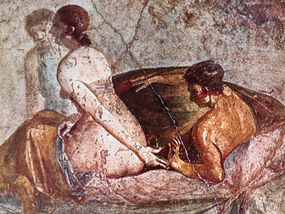
Sex in Pompeii

Brothels

Prostitution was also institutionalised under the form of brothels which Juvenal called lupanaria (Sat. 11.172-173) and Horace fornices (Ep. 1.14.21). These, John Moschus described in his sixth-century Spiritual Meadow as a ‘house of prostitution’ in Jericho or even more vaguely ‘an abode of lust’ in Jerusalem (Prat. Spir. 17). The prostitutes who were employed in these establishments were slaves and the property of a pimp (leno) or of a ‘Madam’ (lena).

The very name of the prostitute in Tyre who called out to a monk to save her – Kyria Porphyria – is telling. She was so used as a ‘Madam’ to boss other women, that once she had been reformed and had convinced other harlots (presumably her former ‘girls’) to give up prostitution, she organised them into a community of nuns of which she became the abbess – the mirror image of her brothel.

A Byzantine brothel has recently been unearthed in the course of excavations at Bet She’an, ancient Scythopolis, capital of Palaestina Prima. At the heart of this thriving metropolis, a Roman odeon founded in the second half of the second century was partly destroyed in the sixth century. Byzantine Baths adjoined it to the west. To the south-west, the second row of shops of the western portico of the impressive Street of Palladius was also dismantled to make way for a semi-circular exedra (13x15m). Each half of the exedra comprised six trapezoidal rooms with front doors. Some of these rooms also opened onto a corridor or a hall at the back of the building. In one room, a staircase led to an upper storey. Some rooms had niches with grooves for wooden shelves. The apses at both ends of the exedra and in the centre of the semi-circle, as well as the façades of the rooms were revetted with marble plaques, most of which are now lost, there only remaining holes for the nails which held these plaques in position. The inner faces of the walls of these rooms exhibited two coats of crude white plaster.


The floor of most of these rooms was paved with mosaics depicting geometric motifs enclosing poems in Greek, animals and plants, and lastly, in an emblema, a magnificent Tyche crowned by the walls of Scythopolis and holding a cornucopia. The mosaic pavements of some rooms had been subsequently replaced by bricks or a layer of crushed lime. Traces of crude repairs in the mosaics and the insertion of benches in other rooms indicated that the building had undergone various stages of construction. A semi-circular courtyard (21x30m) stretched in front of the twelve rooms. Towards the street, it was closed off by a set of rooms which incorporated the shops previously at the northern end of the portico of the Street of Palladius, whilst putting them to a different use. This row of rooms which was probably interrupted by the main entrance into the complex, opened onto a portico with an opus sectile floor of black and white marble. Two steps running for the entire length of the portico enabled access from the street. The portico and the rooms had a tiled roof. The exedra was demolished at the end of the sixth century or in the early seventh century.

The cabins of the Bet She’an exedra are reminiscent of the cells of the Pompeii lupanarium which consisted of ground floor rooms, each equipped with a stone bed and a bolster. An external staircase provided access to the first floor balcony onto which opened five more spacious rooms. At Bet She’an, the back doors of some rooms on the ground floor enabled clients who were keen to remain anonymous, to enter an abode of lust without being seen from the main street and thus to surreptitiously satisfy their sexual fantasies.

The portico where the girls strolled in the hope of attracting passers-by from the Street of Palladius, as well as the neighbouring Byzantine Baths were part of a fascinating network: soliciting at the Baths, in the portico and in the exedra courtyard, followed by sex in the cabins; and at the back of the building, an entrance-and-exit system for supposedly ‘respectable clients’.


The Roman / Byzantine Provinces of the greater Holy Land.


(Classics Ireland.com)          (Express.co.uk - The Roman Empire of sex)

Thursday, September 15, 2011

Sex Crimes in Byzantium - Torture and Mutilation

Sex and love were much more open in a tolerant Greek and Roman world.


Byzantine Christians made sex a crime punishable by torture, mutilation and death 


Greece and Rome in many ways had more tolerant, open societies regarding sex and love.  But as Christianity took a stronger hold on the Roman Empire, and Paganism was forcibly stamped out, Puritanism became the law of the land.

If you dared to have sex then you were violating the laws of the Christian God.  The proper punishment for sex crimes were torture, mutilation or castration.

Although the frequently mentioned punishment of mutilation might offend modern sensibilities, it is important to note that such measures often replaced capital punishment and were considered to provide a time for penance, thus presumably allowing the wrongdoer to secure the forgiveness of God.

Let's see.  As you are being strapped down by government officials to be castrated or tortured you were supposed to be thankful that the Christian God was a loving God and now you had extra time to save your soul.

Right.  No wonder there was a Protestant Reformation.

The Ecloga of Eastern Roman Emperor Leo III (717-41) was meant an abridgment of the Corpus Juris Civilis, but there are several modifications to be noted in it. These have led some scholars to term the Ecloga the first law code to be influenced by Christian principles. This influence is apparent in the following list of criminal punishments, taken from the Ecloga.

The Ecloga on Sexual Crimes

1. A married man who commits adultery shall by way of' correction be flogged with twelve lashes; and whether rich or poor he shall pay a fine.

2. An unmarried man who commits fornication shall be flogged with six lashes.

3. A person who has carnal knowledge of a nun shall, upon the footing that he is debauching the Church of God, have his nose slit, because he committed wicked adultery with her who belonged to the Church; and she on her side must take heed lest similar punishment be reserved to her.

4. Anyone who, intending to take in marriage a woman who is his goddaughter in Salvation-bringing baptism, has carnal knowledge of her without marrying her, and being found guilty' of' the offence shall, after being exiled, be condemned to the same punishment meted out for other adultery, that is to say, both the man and the woman shall have their noses slit.

5. The husband who is cognizant of, and condones, his wife's adultery shall be flogged and exiled, and the adulterer and the adulteress shall have their noses slit.

6. Persons committing incest, parents and children, children and parents, brothers and sisters, shall be punished capitally with the sword. Those in other relationships who corrupt one another carnally, that is father and daughter-in-law, son and stepmother, father-in-law and daughter-in-law, brother and his brother's wife, uncle and niece, nephew and aunt, shall have their noses slit. And likewise he who has carnal knowledge with two sisters and even cousins.

7. If a woman is carnally known and, becoming pregnant, tries to produce a miscarriage [abortion], she shall be whipped and exiled.

8. Those who are guilty whether actively or passively of committing unnatural offences shall be capitally punished with the sword. If he who commits the offence passively, is found to be under twelve years old, he shall be pardoned on the ground of youthful ignorance of the offence committed.

9. Those guilty of "abominable crime" [homosexuality?] shall be emasculated.


From E. Freshfied, trans, A Manual of Roman Law: The "Ecloga", (Cambridge, 1926], 108-12.). Reprinted in Deno Geanokoplos, Byzantium, (Chicago: 1984), 78


Going from an open Roman-Greek sexual culture to Puritanism under the Byzantine Christianity.


Internet Medieval Sourcebook