.

Dedicated to the military history and civilization of the Eastern Roman Empire (330 to 1453)


"Time in its irresistible and ceaseless flow carries along on its flood all created things and drowns them in the depths of obscurity."

- - - - Princess Anna Comnena (1083–1153) - Byzantine historian

Tuesday, October 4, 2011

The Siege of Constantinople


Artist conception of Arab forces that could have faced Roman troops.


The First Arab Siege of Constantinople (674 - 678) 


The first Arab siege of Constantinople is perhaps the single most important military action in the history of Western Civilization.  But it is a battle that little is known about.

The Umayyad Caliphate was fresh with a sting of victories and backed by the fervor of the new religion of Islam.  The "nations" of the West were basically non-existent.  If Constantinople had fallen at this point there would have been nothing to stand in the way of an Arab sweep up through the Balkans into central Europe.

Background

In the 7th Century the Eastern Roman Empire was under enormous military pressure on multiple fronts for decade after decade.  For the Romans, the 7th Century was almost non-stop war, invasions, counter invasions, amphibious operations, battles, sieges and sea battles.

The Empire was attacked by a series of enemies  -  Persians, Slavs and Arabs.  In the last of the Roman-Persian Wars (602 - 629 AD) the Empire had almost ceased to exist.  The great Roman Emperor Heraclius totally crushed the Persians reducing them to a state of internal anarchy and restored the Eastern Empire.


FIGHTING WARS ON THREE CONTINENTS
Roman Emperor Constantine IV and his court.  He organized the military and city of Constantinople for a siege of five years while fighting wars on multiple fronts over three continents (Africa, Europe and Asia).


The Arab Invasions 

After the near death war with Persia the Empire badly needed peace, but that was not to be.  Islam now exploded on to the Middle East.  In late 620s Muhammad had already managed to conquer and unify much of Arabia under Muslim rule.

Starting in the 630s Arab armies fought an almost endless series of major engagements with Eastern Roman forces.  The slower moving and traditional Byzantine armies fought a losing battle against light and nimble Arab cavalry forces that out maneuvered them in the open country and deserts.  The results of the battles was the loss long held Roman provinces of Egypt, Cyrenaica, Arabia, Palestine, Mesopotamia, Armenia and Syria.

The pressure facing the Romans was not just military.  With every lost province the Empire was losing its tax base, food supplies, business income and population.  Areas that once supplied the Empire with bureaucrats, educators, soldiers, religious leaders and businessmen were now under the control of the Arab invaders.

VIDEO:  The Byzantine Army


The Late Roman Army

Constans II was the last Emperor to campaign in northern Italy and visit Rome as an Imperial possession.  He was also the last to exert real control over the Popes, arresting Martin I (649-653, d.655) and exiling him to the Crimea.

Under Constans the structure of the Roman Army was fundamentally changed to deal with the new circumstances of the Empire. As the traditional units, largely familiar from the 5th Century, fell back from the collapsing frontiers, they were settled on the land in Anatolia, to be paid directly from local revenues instead of from the Treasury, whose tax base from Syria and Egypt had disappeared.


The areas set aside for particular units became the themes, which remained the military bedrock of Romania until the end of the 11th century and soon replaced the old Roman provinces as the administrative divisions of the Empire.

Byzantine infantry re-enactor.

The Army of the East, driven out of Syria, was settled in the Anatolic Theme, where it would guard the obvious route for invasion or raids from Syria: the Cilician Gates through the Taurus Mountains. Although invasions and raids there would be, the Arabs never did secure any conquests beyond the Gates. Where the Army of the East in the Late Empire numbered about 20,000 men, the forces of the Anatolic Theme varied from about 18,000 in 773 to 15,000 in 899 [Warren Treadgold, Byzantium and Its Army, 284-1081, Stanford, 1995, p.67].

As the remnants of the Late Roman Army were settled on the land, there were also standing forces that accompanied the Emperor. There was already one such unit in the Late Empire, the Scholae. This would grow into a new Standing or Mobile Army, the Tagmata.  The Tagmata together numbered about 28,000 men, while the entire Army, Themes and Tagmata combined, added up to about 128,000 men [Treadgold, op.cit.].


This was less than half of the Augustan Army and not even a quarter of Constantine's; but considering that the Empire is reduced to the lower Balkans and Anatolia, it is proportionally still robust, especially in an Age when a paid military establishment was impossible in most of Europe.

Despite this unprecedented disasters and loss of territories, the internal structures of the army remained much the same, and there is a remarkable continuity in tactics and doctrine between the 6th and 11th centuries.


Roman Empire military districts in 668AD.  The Empire had to defend North Africa, Italy
the Balkans and Asia Minor.
Click graphic to enlarge.

Three of the four sides of the city of Constantinople were the ocean.  Here are the sea walls of the city.
Only a small number of enemy troops could land at one time, and they would be vulnerable to Byzantine
attack with arrows, boiling oil, rocks etc.
(marylebonejournal.com)

Opening Moves

In spring 669, after receiving additional troops, Arab forces entered Asia Minor and advanced as far as Chalcedon, on the Asian shore of the Bosporus across from the Byzantine capital, Constantinople. The Arab attacks on Chalcedon were repelled, and the Arab army was decimated by famine and disease. Mu'awiya dispatched another army, led by his son (and future Caliph) Yazid, to Fadhala's aid. Accounts of what followed differ.

The Byzantine chronicler Theophanes the Confessor reports that the Arabs remained before Chalcedon for a while before returning to Syria, and that on their way they captured and garrisoned Amorium. This was the first time the Arabs tried to hold a captured fortress in the interior of Asia Minor beyond the campaigning season, and probably meant that the Arabs intended to return next year and use the town as their base, but Amorium was retaken by the Byzantines during the subsequent winter.

The campaign of 669 clearly demonstrated to the Arabs the possibility of a direct strike at Constantinople, as well as the necessity of having a supply base in the region. This was found in the peninsula of Cyzicus on the southern shore of the Sea of Marmara, where a raiding fleet under Fadhala ibn 'Ubayd wintered in 670 or 671.

Re-enactor preparing to imitate Roman-Byzantine
infantryman from the age Justinian.  The Roman
infantry at the time of the siege could have looked
much like this soldier.

Mu'awiya now began preparing his final assault on the Byzantine capital. In contrast to Yazid's expedition, Mu'awiya intended to take a coastal route to Constantinople. The undertaking was not haphazard, but followed a careful, phased approach: first the Muslims had to secure strongpoints and bases along the coast, and then, with Cyzicus as a base, Constantinople would be blockaded by land and sea and cut off from its agrarian hinterland, on which it depended for its food supply.

Accordingly, in 672 three great Muslim fleets were dispatched to secure the sea lanes and establish bases between Syria and the Aegean. Muhammad ibn Abdallah's fleet wintered at Smyrna, a fleet under a certain Qays wintered in Lycia and Cilicia, and a third fleet, under Khalid, joined them later. According to the report of Theophanes, the Emperor Constantine IV, upon learning of the Arab fleets' approach, began equipping his own fleet for war.

Constantine's armament included siphon-bearing ships intended for the deployment of a newly developed incendiary substance, Greek fire. In 673, another Arab fleet, under Gunada ibn Abu Umayya, captured Tarsus in Cilicia, as well as Rhodes. The latter, located midway between Syria and Constantinople, was converted into a forward supply base and centre for Muslim naval raids. Its garrison of 12,000 men was regularly rotated back to Syria, a small fleet was attached to it for defence and raiding, and the Arabs even sowed wheat and brought along animals to graze on the island.

The Byzantines attempted to obstruct the Arab plans with a naval attack on Egypt, but it was unsuccessful. Throughout this period, overland raids into Asia Minor continued, and the Arab troops wintered on Byzantine soil

Siege of Constantinople

The five year siege of this great city was the most important battle in the history of the Western world.  If the Arab armies had broken the Romans at Constantinople nothing would have stood in their path to invade Europe.

We know so very, very little about this battle.  But what we can do is use the information we do have to extrapolate what might have happen based on military history in general.

Many historians in the last few centuries have taken their cue from Edward Gibbon in his Decline and Fall of the Roman Empire.  Gibbon would often look down on the Byzantines as pretend Romans.  He would long for the good old days of the Legion.

Gibbon savagely attacked "the courage and vigilance of the reigning emperor, who disgraced the name of Constantine."  Gibbon's insults are not real history.  The Emperor Constantine IV organized the Empire for multiple major military operations at the same time including the great siege of the capital itself.  That implies a major degree of planning, command and control with a large professional military and civil service.


Byzantine Infantry

Multi-Front Warfare:  There was active warfare in North Africa with Arab invasions slowly taking over Roman provinces.  The Slavs were (as usual) yet again invading the Balkan provinces.  Arab armies had just conquered Roman Armenia and threatened the rest of Asia Minor.  More Arab armies were in Syria pinning down Roman units and pushing up the coast of Anatolia.  And now a massive naval invasion force is heading to Constantinople itself.

To say that Constantine IV had his hands full is an understatement.

Troop Deployment:   The Byzantine historian Treadgold says the strength of the Roman Army at this point was 109,000 men under arms.  We cannot be sure how many troops were assigned to Constantinople for the coming siege.  What we can do is to work backwards from the 109,000 number and subtract units that appear to have been assigned to other areas.  (see map graphic above.)

  • 15,000 troops.  Army of Africa, Exarchate of Africa.
  • 20,000 troops.  Army of Italy, Exarchate of Ravenna.
  • 20,000 troops.  Army of the East, Anatolic Theme.
  • 15,000 troops.  Army of Armenia, Aramenic Theme.

These units total 70,000 men more or less, but it is all guess work.  The important point is these units are based far from Constantinople itself and cannot be easily or rapidly re-deployed to other areas.  If troops were taken from the Army of the East then that part of the frontier would be weakened in the face of enemy forces and invite invasion on yet another front.

So it might be safe to say that in the greater Constantinople area the Emperor might have available to him in the range of 39,000 troops.  Perhaps more men might have been available through raising additional civilian militias and volunteer units.  But a certain number of these troops would have to be pealed away from defending Constantinople in order to defend other cities and strategic points in the area.

For example, when the siege of Constantinople was raised Constantine rushed to go to the relief of Thessalonika, which was still under siege from the Slavs.  So some units must have been assigned garrison duty in the Balkans. 

But a Slavic siege going on at the same time as an Arab siege makes you wonder if there was co-ordinated action between Arab and Slav forces.  Maybe the Slavs were just taking advantage of the situation.  Recorded history is silent on a possible alliance.
7th Century Arab Soldier

I can find no real information on the numbers of Arab troops transported to the area for the siege.  If you look at military history in general those conducting a siege usually outnumber those inside the walls to a large degree.  If not then those inside could easily break out or bring in supplies. 

If the Romans had 25,000 plus troops inside the city it is fair to say the Arabs would not have shown up with less.  I would give the Arabs a force of 40,000 or more troops as the minimum needed to maintain a siege.  In the 2nd siege carried out 40 years later the Arabs had 80,000 or more men.  So it is possible that the 40,000 estimate for the 1st siege is too low.

Romans    -    25,000 or more
Arabs       -    40,000 maybe much higher

Naval Forces  -  There are no numbers on the Arabs ships.  The Romans used over 1,100 ships to transport a large invasion force of tens of thousands of troops and their supplies in the attack on Carthage in 468 AD.  It is reasonable to think that the Arabs might use a fleet of about the same size or less.

The Romans had almost their entire fleet crushed in 655 in "The Battle of the Masts."  With so many provinces lost and constant wars, the money available for national defense would have been tight.  What fleet the Romans had available they kept close to the city.

Theodosian Land Walls, Belgrade Gate/Second Military Gate/Xylokerkos Gate.
Whereist.com


The Battle Begins

In 674, the Arabs launched the long awaited siege of Constantinople.  The great fleet that had been assembled set sail under the command of Abd ar-Rahman before the end of the year; and during the winter months some of the ships anchored at Smyrna, the rest off the coast of Cilicia.  Additional squadrons reinforced the forces of Abd ar-Rahman before moving on.  The naval forces of the Umayyads passed through the unguarded channel of the Hellespont about April 674.

But the besiegers had formed an insufficient estimate of the strength and resources of Constantinople.  Simply the Arabs had no idea what they were going to face.  The size of Constantinople and its massive defenses had shocked visitors for centuries on end.

Now a perhaps fairly lightly armed Arab army and fleet would have shown up with no idea on how to break into this fortress defended by a system of multiple walls and the ocean itself.

The Arabian fleet cast anchor, and the troops were disembarked near the palace of Hebdomon, seven miles from the city. From the first light of dawn till the evening over a period of many days the Arab infantry attacked the city's land walls from the Golden Gate going far to the east.  The reports say that the warriors in front were pushed forward toward the walls by the weight of the troops piling up behind them.

The solid and lofty walls were guarded by numbers and discipline: the spirit of the Romans was rekindled by the last danger to their religion and empire. The fugitives from the conquered provinces more successfully defended the city than they had at the sieges of Damascus and Alexandria. 

VIDEO:  Greek Fire


Greek Fire:  Just prior to the siege, a Syrian Christian refugee named Kallinikos (Callinicus) of Heliopolis had invented for the Byzantine Empire a devastating new weapon that came to be known as "Greek fire".   Its ingredients are a much debated topic, with proposals including naphtha, quicklime, sulphur, and niter. What set the Byzantine usage of incendiary mixtures apart was their use of pressurized siphons to project the liquid onto the enemy.

The first reports of the use of Greek Fire appears to have been on the Arab infantry trying to break through the land walls.  It is said they "were dismayed by the strange and prodigious effects of artificial fire."

This firm and effectual resistance by the Romans discouraged the Arab forces that were used to quick victories with fast moving cavalry tactics.  Arab soldiers came looking for fast loot and slaves.  The Arab leadership needed to keep the troops happy.  They diverted their arms to the more easy attempt of plundering the European and Asiatic coasts of the Propontis. 

Greek Fire

After controlling the sea from the month of April to that of September, on the approach of winter they retreated eighty miles from Constantinople, to Cyzicus, in which they had established their magazine of spoil and provisions.

For the six following summers the Arabs repeated this same pattern of attack and then retreat for the winter months. 

Then in 677 after three years of siege, the Byzantine navy utilized Greek Fire to decisively defeat the Umayyad navy in the Sea of Marmara.  The naval victory that the Byzantines won ensured that the city could be re-supplied by sea.  Meanwhile, the Arab forces were beset with starvation in winter.

Each year had seen a gradual abatement of Arab hope and vigor.  Finally after years of naval defeats and a fruitless siege the Arab forces broke camp in 678 and returned home.

It was said that 30,000 Arabs had died.  Byzantine casualties were thought to be several thousand.

Peace 

The victory for the Romans was total.

As the Arabs withdrew from Constantinople they were almost simultaneously defeated by the Romans on land in Lycia in Anatolia.

Byzantine historian J.B. Bury says the Arab fleet was caught in a storm and dashed on the rocks off the southern coast of Turkey near modern day Antalya.  What was left of the Arab fleet was destroyed by a Roman fleet operating from the Byzantine Theme of Cibyraiot off the southern coast of Asia minor.

In addition the Muslims of Syria came under attack by Christian irregular troops or armatoli operating in the Taurus Mountains.  The armatoli attacked and plundered Muslims from Asia Minor all the way south to Mount Lebanon.  Reinforced by Christian Syrians and Slavs they grew in power raiding as far as Jerusalem and helping Christian refugees escape to the north away from Islam.    

These losses at Constantinople, of the fleet and setbacks on land forced the Umayyads to seek a truce with Constantine.  The Roman Ambassador was received in Damascus by a general council of emirs.  A peace of thirty years was signed.   The Arabs evacuated the islands that they had captured in the Aegean.  In addition they paid the Romans an annual tribute consisting of fifty slaves, fifty horses and 3,000 pounds of gold. 

With the siege raised, Constantine could march to the relief of Thessalonika which was under siege from the Slavs.

The Arab invasions has finally been checked by Roman arms.  Europe was saved from an invasion they had no way to counter.

One artist's view of Greek Fire being used by the Byzantines.
(gilbert1986.blogspot.com)

The horror of burning to death by Greek Fire would have given the Byzantines a huge edge in battle.
(gilbert1986.blogspot.com)

Two maps showing the Eastern Roman Empire.  Top map shows the Empire after the defeat of
the Persian Empire.  The bottom map shows the Arab conquest of Egypt, Syria and Palestine.
Click on map to enlarge.

Constantinople in the Byzantine period.
Click image for full size map.


The Decline and Fall of the Roman Empire, Gibbons

Thursday, September 15, 2011

Sex Crimes in Byzantium - Torture and Mutilation

Sex and love were much more open in a tolerant Greek and Roman world.


Byzantine Christians made sex a crime punishable by torture, mutilation and death 


Greece and Rome in many ways had more tolerant, open societies regarding sex and love.  But as Christianity took a stronger hold on the Roman Empire, and Paganism was forcibly stamped out, Puritanism became the law of the land.

If you dared to have sex then you were violating the laws of the Christian God.  The proper punishment for sex crimes were torture, mutilation or castration.

Although the frequently mentioned punishment of mutilation might offend modern sensibilities, it is important to note that such measures often replaced capital punishment and were considered to provide a time for penance, thus presumably allowing the wrongdoer to secure the forgiveness of God.

Let's see.  As you are being strapped down by government officials to be castrated or tortured you were supposed to be thankful that the Christian God was a loving God and now you had extra time to save your soul.

Right.  No wonder there was a Protestant Reformation.

The Ecloga of Eastern Roman Emperor Leo III (717-41) was meant an abridgment of the Corpus Juris Civilis, but there are several modifications to be noted in it. These have led some scholars to term the Ecloga the first law code to be influenced by Christian principles. This influence is apparent in the following list of criminal punishments, taken from the Ecloga.

The Ecloga on Sexual Crimes

1. A married man who commits adultery shall by way of' correction be flogged with twelve lashes; and whether rich or poor he shall pay a fine.

2. An unmarried man who commits fornication shall be flogged with six lashes.

3. A person who has carnal knowledge of a nun shall, upon the footing that he is debauching the Church of God, have his nose slit, because he committed wicked adultery with her who belonged to the Church; and she on her side must take heed lest similar punishment be reserved to her.

4. Anyone who, intending to take in marriage a woman who is his goddaughter in Salvation-bringing baptism, has carnal knowledge of her without marrying her, and being found guilty' of' the offence shall, after being exiled, be condemned to the same punishment meted out for other adultery, that is to say, both the man and the woman shall have their noses slit.

5. The husband who is cognizant of, and condones, his wife's adultery shall be flogged and exiled, and the adulterer and the adulteress shall have their noses slit.

6. Persons committing incest, parents and children, children and parents, brothers and sisters, shall be punished capitally with the sword. Those in other relationships who corrupt one another carnally, that is father and daughter-in-law, son and stepmother, father-in-law and daughter-in-law, brother and his brother's wife, uncle and niece, nephew and aunt, shall have their noses slit. And likewise he who has carnal knowledge with two sisters and even cousins.

7. If a woman is carnally known and, becoming pregnant, tries to produce a miscarriage [abortion], she shall be whipped and exiled.

8. Those who are guilty whether actively or passively of committing unnatural offences shall be capitally punished with the sword. If he who commits the offence passively, is found to be under twelve years old, he shall be pardoned on the ground of youthful ignorance of the offence committed.

9. Those guilty of "abominable crime" [homosexuality?] shall be emasculated.


From E. Freshfied, trans, A Manual of Roman Law: The "Ecloga", (Cambridge, 1926], 108-12.). Reprinted in Deno Geanokoplos, Byzantium, (Chicago: 1984), 78


Going from an open Roman-Greek sexual culture to Puritanism under the Byzantine Christianity.


Internet Medieval Sourcebook

Friday, September 2, 2011

The Battle of the Masts - 655 AD


At the Battle of the Masts in 655, a fledgling Arab fleet from the Levant crushed the mighty Byzantine navy (Cyclopedia of Universal History, 1885).


BACKGROUND

The popular view of the Roman Empire falling in 476 AD has always been wrong.  The Western half of the Empire did indeed fall.  But the Eastern Empire, the Emperor, the Senate, the bureaucracy, Imperial Army and Navy went on.

From 476 on the Empire fought a staggering and endless stream of foes coming from all possible directions:  Vandals, Goths, Slavs, Persians, Arabs and more.  More than once the Empire nearly ceased to exist and held on only by its' fingernails.

Up to this point in the 600s the Romans had finally come out on top.  They has totally crushed their ancient enemy the Persian Empire.  After decades of war there was a badly needed peace.

But that much needed peace was shattered almost at once by the sudden rise of Islam.  An exhausted and almost bankrupt Empire fought an endless series of major battles with the Arabs resulting in the loss of the Roman provinces in Syria, Palestine, Mesopotamia, Egypt and Libya.

No matter how badly the Empire needed peace to re-build their military and economy, the Arab invasions just would not stop.

PRE-BATTLE SITUATION

Constans was the son of Constantine III and Gregoria. Due to the rumors that Heraklonas and Martina had poisoned Constantine III he was named co-emperor in 641. Later that same year his uncle was deposed and Constans II was left as sole emperor.

Constans owed his throne to a popular reaction against his uncle and to the protection of the soldiers led by the general Valentinus. Although the precocious emperor addressed the senate with a speech blaming Heraklonas and Martina for eliminating his father, he reigned under a regency of senators
Eastern Roman Emperor
Constans II

Under Constans, the Byzantines completely withdrew from Egypt in 642, and Caliph Uthman launched numerous attacks on the islands of the Mediterranean Sea and Aegean Sea. A Byzantine fleet under the admiral Manuel occupied Alexandria again in 645, but after a Muslim victory the following year this had to be abandoned. The situation was complicated by the violent opposition to Monothelitism by the clergy in the west, and the related rebellion of the Exarch of Carthage, Gregory. The latter fell in battle against the army of Caliph Uthman and the region remained a vassal state under the Caliphate, until the civil war broke out and the imperial rule was again restored.

The Caliphate advance continued unabated. In 647 they had entered into Armenia and Cappadocia, and sacked Caesarea Mazaca. In 648 the Arabs raided into Phrygia and in 649 launched their first maritime expedition against Crete. A major Arab offensive into Cilicia and Isauria in 650–651 forced the emperor to enter into negotiations with Caliph Uthman's governor of Syria, Muawiyah. The truce that followed allowed a short respite, and made it possible for Constans to hold on to the western portions of Armenia.

ARAB NAVY

In building a new navy the Muslim elite, which came from the inland-oriented northern part of the Arabian peninsula, largely relied on the resources and manpower of the conquered Levant (especially the Copts of Egypt), which until a few years previously had provided ships and crews for the Byzantines. 
The Arab dhow were between 150
and 250 tons, 85 feet long and 20
feet wide.

There is evidence that in the new naval bases in Palestine shipwrights from Persia and Iraq were also employed. The lack of illustrations earlier than the 14th century means that nothing is known about the specifics of the early Muslim warships, although it is usually assumed that their naval efforts drew upon the existing Mediterranean maritime tradition.

The centuries-long interaction between the two cultures, Byzantine and Arab ships shared many similarities. This similarity also extended to tactics and general fleet organization; translations of Byzantine military manuals were available to the Arab admirals.


BYZANTINE NAVY

The Byzantine navy was the naval force of the East Roman or Byzantine Empire. Like the empire it served, it was a direct continuation from its imperial Roman predecessor, but played a far greater role in the defense and survival of the state then its earlier iterations.

With the onset of the Muslim conquests in the 7th century. Following the loss of the Levant and later Africa, the Mediterranean Sea was transformed from a "Roman lake" into a battleground between Byzantines and Arabs. In this struggle, the Byzantine fleets were critical, not only for the defense of the Empire's far-flung possessions around the Mediterranean basin, but also in the repulsion of seaborne attacks against the imperial capital of Constantinople itself.
Reconstruction of an early 10th century
Byzantine bireme dromon


The size of the standing navy varied over the centuries based on the enemy of the monent and budgets.  In 899 the navy numbered 42,000 men with 300 ships.

The dromon (from Greek δρόμων, dromōn, i.e. "runner") was a type of galley and the most important warship of the Byzantine navy from the 6th to 12th centuries AD. It was indirectly developed from the ancient trireme and was usually propelled by both oars and sails, a configuration that had been used by navies in the Mediterranean Sea for centuries.

The dromon would come in different sizes.  Crews could run from 100 to 200 men.  The larger ships could carry 50 Marines.

The dromons had a central tower (xylokastron – Greek: "wooden castle") near the main mast, from which the marines could use their bows and arrows or throw spears and other projectiles. Dromons were frequently equipped with catapults capable of hurling 10 kg projectiles up to 250 meters.

Roman Emperor Constans II personally commanded a fleet of 500
ships.  He sailed south meeting the smaller Arab fleet off of the province of
Lycia in the southern portion of Asia Minor.

THE BATTLE

Konstans II recognized the danger posed by Muawiya’s success at sea, since it meant that the Byzantine heartland of Asia Minor was being caught in the “pincers” of a double threat from the Arabs: attacks by land and a surrounding movement to the south by sea. The emperor organized and personally commanded a fleet that set off to challenge the Arab navy, and the two powers met at the “Battle of the Masts” at Phoenix (modern Finike) in Lycia, off the southern coast of Asia Minor, in 655.

Word reached Constans that Arab ships had attacked the islands of Rhodes, Kos, and Crete in the southern Aegean. Clearly, they meant to sail up the Aegean, through the Dardanelles, and into the Sea of Marmara. Constantinople, Constans's home and the Byzantine capital, was being threatened again, this time from the sea. The emperor set out to destroy these upstarts once and for all. His navy of 500 ships was the greatest in the Mediterranean, its galleys crewed by the finest sailors and marines in the empire.

When it caught the Arab fleet of 200 ships north of Cyprus, near the modern Turkish port of Finike, Constans attacked without hesitation. The emperor did not bother to bring his ships into formation. The Arabs knew nothing of naval warfare, and he expected to crush them in a single assault. Sailing straight into the Arabs, the Byzantines engaged so closely the clash was called the Battle of the Masts. 

Very little information is available on the battle.  But it appears the Byzantine's suffered from poor generalship, while the Arabs had better than expected leadership.  The fighting lasted more than a day; according to one account, "the sea ran with blood and the waves piled up the bodies on the shore.

Though outnumbered, the Arabs cut the Byzantines to pieces.  According to the 9th century chronicler Theophanes the Confessor,  Constans escaped only by putting on the garb of an ordinary seaman and having himself thrown bodily onto another ship. As the Byzantines fled, a storm decimated what remained of their shattered fleet.

Although the Arab fleet retreated after its victory, the Battle of the Masts was a significant milestone in the history of the Mediterranean, Islam and the Byzantine Empire, as it established the superiority of the Muslims at sea as well as on land. For the next four centuries, the Mediterranean would be a battleground between Byzantines and Muslims. In the aftermath of this disaster, however, the Byzantines were granted a respite due to the outbreak of a civil war among the Muslims.

The Eastern Roman Empire in 650 A.D under Constans II.  By 650 The Romans had lost their
provinces in Syria, Palestine, Mesopotamia, Egypt and Libya to Arab conquest.

Tuesday, August 16, 2011

Battle of Taginae - 552 AD

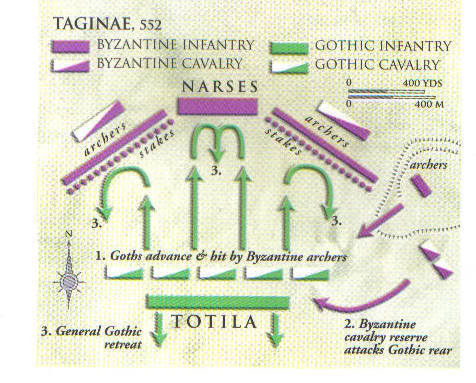
Battle of Taginae  -  The battle to the death between the Ostrogothic Kingdom of Italy and
the Eastern Roman Empire.

General Narses vs. King Totila and the death of the Ostrogothic Kingdom


The Battle of Taginae brought an end to the long struggle between Byzantium and the Ostrogothic Kingdom in Italy.

During 550-51 Eastern Roman Emperor Justinian I started gathering a large expeditionary force totaling 20,000 or possibly 25,000 men.  The Byzantine army was mostly cavalry, with some 8000 Byzantine foot archers.  It was assembled at Salona on the Adriatic, comprising regular Byzantine units and a large contingent of foreign allies, notably Lombards, Heruls and Bulgars.

The imperial chamberlain (cubicularius) Narses was appointed to command in mid 551.

Narses moved down the Via Flaminia, heading for Rome. The Ostrogothic king, Totila, advanced with a smaller force of perhaps 13,000 men to intercept him at Taginae (the modern Gualdo Tadino). He arrived in time to force Narses to fight, or else make a perilous retreat back over the Apennines.

Roman Emperor Justinian I

Totila, aware that he was outnumbered, and awaiting reinforcement of 2,000 addition troops on the way.  At first the king negotiated with Narses, then advanced on the Byzantines, hoping to take them by surprise.

Narses enjoyed superiority in numbers, but deployed his army in a strong defensive position.

Narses ordered his 10,000 barbarian foederati to dismount, and form a deep phalanx in the center.  The archers were divided into two sections, which were placed on either wing of the infantry. Then, the Byzantine cavalry was divided into two main wings, placed to the rear of the archers. Finally, a further 1500 horsemen were placed at the far left wing of the army; these men would be used to outflank the Gothic army, if the opportunity presented itself.

The Ostrogothic cavalry was drawn up into a long line, which probably accounted for over half of the entire army. Totila probably thought he could break the Byzantine center with a single cavalry charge. The Gothic foot soldiers, originally archers, were positioned in a single block behind the cavalry. The historian Procopius noted that Totila gave the unusual order that he entire army could only fight with their spears. Why he gave this command is one of history's mysteries.

Video of the Battle of Taginae


The Battle

On one flank was a small hill that offered the prospect of turning the Byzantine left, but Narses got to it first, occupying it with just fifty men, who held a defile there. Totila sent cavalry against them but the Byzantine infantry succeeded in holding off multiple attacks by Ostrogothic cavalry.

Again, King Totila played for time.  There was even an individual challenge between warriors from both side out in no man's land between the armies. 

Finally Totila's reinforcements arrives.  Now Totila had his troops break for lunch. 
Byzantine Infantry

Narses fearing a trick permitted his troops to refresh themselves without leaving their positions. Totila, apparently hoping to take his enemy by surprise, launched a sudden large-scale mounted assault upon the Byzantine center. Ancient and modern authors have accused him of folly, but Totila probably sought to close with the enemy as fast as possible in order to avoid the effects of the formidable Byzantine archery.

Narses was prepared for such a move, however, and ordered the archers massed on his flanks to incline their front towards the center so that his battle-line became crescent-shaped. Caught in the enfilading fire from both sides, the Ostrogothic cavalry sustained high casualties and their attack faltered.

The Goths who reached the infantry block were repelled with heavy losses. Totila sent wave after wave of troops that became so disorganized by the raining arrow storm, by the time they met the dismounted infantrymen they were completely broken. This folly continued through the afternoon.

The Gothic infantry never even engaged in actual combat as they hesitated to advance far enough to actually become effective. They were kept in the rear of the advance, fearing that Narses' horsemen would outflank them.

The Byzantine center began to push Totila's cavalry backwards onto their own line of infantry, At that critical moment, sometime in the early evening, Narses charged with his own cavalry – nearly all of them Byzantine heavy cavalry – that had been held in reserve. The retreat quickly turned into a rout, as the Gothic cavalry in their haste ran right over their own infantry, who joined them in the withdrawal.

The only casualty figures given for this battle were by Procopius, who said that 6,000 Ostrogothic cavalry were slain in the battle.  The majority of the Byzantine casualties were sustained by their foederati, who bore the brunt of the initial fighting.

King Totila was either killed on the battlefield or killed shortly afterward after fleeing with several followers.

6th Century Eastern Roman Cavalry 


The Roman Empire at the end of the Gothic Wars.

Gothic warriors that could have faced Narses in Italy.

Thursday, August 4, 2011

The Golden Gate of Constantinople

The Golden Gate in the early 20th century.

After 324, Constantine the Great expanded the old city of Byzantium to the west, naming the re-founded town Constantinople. It was a success and by 328, the emperor decided to make it his capital. By then, the mighty walls already surrounded an area of 6 km. Soon, the city expanded beyond these fortifications: during the reign of Theodosius the Great (378-395), the suburb known as Kainopolis stretched  forward along the Via Egnatia for almost 2½ km outside the walls of Constantine.

Solidus of Emperor Theodosius. The reverse depicts Theodosius
and Valentinian II seated, both holding a globe.

To mark the true beginning of the urban area, Theodosius built the triumphal arch that was soon known as Golden Gate. The occasion may have been his victory over the Visigoths in 386, which did much to restore Roman self-confidence after the disastrous battle of Adrianople (378).

Of course an isolated triumphal arch does not defend an entire suburb, and after Rome had been captured and sacked by Alaric's Visigoths, the emperor Theodosius II ordered his praetorian prefect, Anthemius, to build new walls: these Theodosian Land Walls, one of the greatest pieces of military architecture ever, was built between 412 and 414, and were in 447 further expanded by another praetorian prefect of Theodosius's, Cyrus of Panopolis. 

Porta Aurea - Golden Gate (Sunrise Version)
Click this video to full screen.  Beautiful.


The Golden Gate was the splendid entrance to the city for all visitors approaching the city from the west. Theodosius was not the last one to stage a triumphal entry of Constantinople over here; for example, on 14 September 628, the Emperor Heraclius, who had decisively defeated the Sasanians and had recovered the True Cross, entered the city over here in a chariot drawn by four elephants. The arch was indeed the perfect place for celebrations: part of the walls was covered with gilded plates of bronze and there were all kinds of colorful statues.

The gate was later included in a fort with five towers by the emperors John I Tzimiskes (969-976) and Manuel I Comnenus (1143-1180). It was partly demolished when the Crusaders sacked Constantinople in 1204, but restored by John VI Palaeologus (1347-1454) and his regent and successor John V. The name Heptapyrgion, "the seven-towered bulwark", dates from this time. The fort was destroyed for the second time in 1391, when the Ottoman sultan Bayezid I ordered the emperor to do so, threatening with harsh measures against John V's captive son. After Mehmet II the Conqueror had become master of Constantinople in 1453, he rebuilt the Heptapyrgion; the Turkish name Yedikule is a translation of "seven towered bulwark". It was used as the Ottoman state treasury until 1789.


Modern view of the Golden Gate.

THE GOLDEN GATE OF CONSTANTINOPLE
This image and the one below used under FAIR USE from Byzantium1200.
.
Review for comment, criticism and scholarship as allowed under FAIR USE section 107 of the US Copyright Law. In accordance with Title 17 U.S.C.
.
The historical website Byzantium 1200 published a beautiful computerized recreation of the Golden Gate.  Here are two samples.

A recreation of what the Golden Gate looked like in 1200 A.D.  The Golden Gate was the great ceremonial gate of the land walls of Byzantium through which the emperors left for their campaigns, and where they celebrated their triumphant return.  In contrast to the usual brick and limestone construction of the walls, it was built from white marble and had golden doors. On its top there was a monumental quadriga with elephants.
.
Despite its ceremonial role, the Golden Gate was one of the stronger positions along the walls of the city, withstanding several attacks during the various sieges. With the addition of transverse walls on the peribolos between the inner and outer walls, it formed a virtually separate fortress. Its military value was recognized by John VI Kantakouzenos (r. 1347–1354), who records that it was virtually impregnable, capable of holding provisions for three years and defying the whole city if need be.
.
Byzantium 1200 has done an outstanding job in their recreation.  It is well worth visiting that site to view all of their images.


Recreation of the land walls and defenses around the Golden Gate. 

(Golden Gate of Constantinople)

(Byzantium1200.com)

Tuesday, July 19, 2011

The Roman - Persian War


The Roman - Persian frontier.

Roman – Persian War of 572–591


The wars between the Roman Empire and Sassanid Persia had gone on and on for centuries.  Each side looking to gain territory or military advantage over the other.  The latest war was triggered by pro-Roman revolts in areas of the Caucasus under Persian hegemony, although other events contributed to its outbreak.

The politics and brushfire mini-wars of the period can easily make you dizzy.  The connections and interconnections and political-military layers are no different than the world today.

You had the Eastern Roman Empire attempting, and failing, to make a military alliance with Turkish tribes in Central Asia against Persia.  The Roman Empire and the Persian kingdom were in very similar circumstances. The Romans were placed between the Avars in the West and the Persians, just as the Persians were placed between the Turks (on the north) and the Romans.
Historical re-enactment of a Sassanid-era
Persian Cataphract.  Light to heavy armored cavalry
were used by the Persians.

The Romans also backed a pro-Roman faction in a takeover of Yemen.  The Persians in turn backed their allies in restoring a Persian client state in Yemen.  Both sides had their client Arab tribes battle each other on the frontier.

The Christians in Anatolia and the Caucasus region were in a constant state of actual or intermittent rebellion.  As the Christian population could not remain happy under Persian domination, they appealed to the Emperor of the Romans in the name of their common religion.  In 570 the Romans made a secret agreement to support an Armenian rebellion against the Sassanids, which began in 571, accompanied by another revolt in Iberia.

Any one of the causes mentioned might have been insufficient to produce a rupture, but all together were irresistible, and accordingly, when the time came for paying the stipulated peace treaty annuity, Emperor Justin II refused (572). The war which ensued lasted for twenty years; and its conclusion was due to the outbreak of a civil war in Persia.

The War Begins

Early in 572 the Armenians under Vardan Mamikonian defeated the Persian governor of Armenia and captured his headquarters at Dvin; the Persians soon retook the city but shortly afterwards it was captured again by combined Armenian and Roman forces and direct hostilities between Romans and Persians began.

By joining the Iberians, Lazi and Romans in a coalition of the region's Christian peoples, the Armenians dramatically shifted the balance of power in the Caucasus, helping Roman forces to carry the war deeper into Persian territory than had previously been possible on this front.

The Fall of Dara

In Roman Mesopotamia the war began disastrously.  After a victory at Sargathon in 573 they laid siege to the fortress of Nisibis and were apparently on the point of capturing this, the chief bulwark of the Persian frontier defenses, when the abrupt dismissal of their general Marcianus led to a disorderly retreat.

Persian forces under Shah Khosrau I (531-579) swiftly counter-attacked and encircled Dara.  Khosrau besieged it, using against its walls the engines which the Romans had left behind them at Nisibis. But it was not easily taken, and the Persians almost despaired. Finally, over-confidence produced remissness in the garrison, and after a siege of six months the city passed into the hands of the Persians.  Khosrau now held the two great fortresses of eastern Mesopotamia, Nisibis and Dara.
Minted Coin of Persian Shah Khosrau I.

At this juncture the Persians and their Arab allies invaded Syria and laid it waste as far as Antioch.

The invasion of Syria took place under the leadership of Adarmahan, and the country, as has been said, was devastated up to the walls of Antioch. The city of Apamea was committed to the flames. Syria seems to have been entirely undefended; for thirty years the inhabitants had been exempt from hostile attacks, and had consequently become so unaccustomed to the sights of war that they were unable to take measures for their own defense. The captives who were led away to Persia are said to have numbered in the tens of thousands.

To make matters worse, in 572 the Emperor Justin II (565–578) had ordered the assassination of his Arab ally the Ghassanid king al-Mundhir III.  Needless to say, the formerly pro-Roman tribe did nothing to help the Empire during this phase of the Persian invasion.

The Empire needed to buy time to regroup.  In 574 the Romans agreed to pay 45,000 nomismata for a one-year truce, and later in the year extended this to five years, secured by an annual payment of 30,000 nomismata.  These truces applied only to the Mesopotamian front and elsewhere the war went on.

Eastern Roman Empire infantry.
Shah Khosrau's Campaign

In 575 the Romans managed to settle their differences with the Ghassanids; this renewal of their alliance at once bore dramatic fruit as the Ghassanids sacked the Lakhmid capital at Hira. In the same year Roman forces took advantage of the favorable situation in the Caucasus to campaign in Caucasian Albania.

In 576 Khosrau set out on what was to be his last campaign and one of his most ambitious, staging a long-range strike through the Caucasus into Anatolia, where Persian armies had not been since the time of Shapur I (241-272). His attempts to attack Theodosiopolis and Caesarea were thwarted, but he managed to sack and burn Sebasteia before withdrawing.

Justinian, the son of Germanus, was appointed Magister militum (Latin for "Master of the Soldiers") and marched his troops to Armenia (576) to meet the Shah in battle. 

The Shah found himself in serious difficulties in a hostile and mountainous country, and apparently not supported in the rear.  Khosrau began to retreat. But he was not allowed by Justinian to depart with impunity; the Romans pressed on, and the Persians were forced to fight against their will.

The battle was fought somewhere between Sebaste and Melitene, probably in the valley of the river Melas, land its details are described or invented by a rhetorical historian. It resulted in a complete victory for Justinian.  Khosrau was forced to flee from his camp to the mountains, and leave his tent furniture, with all the gold, the silver, and the pearls which an oriental monarch required even in his campaigns. The booty, it is said, was immense.

The routed Persians grumbled at their lord for conducting them into this hole in the mountains, and Khosrau with difficulty mollified their indignation by an appeal to his gray hairs. Then the Sassanid descended into the plain of Melitene and burned that city, which had no means of resisting his attack. In the meantime, it may be asked, how was the Roman army occupied? It would seem that there was nothing to prevent the Romans from following the defeated and demoralized Persians, and at least hindering the destruction of Melitene, if they did not annihilate the host. This loss of opportunity is ascribed by a contemporary to the envy and divisions that prevailed among the Roman officers.

After the conflagration of Melitene, Khosrau retired towards the Euphrates, but he received a letter from the Roman general, reproaching him for being guilty of an unkingly act in robbing and then running away like a thief. The great king consented to accept offer of battle, and awaited the arrival of the Romans. The adversaries faced one another until the hour of noon; then three Romans rode forth, three times successively, close to the Persian ranks, but no Persian moved to answer the challenge. At length Khosrau sent a message to the Roman generals that there could be "no battle today," and took advantage of the fall of night to flee to the river. The Romans pursued and drove the fugitives into the waters of the Euphrates. More than half of the Persian army was drowned; the rest escaped to the mountains. It is said by Roman historians that Khosrau  signalized these reverses by passing a law that no Persian king should ever go forth to battle in person.

Sassanian Persian fortress in Derbent, Russia
The twenty-meter-high walls with thirty north-looking towers are believed to belong to the time of  Khosrau I of Persia. The chronicler Movses Kagankatvatsi wrote about "the wondrous walls, for whose construction the Persian kings exhausted our country, recruiting architects and collecting building materials with a view of constructing a great edifice stretching between the Caucasus Mountains and the Great Eastern Sea."   This Persian fortress is a good example of walled cities that both Roman and Persian armies would face in their endless border wars, sieges and invasions.


Thus the campaign of 576 was attended with good fortune for the Romans, notwithstanding the destruction of Sebaste and Melitene. Nor were the events to the west of the Euphrates the only successes. Roman troops  penetrated into Babylonia, and came within a hundred miles of the royal capital; the 24 war elephants which they carried off were sent to Constantinople.

The Romans exploited Persian disarray by raiding deep into Albania and Azerbaijan, launching raids across the Caspian Sea against northern Iran, wintering in Persian territory and continuing their attacks into the summer of 577. Khosrau now sued for peace, but a victory in Armenia by his general Tamkhosrau over his recent nemesis Justinian stiffened his resolve and the war continued.

In 576 - 577, the Persian general Tamkhusro invaded Armenia, where he defeated the Byzantines under Justinian. Later, Tamkhusro and Adarmahan launched a major raid into the Byzantine province of Osroene. They threatened the town of Constantina, but withdrew when they received word of the approach of the Byzantine army under Justinian. Following these reversals, later in the same year, the Byzantine regent, Caesar Tiberius, appointed Maurice as Justinian's successor.

Mesopotamia and Stalemate


A coin with Maurice in consular uniform.  Maurice
served as the Roman commander on the Persian front
and went on to become Emperor.
In 578 the truce in Mesopotamia came to an end and the main focus of the war shifted to that front. After Persian raids in Mesopotamia, the new magister militum of the East Maurice mounted raids on both sides of the Tigris, captured Aphumon and sacked the town of Singara. Khosrau again sought peace in 579, but died before an agreement could be reached and his successor Hormizd IV (579-590) broke off the negotiations.

In 580 the pro-Roman Ghassanid Arabs scored yet another victory over the pro-Persian Lakhmids, while Roman raids again penetrated east of the Tigris. However, around this time the future Khosrau II was put in charge of the situation in Armenia, where he succeeded in convincing most of the rebel leaders to return to the Sassanid allegiance, although Iberia remained loyal to the Romans.

The following year, an ambitious campaign along the Euphrates by Roman forces under Maurice and Ghassanids under al-Mundhir III failed to make progress, while the Persians under Adarmahan mounted a devastating campaign in Mesopotamia.

To concentrate on the Persian front, the Emperor Tiberias purchased peace with the Balkan Avars for 80,000 aurei.  Maurice became Emperor in 582 and continued the war as well as reforms in the Roman army.  For example, Maurice re-introduced the Roman custom of entrenching the army camps.

During the mid-580s the war continued inconclusively through raids and counter-raids, punctuated by abortive peace talks; the one significant clash was a Roman victory at the Battle of Solachon in 586.

In 588 there was a mutiny by unpaid Roman troops who also had their rations reduced by 25%.  Their new commander, Priscus, was wounded and fled.  This seemed to offer the Sassanids a chance for a breakthrough, but the mutineers themselves repulsed the ensuing Persian offensive; after a subsequent defeat at Tsalkajur, the Romans won another victory at Martyropolis. During this year, a group of prisoners taken at the fall of Dara 15 years earlier reportedly escaped from their prison in Khuzestan and fought their way back to Roman territory.

A Civil War in Persia

In 589 the war was raging on all fronts in Central Asia, the Caucasus, the the Arabian desert frontiers. 


In Central Asia the Persians were led by General Bahram Chobin who was chosen to lead an army against the Turkish tribes of the region.  Bahram's 42,000 man army included 12,000 hand picked Savaran, Persia's elite soldiers.  He successfully defeated a large Turkish army.  Reportedly, the Turkish forces outnumbered his troops five to one. Relying on the discipline and superior training of his Persian Cataphract cavalry.

His army defeated the Turks and Hephthalites in April 588 and again in 589, capturing Balkh and Herat respectively. He then proceeded to cross the Oxus river and managed to repulse the Turkish invasion.

In the Caucasus, Roman and Iberian offensives were repulsed by the Persian general Bahram Chobin, who had recently been transferred from the Central Asian front.  After suffering a minor defeat in battle on the river Araxes in Azerbaijan against the Romans, Shah Hormizd IV humiliated him, sending him women's clothing to wear.

Enraged at this humiliation,  Bahram raised a revolt which soon gained the support of much of the Sassanid army.  Alarmed by his advance, in 590 members of the Persian court overthrew and killed Hormizd, raising his son to the throne as Khosrau II (590–628).  Bahram pressed on with his revolt regardless and the defeated Khosrau was soon forced to flee for safety to Roman territory, while Bahram took the throne as Bahram VI.

With support from the Emperor Maurice, Khosrau set out to regain the throne, winning the support of the main Persian army at Nisibis and returning Martyropolis to his Roman allies. Early in 591 an army sent by Bahram was defeated by Khosrau's supporters near Nisibis, and Ctesiphon was subsequently taken for Khosrau by Mahbodh.


Having restored Dara to Roman control, Khosrau and the magister militum of the East Narses led a combined army of Roman and Persian troops from Mesopotamia into Azerbaijan to confront Bahram, while a second Roman army under the magister militum of Armenia John Mystacon staged a pincer movement from the north. At the Battle of Blarathon near Ganzak, a combined allied army of Romans and Persians decisively defeated Bahram, restoring Khosrau II to power and bringing the war to an end.

Bahram fled to the Turks in Central Asia and settled in Ferghana.  After some time he was murdered by the hired assassin sent by Khusrau II.

The Romans were left in a dominant position in their relations with Persia.  The Persians handed over many Roman cities.  The extent of effective Roman control in the Caucasus reached its zenith historically. Also, unlike previous truces and peace treaties, which had usually involved the Romans making monetary payments either for peace, for the return of occupied territories or as a contribution towards the defense of the Caucasus passes, no such payments were included on this occasion, marking a major shift in the balance of power. The Emperor Maurice was even in a position to overcome his predecessor's omissions in the Balkans by extensive campaigns.


 A HISTORY OF THE LATER ROMAN EMPIRE, by J.B. Bury